








Is Binance evil? The data tells you an unexpected story
 Core Viewpoint

 Whether you think Binance is "evil" or "a cancer in the industry" completely depends on yourself.
Author: ltrd
Compiler: Block unicorn
All long-term profitable traders know that making decisions without bias or emotion is key to the sustained development of a trading career. You must break free from entrenched thinking patterns and continually reassess risk-reward ratios and the likelihood of adverse choices. For this reason, a well-structured research process is crucial for every successful trader.
But why am I speaking to you this way—and why did I title this article "Is Binance Evil?"
The reason is simple. Over the past few weeks, I have seen strong emotions surrounding Binance and other exchanges. Some arguments against exchanges (especially Binance) are indeed well-founded, but I keep seeing reasoning and conclusions filled with bias, which is why I decided to conduct a simple and transparent study on a hypothesis:
H₀: "Binance is evil and negative for projects listed on exchanges."
The first thing that motivated me to conduct this research was a post by Scott Phillips (I actually enjoy your posts and your way of thinking—there's no personal offense intended, I hope you can forgive me). He published a nice chart showing the average price trends of all tokens in the first 300 days after being listed on Binance. The chart itself is fine—I also appreciate this kind of analysis—but one thing made me uncomfortable: the statement "Binance is a cancer to the industry."
I just couldn't see the connection between the data in the chart and that conclusion.
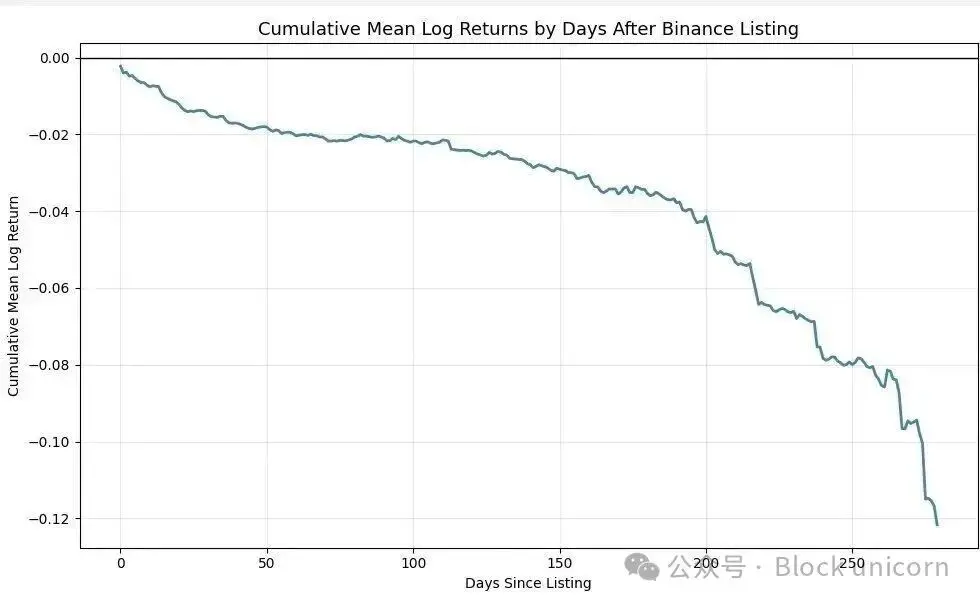
Imagine you walk into my office (many people do this every day) and tell me, "Tom, look at this chart—Binance is a cancer to this industry."
You better have backed up everything in your work notebook because you won't be touching it again. This article is not actually about Binance—it’s about testing a hypothesis and verifying whether it holds true. It’s about the integrity of methodology and how to persuade people that the hypothesis you propose is valid.
Before we begin, I hope you can critique my points through analysis. That’s exactly what we do in research meetings. I won’t get upset—I’m used to constructive criticism and don’t even care anymore; I just want to ensure my analysis is correct so I can learn from it. Your only goal is to scrutinize and point out every possible error in my reasoning. I’m not here to prove that Binance is not evil. I just want to verify whether this hypothesis is valid.
When I see this type of chart, I always think: there’s a lack of random correction.
What does that mean? It means I want to look at random listing data from other similar exchanges and then subtract those results from the Binance dataset. That’s how you eliminate bias. In our case, it’s not actually random because we can easily calculate all the factors related to listings on other exchanges. Typically, in high-frequency trading, you can’t "calculate everything," so I call it random correction.
When conducting research, you need to clearly state your hypothesis:
I selected all products listed on Binance (spot market) since January 1, 2022. Why this date? Because I didn’t want to introduce confirmation bias by selecting data from 2020 to 2021, as I already know the results would clearly lean positive and not represent the current market.
I only included USDT trading pairs.
I only selected products that have been traded for more than 90 days.
I excluded the first day (that’s why all charts start from 0).
Why? Because exchanges handle opening trades differently. Some exchanges "artificially" create a first trade far below fair value just to show a significant rise at listing—this is completely misleading. Some exchanges announce listing news long before or at the time of listing, making it difficult to effectively distinguish the announcement effect.
Excluding the first day makes the analysis clearer and more comparable. Of course, you can propose your own handling methods.
After completing the analysis, I obtained the following results:
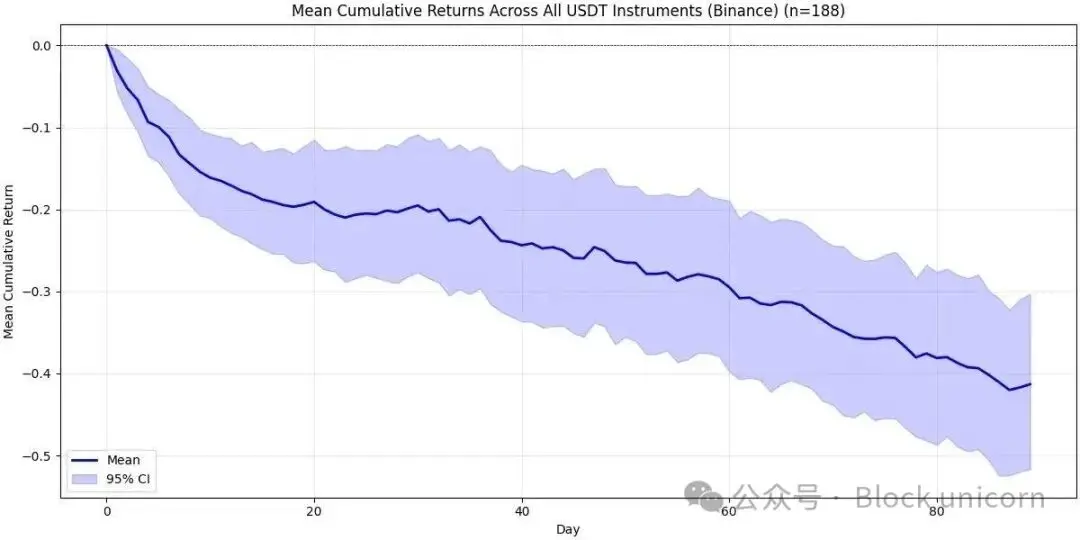
This shows the cumulative returns of all tokens that met my criteria in the first 90 days after being listed on Binance's spot market. What do we see? There is a massive—absolutely massive—selling pressure from the very beginning. A few days later, things stabilize a bit, and then we enter a steady downtrend. Why is this happening? Partly due to the overall cryptocurrency market trend. On average, tokens tend to fluctuate downwards after listing. Additionally, I selected all tokens listed after January 1, 2022, which was right after a bull market, so the overall environment was not very favorable.
Now, let’s talk about my biggest concern—lack of random correction. For me, without random correction, there’s no real research. Even if you show me your last 100 runs with an average of 10.50, I can’t judge unless I see it compared to the overall market. Without a benchmark, there’s no judgment.
In this case, "the overall market" should refer to other comparable exchanges—such as Coinbase and Bybit. Therefore, to execute this correctly, we need to perform exactly the same calculations for Bybit and Coinbase (under the same conditions). Let’s take a look at the charts below.
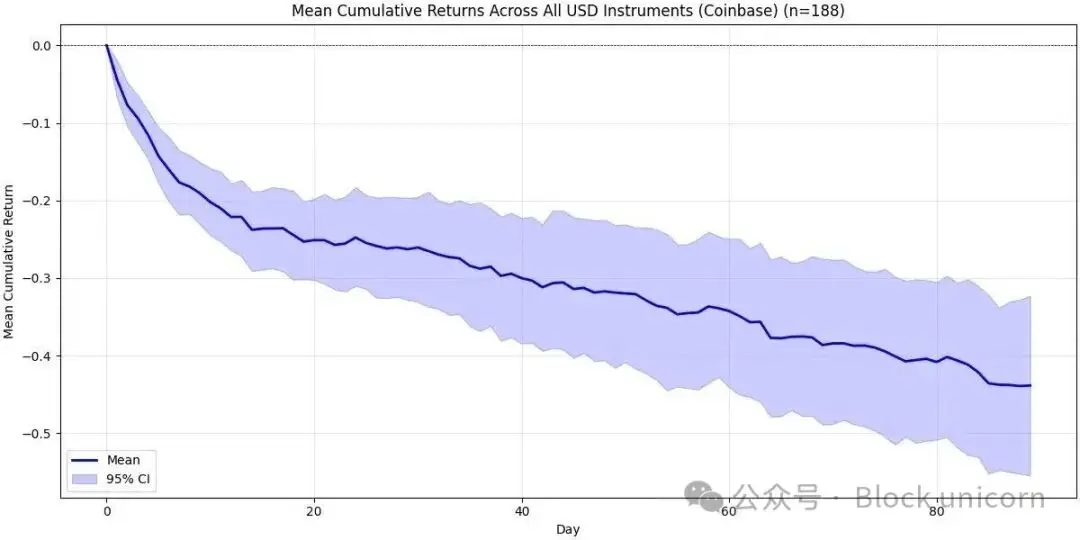
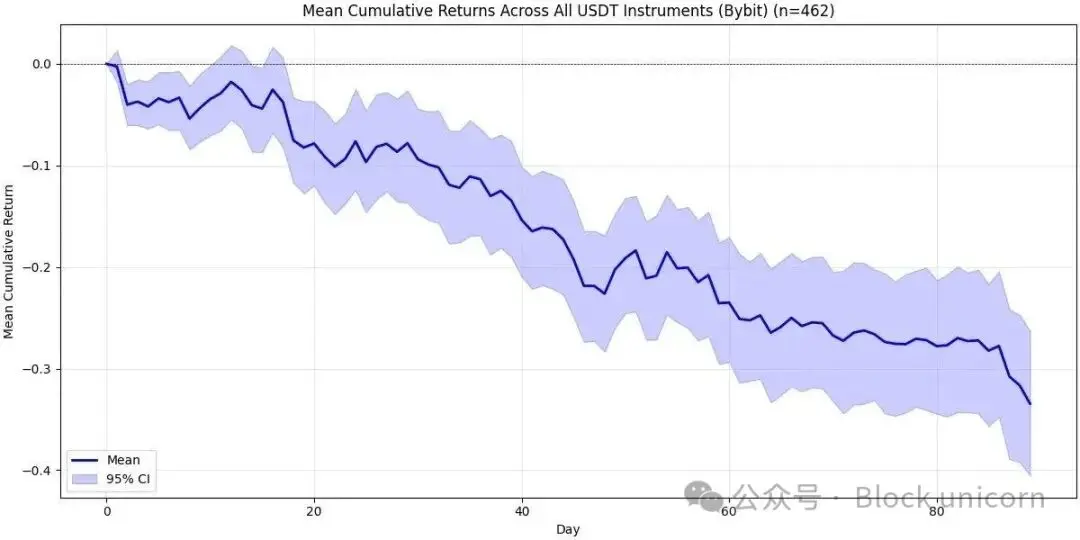
As you can see, the chart for Coinbase looks much worse than that for Binance. About 20 days after listing, the expected return drops to around -25% (and the upper confidence interval is still around -20%!). After that, we see the same pattern again—a brief stabilization followed by a slow downtrend, just like on Binance.
Bybit’s situation is slightly different. After 90 days, the expected return still drops significantly, but the initial selling pressure is not as great. Based on the data and intuition, I believe that Coinbase is far more comparable to Binance than Bybit.
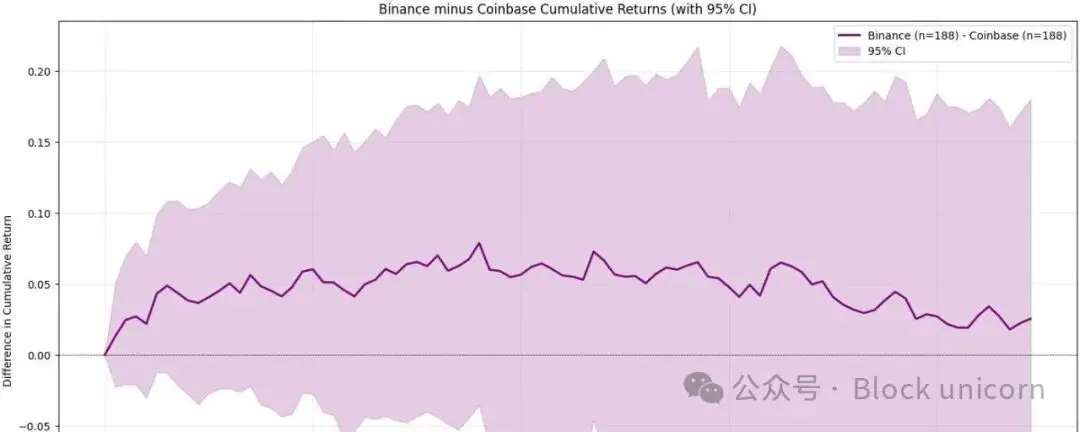
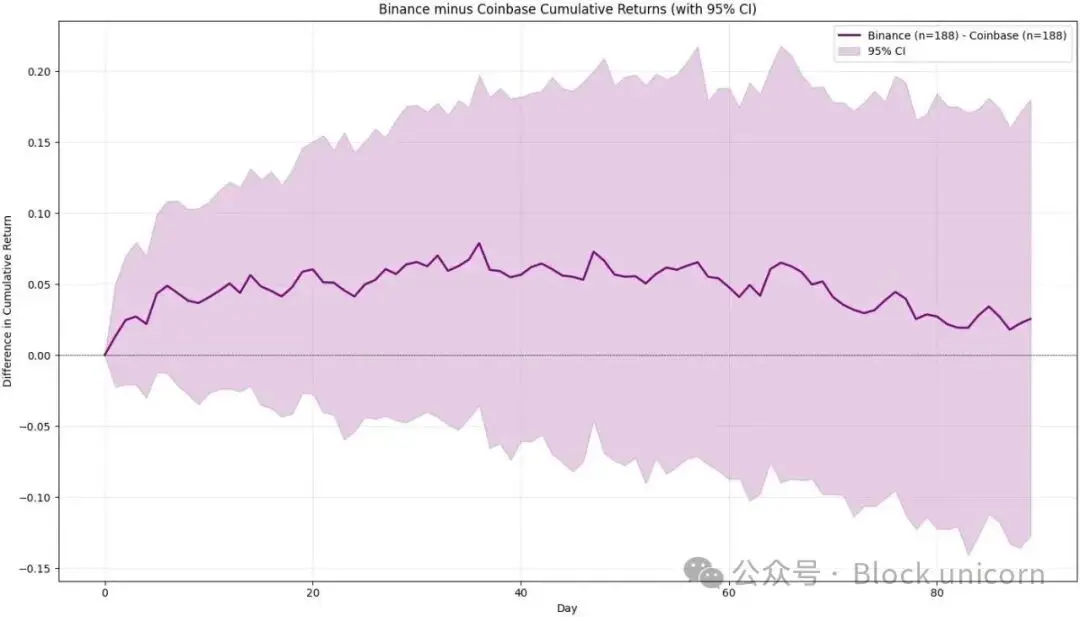
Now, let’s make a real comparison of these exchanges with Binance. To perform random correction, simply subtract the above results from Binance’s main analysis. The following chart shows this. Intuitively, what we now have is the net impact of Binance when benchmarked against each exchange (Bybit / Coinbase).
You can clearly see—especially in the case of Coinbase—that Binance’s impact is positive, not negative. The selling pressure on Coinbase is much greater than on Binance. Of course, once you consider the confidence intervals, this difference is not statistically significant at the 95% confidence level—but the conclusion is still quite clear: the performance of tokens listed on Binance is better than those listed on Coinbase.
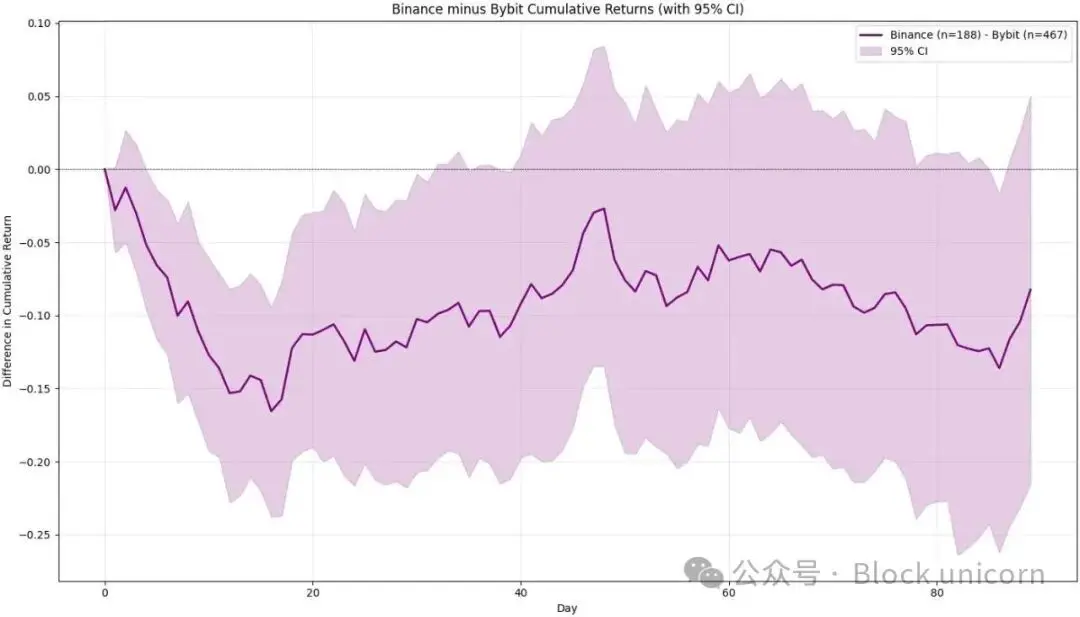
For Bybit, we can see that it performs significantly better in the initial days after listing. However, the difference quickly increases, and while we can say that Bybit performs better than Binance in the short term, the effect is not particularly pronounced.
After random correction, we absolutely cannot conclude that Binance is "evil" compared to other exchanges (especially Coinbase), as the performance of projects listed on Coinbase is clearly worse. Now, let’s talk about an important issue—one we haven’t discussed enough.
The Curse of Becoming the Ultimate Goal
Imagine you are communicating with a project team that hasn’t launched yet. What do you expect to hear from them? The answer is almost always:
"Our ultimate goal is to get listed on Binance (or Coinbase, Upbit)."
When we talk about the impact of being listed on Binance for a project, this statement is very important. Everyone is waiting for that moment. If you are a major investor or the project founder and you truly believe you will eventually land on Binance, Coinbase, or Upbit, what motivation do you have to sell tokens after launching on Bybit? I think it’s almost zero—except for some operational costs that force you to sell a small portion of tokens.
That’s why you see massive selling pressure on Binance and Coinbase, while Bybit has almost no selling pressure (Bitget, KuCoin, or Gate may also have none). However, based on our methodology, even after excluding the announcement day’s impact, Binance’s listing performance still exceeds that of Coinbase. Now, I’m sure your question would be:
"What percentage of tokens do you estimate an average large investor or founder wants to sell after the ultimate goal listing?"
We cannot directly answer this question—there’s currently no clear data. But you should at least have an estimate in your mind, think through the logic, and come up with a number. I mentioned earlier that Upbit is also an "ultimate goal" exchange where people like to get listed in Korea. Unfortunately, we still see strong selling pressure after the listing day. For projects, this is almost always a dead end—perhaps not as severe as Binance, but still significant—you can clearly see this in the data. The following chart shows Upbit’s performance and the differences between Binance and Upbit.
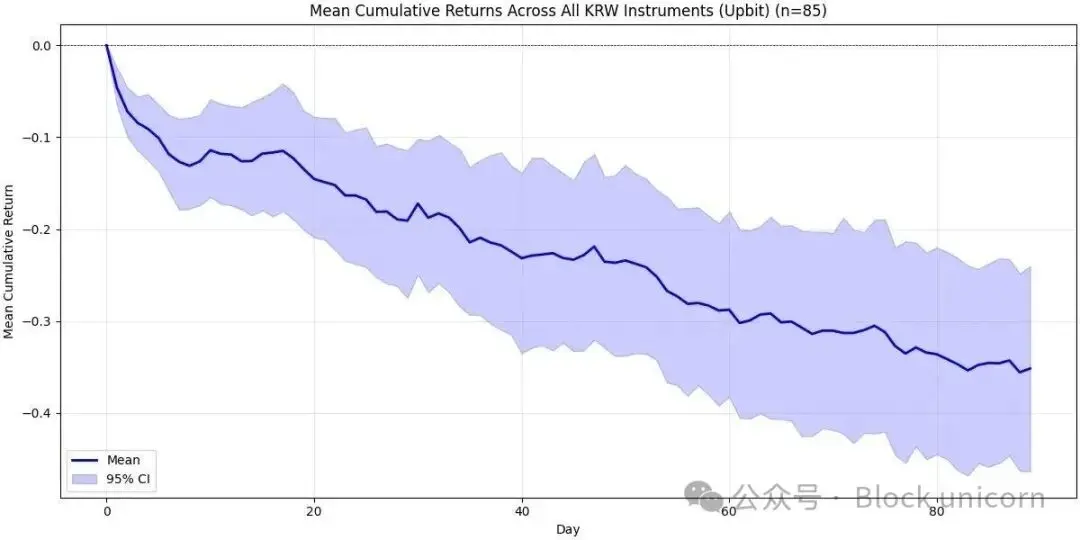
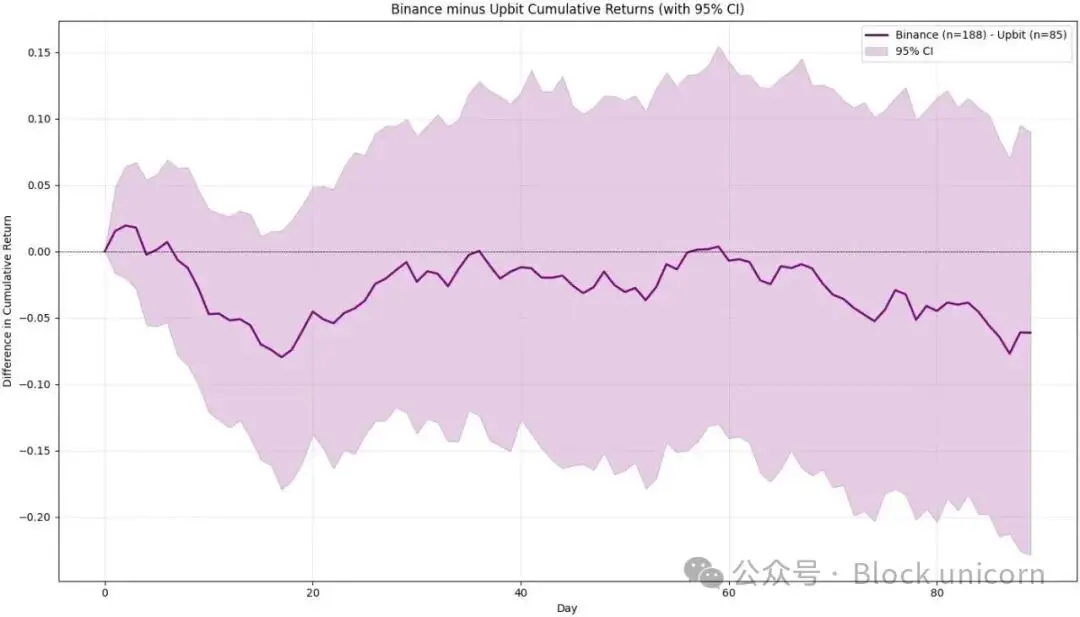
After 90 days, Upbit’s performance is slightly better than Binance, but the difference is so small that we cannot reasonably claim that Upbit is a better listing platform. In both cases, we see strong selling pressure—if you think about it deeply, this is actually completely logical.
How to Price for Liquidity?
There’s one thing that almost no one has considered.
After being listed on Binance, liquidity far exceeds that of any other exchange. Binance allows founders and investors to partially close positions as needed or to increase holdings on a larger scale when they need to buy back (to be honest, I hope this happens often). So how should project parties or investors price this significant increase in liquidity?
This is something that (almost) only Binance can provide—and it’s definitely something that every participant in the market should be willing to pay for directly or indirectly.
We all want deep liquidity and the ability to short or long perpetual contracts (of course, the focus of our analysis here is on spot exchanges, not perpetual contracts, but this is an important feature worth mentioning).
A Simple Way to Test Binance's Liquidity Advantage
I have been thinking of a simple way to test whether Binance’s liquidity is indeed superior to other exchanges while avoiding introducing significant bias. Here are my thoughts:
Find tokens that were listed on Bybit and Coinbase.
Find tokens that were listed on Binance, but only after they had been listed on Bybit and Coinbase (ideally with as long a time gap as possible).
Compare the liquidity of Binance, Bybit, and Coinbase a few days after being listed on Binance.
In this setup, Bybit and Coinbase have mature markets, while Binance is an emerging market. If Binance’s liquidity is still significantly better than other platforms, we can confidently say that the liquidity surplus brought by Binance’s listing is real and substantial.
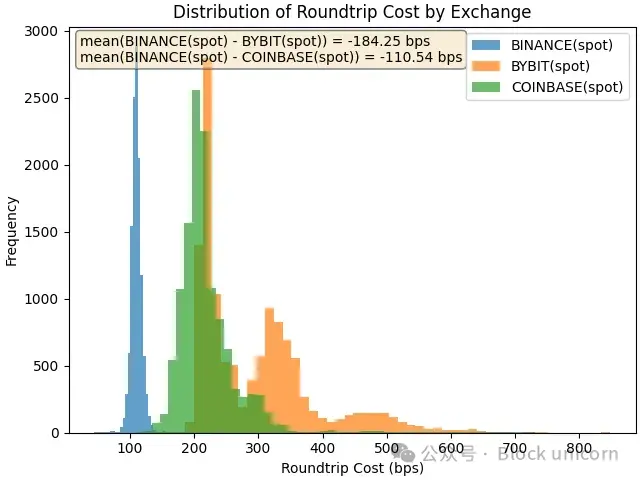
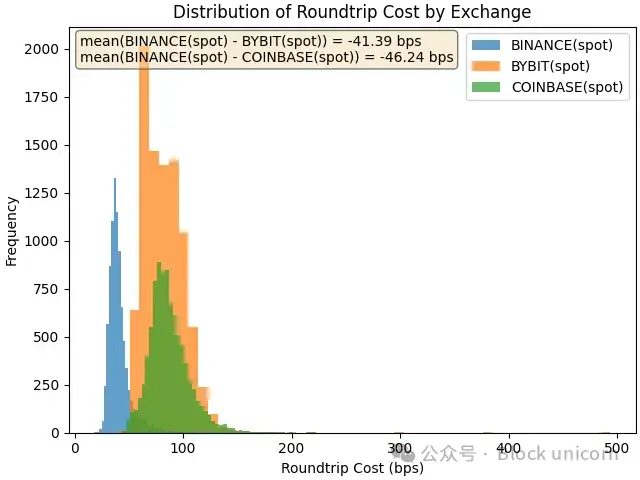
The chart shows the distribution of round-trip costs, i.e., the cost of executing a $100,000 market buy and a $100,000 market sell. The higher the cost, the lower the liquidity. For the token LA, which was listed on Binance more than a month after being listed on Bybit and Coinbase, we found that five days later, the round-trip cost on Binance was 184 basis points lower than Bybit and 110 basis points lower than Coinbase.
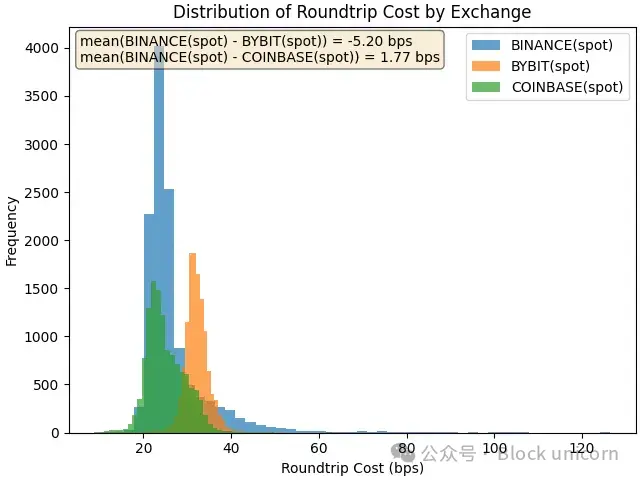
For ONDO, the round-trip costs between Binance and Coinbase are roughly similar—Coinbase has a slight advantage (only 1.77 basis points difference, possibly due to differences in minimum tick size).
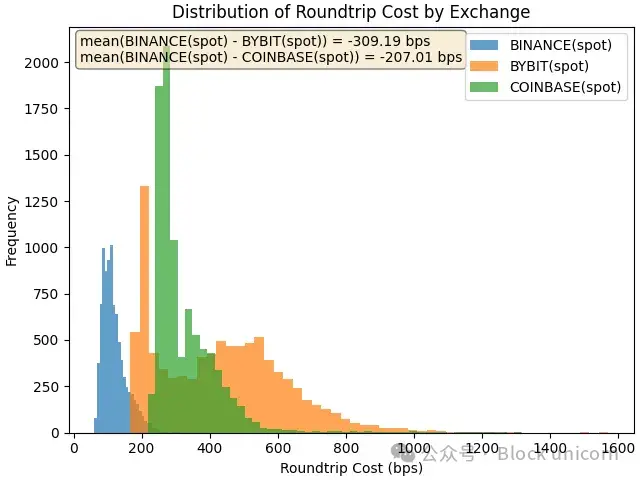
Now let’s look at the less liquid product AXL. Here, the cost difference is enormous. For a $100,000 trade, the cost difference compared to Bybit is 309 basis points, and compared to Coinbase, it’s 207 basis points. For a $20,000 trade, the cost difference remains 41 basis points and 46 basis points, respectively. From the perspective of any existing or potential holder, these numbers are staggering.
What’s the next step?
This is clearly not the only way to study this topic—but it is a biased starting point. If we want to delve deeper, here are some open questions (I won’t answer them now—time is always limited):
How should we incorporate broader market trends and their relationship with listing performance?
How do we quantify the announcement effect and include it in the analysis?
How should we weigh individual cases? Is ONDO more important than AXL? If so, by what metric (perhaps market cap) should we measure it?
Should we make the analysis more robust—e.g., by winsorizing outliers?
Would excluding BSC tokens from the Binance data lead to significant changes in results?
We could keep asking such questions forever—that’s the beauty of research.
There is always room for improvement, but ultimately, creativity and research ethics are more important than any specific model. Conducting research that is nearly unbiased can take you further than any machine learning method. It’s always about your ideas, your data preparation, and your culture of reasoning.
Conclusion
We are not here just to discuss research; we are here to discuss Binance.
Whether you think Binance is "evil" or "a cancer to the industry" is entirely up to you. Please critically examine yourself. Don’t let bias and emotion bind you. Because that’s not where the money is.
 Risk warning
 Risk warning



Popular articles




