








Argentina Web3 Industry Report: Digital Ark Amidst the Inflation Tsunami
 Core Viewpoint

 Argentina represents an important, economically driven, key real-world use case for cryptocurrency.
Author: Esther, IOSG
I. Introduction
The research on the Web3 industry in Argentina is based on a fundamental premise: Argentina represents an important real-world use case for cryptocurrency driven by economic necessity. Decades of persistent economic instability, including nearly 300% hyperinflation and strict capital controls, have made stablecoins and decentralized assets crucial financial havens for millions of citizens. This bottom-up, organic mass adoption, combined with a world-class talent pool, has created a unique ecosystem. This makes the Argentine ecosystem an invaluable living laboratory that helps us deeply understand how decentralized technologies can effectively address real problems when facing urgent social and economic challenges.
Devconnect 2025
This report aims to provide forward-looking insights for the global Web3 community ahead of the Devconnect conference to be held in Buenos Aires in November 2025. By presenting Argentina's market dynamics, world-class talent reserves, and local community ecology, we are committed to catalyzing high-impact collaborations and precise resource matching.
This report serves as a key resource connecting international builders with a mature local ecosystem, aiming to accelerate the deployment of Web3 solutions across Latin America. We sincerely invite all developers, founders, and community leaders to connect and provide feedback to jointly promote regional growth.
II. How Cryptocurrency Emerged in Argentina
Long-standing Economic Instability in Argentina
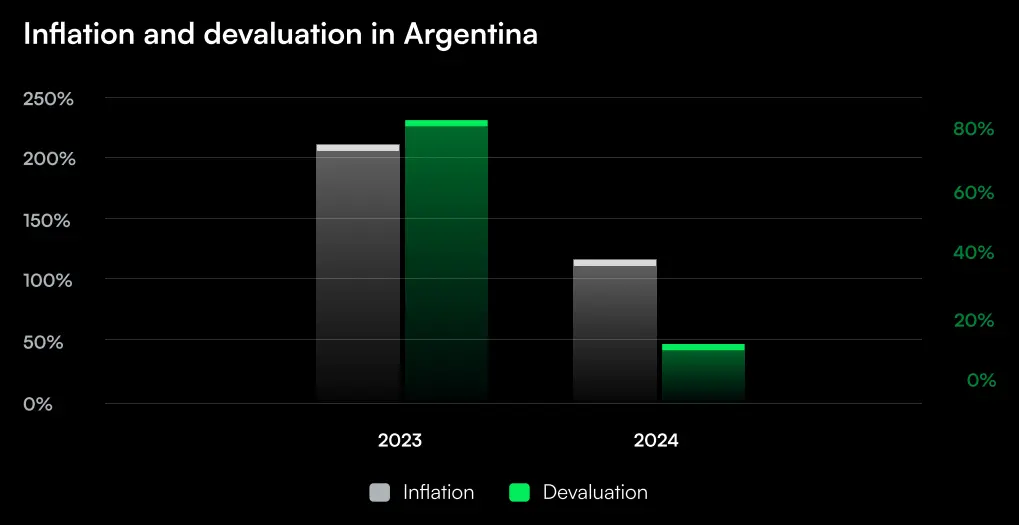
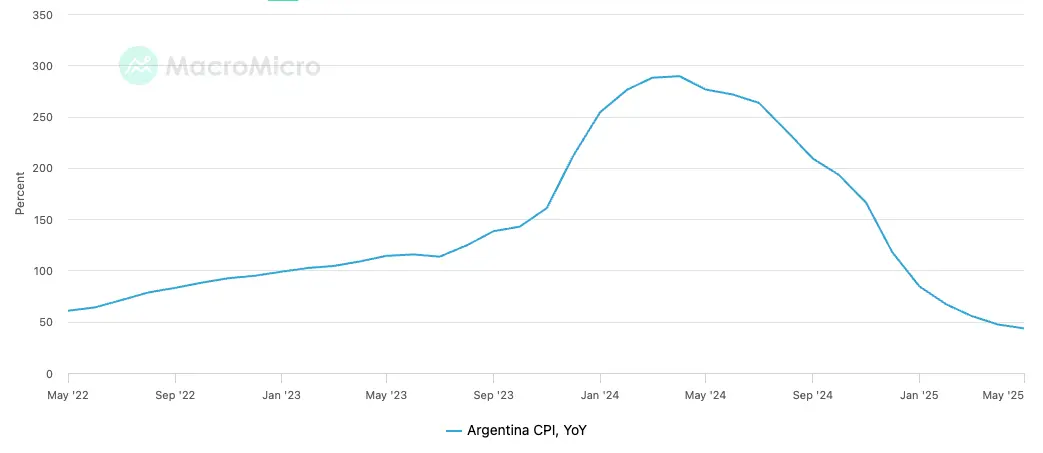
The economic narrative of Argentina has always been accompanied by profound structural instability, with its national currency, the Argentine peso, enduring double-digit inflation rates for decades. This volatility peaked astonishingly in April 2024, with the inflation rate soaring to 289.4% year-on-year. Nevertheless, under the radical economic reforms (such as "shock therapy") implemented by President Javier Milei's government, Argentina's inflation rate and peso depreciation significantly declined between 2024 and 2025. By mid-2025, the annual inflation rate had dropped considerably, with data released in May 2025 showing an inflation rate of 43.5%.
 ▲ cr. lemon.me
 ▲ cr. MacroMicro
Despite these reforms showing initial results, Argentina's economic situation remains at a double-digit inflation level, with a fragile underlying foundation. Continuous currency depreciation severely erodes the purchasing power and savings of the populace. More challenging is the strict capital controls and foreign exchange restrictions imposed by the government, which have historically locked Argentinians out of protecting their wealth through traditional means such as purchasing US dollars.
Cryptocurrency as a "Digital Safe Haven"
The "Corralito crisis" in 2001 was a key historical event that continues to shape Argentina's financial landscape. At that time, the government severely restricted access to bank accounts, leading to widespread distrust of traditional financial institutions and the government's ability to safeguard private assets.
▲ cr. MacroMicro
Despite these reforms showing initial results, Argentina's economic situation remains at a double-digit inflation level, with a fragile underlying foundation. Continuous currency depreciation severely erodes the purchasing power and savings of the populace. More challenging is the strict capital controls and foreign exchange restrictions imposed by the government, which have historically locked Argentinians out of protecting their wealth through traditional means such as purchasing US dollars.
Cryptocurrency as a "Digital Safe Haven"
The "Corralito crisis" in 2001 was a key historical event that continues to shape Argentina's financial landscape. At that time, the government severely restricted access to bank accounts, leading to widespread distrust of traditional financial institutions and the government's ability to safeguard private assets.
This historical context is the deep driving force behind the widespread adoption of decentralized financial tools such as cryptocurrency today. Memories of past confiscation and intervention of financial assets make the inherent decentralized and censorship-resistant properties of cryptocurrency not just technical features, but fundamentally appealing to many Argentinians—it is seen as a reliable barrier against state control and financial erosion. This deep-seated distrust of the traditional financial system has led to the adoption of cryptocurrency far exceeding mere economic hedging needs.
In an environment of economic uncertainty and financial restrictions, cryptocurrency, especially stablecoins pegged to the US dollar, has become a vital practical financial safe haven for millions of Argentinians. These digital assets provide a safer and more efficient alternative to the volatile peso, while replacing the local underground currency exchange networks colloquially known as "cuevas" (caves).
For individuals and businesses, cryptocurrency offers a channel to bypass direct government control over assets, enabling cross-border payments and generating income. This shift has made digital currency not only an investment tool but also a fundamental element of daily financial survival, empowering Argentinians to maintain greater autonomy and stability in a challenging economic environment.
III. Scale of Cryptocurrency Adoption and Market Observations
Cryptocurrency Ownership and User Activity Argentina is renowned globally for its high cryptocurrency ownership rates and active user participation. Between 2023 and 2024, approximately 18.9% of Argentinians reported owning cryptocurrency, placing the country fourth in the world for cryptocurrency ownership, surpassing Brazil (17.5%) and the United States (15.5%). Although other reports show slightly different figures, such as a study by the Central Bank of Argentina indicating that around 12% of the population owned cryptocurrency in 2023, and data from Triple A showing a share of 5.6% in the same year, the overall trend indicates a rapid and irreversible acceleration in cryptocurrency adoption between 2023 and 2024.
The statistical discrepancies stem from differences in survey methods and target populations (e.g., the general public versus internet users or specific exchange users), but the consistently rising trend confirms the widespread penetration of cryptocurrency in Argentina. In January 2025, Coinbase officially entered the Argentine market after obtaining regulatory approval, estimating that about 5 million people (out of a total population of 45.8 million) use digital assets daily, highlighting a large and active user base.
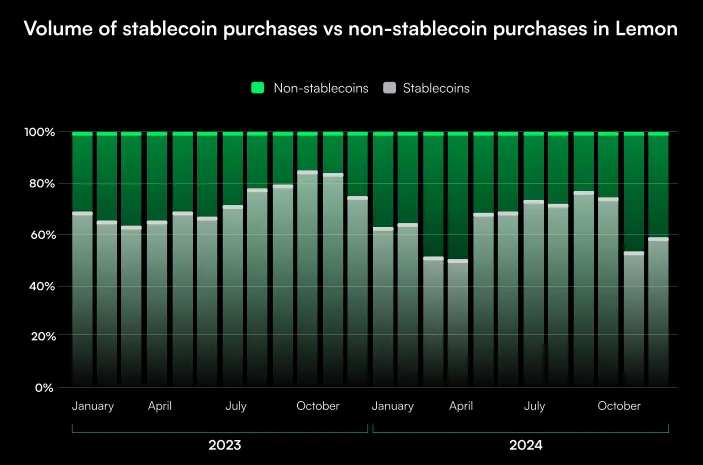
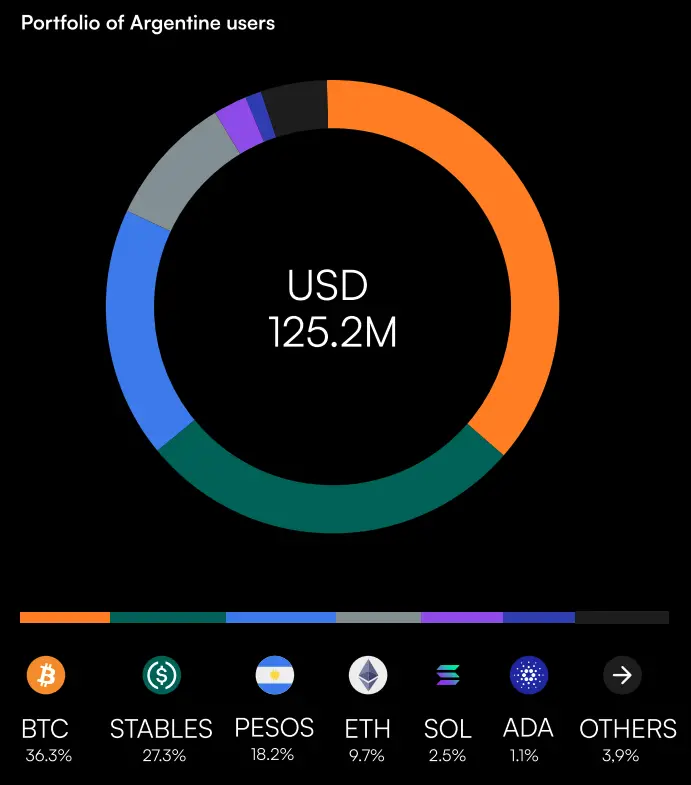
Platform data also corroborates the trend of increasing user participation. Data from the well-known Latin American cryptocurrency platform Bitso shows that by the end of 2024, its user base in Argentina grew by 11% compared to 2023. The largest local platform, Lemon, had nearly 600,000 Bitcoin holders by the end of 2024, accounting for 36% of its managed assets in Argentina. Stablecoins made up 27%, while the Argentine peso accounted for 18% of holdings. In terms of trading volume, stablecoin trading increased by 44.4%, while Bitcoin and altcoin trading volumes grew by 126% and 158.5%, respectively.
 ▲ cr. lemon.me
Similarly, demographic analysis reveals a trend towards a younger and more gender-balanced cryptocurrency community in Argentina. Across Latin America, 38% of cryptocurrency users are aged between 25 and 34, aligning with global trends. Notably, the participation rate of young users aged 18 to 24 increased from 22% in 2023 to 23% in 2024.
▲ cr. lemon.me
Similarly, demographic analysis reveals a trend towards a younger and more gender-balanced cryptocurrency community in Argentina. Across Latin America, 38% of cryptocurrency users are aged between 25 and 34, aligning with global trends. Notably, the participation rate of young users aged 18 to 24 increased from 22% in 2023 to 23% in 2024.
Argentina exhibits a unique social trend in gender participation: the proportion of female users increased by three percentage points to 31% in 2024, while male users accounted for 69%, slightly above the global ratio of 70/30. The increase in female participation indicates that the practical benefits of cryptocurrency, especially as a hedge against economic turmoil, are breaking through traditional gender barriers in the financial sector. This suggests that cryptocurrency is being viewed as a key tool for achieving financial empowerment, with its universality and appeal crossing boundaries among different demographics.
Market Size and Activity
The cryptocurrency market in Argentina demonstrates significant activity and trading volume. According to Chainalysis data, from July 2023 to June 2024, the country’s digital asset trading volume reached nearly $91 billion, a 6.7% increase from the previous year. This strong performance propelled Argentina to 13th place in global cryptocurrency trading volume rankings in 2024.
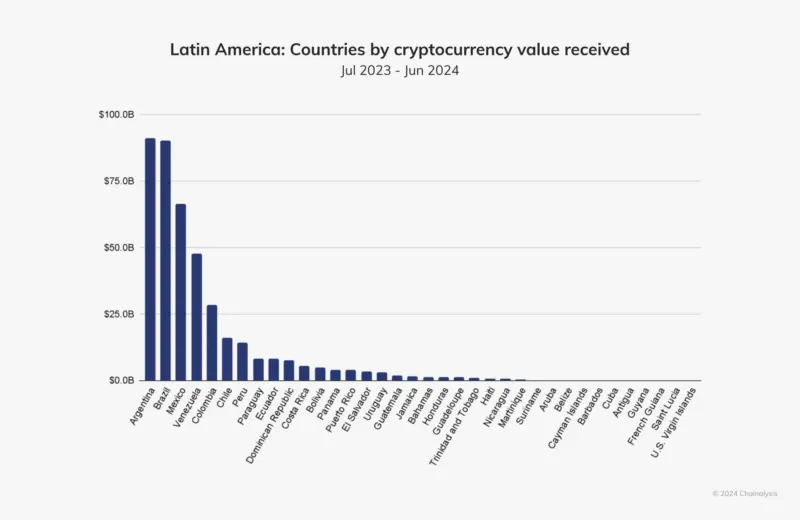 ▲ cr. Chainalysis
Although Chainalysis did not disclose specific monthly active user data in its public information, the high proportion of cryptocurrency holders (30% in 2024) and the estimated daily user count of 5 million indicate that Argentina has a large and highly engaged user base.
▲ cr. Chainalysis
Although Chainalysis did not disclose specific monthly active user data in its public information, the high proportion of cryptocurrency holders (30% in 2024) and the estimated daily user count of 5 million indicate that Argentina has a large and highly engaged user base.
In the context of Argentina's historically informal financial market and capital controls, the large trading volumes and high adoption rates suggest that a significant portion of cryptocurrency activity occurs through peer-to-peer channels or decentralized exchanges. This behavior stems from the desire to circumvent the formal financial system and government regulation. This model highlights a deeply rooted behavioral adaptability: seeking alternative financial channels has become a common strategy for managing wealth and transactions.
Stablecoin-Dominated Digital Currency Adoption
Despite the widespread application of cryptocurrency, it is noteworthy that stablecoins dominate the cryptocurrency landscape in Argentina. Between 2023 and 2024, stablecoin trading volume accounted for 61.8% of the total, far exceeding the global average of 44.7%. From the third quarter of 2022 to the second quarter of 2024, 31% of small retail transactions (under $1,000) in Argentina were completed using stablecoins, second only to Venezuela in the region.
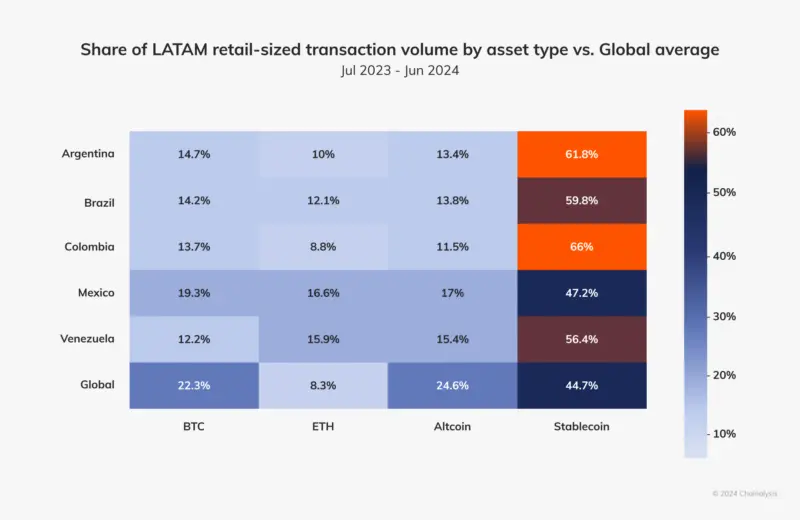 ▲ cr. Chainalysis
The preference of Argentinians for specific stablecoins is also evident: in 2024, USDC and USDT together accounted for 39% of cryptocurrency purchases, a significant increase from 30% in 2023. Maximiliano Hinz, head of Bitget Latin America, described Argentina as "an anomalous market where many people buy USDT and no longer consider other options," noting that this phenomenon is uncommon in other regions.
▲ cr. Chainalysis
The preference of Argentinians for specific stablecoins is also evident: in 2024, USDC and USDT together accounted for 39% of cryptocurrency purchases, a significant increase from 30% in 2023. Maximiliano Hinz, head of Bitget Latin America, described Argentina as "an anomalous market where many people buy USDT and no longer consider other options," noting that this phenomenon is uncommon in other regions.
The strong preference for stablecoins among Argentine users stems from several key factors:
Hedging against inflation and currency depreciation: Stablecoins primarily pegged to the US dollar provide a crucial and convenient hedging mechanism against the ongoing volatility of the Argentine peso.
Digital convenience and no purchase restrictions: Before April 2024, Argentinians were limited to purchasing only $200 per month, making it often difficult for individuals to obtain and accumulate US dollars. In contrast, stablecoins, as digital assets, can be used and exchanged on various devices, typically without such restrictions.
Efficient and low-cost: Compared to traditional remittance channels, stablecoins enable faster and more economical cross-border payments.
The "anomalous phenomenon" of stablecoins occupying such a market share in Argentina marks a unique behavioral pattern born from an extreme economic environment. This reflects not only the high usage rate of stablecoins but also a fundamental shift in currency psychology: digital dollar-pegged assets are often viewed as more trustworthy and accessible than the national fiat currency or even physical foreign currency.
IV. Overview of the Argentine Web3 Ecosystem
Startups and Key Players Argentina has nurtured one of the oldest and most resilient startup ecosystems in Latin America, laying the foundation for its thriving Web3 sector. Buenos Aires is often hailed as the "Silicon Valley of South America." The country is home to numerous blockchain companies and has birthed 12 unicorns valued at over $1 billion, boasting an excellent track record in scaling tech enterprises.
The Web3 sector includes over 40 companies, covering everything from native crypto-financial platforms to specialized development agencies:
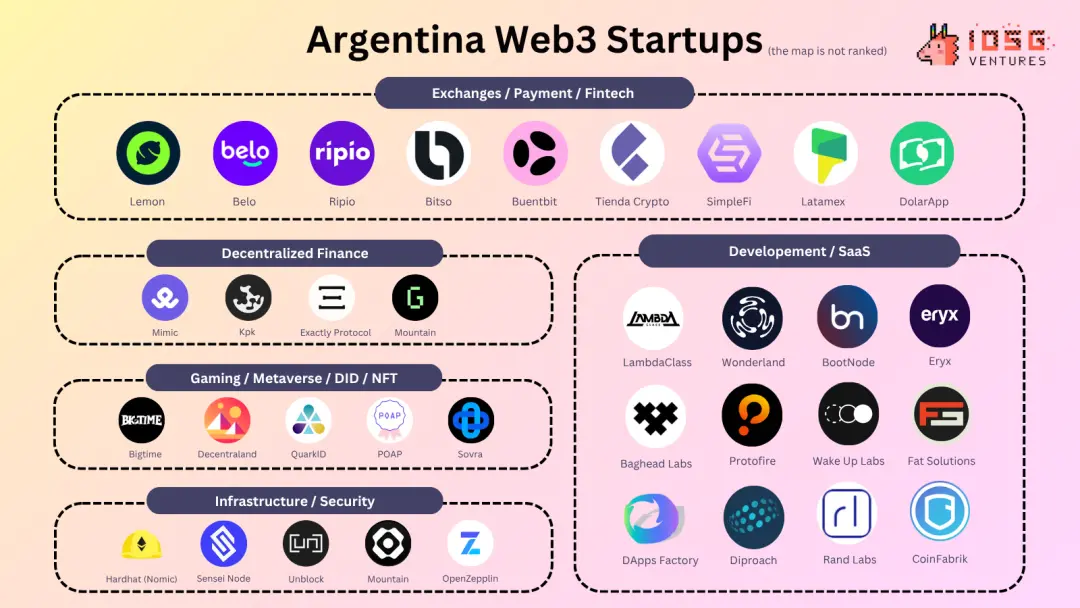 # Cryptocurrency Exchanges, Payment, and Financial Platforms (Fintech)
This is the largest and most vibrant sector, primarily driven by the strong retail adoption of cryptocurrencies, especially stablecoins. Major local players include:
# Cryptocurrency Exchanges, Payment, and Financial Platforms (Fintech)
This is the largest and most vibrant sector, primarily driven by the strong retail adoption of cryptocurrencies, especially stablecoins. Major local players include:
Exchanges and wallets: Lemon, Belo, Ripio, Buenbit, Bitso, Tienda Crypto, SimpleFi, Latamex, and DolarApp.
International presence: Global mainstream exchanges such as Binance, Bybit, and Coinbase also operate in the market.
# Web3 Infrastructure, Development, and SaaS This sector provides the foundational tools and services needed to build decentralized applications:
Infrastructure: Organizations and companies such as Hardhat, Sensei Node, Unblock, and OpenZepplin.
Development/SaaS: Numerous specialized development agencies and studios, including LambdaClass, Wonderland, BootNode, Eryx, Rand Labs, Baghead Labs, Protofire, Wake Up Labs, Fat Solutions, CoinFabrik, DAppsFactory, and Diproach.
# Emerging Fields Local innovation is extending into more cutting-edge and specialized application scenarios such as DeFi, gaming, on-chain governance, and NFTs:
DeFi: Projects like Mimic, Kpk, Exactly Protocol, and Mountain Protocol.
Metaverse and Gaming: Notable projects such as Decentraland and Bigtime.
Digital Identity and On-Chain Governance: Platforms like QuarkID, POAP, and Sovra.
The vitality of Argentine Web3 startups can be summarized as "market-validated" and "technology-intensive," driven by a unique economic environment that has transformed cryptocurrency from an optional speculative asset into a necessary financial tool. This urgency has fostered a highly competitive and innovative environment, resulting in a dual advantage: occupying a significant position in consumer-facing platforms (such as exchanges and payments) while possessing deep technical expertise in infrastructure and innovative decentralized applications (DApps). Developers and Talent Pool Argentina is a powerhouse of tech talent in the region, boasting high-quality developers and engineers who are highly sought after by companies looking for nearshore outsourcing. # Talent Scale and Quality Argentina has a robust talent pool with over 115,000 software developers, producing approximately 27,000 new professionals each year. Argentine tech talent is regarded as highly skilled, often comparable to American standards, and possesses a global mindset. The combination of high-quality talent and cost advantages makes Argentina an attractive base for development and engineering. # Web3 Specialization Advantages Economic turmoil and long-term inflation have instead fostered unique advantages, driving a generation of developers who are not only technically proficient but also deeply passionate about the potential of blockchain and cryptocurrency. Developers generally exhibit strong skills in high-demand blockchain languages and frameworks, including Solidity, Rust, Anchor, TypeScript, and Node.js. Local Community and Innovation Spaces The developer ecosystem is highly collaborative, centered in Buenos Aires, and frequently hosts blockchain events, workshops, and hackathons. Local activities are often reinforced through structured educational collaborations, such as grassroots movements and communities: # Crecimiento
Core Vision: Committed to making Argentina a global hub for cryptocurrency and cutting-edge technology innovation.
Contribution Highlights: Serving as a connecting link, bringing together builders, founders, policymakers, and global partners. Organizing high-impact projects (such as the Aleph Hub series of events) and actively participating in the construction of government regulatory frameworks, such as promoting a tokenization sandbox program in collaboration with the National Securities Commission (CNV).
# Ethereum Argentina & ETHKipu
Core Vision: Focused on building the Ethereum ecosystem, promoting education, and organizing large-scale events.
Contribution Highlights: They lead the organization of significant events such as the annual Ethereum Argentina conference and successfully facilitated the Devconnect conference in Buenos Aires.
ETHKipu focuses on educational projects, successfully integrating Ethereum and Solidity programming languages into the high school curriculum in Buenos Aires.
# SEED Org
Core Vision: Promoting decentralized solutions through three pillars: governance, community/education, and infrastructure.
Contribution Highlights: Stabilizing the ecosystem through SEED nodes (infrastructure), conducting community education through the SEED Latin America branch, and facilitating decentralized decision-making through the SEED governance platform.
# Mujeres en Crypto (MEC) Women in Crypto Organization
Core Vision: Promoting diversity, equity, and inclusion by enhancing women's participation and leadership in the Web3 ecosystem.
Contribution Value: The organization creates career opportunities for women by hosting events, building communication platforms, and providing industry resources, while also playing a crucial role as a core community partner for international large-scale events.
# Cultura C3
Core Philosophy: A passionate tech community dedicated to practicing the values of Creer (believe), Crear (create), and Compartir (share) in the cryptocurrency and Web3 fields.
Contribution Value: Regularly hosting workshops and offline meetups, sharing educational content, and often collaborating with mainstream groups like Ethereum Argentina to extend decentralized opportunities from Buenos Aires to places like Córdoba.
This overview is not exhaustive; the Argentine Web3 ecosystem continues to expand, with many outstanding local communities and projects actively driving ecological development. We sincerely invite all builders and communities committed to promoting development in Latin America to connect and collaborate. Investment Trends Despite the overall impact of global economic pressures on the venture capital market in Latin America in recent years, Argentina's Web3 sector continues to attract significant investment, often concentrated in the broader fintech category.
Fintech-Dominated Investment: Fintech remains the dominant area for startup financing in Latin America. Argentina stood out in 2024, with its new digital bank Ualá in Buenos Aires completing a $300 million Series E funding round, setting a record for the largest venture capital investment in the region. This underscores investors' confidence in large fintech companies in Argentina, even if these companies are not purely cryptocurrency-native.
Web3-Specific Financing: Cryptocurrency platforms have also secured substantial investments from well-known venture capital firms, with fintech and payment-related projects attracting the most attention in funding.
Argentine cryptocurrency exchange Lemon successfully completed a $20 million Series B funding round for expansion in Latin America, with participation from prominent US funds F-Prime and ParaFi.
Leading Latin American crypto service provider Ripio has raised over $50 million in equity financing, including a $50 million Series B round led by DCG in September 2021. Prior to equity financing, the company successfully raised $37 million for the Ripio Credit Network (RCN) in 2017.
The DeFi protocol Kpk (formerly karpatkey) disclosed that it secured $7 million in funding in 2024, with investors including Borderless Capital, Wintermute Ventures, and angel investors such as Joe Lubin and the founder of Aave.
While current global venture capital trends indicate increased caution, emphasizing comprehensive due diligence and focusing more on founder strength and product-market fit rather than merely using "Web3" as a narrative selling point, the investment landscape in Argentina's Web3 sector is dominated by fintech and payment-related platforms. This reflects a market focus on addressing the severe economic instability in the country and solving the financial pain points of the populace through crypto-financial solutions. A significant amount of capital is flowing into mature local exchanges and service providers like Lemon and Ripio to promote the application of stablecoins and cross-border payments.
Although new digital banks and the broader fintech sector attract the most funding, technically complex on-chain infrastructure solutions are also gaining increasing attention, indicating that investment strategies are becoming more balanced: supporting scalable consumer-facing financial necessities while also aiding in building the technological foundations of decentralized ecosystems.
V. Conclusion
Argentina has undeniably become a core testing ground for the practical application and innovation of Web3 globally. The data is indisputable: from the overwhelming dominance of stablecoins in trading volume to its position among the top holders of digital assets worldwide, cryptocurrency here is a mechanism for economic survival, not merely a speculative tool.
As the ecosystem driven by world-class developers and a strong local community matures, its development focus is shifting from basic trading platforms to more complex underlying infrastructure, decentralized finance, and cutting-edge on-chain solutions. Looking ahead, the convergence of mature technological foundations, organically emerging user demand, and the focal effect of the Devconnect conference in Buenos Aires in 2025 will create unprecedented historic opportunities.
We sincerely invite policymakers, global builders, and investors to view Argentina as a "sandbox" for unlocking the financial future, rather than merely a speculative market. We call for continued deep collaboration with all stakeholders to jointly unleash broader development potential across the entire Latin American region.
Recommended Reading:
$1 Billion Stablecoin Evaporation: What’s the Truth Behind the DeFi Chain Reaction?
MMT Short Squeeze Event Review: A Carefully Designed Money-Making Game
 Risk warning
 Risk warning



Popular articles





