








Coinbase opens "IPO" to retail investors across the U.S., can it bring new vitality to the market?
 Core Viewpoint

 Coinbase's design approach is closer to the traditional financial market's "IPO + allocation + lock-up" process.
Original Author: Seed.eth
In the past few years, the "new token" scene in the cryptocurrency primary market has always been in a regulatory gray area. Since 2018, U.S. users have been almost completely excluded from the token issuance process. However, this pattern is being broken.
Less than a month after spending $375 million to acquire the on-chain fundraising platform Echo, cryptocurrency exchange Coinbase has taken another key step. Overnight, its official token sales platform announced the reopening of compliant participation in token issuances for U.S. retail investors.

Coinbase New Token: A Structural Shift
1. From Lottery to Algorithmic Allocation: Enhancing Fairness for Retail Investors
Previously, mainstream platforms (such as Binance Launchpad and OKX Jumpstart) mostly adopted "lottery" or "first-come, first-served" mechanisms, with project teams more inclined to attract large investors, leaving ordinary users' chances of winning largely to luck.
The platform launched by Coinbase employs an "algorithmic allocation" mechanism, prioritizing small investors' subscriptions and gradually expanding to higher amounts. This design lowers the financial threshold and curbs the space for high-frequency arbitrageurs, providing retail investors with a more genuine opportunity to participate.
2. Lock-up and Anti-Arbitrage Mechanism: Encouraging Long-term Participation, Avoiding Immediate Sell-offs
Coinbase sets a mandatory lock-up period for project teams—within six months of issuance, project teams and their affiliates are prohibited from conducting over-the-counter transactions or selling tokens. At the same time, the platform introduces incentives and constraints on user behavior: if users sell their acquired tokens within 30 days of listing, they will be automatically allocated fewer tokens in the future.
3. Standardized Information Disclosure: Informed Decision-Making, Not Blind Following
On the Coinbase platform, project teams must disclose detailed information, including token economic models, use of funds, team backgrounds, development roadmaps, and potential risks. This disclosure standard is significantly higher than the information depth required by most current exchange Launchpads.
While other platforms also require some disclosure, most focus on marketing materials and basic data, whereas Coinbase enforces standardization, aiming to align with the IPO market's prospectus. This helps investors truly understand the projects they are participating in, rather than betting solely on "community hype" or "FOMO emotions."
4. No Platform Token Participation Mechanism: Decentralized Arbitrage Incentives, Returning to Value Judgment
Currently, most exchanges require holding platform tokens (such as BNB or OKB) to participate in new token offerings, forcing users to purchase platform ecosystem assets to gain eligibility, thereby exacerbating platform token price volatility and amplifying risks.
Coinbase breaks this "dependency on token economic models": it does not require users to lock up any platform tokens; participation only requires USDC, and there are no fees throughout the process. The platform's revenue comes from a fixed percentage service fee paid by project teams. This mechanism allows "new token offerings" to return to their essence—selecting projects rather than speculating on platforms.
First New Token Offering: Is Monad Worth Participating?
The first project on the Coinbase token sales platform is Monad ($MON), a high-performance public chain under development, focusing on parallel computing, extremely high transaction throughput, and complete compatibility with the Ethereum Virtual Machine (EVM). Monad is backed by several well-known institutional investors, including Jump Trading, Placeholder, Lattice, and Dragonfly.
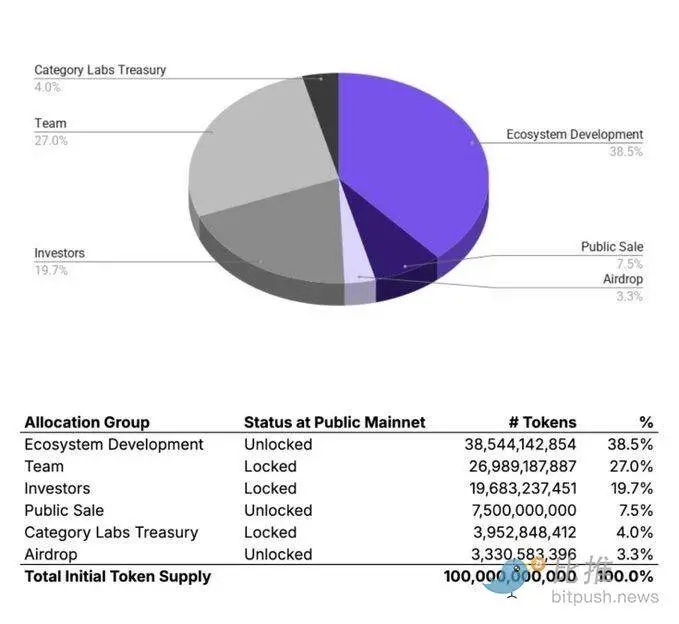
The public offering price is set at $0.025, which is significantly discounted compared to the previous pre-market trading price of around $0.06. Market expectations suggest a short-term upside potential of 2-3 times, especially under the halo of Coinbase's launch.
However, it is important to note that Monad is only releasing 7.5% of its total supply this time, with a valuation of approximately $2.5 billion, which is relatively high among similar L1 projects that have not yet launched on the mainnet. Additionally, the ecosystem has not yet started, and the development progress is still early, leaving future performance uncertain.
Furthermore, the algorithmic allocation mechanism used by Coinbase will prioritize small applications, so even if users win, their allocation amounts are usually small, limiting actual investment opportunities.
Therefore, for ordinary investors, Monad is a project with potential, but it does not equate to a "sure win." If participating, it is advisable to control the subscription amount, view the project's development with a medium to long-term perspective, and pay attention to its ecosystem construction after the mainnet launch.
The Era of Intense Competition Among CEXs
Coinbase's latest move is not an isolated case. In fact, in recent years, most mainstream exchanges have been continuously ramping up their efforts in the "token launch" arena, from project screening and financing design to trading launch and ecosystem support, gradually building a "launch closed loop." Well-known examples include Binance Launchpad, OKX Jumpstart, and Bybit IDO, all of which represent this trend.
This evolution from a "trading matching platform" to a "full-chain service provider for the primary market" is both a result of exchanges expanding their own businesses and reflects that the cryptocurrency industry is gradually entering a more structured and standardized era.
Here is a comparison of several leading exchanges:
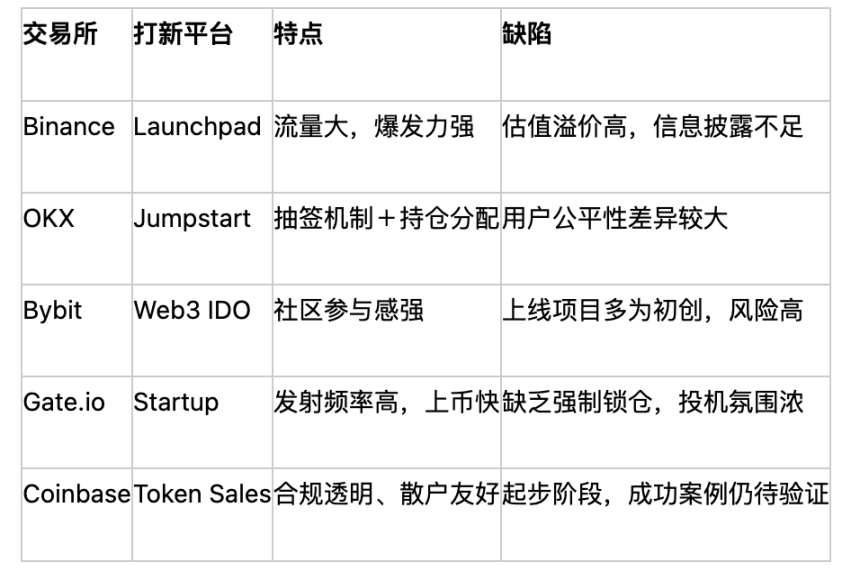
It can be seen that the biggest difference between Coinbase and other platforms is that its design approach is closer to the traditional financial market's "IPO + Allocation + Lock-up" process, attempting to guide the entire token issuance ecosystem from the previous "speculation logic" to "institutional construction."
Coinbase is not replicating Binance's success but is carving out a new path that is more suitable for compliant users and aimed at long-term investors. The essence of this model is to inject stability and predictability into crypto assets through standardized processes and risk control systems.
For the entire cryptocurrency industry, Coinbase's issuance platform not only helps restore retail investors' confidence but may also become the "front door" for quality projects to enter the market in the future, reducing gray paths that bypass regulation and establishing a new trust foundation for the primary market.
Can an Institutionalized Crypto Primary Market Emerge from Here?
The industry currently urgently needs blockbuster projects and a system that allows ordinary people to participate fairly and legally in token issuance. Coinbase may be paving a new path for this.
Rather than calling this a "new token innovation," it might be more accurate to say that Coinbase is posing a question: Can the early financing mechanisms of Web3 be more orderly than speculation, fairer than lotteries, and more rational than blind investments? It may not succeed immediately, but at least it has opened a door. Whether this door can become an entry point for mainstream compliant users and quality projects in the future remains to be seen.
However, before the feast begins, we might want to pour a glass of cold water: Can this market, which is already saturated with new tokens, really be saved by yet another launch platform? Coinbase has restructured the rules of issuance, but perhaps its biggest challenge is to find truly valuable new assets for a saturated market.
 Risk warning Risk warning



Popular articles




