








Gemini's first financial report after going public: Revenue increases but profit does not, stock price hits all-time low
 Core Viewpoint

 What goes around comes around.
Original Author: Eric, Foresight News
On November 10, local time in the U.S., the newly listed Gemini released its first financial report since going public. The report shows that Gemini's net revenue for the third quarter was $49.775 million, a year-on-year increase of 104.4% and a quarter-on-quarter increase of 51.8%, exceeding market expectations of $46.84 million; however, despite the significant increase in revenue, the net profit remained negative, with losses increasing by 76.9% year-on-year to $159.5 million, and earnings per share at -$6.67, far exceeding the market expectation of -$0.767.
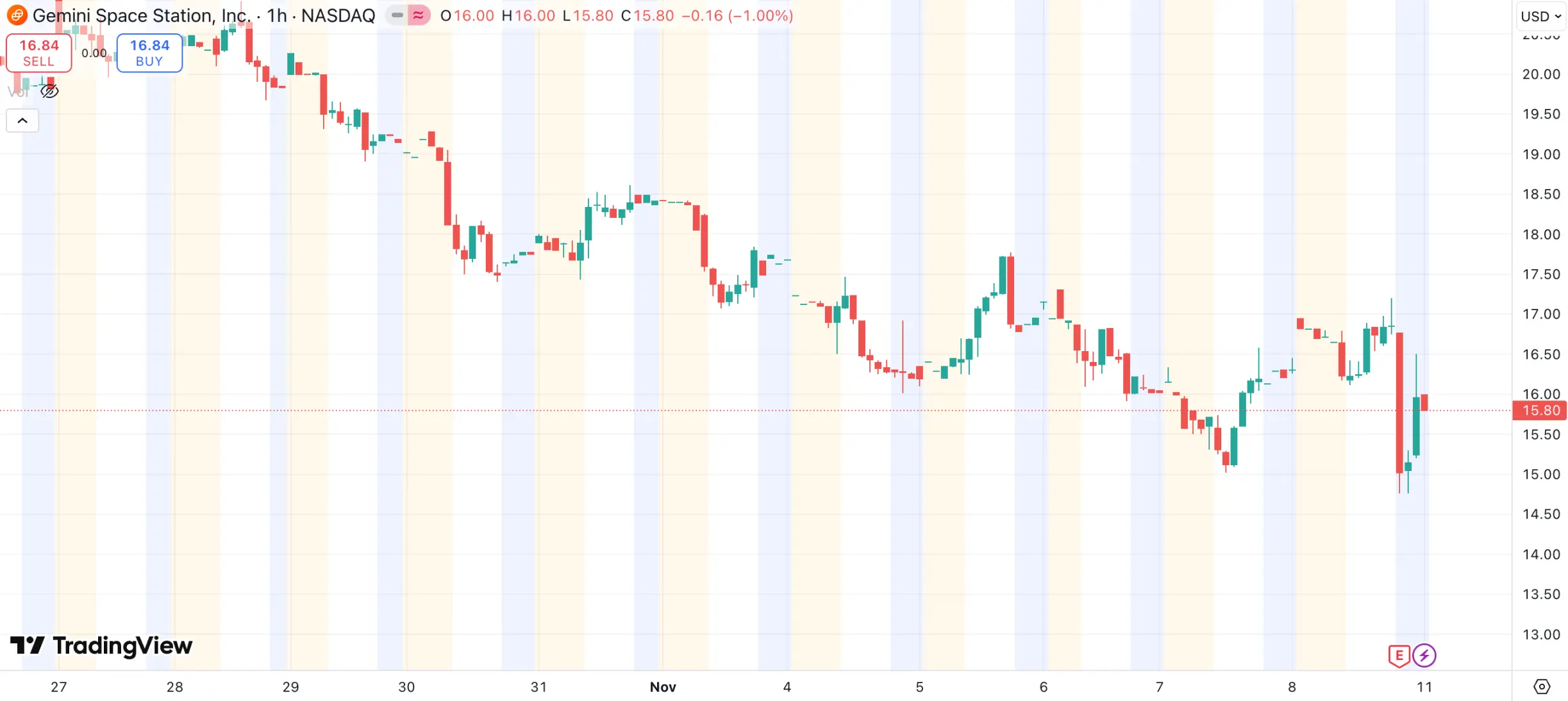
Due to investors' concerns over Gemini's expanding losses, the stock price fell below $15 in after-hours trading, setting a new low since its IPO, having dropped two-thirds from its peak.
In terms of revenue, Gemini saw significant improvements in both trading and service revenues. In the third quarter, Gemini's trading revenue was $26.337 million, with a year-on-year increase of over 80%. The total trading volume on the Gemini platform for this quarter was $16.4 billion, a year-on-year increase of 144.8% and a quarter-on-quarter increase of 45.1%. Regarding service revenue, efforts in credit cards, institutional staking, and custody services led to year-on-year revenue growth of 226%, 89.7%, and 75.6%, respectively.
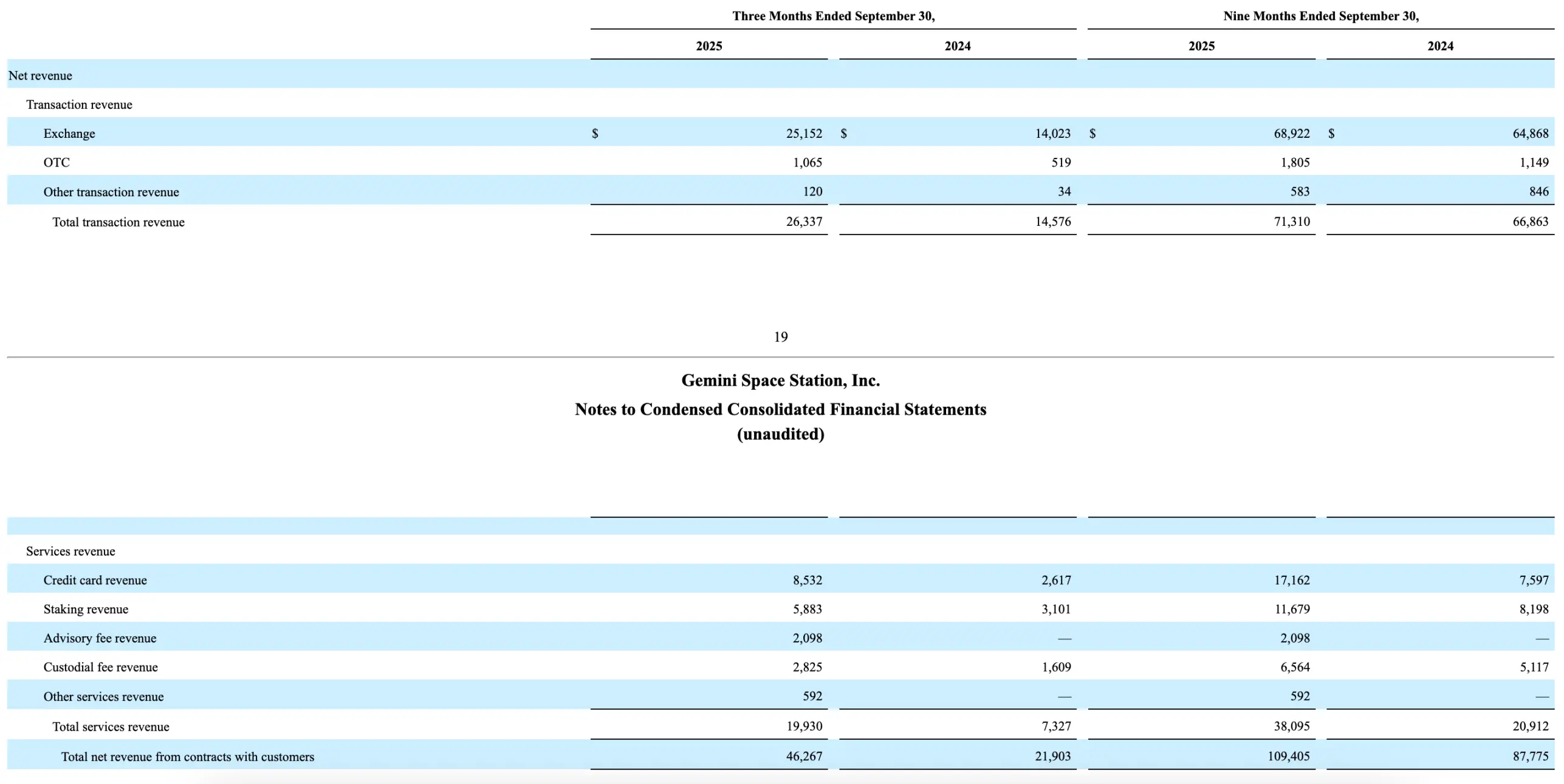
According to data provided in the shareholder letter, the number of Gemini credit card accounts has surpassed 100,000, with spending exceeding $350 million, doubling quarter-on-quarter; at the same time, the value of staked assets on the platform reached $741 million. This quarter, service revenue accounted for 39% of total revenue, compared to less than 30% a year ago.
While revenue increased, Gemini's operating costs also rose at a higher rate. In the third quarter, Gemini's operating expenses reached $171 million, an increase of 123.1% year-on-year, with sales and marketing expenses rising nearly sevenfold year-on-year.
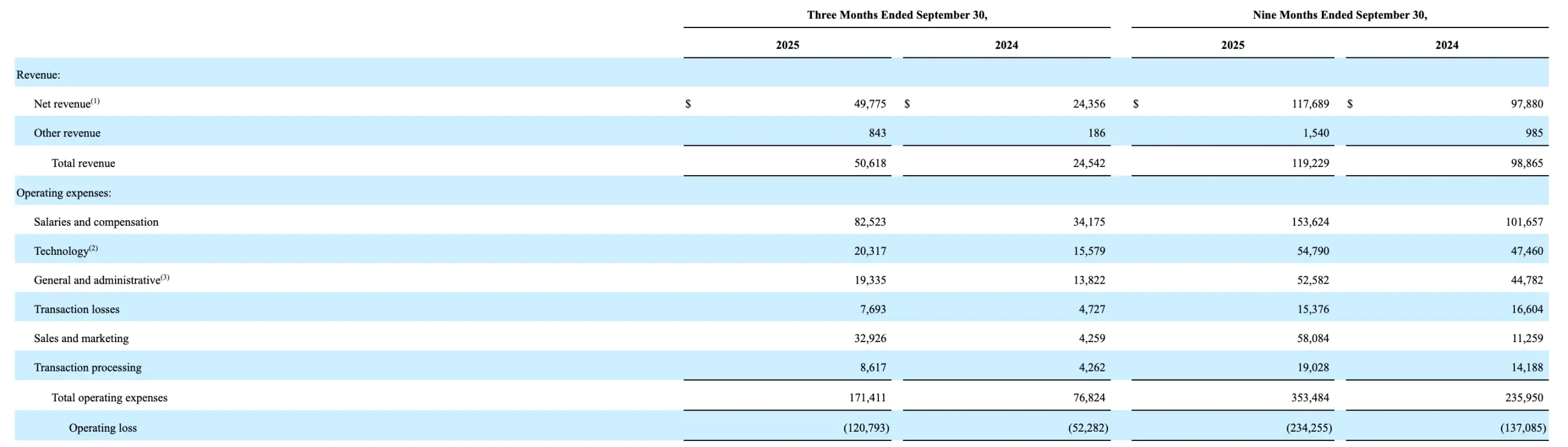
The increase in operating expenses outpaced the increase in revenue, combined with the continued widening of losses, making Gemini's first report after going public very disappointing. To date, Gemini has not proven its ability to generate self-sustaining profits; although part of the losses stem from IPO expenses, even when calculating EBITDA (Earnings Before Interest, Taxes, Depreciation, and Amortization), Gemini still reported a loss of $52.4 million in the third quarter, an increase of 3.4% year-on-year.
The lack of profit growth despite revenue increases is often seen as an issue of operational capability. In fact, Gemini's IPO documents clearly outline a significant risk: as of June 30 of this year, Gemini's total borrowings were approaching $1.4 billion, of which $1.28 billion was provided by investment companies owned by Gemini's founding brothers. Among this $1.28 billion, over $400 million can be converted into shares at a 20% discount to the IPO price at the time of the IPO. Gemini has even stated that the purpose of the IPO financing is to repay debts.
Under these circumstances, the decline in Gemini's stock price after going public was entirely expected. If one were to find some points worth looking forward to, it would be that its total liabilities have decreased by 9.2% from the end of last year to $1.685 billion. Discretionary cash has also increased by 118.6% year-on-year to $1.108 billion. If Gemini can achieve a situation of "decreasing expenses and increasing revenue" after short-term investments, it may indicate an improvement in the company's operational status.
 Risk warning Risk warning




Popular articles





