








What has the OKX exchange done by launching the "built-in DEX"?
 Core Viewpoint

 OKX officially launched the "Exchange Built-in DEX" feature, which is seen as an attempt to bridge the gap between CEX and DEX, redefining the boundaries for users. The core of this product is to simplify the complex on-chain processes (Gas fees, mnemonic phrases, cross-chain) into a smooth experience familiar to CEX users, while ensuring asset self-custody and security.
In this extreme world, users are often divided into two camps. One camp consists of users of centralized exchanges, who enjoy a smooth trading experience, mature risk control systems, and stable liquidity, but at the cost of limited choices—whatever the platform offers is what they can trade, and more importantly, the control over their assets ultimately does not lie in their hands.
The other camp is made up of explorers of decentralized exchanges, who embrace the infinite possibilities on-chain, where the earliest new assets and wildest yields exist, along with the highest degree of freedom. But the flip side of freedom is the cumbersome cross-chain processes, expensive gas fees, heavy private key management, and the risk of being hacked and having their wallets emptied if they are not careful.
For a long time, this has been the "binary dilemma" of the crypto world—a tug-of-war between security and freedom. But now, it seems someone wants to flip the table. OKX has officially launched an exchange-integrated DEX, and this is not just another centralized platform integrating a decentralized platform as a gimmick, but a genuine attempt to bridge the two ends and reconstruct the boundaries for players. The key ------ this product is currently completely gas-free, subsidized by OKX for users!
Exchange-Integrated DEX : A Portal to the On-Chain World
So, what exactly has the OKX exchange-integrated DEX done? In simple terms, OKX allows you to directly use tokens like USDT and USDC in the exchange to buy any on-chain tokens currently supported on public chains like Solana, X Layer, and Base. The tokens you purchase will go into a self-custodial wallet that is exclusively yours, with complete control over your assets.
This sounds like "CEX integrates DEX," or just moving the DEX aggregator from the OKX Wallet? But in essence, it is completely different.
In the past, when you used a DEX aggregator in the OKX wallet, you had to manage the mnemonic phrase yourself, handle cross-chain transactions, and bear the operational risks on your own. The newly launched exchange-integrated DEX is essentially an on-chain entry tailored for centralized users—you just need to scan your face to open a wallet, without needing a mnemonic phrase; you can pay gas directly with USDT/USDC, without needing to exchange for native tokens like SOL. In other words, this is not about "making you adapt to on-chain," but "making on-chain adapt to you."
What does this mean?
You have the experience of a CEX: no need to register a Web3 wallet, no need to calculate gas fees, no need for cross-chain transactions. The entire trading process is as smooth as buying and selling BTC or ETH on a centralized exchange. Your USDT is a universal bullet. At the same time, you also have control over your assets. The assets are not in OKX's hands but in an independent self-custodial wallet generated by the system for you. OKX has once again realized the long-voiced slogan—"Not your keys, not your coins."
From an experiential perspective, this feels more like opening a "portal" within the CEX. When you see a potential on-chain token, you just need to place an order with one click, and the OKX DEX trading system will complete the transaction at a better price and faster speed, directly transferring the tokens to your self-custodial wallet. Additionally, the entire system also includes token discovery, market intelligence, and asset tracking features, allowing ordinary users to "easily understand on-chain" for the first time.
Once this product feature is activated, users can create a wallet in seconds, supporting Passkey and facial recognition, without needing a mnemonic phrase, and can exchange potential tokens with one click. Familiar operations, smooth experiences, and self-custodial assets—OKX is attempting to break down the "wall" that separates CEX from DEX, allowing more people to truly step into the on-chain world.
OKX is trying to solve the industry's long-standing "impossible triangle": security, convenience, and opportunity—can we really not have all three? In a sense, OKX's answer is: "Yes, we can." It is attempting to play that long-lost role—the ferryman between the centralized world and the decentralized world.
Three Types of "Ferrymen": Exchange-Integrated DEX, One-Stop Solution for Different Needs
The OKX exchange-integrated DEX is trying to ferry these different types of users.
The first type is Web3 novices or light users. They are curious about the on-chain world and have heard that "those who get on-chain early have all made money," but when it comes to actual operation, they are often stopped at the door—mnemonic phrases are complex and hard to remember, gas fees are opaque, cross-chain operations are cumbersome, and they have to manage their wallets themselves. Most of these users have trading experience on centralized exchanges but rarely go on-chain, occasionally buying inscriptions, NFTs, or Dogecoin for hot trends, only to return to the familiar exchange after some hassle.
The OKX exchange-integrated DEX provides them with a brand new solution: in a familiar trading interface, they can directly use USDT or USDC to purchase on-chain tokens from Solana, X Layer, Base, without needing a mnemonic phrase, without needing to exchange for gas, and without leaving the exchange. In the past, to chase popular coins, they had to rush to secondary exchanges, manually cross-chain on DEX, and pray that the transaction wouldn't fail; now, they just need to place an order with one click, and the on-chain tokens will be in hand, while their USDT can continue to earn interest in the trading account. For them, this is not just a new product, but a ticket that allows them to easily step into the on-chain world.
The second type is cautious large users. They may have been hacked on-chain or seen cases of mnemonic phrases being leaked or wallets being hacked, so they are understandably wary. Although they want to participate in on-chain opportunities, security is always the top priority. They would rather keep their funds on the exchange than manage private keys alone.
The OKX exchange-integrated DEX provides these users with a "middle solution": the wallet remains in self-custodial mode, with assets completely controlled by the user, and OKX cannot access the private keys, but the trading process still occurs within the security framework of the exchange. Funds can be transferred out for independent management at any time or can continue to be kept within the OKX environment, allowing users to avoid worrying about losing assets due to phishing or operational errors. In short, these users get an ideal combination: funds in the exchange, security on-chain, allowing them to explore on-chain opportunities without sacrificing safety.
The third type is seasoned on-chain players, also known as "nomads" on-chain. They might be trading Dogecoin on BSC today, running to Solana for new projects tomorrow, and then switching to Base the day after, but the long-standing pain point for them is: slow cross-chain transactions, chaotic gas fees, and frequent wallet switches, leading to extremely low efficiency.
The OKX exchange-integrated DEX allows them to experience "exchange-level" trading for the first time: they can directly use USDT to search and purchase multi-chain tokens within the exchange, with initial support for X Layer, Solana, and Base, and future expansions to ETH, SUI, Aptos, and more public chains. No need to withdraw tokens, no gas fees, no cross-chain transactions, no waiting—"if you see it, you can buy it," which not only saves operational time but also allows them to seize market opportunities.
Whether they are novices, cautious large users, or seasoned on-chain players, they can enjoy the convenience of a CEX while having the asset sovereignty of a DEX in a familiar trading interface, no longer having to choose one over the other.
Tutorial Guide: How to Trade on DEX in OKX Exchange
To experience the built-in DEX in the OKX exchange, you first need to meet some basic conditions: for a better experience, it is recommended to upgrade the OKX APP to the latest version before activating this feature, then complete the OKX registration and pass KYC verification, etc.
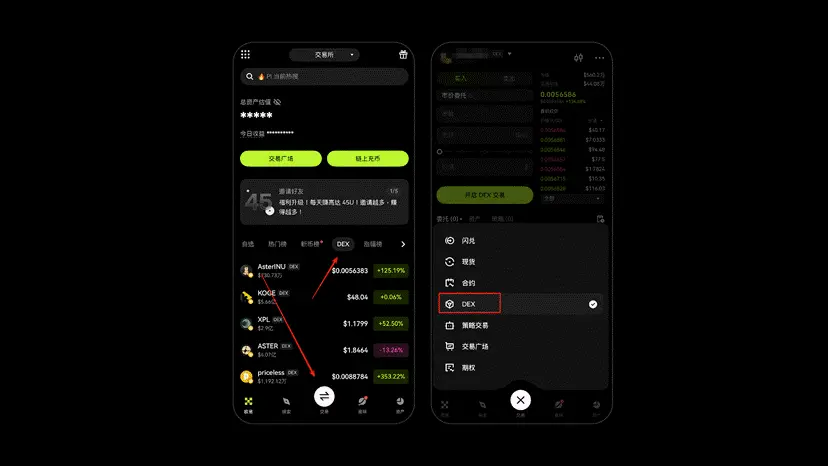
Step 1: Find the DEX Trading Entry
Open the OKX App, and click on "Trade" at the bottom of the exchange homepage to see the "DEX" option; alternatively, you can enter the DEX trading interface through the homepage rankings, market, search, etc. Once you find the entry, you are ready to step into the world of on-chain trading.
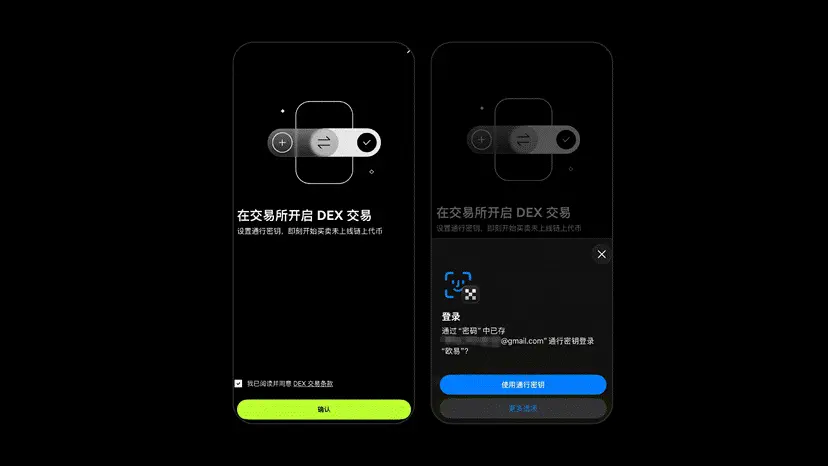
Step 2: Create a Self-Custodial Wallet (Only Once)
Before conducting DEX trading for the first time, you need to create a dedicated self-custodial wallet. Each user can only have one DEX wallet. After creation, set up a passkey, and thereafter, for each transaction, you only need to use facial recognition to start buying and selling on-chain tokens that are not yet listed.
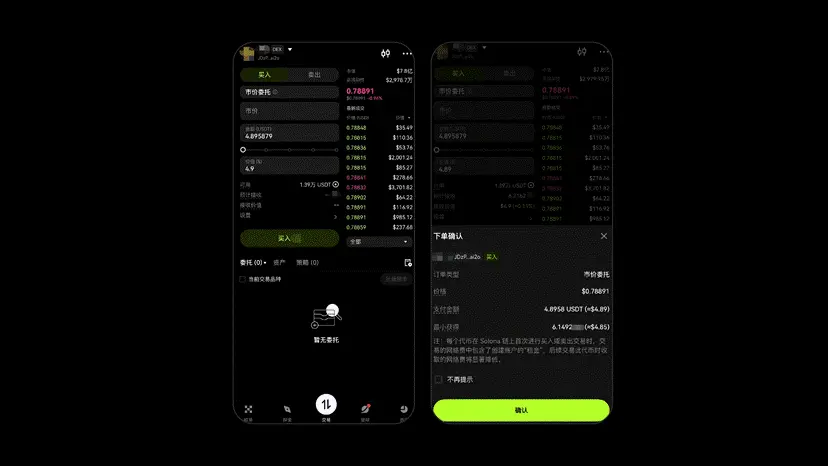
Step 3: Conduct DEX Trading
Once the wallet is successfully created, you can start operating in the DEX trading interface. Transactions can be conducted directly using USDT, USDC, or native tokens from the network in your exchange account. The entire process is similar to buying and selling tokens on a centralized exchange—simple, smooth, while enjoying ownership of on-chain assets.
Step 4: Check DEX Assets
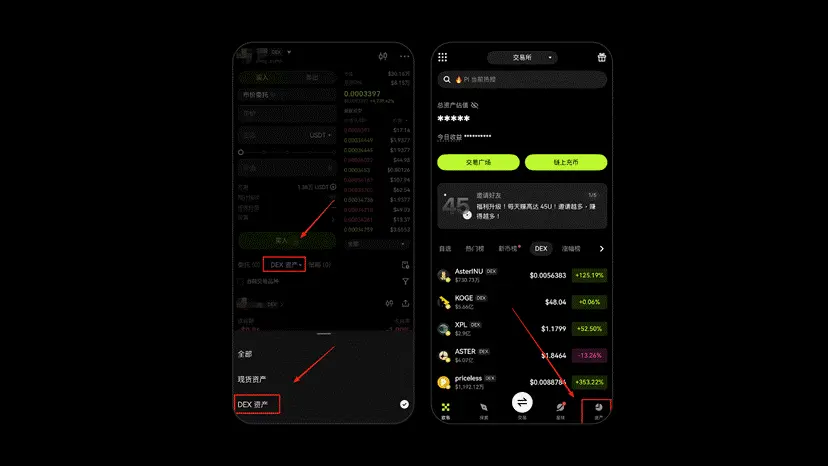
After completing a transaction, you can check your DEX token holdings at any time. Just click the "Assets" button at the bottom right of the OKX App, or select "Assets" on the DEX trading page—then enter "DEX Assets" to clearly see all on-chain assets.
Infinite Assets, One-Stop Trading
When an industry has been locked down for too long by poor experiences and high barriers, the true disruptor is not one that relies on a wave of hype to make a meme coin skyrocket, nor is it one that uses so-called quick-fix tutorials to trap a few players, but one that dares to use the most straightforward and substantial methods to pave a safe, fast, and accessible on-chain path for ordinary people.
The "exchange-integrated DEX" product is such a gamble. It bets that the future of Web3 does not depend on which chain is faster, nor on which trend is hotter, but on who can first dismantle the wall that separates ordinary users from the on-chain world. It allows you to purchase on-chain tokens as smoothly as on a centralized exchange, without needing to cross chains, calculate gas fees, or worry about private key management, while also having complete control over your assets.
Truly achieving "infinite assets, one-stop trading."
For those who have long been blocked on the banks of Web3, they do not need to undergo painful education or experience the fear of being hacked or losing private keys. What they need is an opportunity to participate in the on-chain world safely, smoothly, and decently. When ordinary users can browse, purchase, and explore various on-chain assets as easily as shopping online, they are no longer just bystanders; the on-chain world truly begins to belong to everyone.
And this "ferryman" is making freedom and security no longer a choice between the two. OKX is proving through action that CEX is not just a starting point but can also become a bridge to the decentralized world.
Disclaimer
This article is for reference only. The views expressed in this article are solely those of the author and do not represent the stance of OKX. This article does not intend to provide (i) investment advice or recommendations; (ii) offers or solicitations to buy, sell, or hold digital assets; (iii) financial, accounting, legal, or tax advice. We do not guarantee the accuracy, completeness, or usefulness of such information. Holding digital assets (including stablecoins and NFTs) involves high risks and may fluctuate significantly. Past performance does not guarantee future results, and historical returns do not represent future outcomes. OKX assumes no responsibility for any potential losses. You should carefully consider whether trading or holding digital assets is suitable for you based on your financial situation. Please consult your legal/tax/investment professionals regarding your specific circumstances. OKX and its affiliates have no affiliation with the owners or operators of third parties displayed or aggregated on the OKX platform. OKX is not liable for any losses, damages, or other consequences arising directly or indirectly from your use of the services. In the event of any loss or damage, including but not limited to the loss of user digital assets, users are advised to seek resolution directly from third parties. Not all products and services are available in all regions, and some products and services may be restricted or unavailable in certain areas. You are responsible for understanding and complying with applicable local laws and regulations.
 Risk warning Risk warning

Popular articles





