








The Solomon public offering results were manipulated, and Polymarket predicts a trust crisis in cryptocurrency
 Core Viewpoint

 Solomon Labs' public offering triggers huge losses for Polymarket, reigniting controversy in the prediction market.
Original | Odaily Planet Daily Golem
Free translation in progress…
Although stablecoins have frequently faced crises recently, the market's enthusiasm for stablecoin protocols remains undiminished. On November 19, the stablecoin protocol on Solana, Solomon Labs, announced the end of its 5-day public fundraising, ultimately raising over $102 million from 6,604 investors through MetaDao, making it the second highest fundraising project for MetaDao, second only to UmbraPrivacy.
In a generally sluggish market, it is indeed commendable for a project to secure significant funding in the public market, but the success of Solomon Labs left some players on Polymarket unable to celebrate.
This is because there was a prediction on Polymarket titled "Total commitments for the Solomon public sale on MetaDAO," where players could bet on the probability of "Solomon's final fundraising not exceeding a certain amount."
On the afternoon of November 18, less than 12 hours before the fundraising ended, Solomon had only raised $7.25 million, leading some players to confidently bet "no" on the possibility of raising over $40 million in the remaining time. Some conservative players even bet "no" on "Solomon raising over $100 million," with the probability of this outcome remaining around 97% three hours before the fundraising ended.
However, in the last hour or two before the fundraising closed, a large amount of funds suddenly poured into Solomon's public sale, raising the total to $100 million. The probability of "Solomon raising over $100 million" on Polymarket instantly surged from 1.6% to 99%, catching many Polymarket players off guard, and ultimately, those who sought to gain a 1% "investment return" ended up losing 100% of their principal.

The probability of "Solomon raising over $100 million" skyrocketed at the last moment.
Afterwards, Solomon's official statement claimed that there were no internal personnel involved in the public fundraising, nor any behind-the-scenes trading. However, this explanation seems somewhat weak, as the community has already identified a Polymarket trader who had bet "yes" on the low probability outcome of Solomon's fundraising beforehand, earning over $560,000 from it.
Insider Trading by the Project Team or Manipulation by Whales?
The trader, named KimballDavies, joined Polymarket in September 2024, with the slogan "metadao, prediction markets," possibly indicating a focus on metadao-related prediction events.
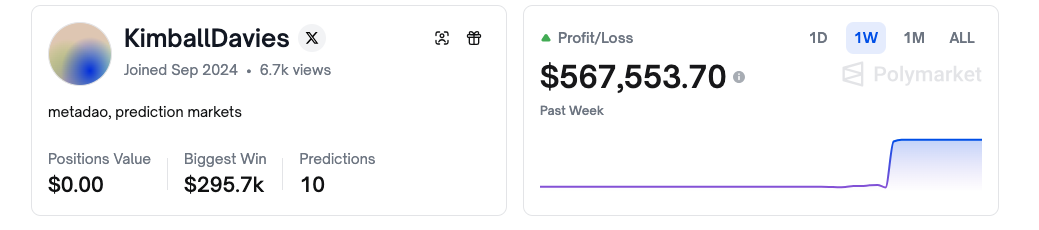
However, since joining, this trader has only placed bets on two events: one was a $10 bet on "The Federal Reserve will lower interest rates by 50 basis points after November 2024," and the other was a cumulative investment of $65,703.58 on the Solomon public sale event.
Insider Trading by the Project Team?
Starting from November 17, KimballDavies began to buy "yes" bets on "Solomon raising over $40 million" in batches, and over the next two days, also placed bets on raising over $60 million, $80 million, and $100 million.
This indicates that the trader had been planning for the November 19 action since November 17, ultimately earning $567,554, with returns nearly 10 times… Therefore, we reasonably suspect that KimballDavies had insider information.
What is even more worth pondering is who owns this account. The prevailing speculation in the community is that this account belongs to the project team, which may have injected tens of millions of dollars at the last moment to earn over $500,000 on Polymarket.
While this possibility exists, upon further reflection, the logic seems flawed. First, the over $500,000 for a project that is about to issue tokens seems a bit too "small," as injecting tens of millions for just over $500,000 appears to be a narrow-minded strategy; second, if such an incident occurs, the first party to be suspected is the project team, as risking the project's reputation for just over $500,000 could undermine community trust and potentially have adverse effects on future exchange listings, which doesn't seem worthwhile.
Of course, there is also the possibility that internal team members placed bets privately. The project team may have had a Plan B, injecting a large amount of funds in case the public fundraising was insufficient, allowing them to further control the token distribution while also conducting some marketing. Thus, an "intern" who knew about this plan might have secretly placed bets on all low-probability events on Polymarket.
Manipulation by Whales is More Likely
If we rule out the possibility of insider trading by the project team, then the last-minute influx of funds into Solomon's public sale can only be attributed to manipulation by whales, or at least by "assistants" who had prior knowledge of the information.
Perhaps these whales had already considered participating in Solomon's public sale but noticed the predictions about the fundraising amounts on Polymarket. Thus, driven by the desire to profit or for "fun," they decided to teach Polymarket players a lesson, demonstrating that those with money can manipulate the outcomes of prediction markets.
This is not the first time that whales have manipulated event outcomes on Polymarket. In July 2025, during a prediction about whether Ukrainian President Zelensky would wear a suit before July, even though mainstream media reported that Zelensky wore a suit at an event, some UMA whales chose "did not wear" in the final result determination vote, resulting in the traders who bet on "did not wear" winning. (Related reading: * Polymarket Again Caught in Truth Controversy: What Zelensky Wears Will Determine the Fate of $140 Million).
Polymarket Does Not Predict Crypto Truth
Although there have been cases of whale manipulation in past prediction markets, the Solomon public fundraising amount prediction is the first incident in the crypto market with significant insider suspicion. This incident serves as a signal that as more crypto players and larger funds enter Polymarket, it becomes a prime ground for exploiting information asymmetry in the crypto market.
For example, betting on when a project will have its TGE or what the FDV will be at TGE inherently carries an asymmetrical advantage, as the project team and VCs already know the outcome and can even easily alter the event. The more funds in the prediction pool, the stronger the motivation for them to commit wrongdoing.
In these events, Polymarket does not predict the truth; it merely reflects human greed. For ordinary users, this incident once again highlights the risks of endgame strategies, as what seems like a stable investment opportunity with a 99% probability could be a carefully woven trap waiting for you to fall into. (Related reading: * 95% Win Rate, Yet Still Losing Money: I've Experienced the Endgame "Investment" Trap in Prediction Markets for You).
In traditional financial markets, insider trading is subject to strict legal penalties once discovered; in the crypto market, money laundering, insider trading, and market manipulation are gradually receiving regulatory scrutiny; however, in the increasingly expanding field of prediction markets, there are still few laws and regulations governing such malicious behaviors. Even if someone were to step forward today and claim they manipulated the Solomon public fundraising results, aside from scorn for their antics, what could we do about it?
However, we believe that in the future, countries will regulate behaviors in prediction markets more stringently, and by then, Polymarket may finally be able to predict the truth beyond public events.
 Risk warning Risk warning


Popular articles





