








From a banned economist to the CEO of Xinhua: Fu Peng has figured out the second half of the traffic game
 Core Viewpoint

 This uproar in the crypto circle appears to be a cultural conflict between a traditional economist and a crypto OG, but looking deeper, it is merely the new fire leveraging Fu Peng's influence in the traditional financial sector to pry open a batch of client funds that were originally difficult to reach.
Author: Zhou, ChainCatcher
On April 20, 2026, the Hong Kong-listed company Bitfire Group (1611.HK) announced that former chief economist of Northeast Securities, Fu Peng, officially joined as the chief economist.
Upon the news, Bitfire's stock price surged over 22% during the day, closing up nearly 18%.
A few days later, Fu Peng also became a hot topic on X. His tweets sparked extensive debate among crypto-native users, and after blocking several KOLs, community sentiment further intensified, with supporters, critics, and analysts discussing him, making the crypto circle lively for several days.
However, perhaps regardless of the voices, they are all part of the hype.
Because from the very beginning, we were not his target customers.
Why did Bitfire hire someone from traditional finance to take the stage?
In April this year, Bitfire Group first brought in Fu Peng as chief economist, followed by the announcement of the acquisition of Avenir Group's investment team of about 20 people and its trading system, incorporating its Alpha BTC options strategy into the Hong Kong Type 9 compliance framework, launching Bitcoin asset management services.
Behind these intensive actions is a comprehensive transformation that is underway.
At the end of August last year, Li Lin promoted former Huobi executive Weng Xiaoqi to co-CEO and officially announced the company's full transformation, aiming to upgrade from an OTC trader to a private banking-level digital asset management platform.
The financial report numbers may illustrate how urgent this transformation is.
In the 2025 fiscal year, Bitfire Group's total revenue was approximately HKD 8.661 billion, a staggering year-on-year increase of about 451%, but despite the revenue surge, it still faced losses. Specifically, the company's revenue almost entirely came from facilitating large trades for clients and earning spreads, which is the OTC bulk trading business. In the 2025 fiscal year, this business generated revenue of about HKD 8.257 billion, with sales costs reaching about HKD 8.256 billion, resulting in a gross profit of less than HKD 2 million.
In contrast, the company's asset management business had revenue of about HKD 27.2 million in the 2025 fiscal year, with assets under management growing from about USD 88.7 million at the beginning of the year to about USD 138.6 million by the end of the year, a growth of over 56% within six months. Although the revenue scale is still small, it operates under a completely different trading logic from OTC, with management fees and performance fees continuously accumulating as AUM grows.
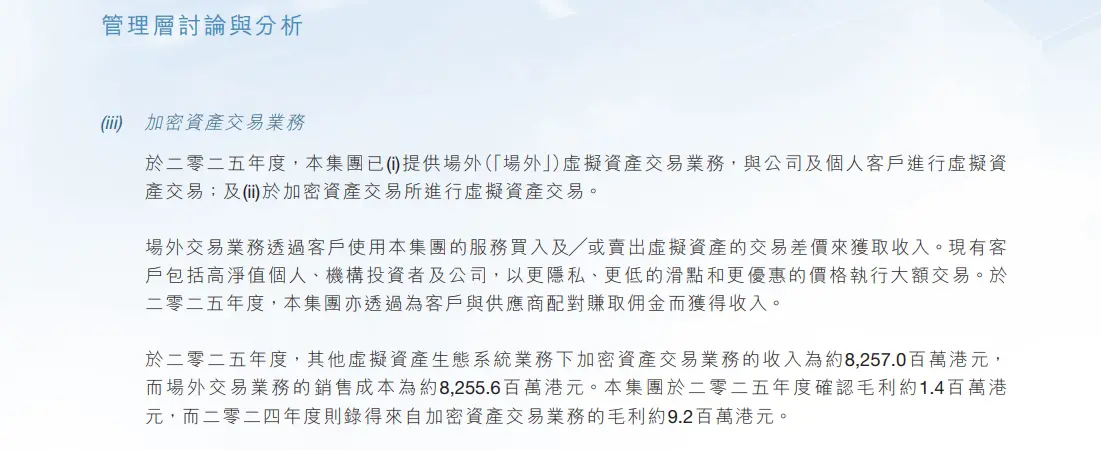
Image source: Bitfire financial report
This is also the logic behind Bitfire's acquisition of the Avenir Group investment team.
It is reported that Avenir Group's Alpha BTC strategy involves holding BTC spot while selling call options to collect premiums, targeting an annualized return of 5% to 7%, with historical drawdowns controlled around 1%.
From the product design itself, BTC is always held in the client's own account, with Bitfire only obtaining API trading execution rights and no withdrawal rights—this separation of asset control and strategy execution is precisely the operational logic of standard asset management products under the Hong Kong Type 9 compliance framework.
Bitfire CEO Livio Weng stated that with the addition of the new team, Bitfire has received about USD 500 million in initial investment intentions from family offices and listed companies.
However, there is often a gap between intended funds and actual funds in place.
The money Bitfire is targeting is not crypto-native users, but high-net-worth individuals, family offices, listed companies, and corporate funds considering asset diversification. These individuals may not understand white papers or look at candlestick charts, but before making decisions, they must go through compliance reviews, risk control assessments, and investment committee approvals. If any of these checkpoints are blocked, it is difficult to proceed.
How to get traditional funds that have never been exposed to crypto products to step through this door is precisely the problem Fu Peng needs to solve.
The customer base determines Fu Peng's positioning
Fu Peng's strategic value to Bitfire cannot be assessed solely by his title; it is also essential to consider who his audience is.
As the former chief economist of Northeast Securities, with a million followers in the traditional finance circle, active on Douyin, WeChat video accounts, and various offline closed-door forums, these are all labels associated with Fu Peng.
The circle he has long been immersed in is precisely the core decision-making level of executives from listed companies, private banking clients, and family offices.
This group is exactly the target customers that Bitfire needs the most and finds the hardest to reach.
To some extent, the real problem Fu Peng is solving is the cognitive barrier. For traditional funds, the main obstacles to crypto products are misunderstanding and distrust, and what Fu Peng excels at is precisely the macro packaging needed for this narrative.
The framework he has built over the years in the traditional finance circle—declining globalization dividends, structural challenges facing the traditional economic system, and the need for the old order to find new value anchors—naturally provides a foundation for companies to re-examine their cash reserve allocation methods.
Therefore, persuading traditional listed companies to convert the cash portion on their balance sheets into Bitcoin is not difficult for Fu Peng.
For Bitfire, having someone who speaks in familiar macroeconomic language stand up to endorse them will significantly reduce customer acquisition friction.
This logic is not new. Before launching the Bitcoin ETF, BlackRock's first step was also to organize analysts with traditional finance backgrounds to write research reports.
Many crypto KOLs have mentioned that Fu Peng is a macro megaphone; by following his content, one can understand what is happening in the broader market, but trading based on his advice is another matter.
This also accurately describes Fu Peng's positioning in this ecosystem—his role is that of a narrative provider, and trade execution is not within his responsibilities. For Bitfire, which has just integrated a trading team, this is precisely the role they need.
In his debut after joining Bitfire, Fu Peng presented the FICC+C framework at the Hong Kong Institutional Digital Wealth Management Summit, incorporating crypto assets into the traditional asset allocation system, with traditional finance background institutional investors in the audience. This presentation did not introduce any specific products but laid the groundwork for the understanding of "why to allocate Bitcoin."
The complete commercial logic chain thus takes shape: Fu Peng reaches target customers using traditional finance language, opening the door to trust; after customers enter, they experience OTC purchases, custody, and then enter the Alpha BTC strategy, with Bitfire collecting corresponding fees in the process. Fu Peng's value is at the top of the funnel, while Bitfire truly wants to keep customers at the bottom of the funnel.
Why are crypto-native users so outraged?
On April 25, Fu Peng tweeted continuously on X, explaining the funding rate logic of BTC and the framework for holding positions. The crypto community quickly raised doubts, and Fu Peng subsequently sent out a Chinese tweet (now deleted), stating, "Many people have no idea what I'm talking about, but the large-scale BTC spot holders who survived the early stages know exactly what I'm saying."
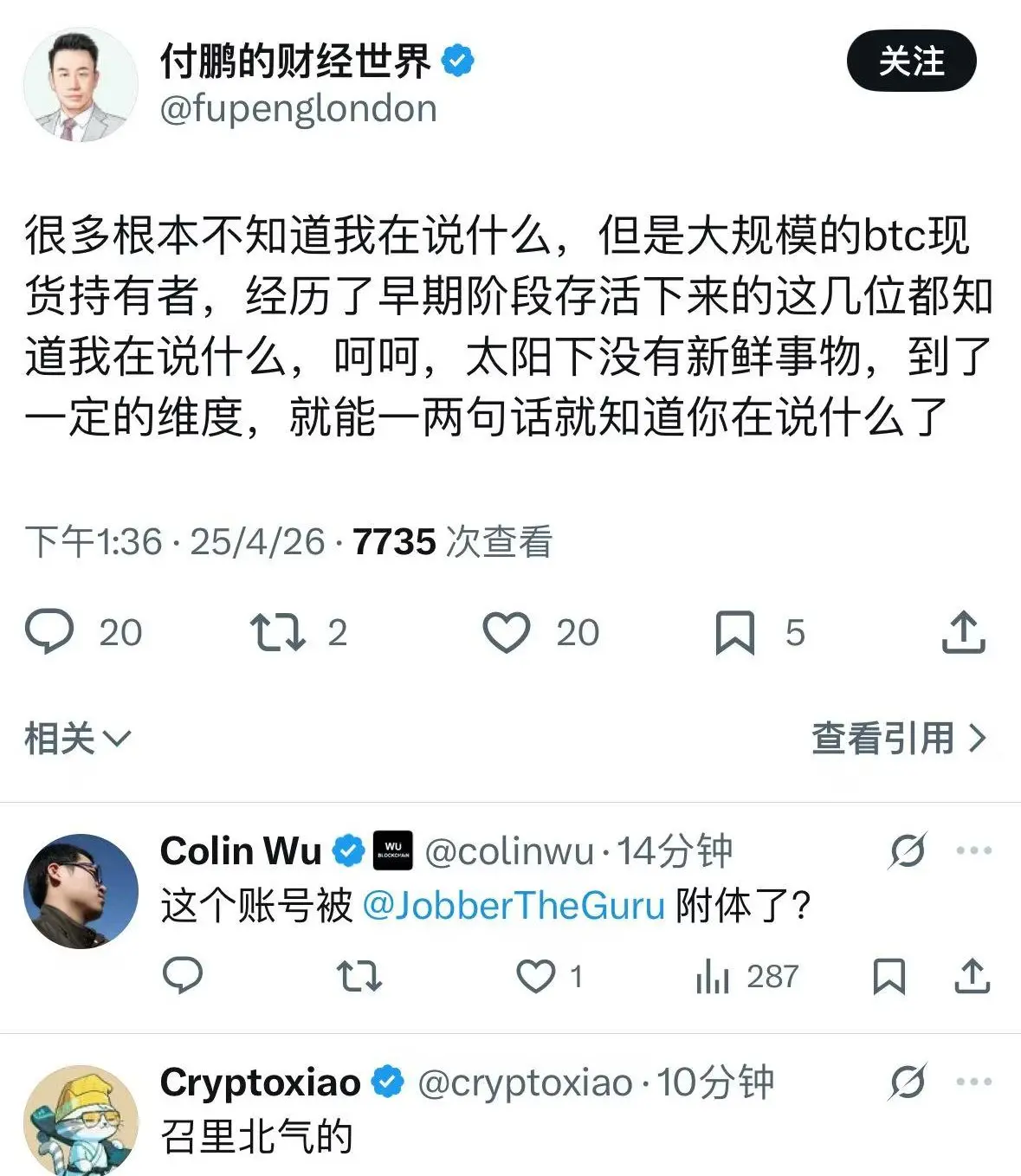
This tweet ignited community sentiment. The implication was clear—just because you don't understand doesn't mean I'm wrong.
In a community built on decentralization and questioning authority, such an expression is bound to provoke backlash. As X user @Nicole_yang88 said, "I hope Fu Peng can appropriately drop the 'Old money' preaching tone; the crypto circle has its own community culture, which is more open, decentralized, and emotionally resonant, essentially unsuitable for a one-way expert expression."
Subsequently, Fu Peng's account blocked several leading Chinese KOLs, and the situation further escalated.
Users bluntly stated that regardless of whether Fu Peng qualifies as a chief economist, the dissemination effect of this blocking incident makes him a chief traffic scientist.
Whether intentional or not, Bitfire completed a zero-cost full-circle exposure through this controversy. The crypto circle's rejection also indicates that this approach's target has never been them.
The outrage in the crypto community is, in fact, quite understandable.
Crypto KOL Tu Ao Da Shi expressed that for OGs who have survived so many storms in this industry, who hasn't been ridiculed? It is entirely normal for a person with a traditional background to be questioned when suddenly entering the scene. Rather than guarding against group criticism, it is better to prove oneself with real performance; results are the best proof.
Some hold an optimistic view. @Billions2022 believes that the entry of traditional capital elites like Fu Peng into the crypto industry signifies that old money's attitude toward BTC is shifting from observation to layout/allocation, and the main drivers of this structural bull market are institutions and wealthy old players.
Conclusion
Ultimately, Fu Peng is a precise move in Bitfire Group's customer acquisition logic, but the game is far from over.
This uproar in the crypto circle appears to be a cultural clash between a traditional economist and crypto OGs, but looking deeper, it is merely the company leveraging Fu Peng's influence in the traditional finance circle to pry open a batch of customer funds that were originally difficult to reach.
However, whether this business can run smoothly ultimately depends on the real conversion rate—how much of the intended funds can actually be realized and whether Bitfire's next financial report can show structural improvement in gross margins.
Regardless, Bitfire has already won the traffic.

 Risk warning




Popular articles





