








With investment from YZi Labs, how does Funes create a permanent "digital copy" for architectural heritage?
 Core Viewpoint
 Aims to be the "GitHub" of the physical world.
Author: momo, ChainCatcher
Recently, YZi Labs announced an investment in Funes, an AI-driven digital heritage platform. It is reported that several institutions, including Dragonfly, Generative Ventures, HashKey Capital, and D11 Labs, as well as Du Jun, the former head of ABCDE, have also invested in Funes.
But what exactly is Funes? In an era where everyone can take photos and upload records, what pain points does human digital heritage face? How does Funes aim to solve these issues? This article provides a brief analysis.
What problems does Funes aim to solve? What is its vision?
Human architecture, as a tangible carrier of civilization, continues to face erosion from wars, natural disasters, and urbanization. Traditional recording methods, such as photographs and blueprints, struggle to fully preserve the three-dimensional structure, materials, and spatial sense of buildings. Meanwhile, there is a lack of a unified, open 3D architectural database globally, with a vast amount of information scattered, creating inaccessible and unusable "data islands."
To address these pain points, Funes aims to build a sustainable global repository of three-dimensional digital assets for architecture and become the "GitHub of the physical world"—a platform that systematically transforms physical buildings into digital assets that can be permanently preserved, freely accessed, and collaboratively built upon through community cooperation, establishing an open architectural heritage repository for human civilization.
How does Funes operate?
Funes operates based on a technology-driven, community-participated closed loop.
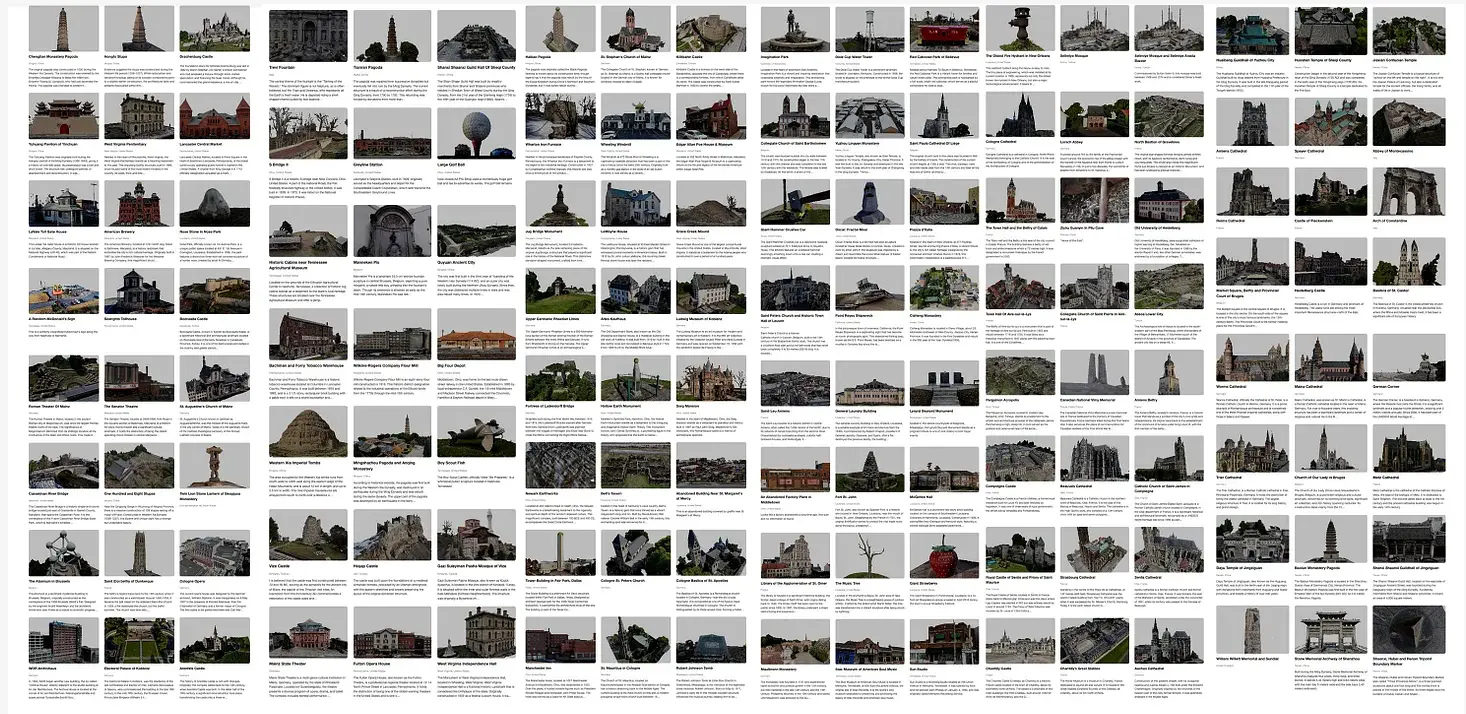
According to its vision of community co-construction, Funes aims to collect data through a crowdsourcing model. The team itself will use drones and other means for professional data collection while also encouraging global users to contribute architectural resources around them.
The core process relies on AI's automated processing, where the platform utilizes photogrammetry and computer vision algorithms to batch convert these two-dimensional images into high-quality three-dimensional models. AI will then optimize, classify, and associate relevant structural and historical information with the models.
At the application level, these models support various use cases. Researchers can use the professional tools provided by the platform, such as "orthographic views" for precise proportional studies, "mapping line diagram modes" that can automatically generate archaeological-grade blueprints, and high-precision measurement tools. Users can also freely download models for educational, artistic, and other non-commercial purposes. Blockchain technology is used to record data sources, creating a trustworthy database maintained by the community.
Project progress and team composition
Currently, Funes has recorded over 1,000 three-dimensional models from different civilizations and architectural types worldwide, with a continuous growth rate of 5-10 models per day. The platform has recently launched several professional research functions and has collaborated with institutions such as the School of Architecture at Tsinghua University, planning to further expand the modeling scope.
The team background exhibits a distinct interdisciplinary characteristic. Co-founder Wang Keda is an architectural archaeologist with an educational background from Peking University and the University of Pennsylvania; another co-founder, Wang Hanyang, has a strong background in artificial intelligence technology. The core team members also include engineers, drone experts, and curators from Tsinghua University, aiming to support the long-term goal of building the "GitHub of the physical world" from multiple levels of technology, academia, and practical operations.
 Risk warning Risk warning



Popular articles





