








A Tale of Two Cities: A Cultural Perspective on BNB Chain and Base
 Core Viewpoint

 The Survival Philosophy of BNB Chain and Base
Author: Jiawei, IOSG
Source: Jon Charbonneau
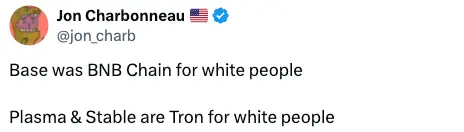
Some time ago, I couldn't help but laugh when I came across this tweet from Jon Charbonneau. When Base is referred to as the "white person's BNB Chain," what exactly is this teasing saying?
Haseeb's article "Blockchains are cities" compares Ethereum and Solana to New York and Los Angeles, respectively. If we use the same analogy:
BNB Chain is a bustling port city that never sleeps, carrying immense traffic from Binance. Cargo ships come and go, the market is noisy, and street vendors stand side by side with exchanges. Here, it doesn't matter where you come from; what matters is whether you can participate immediately. Gas fees are low, the pace is fast, new projects launch every day, some people make money, and others exit. You don't need to understand urban planning or subscribe to a particular ideology—just know where the excitement is and where the opportunities lie to survive.
In contrast, Base is a rapidly developing new city that inherits Ethereum's values. The roads are still being paved, the community is taking shape, and the rules are being discussed repeatedly. There is no port's hustle and bustle, but it has attracted a large number of engineers, creators, and institutions to settle in early. They are not in a hurry to make quick money; instead, they are pondering: if there are truly mass-market on-chain applications in the next decade, where should they be born?
In the same crypto world, different cities, residents, and lifestyles are emerging.
Understanding the differences between these two cities may be far more important than debating which chain is better.
Two Parallel Cultures
If we place BNB Chain and Base on the same map, they appear to be in competition; but if we shift our perspective to users and culture, we find that this is more like the parallel growth of two worldviews.
BNB Chain and Base essentially represent two different user structures, traffic sources, and growth logics. The former is rooted in Asia and emerging markets, while the latter has grown within the developer communities of Europe and America. Rather than simply understanding them as competitors, it is more accurate to say they are the result of the natural stratification of crypto users.
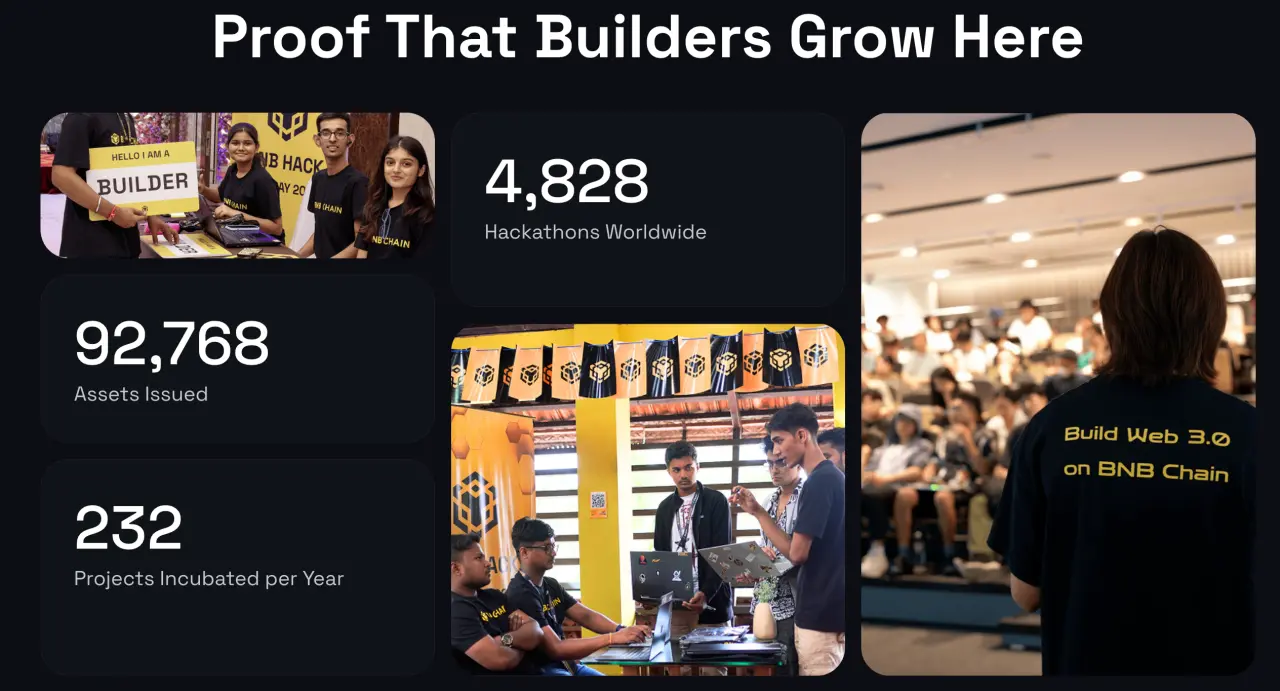
▲ Source: bnbchain.org
The user profile of BNB Chain is very clear.
A large number of users come from the retail base accumulated by Binance over the years, many of whom are using on-chain products for the first time. They are mainly distributed in emerging markets like Southeast Asia and the Middle East, and they are not obsessed with whether "decentralization is pure"; their focus is extremely pragmatic:
Is the gas low enough? Are the transactions fast enough? Can I participate in popular projects right away?
For these users, the chain is not an ideology, but a tool. As long as it is useful, cheap, and can make money, whether it is centralized or semi-centralized is not the primary concern. This also explains why the ecosystem of BNB Chain has always revolved around efficiency, scale, and application density.
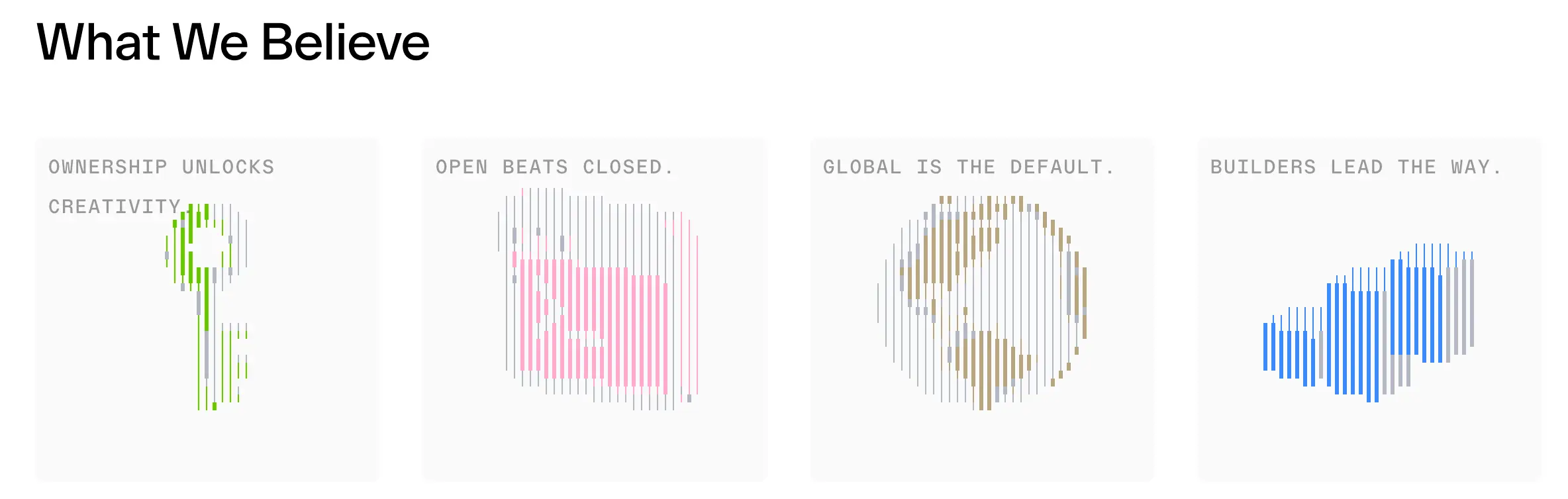
▲ Source: base.org
The user base of Base, on the other hand, is different.
They are more likely to be Coinbase users and the "overflow crowd" from the Ethereum ecosystem, often having a deeper understanding of blockchain and being more willing to discuss underlying design issues. These users care about the relationship between Base and the Ethereum mainnet, the degree of decentralization, the technical route of L2, and even whether the culture and narrative are orthodox.
In their eyes, blockchain is not just a tool for completing transactions; it is also a space for self-expression, community building, and creative experimentation.
It is this difference in user attributes that profoundly shapes the distinctly different cultural genes of the two chains.
BNB Chain has chosen a path closer to the Web2 consumer internet: ecosystem integration, concentrating as many functions, applications, and scenarios into one system as possible. For users in emerging markets, this "everything-in-one" model greatly reduces decision-making costs and learning thresholds, making the on-chain experience closer to the internet products they are familiar with.
In contrast, Base resembles an open experimental ground, willing to reserve enough space and patience for developers and creators. It is not in a hurry to cover all scenarios but prioritizes allowing the right culture and tools to settle down first.
From this perspective, BNB Chain and Base are not competing for the same group of users; rather, they are growing in the soil where they excel.
They are not opposites but two reasonable answers provided by the same industry under different cultural backgrounds.
Similarities and Differences in Vertical Integration
In the past few years, major exchanges have almost simultaneously done one thing:
They are no longer satisfied with being merely a "matching trading platform" but have extended their business reach into public chains and wallets.
The underlying business logic is not complicated.
If an exchange can only engage with users at the moment of "buy" and "sell," then user value is discrete and fleeting; however, once the exchange masters the chain and wallet, the user value path is elongated, transforming into a multi-touch, repeatable lifecycle.
When users complete deposits, go on-chain, use dApps, participate in new projects, and then return to trade on the exchange within the same system, the exchange is no longer just an endpoint but the starting and ending point of the entire on-chain journey. The more steps taken, the higher the switching costs for users, and the stickiness increases accordingly. This is precisely the result that vertical integration aims for: transforming one-time transactional relationships into long-term retention relationships.
More critically, this structure can directly amplify liquidity and trading volume.
The continuous emergence of new tokens and projects on-chain is essentially a capability for "continually creating new assets." When an exchange controls both the chain and the listing and contract pricing rights, this on-chain "minting ability" can be seamlessly converted into spot trading pairs and derivatives, ultimately resulting in sustained fee income.
From this perspective, both BNB Chain and Base are typical examples of the vertical integration strategy of exchanges, but they amplify different advantages.
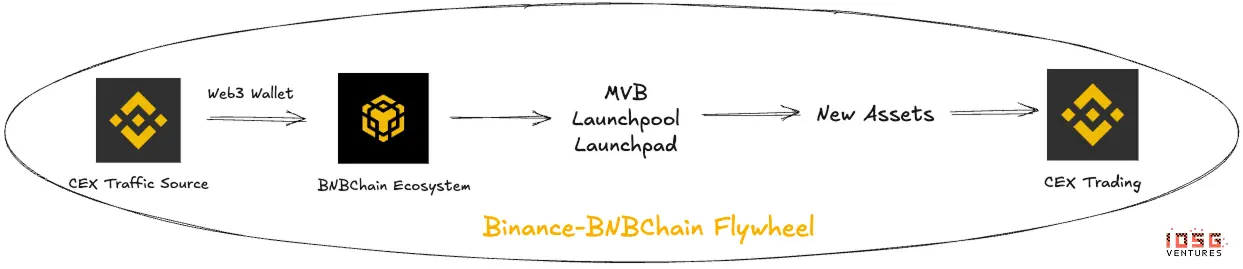 ▲ Source: IOSG
The core competitiveness of BNB Chain comes from Binance itself.
As an exchange with the largest user base and trading depth globally, Binance has a strong ability to distribute traffic instantly. New projects launched on BNB Chain do not need to start from scratch to educate the market and rarely experience a long cold start period. A large number of users can directly transfer from the exchange to participate on-chain and quickly return to the exchange for trading after completing interactions. This "frictionless back-and-forth" path makes BNB Chain more like a high-speed channel created for applications.
Behind this model is Binance's strong exchange gene:
Quick response to market trends, deep understanding of user behavior, and highly mature traffic operations. BNB Chain does not pursue slow, meticulous ecological construction but is better at pushing a new narrative to maximum scale in a short time.
 ▲ Source: IOSG
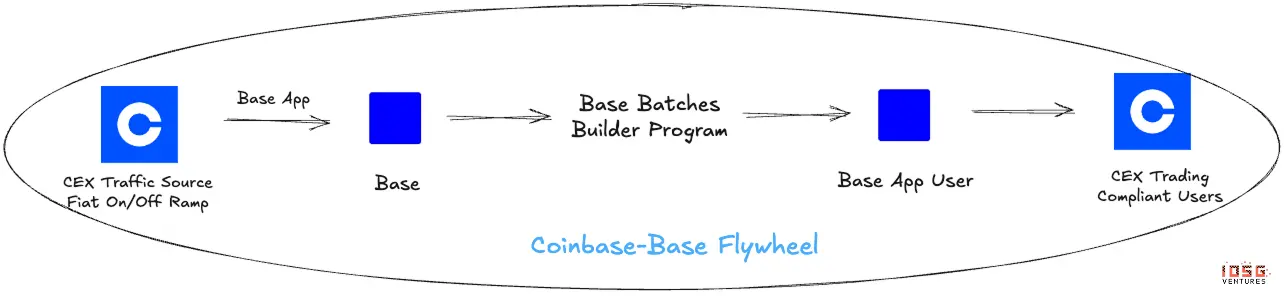
Base's vertical integration path is distinctly different.
It does not attempt to replicate the speed of BNB Chain but relies on Coinbase's long-term accumulation of a compliant brand, fiat entry, and institutional credibility in the U.S. market to build a completely different trust structure. As the first publicly traded cryptocurrency exchange in the U.S., Coinbase's survival experience within the regulatory framework is itself a scarce resource. This also gives Base a naturally "institution-friendly" label.
For institutional investors, enterprise-level applications, and developers sensitive to compliance boundaries, Base provides an environment where they can safely experiment and build long-term. Coupled with Coinbase's long-term deep involvement in the Ethereum ecosystem and continuous investment in developer tools and infrastructure, Base has gradually formed a distinctly "builder-friendly" culture.
If BNB Chain is more like an efficient commercialization testing ground, then Base is closer to a future-oriented infrastructure platform.
The former excels at quickly turning traffic into scale, while the latter is adept at slowly solidifying trust into an ecosystem.
From the perspective of exchanges, there is no right or wrong in these two paths; they merely amplify their respective strengths.
It is this difference that makes BNB Chain and Base the two most noteworthy and representative samples in the current vertical integration of exchanges.
Wallets—The Final Battle?

▲ Source: IOSG, TokenTerminal
From the community's perspective, Binance Web3 Wallet is not very popular, but it undeniably leads the first-tier traffic. For many Binance users, the first time using a Web3 Wallet often comes from a very specific scenario: wanting to participate in a new project, wanting to claim an airdrop, or wanting to get in on a hot project that is temporarily not on the exchange.
Thus, the built-in wallet of the exchange emerged.
You don't need a mnemonic phrase, you don't need to understand complex account models, and you don't even need to consciously realize "I'm using an independent wallet."
From deposits, currency swaps, to cross-chain interactions and authorizations, the entire process is an extremely smooth and easy path.
Behind this is Binance's consistent ability to simplify complex financial operations.
Because of this, Binance Web3 Wallet naturally adapts to the ecological characteristics of BNB Chain—
Trends come quickly, project density is high, and user behavior is highly concentrated in short cycles.
In a 2025 on-chain statistic, the daily trading volume of Binance Wallet once reached approximately $92.6 million, accounting for nearly 57.3% of the decentralized wallet trading market share, a figure that even surpasses the total of all independent wallets.
Users do not need to remember mnemonic phrases or exit existing apps to complete cross-chain transactions, swaps, mining, and airdrop participation; this frictionless experience is something many independent wallets cannot easily replicate.
Coinbase Wallet (Base App), on the other hand, has a completely different temperament. According to the latest market statistics, the user base of Base App has reached approximately 11 million, ranking among the top in the global self-custody wallet ecosystem.
It was designed from the beginning as a product that can exist independently of the exchange. This also leads to a significantly higher learning cost for Base App.
But once this process is completed, the user's psychological state changes: this is "my wallet," not "I'm using Coinbase." This design aligns closely with Base's overall direction. Base is not in a hurry to quickly direct all users to a hot application; rather, it cares more about whether there are people willing to stay long-term, using the same wallet and address to repeatedly build their on-chain identity.
Therefore, you will see that deep users of Base App are often also: early application users on Base, core participants in NFTs, social tools, and creator tools, and a group that is more sensitive to product experience and long-term narratives.
Within the Binance Web3 Wallet ecosystem, it is easier for applications with strong financial attributes, short cycles, and high-frequency interactions that can quickly absorb exchange traffic to emerge. In the Base App + Base ecosystem, it is easier for products that are user retention-oriented, more sensitive to UX, community, and long-term relationships, not in a hurry to monetize but willing to slowly accumulate real users to grow.
Conclusion
Free translation in progress… ▲ Source: IOSG
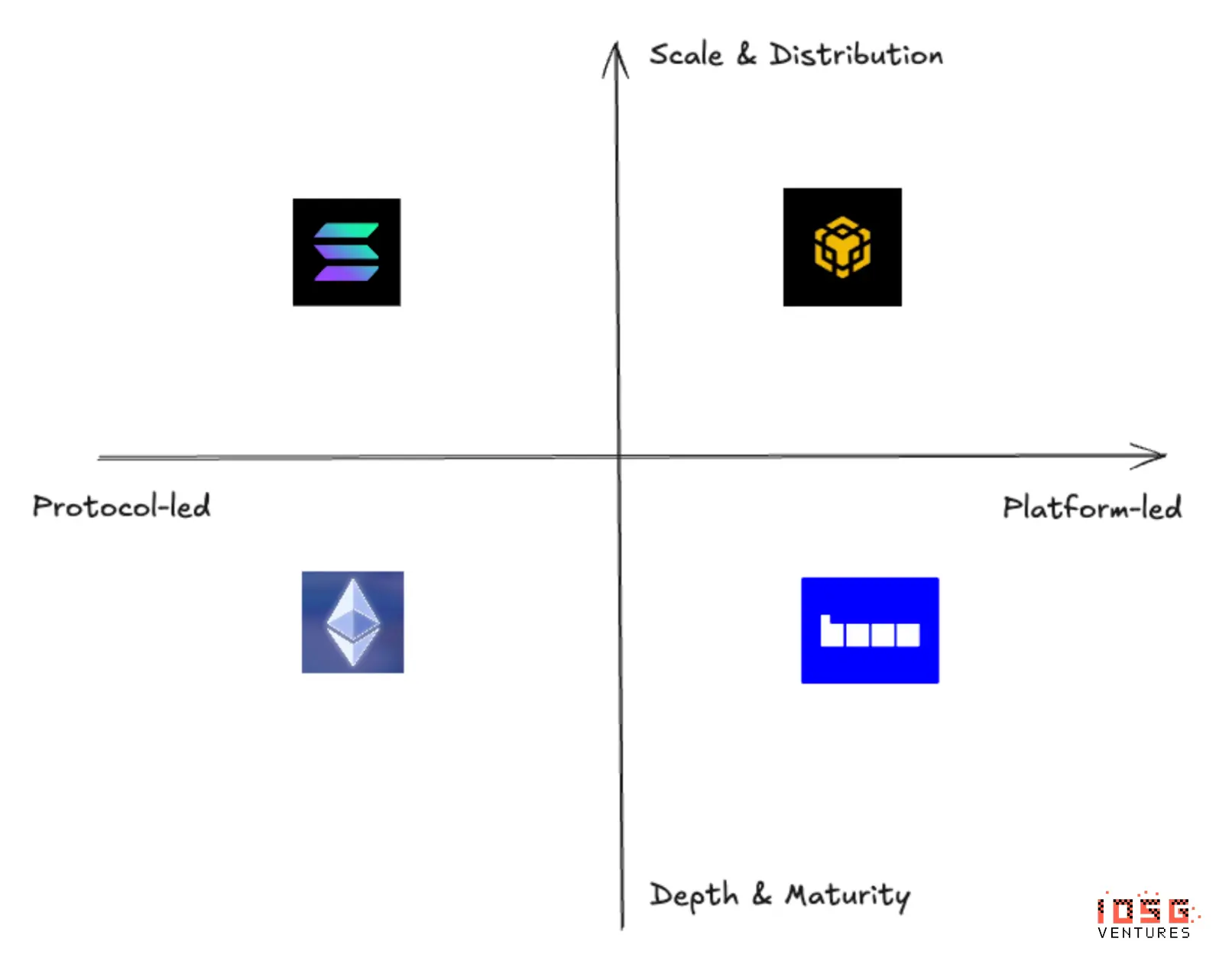
The author believes that the most likely future scenarios for the industry are two types of ecosystems:
CEX-dominated super ecosystems (Binance, Coinbase)
Community-driven large public infrastructures (Ethereum, Solana)
BNB Chain and Base will not replace each other.
Global crypto users are not a homogeneous group. Emerging markets need low barriers, high efficiency, and strong applications; while the European and American markets require compliance, developer-friendliness, and cultural recognition. These two demands will not disappear in the foreseeable future.
The more realistic situation is that infrastructures such as wallets, cross-chain, and account abstraction will gradually smooth out usage differences; users will no longer "belong to only one chain" but will flow between different ecosystems.
From this perspective, BNB Chain and Base are more like two nodes in the same system: one responsible for pushing Web3 to a larger scale, and the other for pushing Web3 to a more mature form.
If early public chain competition was like vying for "the only operating system," then the current competition is closer to "different platforms collaboratively building the internet ecosystem." The true winners may not be a specific chain itself, but those applications and teams that can understand both ecosystems and switch freely between them.
 Risk warning Risk warning


Popular articles





