








Sniping Gold & Silver Swings: Which of the 6 Major CEXs Is the Top Choice for Low-Cost, High-Liquidity Trading?

 In such a volatile market, for most traders, the optimal choice is not physical holding and delivery, but rather to speculate on a direction and magnitude, maximizing profits by capturing price fluctuations.
At the start of 2026, the precious metals market delivered an epic roller-coaster ride.
Amid macroeconomic forces such as central bank accumulation, a weakening U.S. dollar, and rising geopolitical tensions, gold and silver prices surged to record highs. Gold once touched $5,400 per ounce, while silver broke above $118 per ounce. Within just one month, gold gained nearly 25% and silver soared by as much as 65%. This rally was followed by a sharp correction. Gold retreated approximately 15%–18% from its peak, while silver plunged 30%–39%. Such extreme price swings have transformed precious metals from traditionally stable safe-haven assets into highly volatile trading instruments, with profit potential and volatility rivaling that of mainstream crypto assets.
In such turbulent market conditions, physical ownership and delivery are no longer the optimal choice for most traders. Instead, many seek to profit from price direction and magnitude by capturing short-term volatility. As a result, gold and silver perpetual futures, which offer two-way trading and capital efficiency, have become the preferred instruments for a growing number of traders.
As more exchanges rush to launch gold and silver futures products, competition has intensified. But which platform stands out as the best choice? A truly superior trading platform must meet three essential criteria:
-
Deep liquidity: Capable of handling large capital inflows and outflows while avoiding price distortion and extreme wicks.
-
Low trading costs: Reducing fees for high-frequency and large-volume traders.
-
Flexible leverage: Maximizing profit potential during strong market trends.
Based on these standards, we conducted a systematic comparison of gold and silver perpetual futures across six major platforms—MEXC, Binance, Bybit, Bitget, Gate, and OKX—focusing on liquidity, trading costs, and leverage.
Among 6 Major CEXs, Which Offers the Best Gold & Silver Futures Trading Experience?
Liquidity Comparison
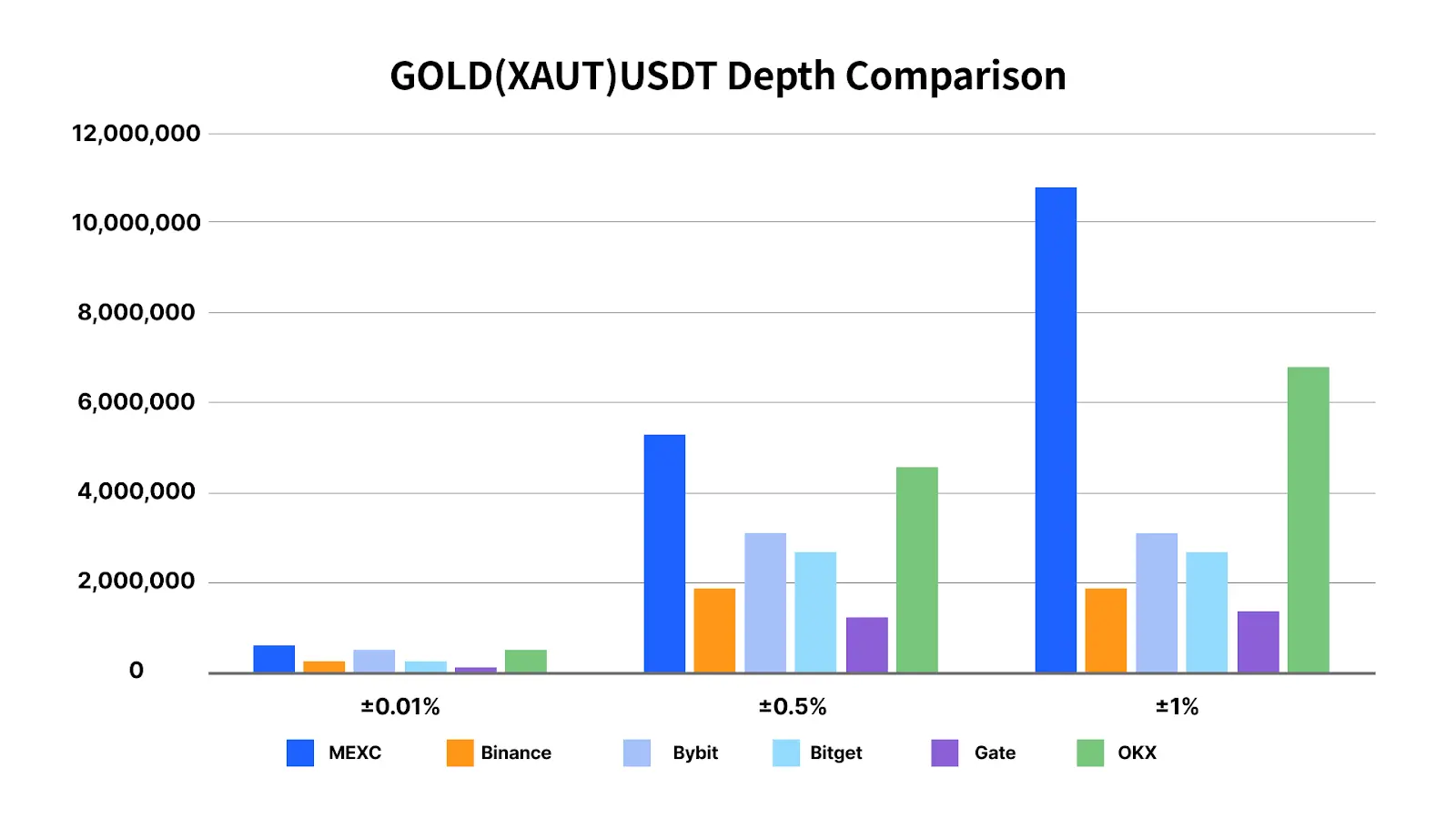
In terms of liquidity, we evaluated market depth and slippage for the primary gold futures XAUTUSDT and silver futures XAGUSDT. These metrics directly impact order execution efficiency and trading costs. The following data is based on live tests conducted across major exchanges (as of January 27, 2026).
Gold Futures: GOLD(XAUT)USDT
Within the ±0.01% price range closest to the mid-market price, MEXC's order book depth reached nearly 400,000 USDT, more than double that of other exchanges. This means that during minor price fluctuations, MEXC can absorb significantly more orders with minimal price deviation. This is especially beneficial for quantitative bots and short-term high-frequency strategies, as market orders are executed more easily and consistently.
When expanding the range to ±1%, MEXC provided over 10 million USDT in depth, compared with 6.8 million USDT on OKX, which ranked second. In highly volatile conditions, such depth reduces the likelihood of extreme price spikes and minimizes the market impact of large orders.
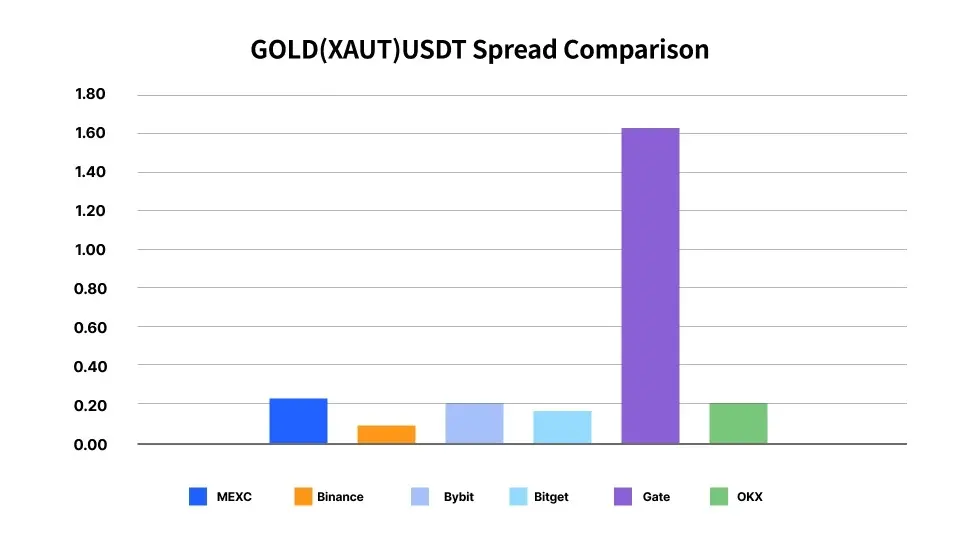
In terms of bid-ask spread, Binance achieved the tightest spreads, offering an advantage for frequent short-term entries and exits. With the exception of Gate, other exchanges showed slightly wider spreads, though still within a reasonable and controllable range.
Another key friction cost is slippage. Using a 100,000 USDT market order as a benchmark, MEXC recorded slippage of just 0.44 USDT, significantly lower than other platforms. By comparison, Binance showed slippage of 2.39 USDT, Bitget 2.85 USDT, and Gate as high as 7.31 USDT.
Overall, while Binance leads in bid-ask spread and is better suited for small, high-frequency trades, MEXC demonstrates clear advantages in market depth and slippage control. For larger trade sizes and order-splitting execution, MEXC is more effective at keeping execution prices close to expectations and reducing market impact costs.

Silver Futures: SILVER(XAG)USDT
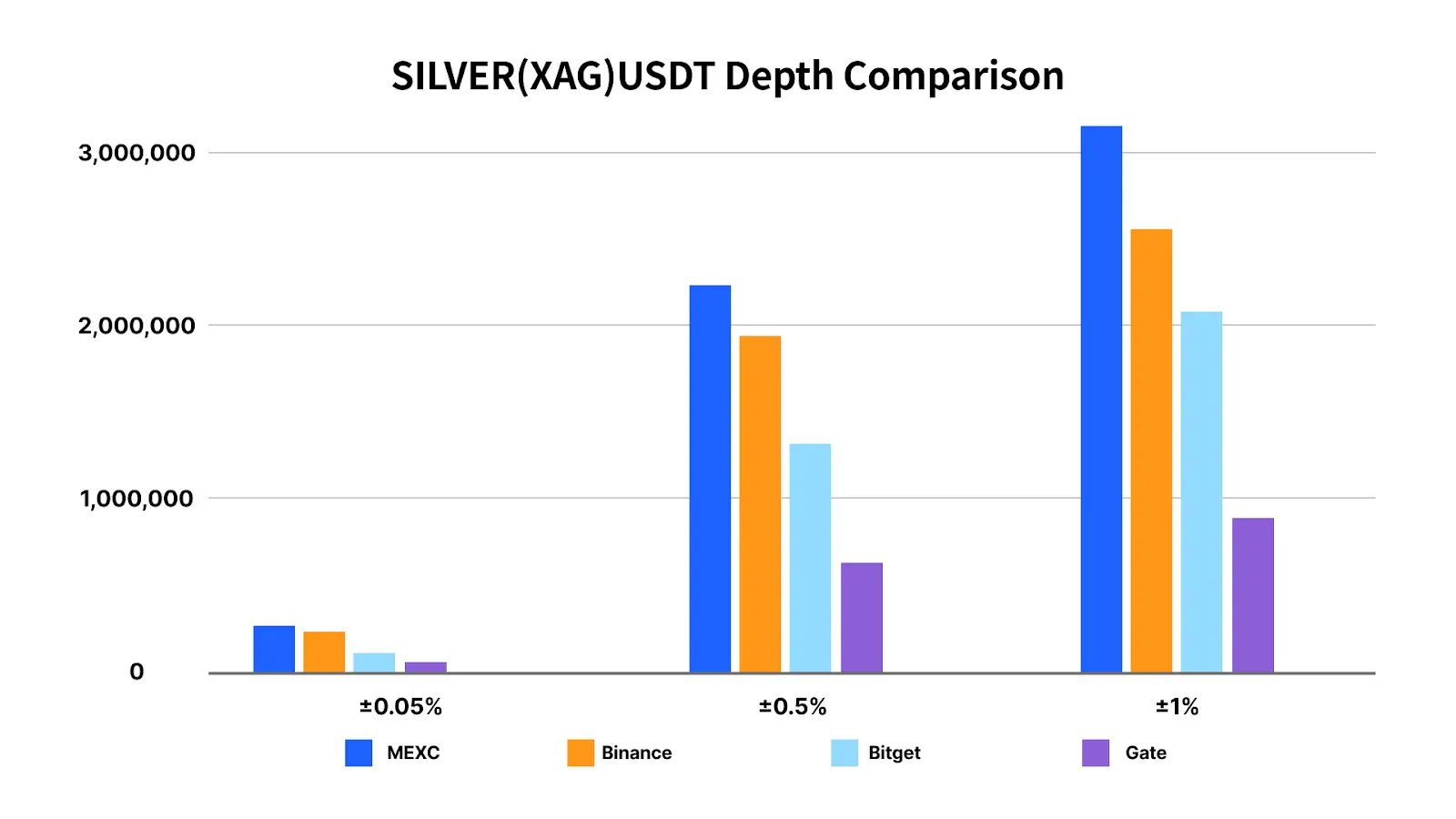
Compared with gold, silver typically exhibits higher volatility and is more prone to thinning order books and increased slippage during sharp market movements. Within the most demanding ±0.05% depth range, MEXC ranked first, with order book volume not only exceeding Binance but also significantly surpassing Bitget and Gate. For ultra-short-term and high-frequency traders, this means orders on MEXC are more likely to be executed close to the intended price, reducing market impact costs.
As the price deviation range widens, MEXC's advantage in order book depth becomes even more evident. Within the ±0.5% range, depth reached approximately 2.3 million USDT, and expanded further to around 3.4 million USDT within the ±1% range—clearly higher than other platforms. Deeper depth indicates stronger market absorption capacity, minimizing price impact from large trades and reducing the likelihood of extreme wick movements during volatile conditions.
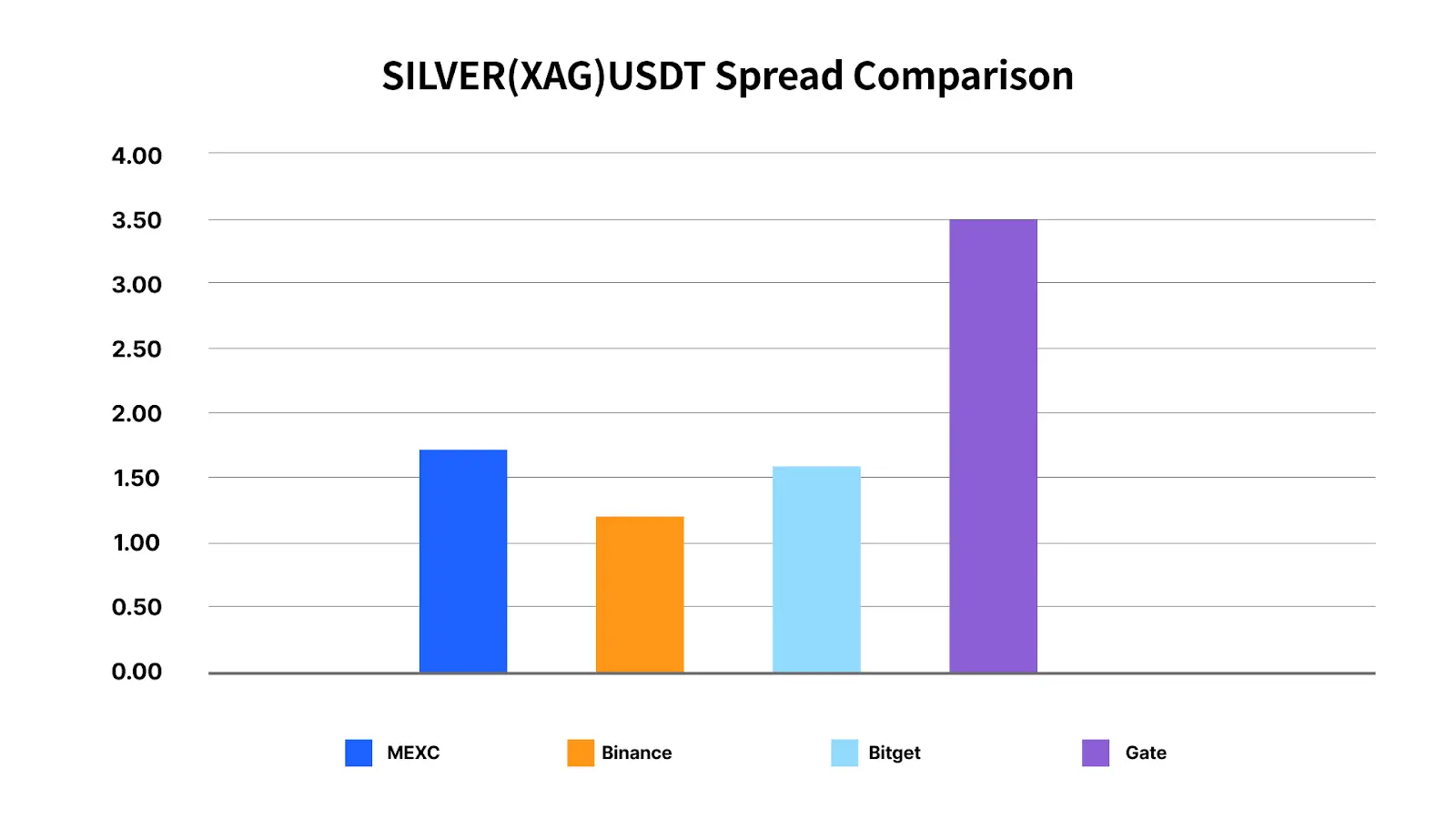
In terms of bid-ask spread, Binance maintained the narrowest spreads, making it more suitable for small, frequent trades with lower immediate execution costs. MEXC and Bitget showed similar spreads, slightly wider than Binance.
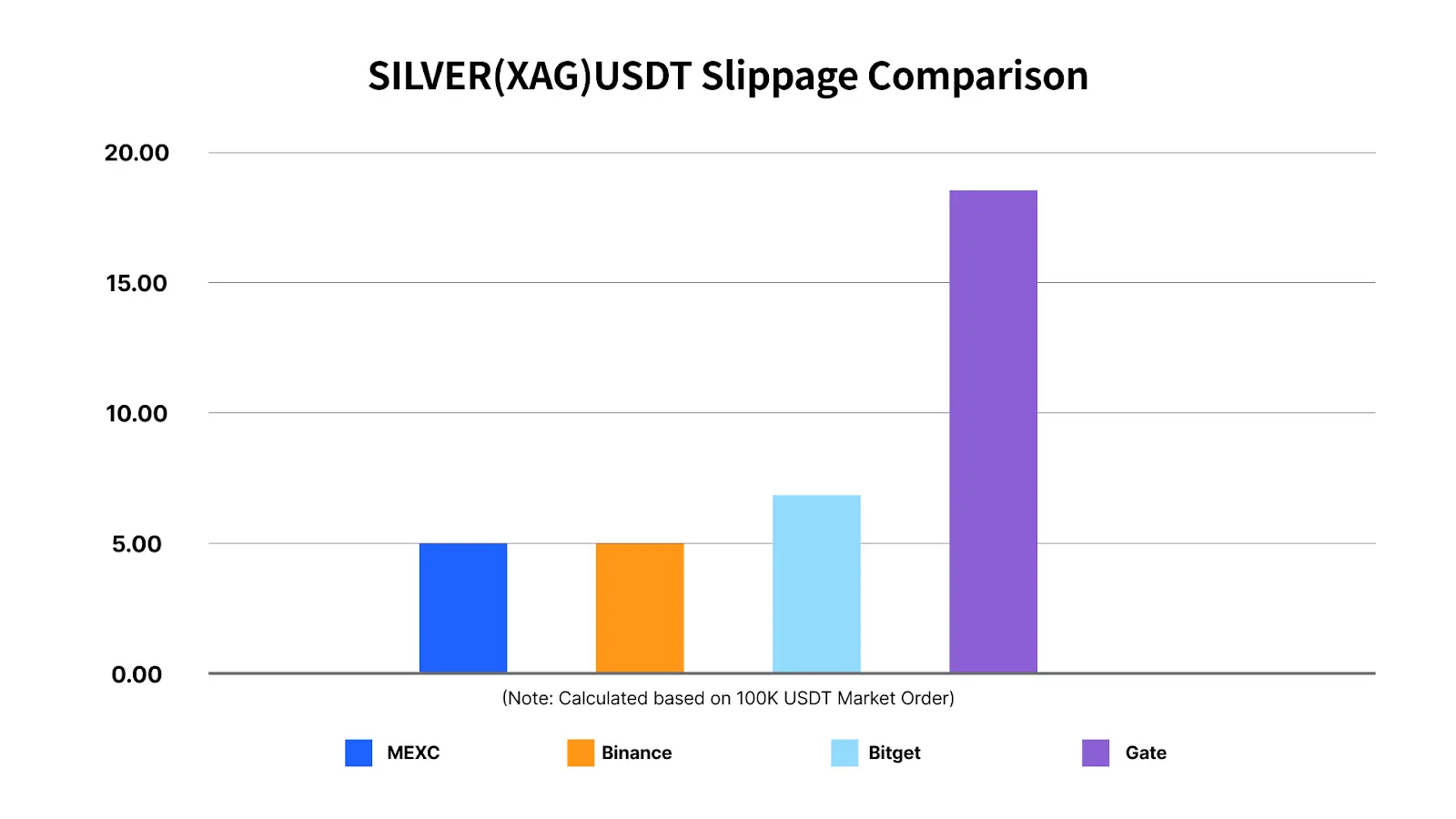
Slippage testing using a 100,000 USDT order size showed that MEXC and Binance recorded the lowest slippage, at approximately 5 USDT. Bitget followed at around 7 USDT, while Gate reached as high as 18 USDT. This indicates that for a more volatile asset like silver, MEXC delivers more stable execution quality and lower hidden trading costs.
Overall, for highly volatile instruments such as silver, deeper order books and lower slippage play a decisive role in ensuring executions remain close to expectations as order size increases or market volatility intensifies. During choppy market conditions, MEXC's deeper liquidity provides a stronger safety margin and greater execution certainty.
Trading Fee Comparison
Trading fees are another critical factor affecting overall profitability. For large-volume and high-frequency traders, even a difference of a few basis points can accumulate into significant performance drag over time.
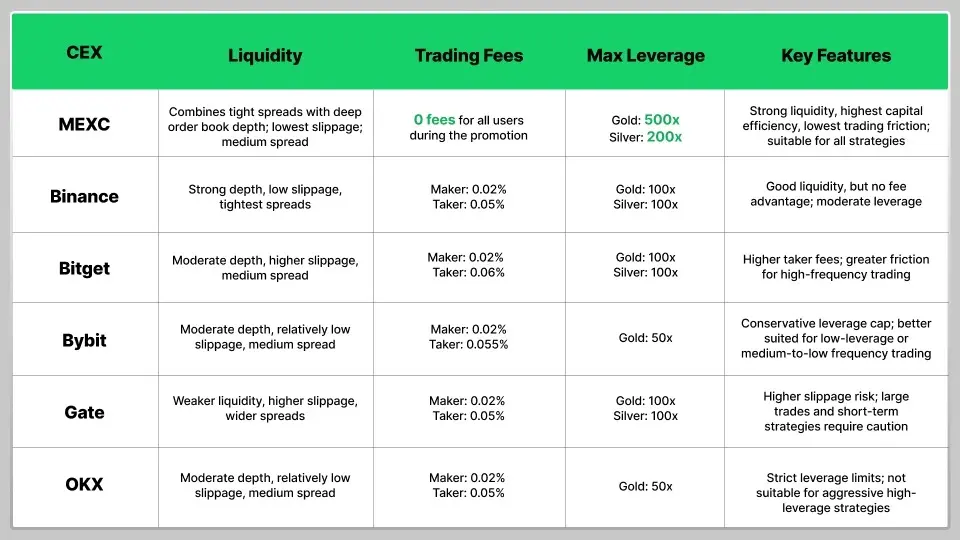
Across the six major exchanges, standard futures trading fees generally fall around 0.05% for takers and 0.02% for makers. Using a single 1,000,000 USDT order as an example, a maker order costs approximately 200 USDT, while a taker order costs about 500 USDT. For a complete trade cycle (entry and exit), these costs can easily double. To access lower fee tiers, users typically need to hold large amounts of platform tokens or meet high monthly trading volume requirements to qualify for VIP discounts. This creates a relatively high barrier for average traders.
In contrast, MEXC's limited-time zero-fee promotion effectively eliminates this friction cost altogether. Regardless of account size, users can trade gold and silver futures without paying trading fees, allowing more profits to remain in their portfolios and preventing long-term erosion caused by fees.
Leverage Comparison
In trending precious metals markets, leverage flexibility can significantly enhance capital efficiency and position management. Under the same trading opportunities, higher leverage allows traders to control larger notional positions with less margin, enabling staggered entries, short-term hedging, and high-turnover execution.
In terms of maximum leverage for gold and silver perpetual futures, MEXC stands out clearly among major platforms. MEXC offers up to 500x leverage for gold futures and up to 200x leverage for silver futures. By comparison, Binance, Bitget, and Gate generally cap leverage for both gold and silver at 100x, while Bybit and OKX limit gold futures to just 50x. This means that with the same capital and the same price movement, MEXC users can theoretically control positions up to five times larger than those on Binance or Bitget. Of course, while higher leverage amplifies potential returns, it also increases risk. Adverse price movements can more easily trigger liquidation, making strict risk management essential.
Importantly, MEXC's high-leverage advantage does not stand alone. When combined with zero trading fees and deep liquidity, it delivers a powerful synergy where the whole exceeds the sum of its parts. Zero fees significantly reduce friction costs for high-frequency, grid, and large-volume trading, ensuring that more profits remain in users' portfolios. Meanwhile, deeper liquidity minimizes price impact and slippage during large entries and exits, allowing trades to be executed more smoothly and closer to expected prices. Together, these factors further amplify capital efficiency and profit potential enabled by leverage.
Zero Fees & Global-Leading Liquidity: Empowering Traders of All Types
MEXC's limited-time zero-fee promotion for gold and silver perpetual futures, combined with its strong liquidity performance, delivers tangible benefits to different types of traders.
Beginner Traders: Lower Costs, 24/7 Learning Opportunities
For newcomers, MEXC's precious metals perpetual futures significantly lower the barrier to entry. First, zero trading fees allow beginners to practice with small and frequent trades without worrying about cost erosion. Second, MEXC supports 24/7 trading, enabling users to participate in the market during their spare time instead of being restricted to weekday trading hours. In addition, beginners can flexibly adjust leverage according to their risk tolerance and use smaller capital to capture market opportunities. This was previously difficult to achieve, as traditional gold futures contracts typically require larger contract sizes and higher margin thresholds, making them unfriendly to small-capital traders. Of course, beginners should still manage positions carefully and control risk to avoid unnecessary losses caused by excessive leverage.
Intermediate Traders: Greater Strategy Diversity
For more experienced traders, MEXC's gold and silver futures open up broader strategic possibilities. Many of these traders monitor both crypto markets and macro safe-haven assets. With MEXC, they can now allocate positions flexibly on a single platform. For example, when macro risk sentiment rises, traders may shift part of their crypto exposure into long positions in gold or silver futures to achieve cross-market hedging. Such convenience is difficult to achieve in traditional environments, where users typically need to operate separate stock, futures, and crypto accounts. Moreover, many intermediate traders engage in frequent short-term or swing trading strategies. With MEXC's limited-time zero-fee promotion, the cost of repeated position adjustments is almost negligible, allowing traders to rebalance more actively without fee-related concerns—an advantage that is particularly valuable in volatile or range-bound markets.
High-Frequency Traders: Maximum Cost Efficiency
For high-frequency traders and professional day traders, the zero-fee promotion is especially attractive. These traders seek to capture small price differentials within seconds and may execute hundreds or even thousands of trades per day. Even minimal per-trade fees can accumulate into substantial costs over time. Under the zero-fee promotion, this translates directly into improved strategy profitability. Equally important, MEXC emphasizes deep liquidity for its gold and silver contracts. For high-frequency and quantitative trading, liquidity is critical. The ability to execute trades repeatedly at prices close to theoretical optimal levels without excessive slippage is essential to maintaining stable performance. Overall, MEXC's precious metals futures not only attract professional trading teams but also help enhance the platform's overall liquidity, creating a positive feedback loop.
More importantly, the combination of zero fees and global-leading liquidity reflects MEXC's long-term strategic direction. Even after the limited-time promotion ends, MEXC plans to maintain highly competitive fee structures to continue delivering value to traders. Whether retail users or institutional participants, traders on MEXC can expect unprecedented convenience and cost efficiency when trading gold and silver futures.
Conclusion: Ambition in Building a Multi-Asset Trading Ecosystem
The launch of gold and silver futures with a zero-fee promotion may appear to be a simple expansion of product offerings, but it actually represents another step forward in MEXC's vision of becoming a one-stop, multi-asset trading platform. As tokenized assets, real-world assets, and crypto-native assets gradually converge at the trading layer, traders increasingly prefer to gain exposure to Bitcoin, stocks, gold, silver, and other assets within a single platform. MEXC is aligning with this trend by delivering a unified trading experience that bridges traditional finance and the on-chain world.
Looking ahead, as more commodities and equity-based products are introduced, MEXC is positioning itself as a “super trading gateway” spanning both crypto-native and traditional assets—not by committing to a single category, but by offering users efficient, low-cost, and round-the-clock access to a diverse range of markets. The launch of gold and silver futures marks an important milestone in this journey, but it is far from the final step. In the emerging era of on-chain multi-asset trading, the platforms that continue to optimize fee structures, deepen liquidity, and meet users' diverse asset allocation needs will be best positioned to become the core hubs of this new financial ecosystem.
 Risk warning



Popular articles





