From OKX to Bybit, exchanges are changing tires on the highway
 Core Viewpoint

 In the current context of tightening global regulations, if one can directly enter the market by partnering with an entity that has already established a compliance system, obtaining federal license endorsement, the credibility of a listed company, and access to banking cooperation channels, and the cost is merely giving up a portion of equity, then this deal is advantageous by any calculation. But who determines the price of this entry ticket?
Author: Zhou, ChainCatcher
Earlier, ChainCatcher cited a report by Wu saying that Coinbase is in talks with Bybit regarding investment and cooperation agreements, with the market expecting Bybit's valuation to be close to that of OKX.
Previously, ICE officially invested in OKX at a valuation of about $25 billion, and within a month, two Chinese exchanges sat down at the negotiation table with U.S. regulatory agencies.
Currently, Binance, OKX, and Bybit are the leaders in global cryptocurrency trading volume. They have rapidly risen from an era of unformed regulation, establishing the world's largest cryptocurrency derivatives market from scratch.
Now, these names are gradually appearing in another context, being invested in, being integrated, and being included in a larger system.
Why Chinese Exchanges Can't Sit Still
CoinGecko data shows that in 2025, Binance alone will account for nearly 40% of global cryptocurrency spot trading volume, with Bybit closely following in second place.
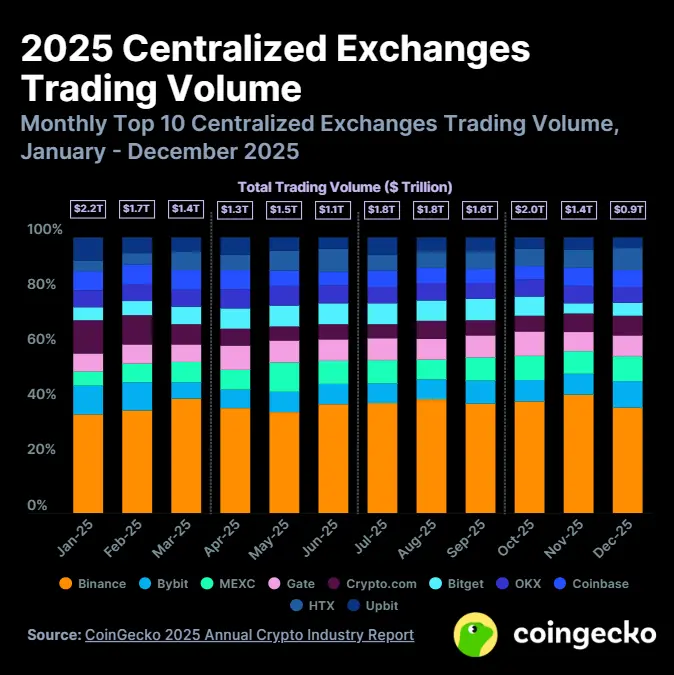
The derivatives market is even more of a home ground for Chinese exchanges. CoinGlass annual report shows that out of the global $85.7 trillion in derivatives trading volume, Binance, OKX, Bybit, and Bitget together account for over 60%.
In contrast, the largest compliant exchange in the U.S., Coinbase, has a market share of just over 1% in the global spot market, and its presence in the derivatives market is also extremely limited, with annual revenue reaching $7.2 billion in 2025.
It is easy to imagine how much these leading exchanges are earning from cryptocurrency trading volume.
So, in such a profitable business, why would they want to give away their equity?
The problem may lie in the ceiling of the offshore model, which has already been reached.
Over the past decade, the core growth engine for Chinese exchanges has been retail derivatives, characterized by high leverage, high frequency, and high fees. This market has indeed been maximized by them.
However, the pool of retail users is limited, the multiples of leverage that can be applied are finite, and the number of retail investors willing to operate on offshore platforms has been decreasing as regulations tighten.
With the existing market shrinking, where is the growth? The answer is institutions.
Pension funds, sovereign funds, family offices—these amounts of money are on a completely different scale than retail users. These funds share a common prerequisite: they need to flow into platforms with compliant identities.
Without a U.S. license, regulatory framework, or an auditable custody system, even if these funds want to enter, compliance departments will not allow it.
At the same time, regulatory tightening is not only coming from the U.S. The EU's MiCAR has been fully implemented, various jurisdictions in the Middle East are establishing licensing systems, and regulatory frameworks in Southeast Asia are also tightening. The survival space for offshore exchanges is systematically shrinking globally.
Thus, the entire ecosystem of Chinese offshore exchanges is facing the same reality: growth cannot stop, and competition is intensifying. They need to change their tires and drive new growth.
OKX spent $500 million to settle with the U.S. Department of Justice, took years to obtain licenses in 41 states, and then brought in management with traditional financial backgrounds to rebuild its compliance system.
It is reported that ICE has obtained a board seat at OKX, and based on a valuation of $25 billion, this investment accounts for at least 5% of OKX's shares, corresponding to an amount of no less than $1.25 billion. In return, OKX will provide ICE with real-time cryptocurrency price data and plans to allow users to directly trade tokenized stocks listed on the New York Stock Exchange in the second half of 2026.
In other words, NYSE products will reach global investors through OKX, while OKX will leverage ICE's traditional financial backing to re-enter the U.S. market. This is not just a financial investment, but a real business binding of two systems.
The path for OKX is too expensive and too slow. If Bybit ultimately chooses to bring in Coinbase, it is essentially taking a shortcut, bypassing the pitfalls that OKX has encountered, and directly obtaining entry qualifications for the compliance system. As for how much this entry ticket is worth and who decides that, is another question.
Coinbase and Bybit, Who Needs Whom More?
If the shift of Chinese exchanges is a passive response, the actions on the U.S. side are much more proactive.
From ICE strategically investing in OKX, to Coinbase negotiating with Bybit, to Nasdaq and Kraken's parent company Payward announcing a partnership to jointly develop stock tokenization infrastructure, the traditional U.S. financial system is systematically laying out a global distribution network for the cryptocurrency market.
For Coinbase, it is the compliance leader in the U.S., but its presence outside the U.S. is relatively thin. In May 2025, Coinbase acquired the cryptocurrency options exchange Deribit for $2.9 billion, attempting to fill the gap in offshore derivatives.
However, in terms of spot user coverage and global retail distribution, Coinbase has always had an unfillable gap. This is precisely Bybit's position.
Currently, Bybit has over 70 million users, covering 160 countries, with a daily trading volume exceeding $36 billion. Its user network spans Asia-Pacific, the Middle East, Europe, and Latin America, with deep penetration in South Korea, Japan, Southeast Asia, and the Gulf region.
These users are the result of Bybit's accumulation over many years in a regulatory gray area—high leverage, low barriers, and accessibility, which are precisely what Coinbase, as a compliant platform, cannot provide and cannot be bought with advertising dollars.
For Bybit, in the current tightening global regulatory environment, if it can borrow a partner that has already established a compliance system to enter directly, obtaining federal license endorsement, the credibility of a listed company, and banking cooperation channels, the cost is merely giving up a portion of equity, making this a worthwhile deal.
It is worth mentioning that in February 2025, Bybit encountered the largest cryptocurrency theft in history, with approximately $1.5 billion worth of Ethereum stolen, and the attackers were identified as being related to North Korea's Lazarus Group. From this perspective, if Bybit brings in Coinbase at this time, it is also a signal to rebuild institutional investor confidence.
However, the scale of this transaction is worth considering carefully. Coinbase currently has a market capitalization of about $55 billion, and the market expects Bybit's valuation to be close to that of OKX, around $25 billion, which is nearly half of Coinbase's own market value.
This ratio determines the boundaries of cooperation; Coinbase is unlikely to make a large-scale acquisition. A more reasonable speculation is a minority equity stake along with a cooperation agreement, with both parties getting what they need without touching control.
Conclusion
The cryptocurrency industry has proven one thing over ten years: decentralization is a technical proposition. Liquidity, rules, and pricing power have always been centralized.
Chinese exchanges have built the world's largest cryptocurrency market at the edges of the rules with strong execution and risk tolerance.
But when this market is large enough and real enough, needing to access institutional funds and enter mainstream visibility, they find themselves lacking one thing: the rules themselves.
So they exchange users for licenses, liquidity for endorsements, and the global network built over many years for an entry ticket held by others.
It can only be said that everyone has made a rational choice.

 Risk warning


Popular articles