








The rivers and lakes are no more, Li Lin returns
 Core Viewpoint

 We no longer need a larger exchange or more complex financial products; we hope to see more individuals like Li Lin in the industry who can drive innovations that truly open up boundaries for the industry.
Author: Zhou, ChainCatcher
News of a mass exodus of talent from the crypto industry has become increasingly common.
Those who once went all in on Web3 have changed their resumes to AI Builder. The group of people who experienced the wild growth of this industry are voting with their feet and leaving.
However, just as the most people are leaving, Li Lin is coming back. It is reported that he recently expressed his intention to return to entrepreneurship at the Avenir annual meeting.
1. The Crypto Landscape Has Changed
Understanding the current real situation of the industry is essential to grasp what Li Lin's return signifies.
On the regulatory front, the entire industry has finally received a long-overdue legal identity.
The U.S. GENIUS Act has established a federal regulatory framework for stablecoins; the CLARITY Act has ended the five-year jurisdictional dispute between the SEC and CFTC; SAB 121 has been repealed, allowing banks to legally custody crypto assets.
On the institutional level, crypto companies are directly integrating into the central bank system, and the power structure is quietly reshaping.
Kraken has obtained a master account with the Federal Reserve, marking the first time a crypto-native institution has achieved equal clearing status with JPMorgan; Circle and Bitgo have gone public on the NYSE; BlackRock and JPMorgan have fully entered the market, launching tokenized assets and compliant derivatives; the parent company of the NYSE, ICE, has invested in OKX, and Xu Mingxing has officially joined the Wall Street camp.
On the asset front, the daily liquidation scale of on-chain oil contracts once exceeded that of Bitcoin—price fluctuations in traditional commodities are beginning to directly impact the on-chain ecosystem, and the risks of the two worlds are now interconnected.
Data from RWA.xyz shows that, excluding stablecoins, the on-chain value of tokenized real-world assets has surpassed $25 billion, nearly quadrupling from about $6.4 billion a year ago; the market cap of stablecoins has risen against the backdrop of an overall decline in crypto market cap, climbing from $20.5 billion to $31 billion.
On the supply side, the story of Bitcoin has shifted from production logic to stock game. The 20 millionth Bitcoin has been mined, with only about 1 million left to mine, bringing the mining economy close to its end. The pricing power has quietly shifted from miners to institutional holders represented by BlackRock.
On the talent front, salaries and token rewards at almost all levels are declining, even the most steadfast believers are wavering.
Kyle Samani, co-founder of Multicoin Capital, announced his exit from daily management to focus on AI and life sciences; his quickly deleted tweet stated that cryptocurrencies are not as interesting as many expect, and blockchain is primarily an asset ledger.
Ken Chan, former co-founder of Aevo, bluntly said he wasted eight years of his life on crypto; Arianna Simpson, a partner at a16z Crypto, has shifted her new fund's investment scope beyond just Web3 after leaving.
Looking at these aspects together reveals a structural tearing.
The external environment of the industry has never been so mature—compliance has landed, institutions have entered, and assets are on-chain; these are all terms from traditional finance, and another set of rules is taking over this industry.
Meanwhile, the people who understand this industry best are accelerating their departure.
This new set of rules has caused some to lose their familiar battleground; it has led others to discover that the industry's direction is not the one they initially believed in; and it has prompted even more to turn their attention to AI, a larger blue ocean.
In this context, Li Lin's return is not just an ordinary entrepreneurial announcement, but a signal.
2. Can Li Lin Not Come Back?
After selling Huobi, Li Lin founded Avenir Group. According to RootData, this is an institutional family office and investment management group that operates under four brands, covering crypto asset management and trading strategies, global multi-asset investment, artificial intelligence and future technologies, as well as family philanthropy.
As of the end of 2025, Avenir Group holds 18,287,323 shares of BlackRock IBIT, maintaining its position as the largest institutional holder of Bitcoin ETFs in Asia for seven consecutive quarters.
However, the market value of its Bitcoin ETF holdings has dropped nearly 40% from a peak of $1.189 billion, now estimated at about $726 million (current IBIT price is approximately $39.71).
Since 2025, Avenir Group has made four investments, including the options trading platform SignalPlus, the Web3 business education institution UWEB, the cryptocurrency wealth management company Metalpha, and the crypto SaaS trading technology provider CoinRoutes.
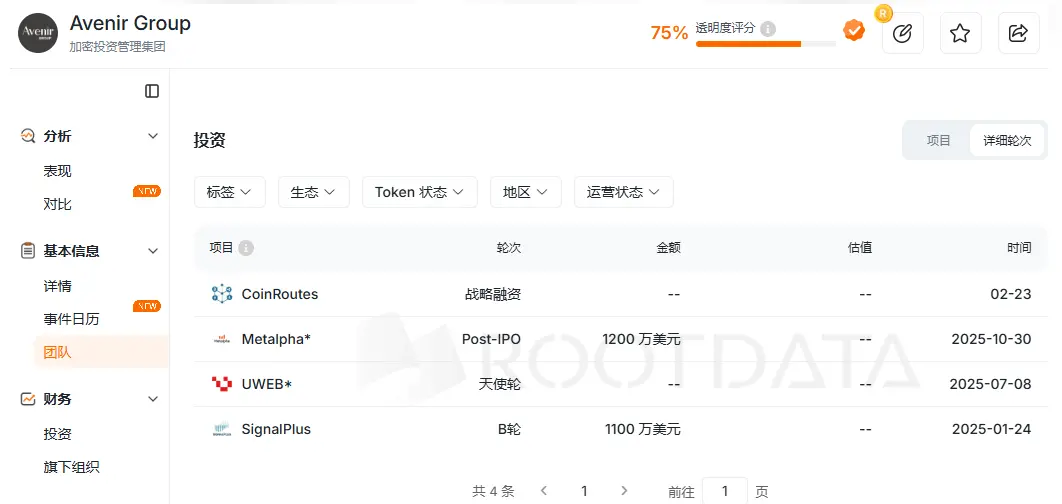 In terms of investment targets, Avenir primarily focuses on institutional trading infrastructure and compliance services, but the scale and frequency of these four investments also reflect a natural limitation of a family office: it can do allocation and incubation, but it is challenging to truly build.
Avenir has also attempted to break through this boundary. In the second half of last year, Bloomberg reported that Li Lin, along with early Ethereum supporters like Shen Bo, Xiao Feng, and Cai Wensheng, planned to establish a $1 billion digital asset trust fund, intending to acquire a NASDAQ-listed shell company as a structural vehicle. About $700 million of the funds were in place, with Avenir contributing $200 million and Asian institutions like Sequoia China following up with about $500 million. This was the largest DAT plan led by Asian investors.
However, after the 1011 incident, the market took a sharp downturn, and many DAT company stock prices plummeted. The plan was ultimately shelved, and the raised funds were all returned, with no news of a restart to date.
This setback indicates that relying solely on capital is insufficient to achieve true innovation in this industry. Data shows that the number of family offices in Hong Kong has increased to 3,384, and similar competitors are accelerating their entry, diluting Avenir's first-mover advantage in asset allocation.
Perhaps it was at this moment that Li Lin decided to re-enter the field.
3. What’s Different This Time?
Sometimes, to judge the true prosperity of an industry, one does not need to look at macro data.
Similar to the Chinese internet industry during the pandemic, the most signal-worthy indicator often boils down to one thing—watching people. Watching whether Ma Huateng comes back, whether Zhang Yiming comes back, whether Liu Qiangdong comes back.
When those who once left or were dormant choose to re-bet, their actions cast a vote that is more honest than any research report.
Because true entrepreneurs will not bet their reputations for the second half of their lives in an industry without a future.
The same applies to the crypto industry.
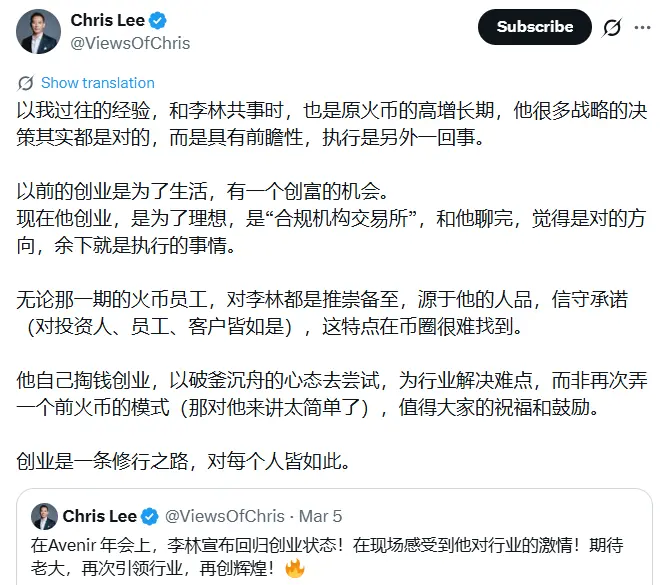
Former Huobi CFO Chris Lee mentioned that Li Lin used to start businesses for a living, as a wealth creation opportunity; now he is starting a business for ideals, putting in his own money, and trying with a do-or-die mentality to solve industry challenges, rather than replicating an old Huobi model.
The motivation has changed, and so has the decision-making function.
The new crypto landscape is different from the past; old rules may rely on information asymmetry and regulatory arbitrage, while under the new rules, compliance capability, institutional connections, and real product strength are more valued.
The "compliant institutional exchange" mentioned by Chris Lee happens to be at the juncture of this rule switch. Kraken has connected with the Federal Reserve account, and the parent company of NASDAQ, ICE, has invested in OKX; the entire industry is waiting for a true entry point that connects compliance and institutions.
During Li Lin's tenure at Huobi, the product experience was recognized as one of the best among exchanges at the time—UI, trading depth, and user service were all at the forefront of the industry.
In a sense, his resources and connections indeed match the direction of a "compliant institutional exchange"—understanding regulatory games, speaking the language of Asian institutions, and grasping the logic of connecting traditional finance with crypto.
However, the current competitive landscape is no longer that of 201X. Coinbase has a compliance moat, Binance has traffic monopoly, and OSL and HashKey have already laid out in Hong Kong. New entrants need to find a truly differentiated positioning to break in.
Moreover, the execution team is also a key variable. In the past, Li Lin played more of a capital decision-maker role, with daily operations mainly handled by a professional management team, which may lack the necessary aggressiveness. Of course, some directly point out that his strong connections and loyalty have led to questionable hiring decisions, making execution prone to issues.
Entrepreneurship is different from investment; ultimately, it still requires the will of the founder to drive it.
This time, Li Lin has chosen to personally stand on the front lines; the return of the founder's spirit may be one of the most critical variables in this re-entry.
Conclusion
The crypto industry has never lacked stories of wealth creation; what it lacks are those who can truly open boundaries.
Huobi is already history, and that chapter does not need to be rewritten.
In fact, we no longer need a larger exchange or more complex financial products; we hope to see more individuals like Li Lin in the industry who can drive innovations that truly open boundaries—not just to write another commercial legend for themselves.
This industry has been waiting for such people for a long time.

 Risk warning



Popular articles





