








Strategy cashes out 2.5 million USD, Bitcoin market value evaporates 80 billion USD
 Core Viewpoint

 The market's reliance on this narrative of hoarding coins is more fragile than many people imagine.
Author: Zhou, ChainCatcher
On June 1, Strategy submitted an 8-K filing to the SEC, disclosing that the company sold 32 bitcoins from May 26 to 31, at an average price of approximately $77,135, totaling about $2.5 million.

This is the first time the company has sold bitcoins since it began its bitcoin accumulation strategy in 2020. Although the market's attention that day was almost entirely drawn to Binance's listing of US stocks and other hot topics, the price of bitcoin still experienced a significant drop after the news was disclosed.
This morning, a controversy began to spread on Polymarket regarding whether Strategy sold coins in May, reigniting the topic of selling coins, and the price of bitcoin subsequently fell below $70,000.
According to the filing, as of May 31, 2026, Strategy holds a total of 843,706 bitcoins, with a total purchase cost of approximately $63.87 billion, at an average price of about $75,699.

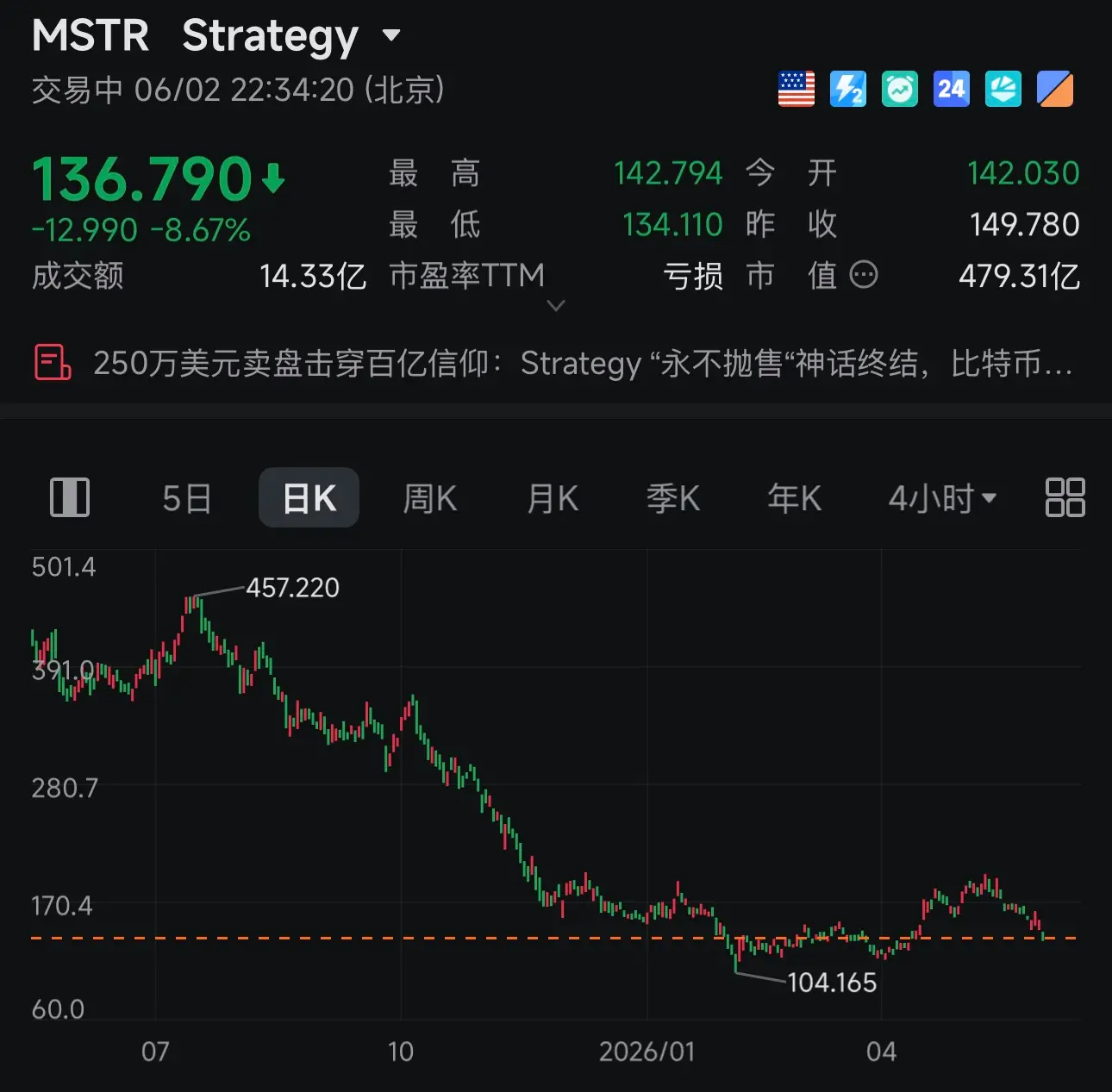
As of the time of writing, the BTC price has fallen below $68,000, with Strategy facing an unrealized loss of about 10%, and a paper loss exceeding $6 billion. Since the news of the coin sale was disclosed, the market capitalization of bitcoin has evaporated by over $80 billion. That evening, during US stock trading, MSTR even dropped over 10% at one point.
During the same period, the company's dollar reserve balance was $900 million. This fund was specifically allocated by Strategy in December 2025 as working capital to pay preferred stock dividends and interest on outstanding debts.
Strategy currently issues multiple series of perpetual preferred stocks, including STRC, STRF, STRK, STRE, and STRD, with STRC maintaining an annual dividend yield of 11.50%. Based on the total scale of each series, the annual dividend obligation is estimated to be about $1.5 billion.
Revenue from software business is almost negligible, and bitcoin itself does not generate cash flow; this continuously growing dividend bill can only be covered by financing or liquidating assets.
Arca's Chief Investment Officer Jeff Dorman bluntly stated that Strategy's current preferred stock financing structure has become "out of control," making it increasingly difficult to sustain amid the ongoing volatility of bitcoin prices. He believes the company may ultimately have only two options: continue selling bitcoin to pay dividends or directly announce a halt to dividend payments.
Against this backdrop, the management's public statements had long laid the groundwork for this coin sale.
On May 28, CEO Phong Le stated in an interview with Fox Business that the company might flexibly decide whether to sell bitcoin based on daily or weekly market dynamics, and utilizing unrealized losses from price fluctuations for tax planning is also a reasonable consideration for selling. He emphasized that the company's long-term goal remains to continuously net increase its bitcoin holdings and enhance the bitcoin content per share.
Michael Saylor also explicitly stated in an interview earlier last month that he does not rule out the possibility of selling some bitcoin before the end of the year, which is a clear public shift from his previous long-held stance of "never selling coins."
The actual sale action this time was relatively restrained.
From May 26 to 31, Strategy sold 32 bitcoins at an average price of $77,135, cashing out approximately $2.5 million. Meanwhile, the company sold about 800,000 shares of MSTR common stock through an ATM plan, raising approximately $128.3 million.
In comparison, the proceeds from the coin sale are just a fraction of the overall financing actions, and the symbolic significance of selling coins far exceeds the actual financial contribution.
After the news was disclosed, interpretations of this coin sale quickly diverged in the market.
Crypto analyst Phyrex believes that while 32 coins are not significant in quantity, it has undermined the confidence of a considerable number of investors. Saylor's initial promise was to never sell bitcoin; once that promise is broken, the quantity is no longer the most important matter.
BITWU.ETH pointed out that the real reason for the market's short-term decline is not the actual selling pressure of these bitcoins, but rather the repricing of expectations for a "permanent one-way buy." For the past six years, Strategy has played the role of a permanent buyer in the market, one that only buys and never sells; this image itself constitutes a significant part of the bullish narrative. When this image shows the first crack, the market needs to reassess a variable that has never been seriously quantified before.
@Michael Liu93 raised questions from a more fundamental perspective. He believes that MSTR selling coins to repay debts marks the beginning of the disproof of the STRC model. Once the market begins to view MSTR from the perspective of a fund manager, it will find that it possesses almost all the disadvantages of a fund company: mediocre trading skills, wear and tear leading to purchase prices always at short-term highs, operations being completely transparent and thus preemptively targeted by the market, and a size too large to escape at the peak of the cycle.
However, some viewpoints suggest that this coin sale is a proactive layout. Saylor is guiding a narrative transition, from "Never sell" to "Never be a net seller." The difference between the two is that the latter allows for tactical sales as long as the overall position net increases. According to Saylor's own words, as long as the annual issuance of STRC reaches 2.3% of the bitcoin holdings, the company can maintain net buying while continuously selling, theoretically covering dividend obligations indefinitely.
Independent analyst Markus Thielen interpreted this sale as a market test, believing that Strategy is probing the market's acceptance of coin-selling behavior while verifying whether capital allocation strategies can operate more flexibly. He pointed out that the success and expansion of the STRC preferred stock financing tool may have a higher priority in the current overall financial arrangement than maintaining the narrative image of "never selling coins."
Therefore, this small-scale sale is, to a large extent, to help the market get used to the idea of "Strategy selling coins" in advance, so that in the future, using bitcoin to pay dividends and repay debts will no longer be seen as a disaster signal.
Rather than letting this issue linger over the market for a long time, it is better to dismantle the fuse early. In this light, Strategy is transitioning from a "never sell coins" faith symbol to a more pragmatic capital operation entity. The market needs time to reprice this role.
Although 32 bitcoins cannot change Strategy's holding logic, nor can it stir up real market waves. But this incident exposed something more worthy of attention: the market's reliance on this accumulation narrative is more fragile than many people imagine.
It is worth mentioning that the ongoing fermentation of the coin sale topic has also affected the prediction market. This disclosure simultaneously triggered a controversy over a prediction event on Polymarket with a trading volume exceeding $20 million.
The market bets on whether Strategy will sell bitcoin before May 31, with the focus of the controversy being: those supporting "yes" believe the sale occurred before the deadline, while those supporting "no" argue that the information had not been publicly disclosed at the time the market closed and should not be counted. Currently, the platform tends to support the "no" side on the grounds that "results confirmed outside the deadline will not be recognized," leading to considerable questioning.

 Risk warning



Popular articles





