Tron Industry Weekly Report: AI rebound drives a brief recovery in BTC, detailed explanation of the infrastructure agreements iZUMi Finance & idOS

 iZUMi Finance and idOS essentially correspond to three core layers of liquidity, identity, and execution/infrastructure: iZUMi builds an efficient liquidity management system through LaaS, centralized liquidity incentives, and on-chain bonds (iUSD), improving capital utilization but with a complex structure that relies on market activity.
I. Outlook
1. Macroeconomic Summary and Future Predictions
This week (April 13 - April 19)
This week, the macroeconomic outlook is generally "neutral to bullish," with core drivers stemming from the repeated speculation on the Federal Reserve's interest rate cuts and the recovery of risk asset sentiment. U.S. inflation data has slightly retreated but did not meet the market's optimistic expectations, leading to ongoing divergence in the market regarding "whether there will be rate cuts within the year"; at the same time, U.S. stocks (especially in the AI sector) have experienced a technical rebound, providing support for risk assets. The U.S. dollar index remains in a high-level fluctuation, and U.S. Treasury yields have slightly retreated but are still in a high range. The overall liquidity environment has not shown significant improvement, nor has it tightened further.
Essence: The macro environment has not turned bullish, but the "worst expectations" have been alleviated → Phase-wise recovery of risk assets.
Next week’s prediction (April 20 - April 26)
The key macro factors for next week include:
Speeches from Federal Reserve officials (whether to continue suppressing rate cut expectations)
U.S. PMI/employment-related data
U.S. stock earnings reports (whether tech stocks will continue to rebound)
If the data continues to be "mild and not deteriorating," the market is likely to maintain a risk-on recovery structure; however, if inflation or employment data is strong again, it will reinforce the notion of "higher rates for longer," suppressing risk assets.
Conclusion:
Short-term bias is towards a fluctuating upward trend, but the upside is limited, and the macro environment has not yet entered a trend of easing.
2. Market Movements and Warnings in the Crypto Industry
This week (April 13 - April 19)
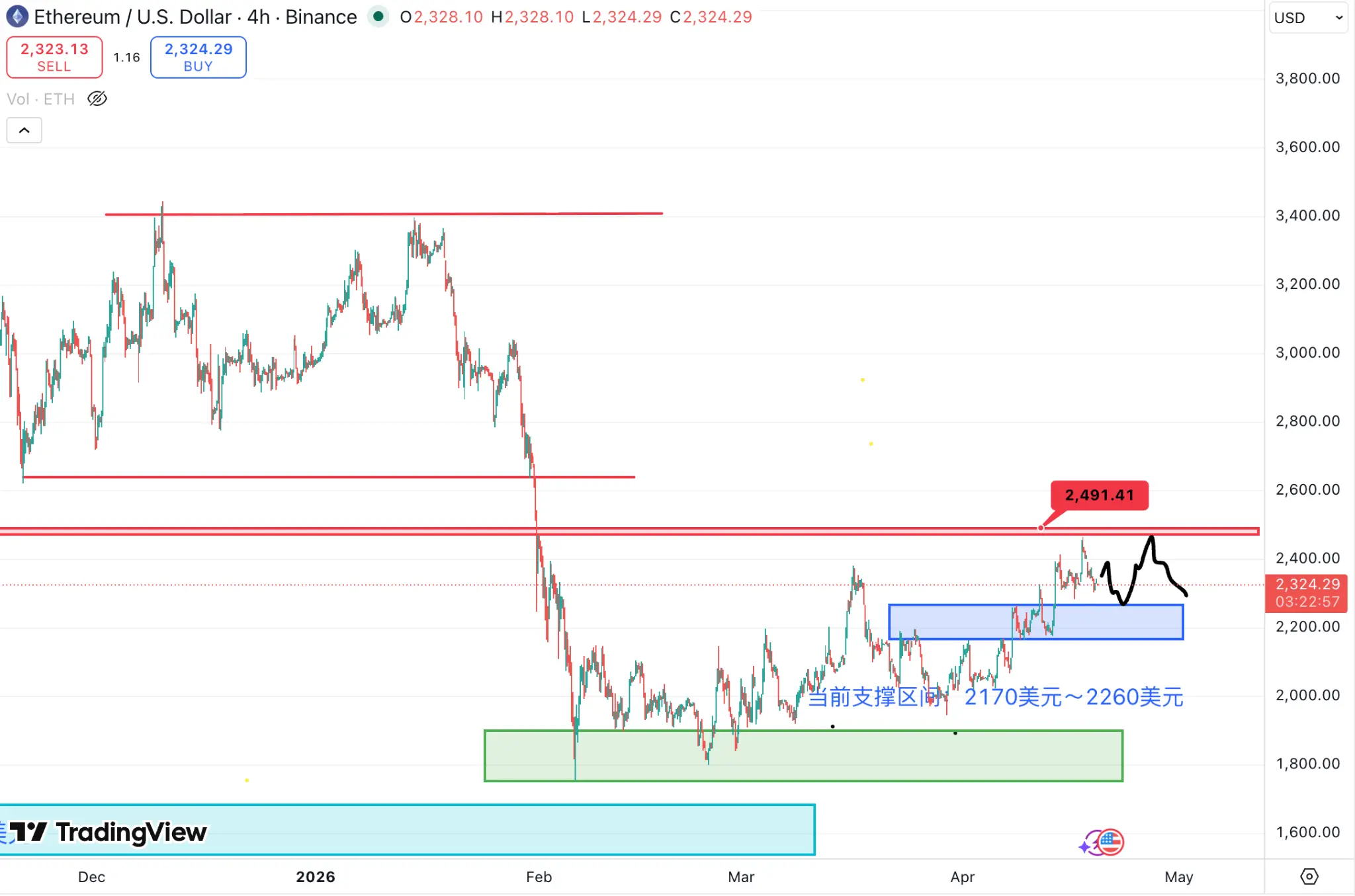
The overall performance of the crypto market this week has been strong with high-level fluctuations, with Bitcoin primarily trading in the 74K - 77K range, briefly spiking close to 78K but failing to form an effective breakthrough; Ethereum has fluctuated in the 2.3K - 2.4K range, significantly weaker than Bitcoin. In terms of market structure, funds remain concentrated in Bitcoin, with no significant signs of spreading to altcoins, indicating a state of high-level consolidation with a bullish sentiment that is not spreading.
Next week (April 20 - April 26) warning
The key point is whether Bitcoin will choose a direction: watch the resistance level at 78K; if it breaks through effectively, it may continue to rise; watch the support level at 75K; if it falls below, it may retest around 73K. Ethereum is more likely to follow; if Bitcoin pulls back, Ethereum will likely test below 2.3K first. Overall judgment: After high-level fluctuations, a direction is about to be chosen, with a short-term bias towards a breakout rather than continued sideways movement.
3. Industry and Sector Hotspots
iZUMi Finance, idOS, and infrastructure projects correspond to three core layers: liquidity, identity, and execution/infrastructure. iZUMi builds an efficient liquidity management system through Liquidity as a Service (LaaS), centralized liquidity incentives, and on-chain bonds (iUSD), improving capital utilization but with a complex structure that relies on market activity;
idOS focuses on decentralized identity, providing a foundational identity layer for stablecoins and compliant finance through data self-custody and verifiable credential mechanisms, but it is still somewhat permissioned, in the early stages of its ecosystem, and dependent on regulatory environments; overall, these types of projects share a common trend of moving from "single applications" to "underlying infrastructure," but generally face challenges of high complexity, immature ecosystems, and ongoing validation of real demand.
II. Market Hotspots and Potential Projects of the Week
1.1. Brief Analysis of Total Financing of 28 Million, Led by CIMG and MIRANA, with Follow-on Investments from GSR, IOSG, and Hashkey—DeFi Protocol iZUMi Finance Focused on Efficient Liquidity Management
Introduction
iZUMi Finance is a multi-chain DeFi protocol that provides a one-stop Liquidity as a Service (LaaS) solution. Its philosophy is that every token deserves more efficient and sustainable on-chain liquidity. Just as "iZUMi" means "spring water" in Japanese—our ultimate goal is to help every partner and every token enjoy continuous and stable on-chain liquidity, flowing endlessly and remaining ever-fresh.
Core Mechanism Overview
- iZiSwap V2
iZiSwap V2 is an automated liquidity protocol that operates based on the "constant product formula" and is implemented on the blockchain through a set of non-upgradable smart contracts.
It does not require centralized intermediaries, emphasizing decentralization, censorship resistance, and higher security.
Any user can deposit two types of tokens (in equal value proportions) into the liquidity pool to become a liquidity provider (LP).
In return, users will receive LP tokens representing their share of liquidity. These LP tokens can be redeemed at any time for the underlying assets in the pool.
Currently, iZiSwap V2 has been deployed on multiple blockchains such as Base, Linea, Scroll, and Mantle, with plans to expand to more chains in the future.
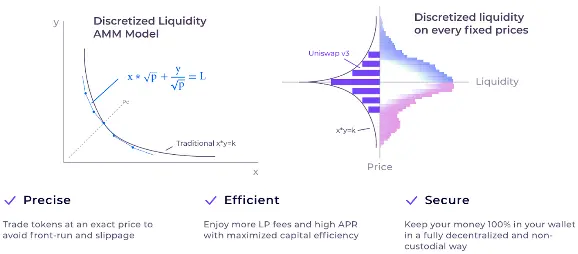
AMM Model (Automated Market Maker)
In the AMM model, each trading pool acts as an automated market maker.
When users exchange tokens, the system prices according to the constant product formula:
x×y=k
Where:
x = the amount of Token A in the pool
y = the amount of Token B in the pool
k = a constant that remains unchanged
This rule ensures that the product of x and y remains constant after the transaction.
In simple terms:
If the transaction size is small, the price change is not significant
If the transaction size is large, it will result in greater slippage relative to the pool's liquidity
Therefore, the price for large transactions will be much worse than for small transactions
This mechanism can automatically maintain market liquidity while protecting liquidity providers from being quickly depleted by large transactions.
- LiquidBox
LiquidBox is a liquidity mining mechanism launched by iZUMi Finance. It designs incentive schemes based on DL-AMM LP NFTs and Uniswap V3 LP NFTs (if the chain supports Uniswap).
Unlike traditional V2 model LP Token mining, LiquidBox can more precisely control liquidity incentives.
In the traditional V2 model:
LP Tokens are fungible
Users only need to deposit LP Tokens into the mining contract to receive rewards
The project team cannot control the price range of the liquidity
The focus of LiquidBox's design is that it can specify the incentive price range.
How LiquidBox Works
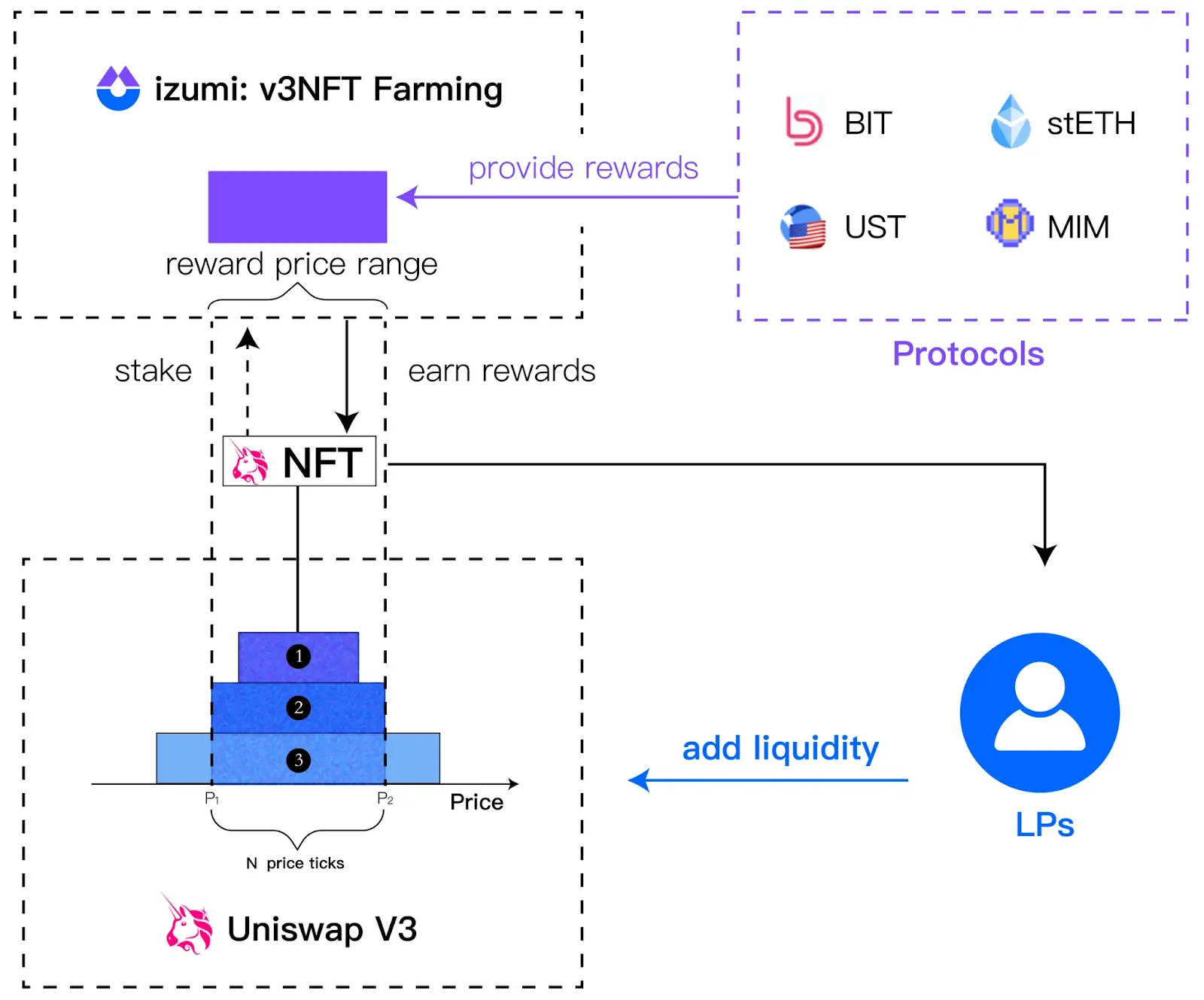
When users deposit Uniswap V3 LP NFTs into iZUMi's LiquidBox:
LiquidBox will automatically check the price range of the LP
The project team will set the incentive price range in advance in the mining plan
If the user's LP price range falls within the incentive range
The system will issue liquidity mining rewards to the liquidity provider
If the LP's price range is not within the incentive range, no rewards will be given.
- iZUMi Bond and iUSD
iZUMi Bond is an on-chain financing tool designed by iZUMi Finance in DeFi. It combines the mechanism of convertible bonds from traditional finance with over-collateralized stablecoins in DeFi.
In simple terms:
Investors lend money to iZUMi, receiving stable returns while also having the opportunity to exchange for iZi tokens in the future for additional gains.
In this system, iZUMi will issue a token called iUSD as a bond certificate.
What is iUSD
iUSD is a bond token denominated in U.S. dollars.
It is different from ordinary stablecoins:
It is not an algorithmic stablecoin
It is not a simple USDT/USDC model
Its underlying value comes from:
Real on-chain funds
Over-collateralized assets
Smart contract and multi-signature wallet management
These assets provide value support for iUSD.
Why is it called "convertible bond"
In traditional finance, a convertible bond is:
A bond that can be exchanged for company stock in the future.
iZUMi adopts a similar logic:
After investors purchase iUSD bonds:
They can receive interest
At maturity, they can exchange for iZi tokens at a fixed price
If the price of iZi rises, investors can also gain additional returns.
Where do the returns come from
Investors' returns primarily come from:
On-chain liquidity earnings from the iZUMi platform
These earnings will:
Prioritize paying back the principal and interest to bond investors
The remaining portion will be redistributed to market makers and other participants
Thus, the design goal of this system is:
To ensure returns for bond investors first, and then reward higher-risk participants.
Bond Farming Operation Logic
iZUMi refers to this mechanism as Bond Farming.
It is essentially a structured liquidity mining model:
There are two types of participants in the system:
- Conservative investors (low risk)
Purchase iZUMi bonds
Receive stable returns
Lower risk
- High-risk participants (higher returns)
Including:
iZUMi project team
Professional market makers
They use iUSD to operate liquidity in the market, taking on higher risks while pursuing more returns.
Tron’s Commentary
The advantage of iZUMi Finance lies in its core focus on "Liquidity as a Service (LaaS)," building a relatively complete on-chain liquidity infrastructure around products like iZiSwap, LiquidBox, and Bond Farming, and enhancing capital efficiency and liquidity quality through centralized liquidity incentives, price range mining, and on-chain bond financing (iUSD), while multi-chain deployment (such as Base, Linea, Scroll, Mantle, etc.) also strengthens its ecological expansion capabilities;
However, its disadvantage lies in the complexity of product structure, high understanding threshold for mechanisms, and significant reliance on project team incentive needs and on-chain trading activity. Once market liquidity or DeFi activity declines, the attractiveness of returns from liquidity mining and bond models may weaken, while the multi-module financial design also increases systemic risks and user learning costs.
2. Detailed Analysis of Key Projects of the Week
2.1. Detailed Analysis of Total Financing of 7 Million, Led by FABRIC, with Follow-on Investments from Arbitrum, Circle, Ripple, and NEAR—Decentralized Identity Operating System for Stablecoin Economy idOS
Introduction
idOS (Identity Operating System) is a decentralized data storage and access management network specifically designed for storing user data. idOS brings portable digital identities to the stablecoin economy. It allows users to register within stablecoin applications and share their data as easily as transferring funds, whether on-chain or off-chain.
idOS Storage Network (Storage Network, L1) provides private data storage that is user-controlled and allows users to share access to their encrypted data with applications and businesses on the internet.
idOS Economy Network (coming soon, built on Arbitrum Orbit) will implement a flexible data economy system within smart contracts and measure the usage of the Storage Network.
Application developers can use the idOS SDK to complete all core interaction functions with idOS.
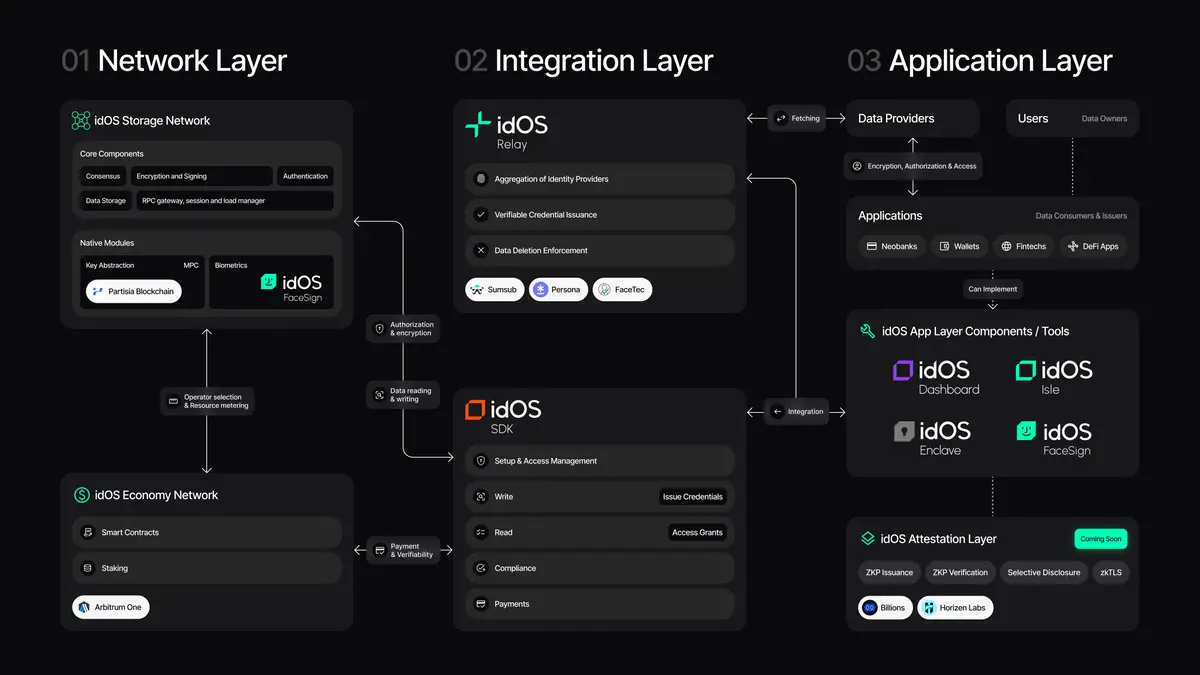
Architecture Overview
idOS is a decentralized identity system that achieves secure storage, verification, and sharing of user data through blockchain technology. The system aims to allow users to own and control their data while enabling trusted entities to access and verify data within a privacy-protecting and compliant framework.
The system mainly consists of three parts:
idOS Storage Network (idOS Storage Network): Decentralized data storage network (L1)
idOS Economy Network (idOS Economy Network): Data economy and incentive layer (under development)
SDK and Application Tools (SDK & Application Tools): Help developers and users connect to idOS
Currently, idOS is a permissioned network: the code is mostly open-source, but only authorized nodes can run the network to ensure accountability of node behavior and protect user privacy. In the future, it will gradually transition to a more open and decentralized architecture.
- Key Actors
Owner (User / Data Owner)
The ultimate owner of the data
Authenticated using EVM or NEAR wallet
Data encryption and decryption are completed through idOS Enclave (secure environment)
Issuer (Credential Issuer)
Verifies and issues user credentials
Typical institutions: banks, insurance companies, schools, medical institutions, government agencies, etc.
Consumer (Data User)
Applications or services requesting access to user credentials
Can only access data after user authorization
Examples: dApps, financial service platforms, etc.
In many scenarios, the Issuer and Consumer may be the same entity, such as a Neobank (digital bank).
- Other Stakeholders
Data Network Node Operators
Responsible for maintaining the Storage Network, ensuring data storage, retrieval, and network stability.
Regulators
Formulate data privacy and protection laws, such as GDPR.
Compliance Officers
Ensure that institutions comply with legal and regulatory requirements when using idOS.
idOS Consortium
Composed of Web3 ecosystem projects, promoting the development of decentralized identity frameworks.
- Network Layer
idOS Storage Network
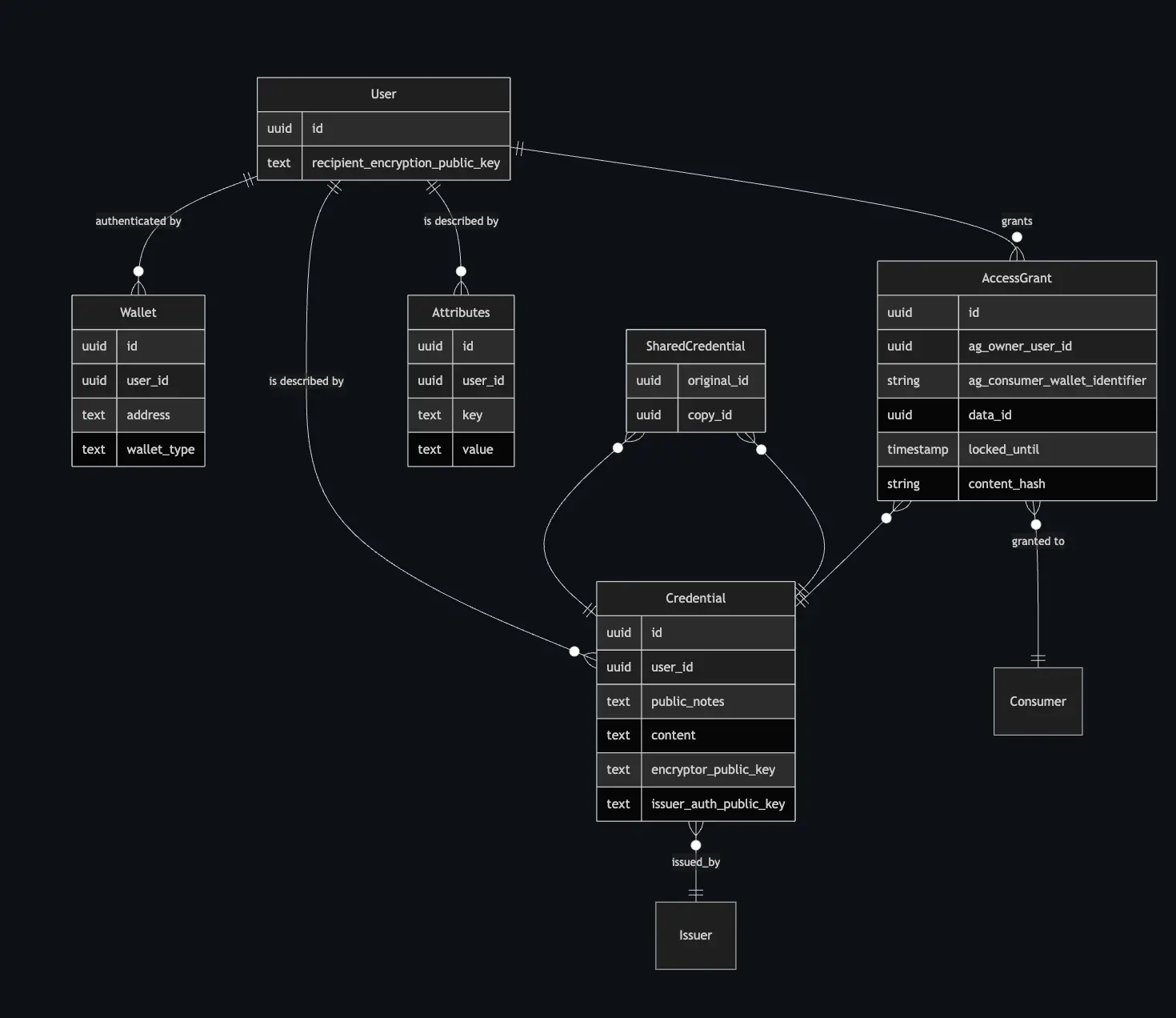
User data is stored in the idOS Storage Network, a decentralized L1 network responsible for identity authentication, consensus mechanisms, data storage, and encryption services.
Storage Network Nodes
Based on Kwil decentralized database
Provides data storage and retrieval
Uses a unified schema to ensure data consistency
KGW (Kwil Gateway)
RPC gateway and load balancer
Manages access cookies
Reduces duplicate signature requests
In the future, nodes will support additional modules, such as:
TSS-MPC encryption module
Decentralized biometric authentication
- Data Architecture
Fundamental Data Structures
User
The core identity entity in the system, controlled through a wallet.
User Profile
A collection of all identity information controlled by the user.
Wallet
Used for identity authentication, can bind multiple chain wallets (EVM, NEAR).
Credential
Verifiable claims about the user, such as KYC, educational background, or credit records.
Key fields include:
User
Public Notes
Encrypted Content
Issuer Address
The system recommends using the W3C Verifiable Credentials standard.
- Credential Sharing Mechanism
Credential data is encrypted for specific recipients.
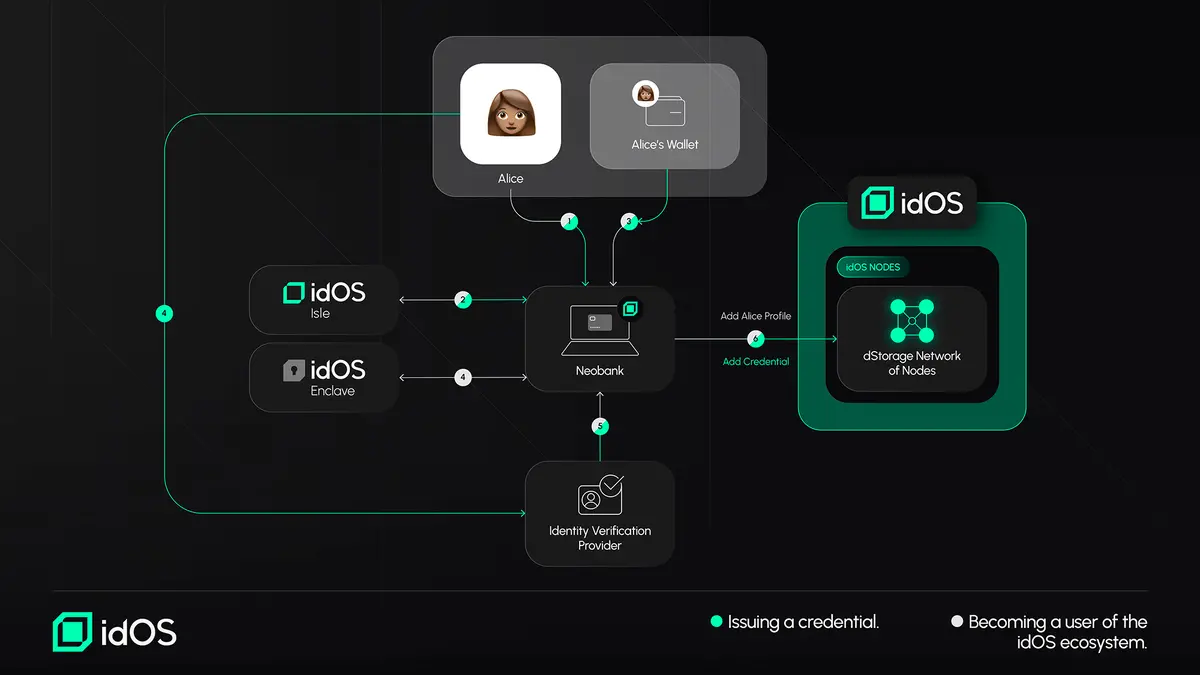
When a user needs to share data:
The user obtains an encrypted credential
The user decrypts the data
Re-encrypts using the new recipient's public key
Generates a new shared credential
This achieves end-to-end encrypted data sharing.
Access Grant
Users can create Access Grants to authorize data access.
Fields include:
Owner
Data ID
Consumer Address
Timelock
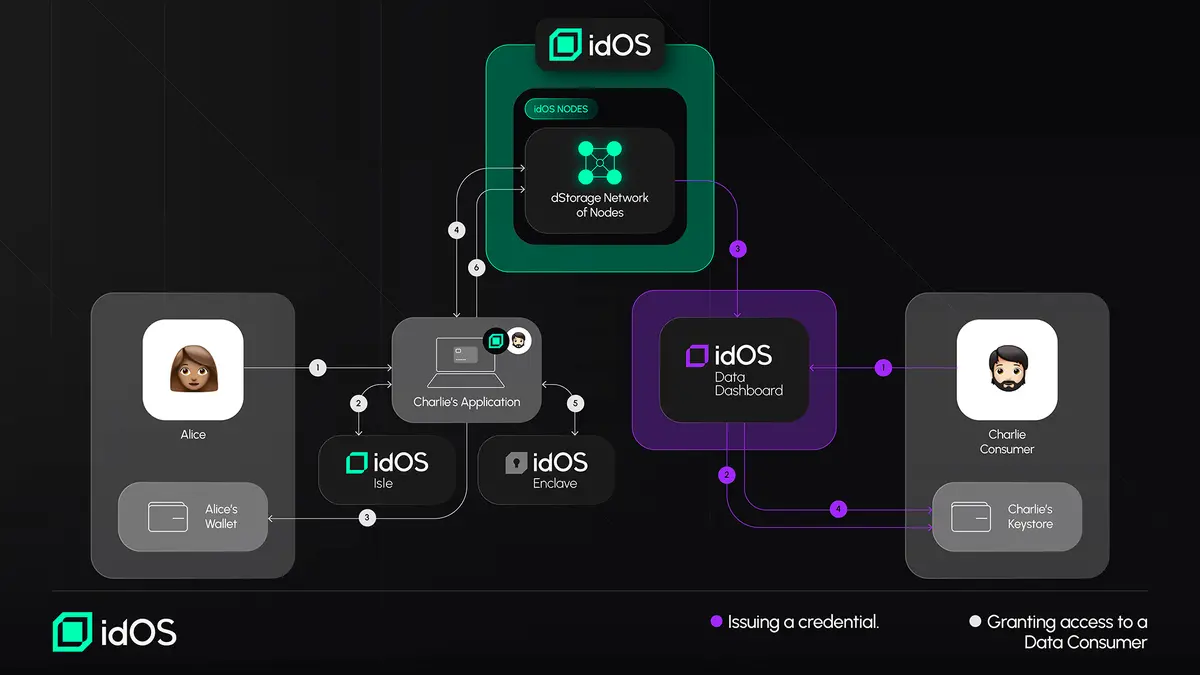
Secondary Data Structures
Delegated Write Grant
Allows users to authorize the Issuer to create credentials on their behalf.
Delegated Access Grant
Allows third parties to create access grants on behalf of the user.
- Data Access Model
Users can authorize third parties to access data through applications or dashboards.
Process:
The user decrypts the data
Re-encrypts with the recipient's public key
Uploads to the idOS network
Only authorized entities can read the data.
- Continuous Data Availability
Once an Access Grant is created:
Even if the user is offline, the recipient can still access the data.
This allows idOS to serve as:
Decentralized CRM
Businesses do not need to store copies of user data.
Revocation and Timelocks
Users can revoke data access permissions at any time.
In compliance scenarios:
Timelocks can be set to ensure that data cannot be revoked within a specified period to meet regulatory requirements.
- Storage & Consensus
idOS uses the Kwil decentralized relational database.
Advantages include:
Supports GDPR "right to be forgotten"
User data can truly be deleted.
High-performance permissioned consensus mechanism
Utilizes the Kwil Roadrunner consensus algorithm, optimized for identity data storage scenarios.
- Node Operators
Currently, all nodes are operated by idOS Association.
Future plans:
Open node operations in H2 2025
Auction approximately 20 node slots
Nodes must complete KYB audits
- idOS Economy Network
Under development, will be based on Arbitrum Orbit L2.
Main features include:
Staking mechanism
Gas fee payments
Access Grant usage fees
idOS Token economic model
The goal is to establish a sustainable data economy system.
- Integration Layer
Developers can connect to idOS in the following ways:
SDK (Software Development Kit)
idOS Client SDK (browser-side SDK)
Consumer Server SDK (consumer server-side SDK)
Issuer Server SDK (issuer server-side SDK)
Direct RPC Calls
Advanced users can directly call node APIs, but this is not officially recommended.
- Application Layer Tools
User Dashboard
Manage user credentials, wallets, and access permissions.
Dashboard for dApps
For dApps to view user-shared data.
idOS Enclave (secure isolation environment)
Used for password input, key generation, and data encryption/decryption, ensuring applications cannot access plaintext data.
idOS Isle (under development)
Standard UI components for identity creation and credential management.
Passporting Server
For sharing compliant identity credentials between different institutions.
Tron Review
idOS achieves user data self-management and controllable sharing through a decentralized identity network, addressing the issue of data monopolization by platforms in the traditional internet. Its architecture combines decentralized storage, end-to-end encryption, and a verifiable credential mechanism, enabling users to carry and reuse identity data across different applications, thereby reducing costs related to KYC, compliance, and user onboarding in Web3 applications. At the same time, idOS provides a unified identity infrastructure for stablecoins, financial services, and cross-platform applications through a layered design of storage networks and future economic networks, demonstrating strong ecological expansion potential.
However, idOS is still in its early stages, with the network being a permissioned architecture and limited decentralization, relying on association management for nodes and governance; its system structure is relatively complex, posing certain barriers for developers and institutional access. Identity data involves strict regulatory and privacy requirements, and compliance differences across different jurisdictions may also affect its large-scale implementation. Furthermore, its ecological scale and application scenarios still require time for validation; without sufficient application and institutional participation, the network's value and data network effects may be difficult to form quickly.
III. Industry Data Analysis
1. Overall Market Performance
1.1. Spot BTC vs ETH Price Trends
BTC
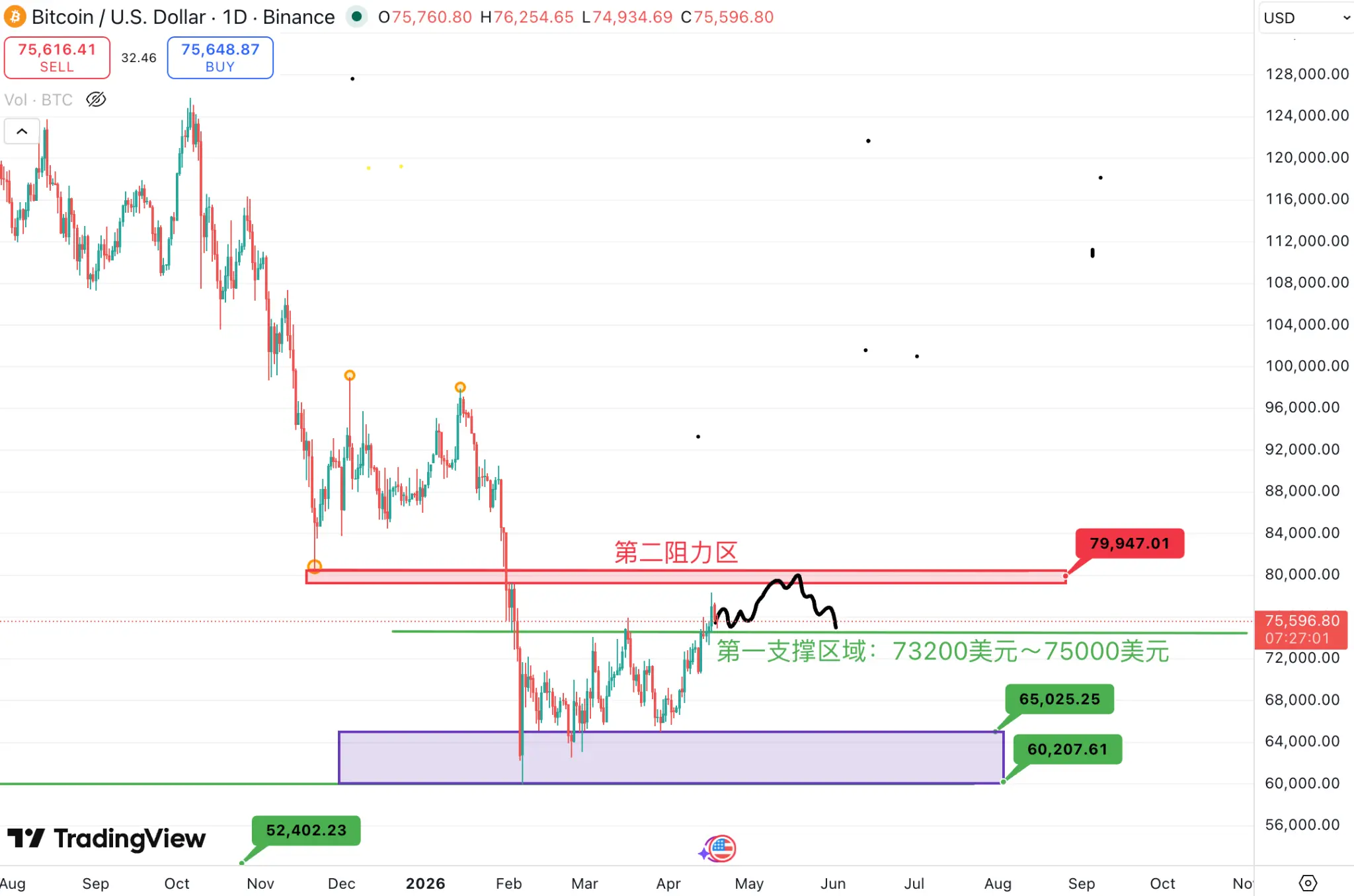
ETH
2. Hot Sector Summary
This week, the market's focus on AI narratives has clearly shifted from "application layer tokens" to "infrastructure projects," with typical examples being B.AI (AI payment and service invocation layer), Autonolas (Agent coordination network), Fetch.ai (Agent economic system), and a new class of security/execution middleware (similar to Nava Labs). The discussion has shifted from "what AI can do" to "how AI can safely execute on-chain operations," especially as modules like payments, identity, and verification are being separated out for infrastructure, indicating that this track is entering a structured phase rather than mere emotional speculation.
IV. Macroeconomic Data Review and Key Data Release Points for Next Week
This week's macroeconomic core revolves around three issues: geopolitical tensions + continued impact of inflation data + the start of the corporate earnings cycle. The escalation of the U.S.-Iran conflict has driven oil prices significantly above $100, raising inflation expectations and limiting the space for interest rate cuts; at the same time, the U.S. enters bank earnings week (Goldman Sachs, JPMorgan, etc.), with the market shifting focus to observing economic resilience rather than solely inflation data. Overall, there are no new "decisive data" this week, but rising risk premiums + tight interest rate expectations remain the main tone.
Key data points for next week (April 20 - April 26)
Next week's focus is not on single data points but on "continuous validation":
U.S. PMI (Manufacturing/Services) → To determine if the economy continues to strengthen
Employment-related data (initial jobless claims, etc.) → To influence interest rate cut expectations
Continuation of U.S. tech earnings → To determine risk asset sentiment
V. Regulatory Policies
1) United States: CLARITY Act Enters Key Advancement Stage
This week, the U.S. Senate Banking Committee reviewed and advanced the CLARITY Act (Cryptocurrency Market Structure Bill), marking a shift in U.S. crypto regulation from "enforcement-oriented" to "legislative framework." This bill will clarify the regulatory boundaries between the SEC and CFTC, representing one of the most critical institutional advancements currently.
2) European Union: Regulatory Authority Centralized to ESMA (Unified Regulatory Direction)
The European Central Bank supports further centralizing crypto regulatory authority to the European Securities and Markets Authority (ESMA), strengthening the transnational unified regulatory framework, which means the EU is moving from the implementation phase of MiCA to a more centralized regulatory execution system.
 Risk warning

Popular articles