








In the end, Binance decided to enter the US stock market
 Core Viewpoint

 Against the backdrop of the gradual decline of the narrative around native crypto assets and the continuous shrinkage of liquidity, leading exchanges need new growth stories to maintain their platform valuations and market positions. Accessing the massive U.S. stock market is currently the most readily available and compelling answer.
Author: Zhou, ChainCatcher
On June 1, Binance officially announced the launch of U.S. stock trading services.

A few days ago, Binance's official account released a teaser image of a "haystack," announcing the launch of a new product on June 1. This image quickly sparked a lot of speculation in the community, with many linking "haystack" phonetically to "Hey Stock," directing attention towards U.S. stocks.
Subsequently, GitHub user YukiCoco conducted a decompilation analysis of the Binance Android version 3.15.7, uncovering a large number of stock-related functional paths and copy from the code level, which helped shape the market's judgment on the product direction.
After the news spread, the price of BNB reacted quickly, briefly breaking through $700.
Now that the announcement is official, Binance has declared its entry with the phrase "For real."
TradFi U.S. Stock Business Layout
According to the official announcement, users can directly buy and sell U.S.-listed stocks and ETFs on Binance's spot trading tab, with over 7,000 underlying assets, including blue-chip stocks, ETFs, and small-cap stocks. Fractional shares are supported, starting from a minimum of $5, with zero commission and dividends automatically credited to accounts. Settlements are primarily in USDC, while USDT and BNB are also supported for automatic conversion.
Trading hours are divided into three segments: regular trading hours follow U.S. stock market opening, extended trading hours cover pre-market and after-hours, and some underlying assets support 24-hour trading including overnight hours, totaling five days a week, rather than the expected 7*24.
This U.S. stock business adopts a "introducing broker + clearing broker" dual-layer model. Nest Trading Limited is responsible for order referral, while Alpaca Securities LLC is responsible for trade execution, clearing, settlement, and asset custody.
Nest Trading Limited, formerly BCI Limited, was approved as a licensed broker by the Abu Dhabi Global Market (ADGM) Financial Services Regulatory Authority (FSRA) at the end of 2025 and officially began operations on January 5, 2026. It is worth noting that Nest Trading is not an independent third party; its official website directly points to Binance, forming a trio of licensed entities in ADGM along with Nest Exchange Limited and Nest Clearing and Custody Limited.
Alpaca Securities LLC is a broker-dealer registered with the SEC and is also a member of FINRA and SIPC, focusing on providing securities trading and clearing custody infrastructure to global financial institutions through APIs. According to The Information, Alpaca currently holds about 94% of the tokenized U.S. stock and ETF market share, with mainstream projects like Ondo Finance, Dinari, and xStocks being supported by it.
Additionally, the Full Payment Securities Lending (FPSL) service will officially open on June 4, allowing users to lend qualified securities they fully own to short sellers, arbitrageurs, or market-making institutions to earn additional income, a common value-added service in traditional financial markets.
In terms of tokenization, bStocks will be launched in the coming weeks, allowing users to convert real stock holdings 1:1 into on-chain tokens, circulating on the BNB Chain.
The official statement clearly points out that bStocks holders do not directly hold the related stocks or ETF equity. Previously, Binance had launched on-chain tokenized assets tracking U.S. stocks and ETFs like Apple, Tesla, and Nvidia through a partnership with Ondo Finance.
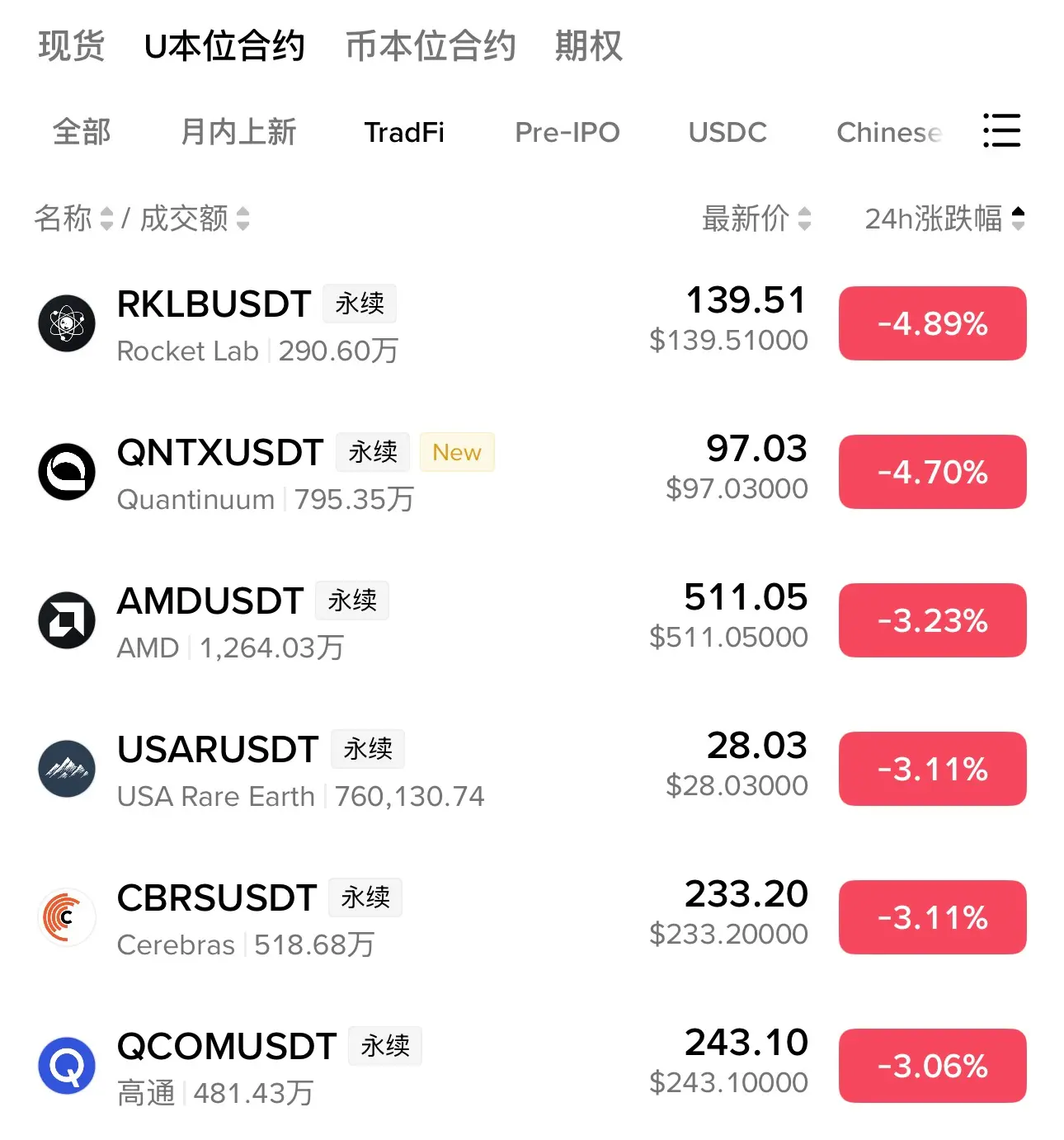
Furthermore, according to the decompilation report, Binance is also laying out two tracks for Alpha Zone tokenized securities and contract account stock derivatives, under the umbrella brand name TradFi, targeting different jurisdictions and user needs. However, the official has not yet confirmed the comprehensive details of these products.
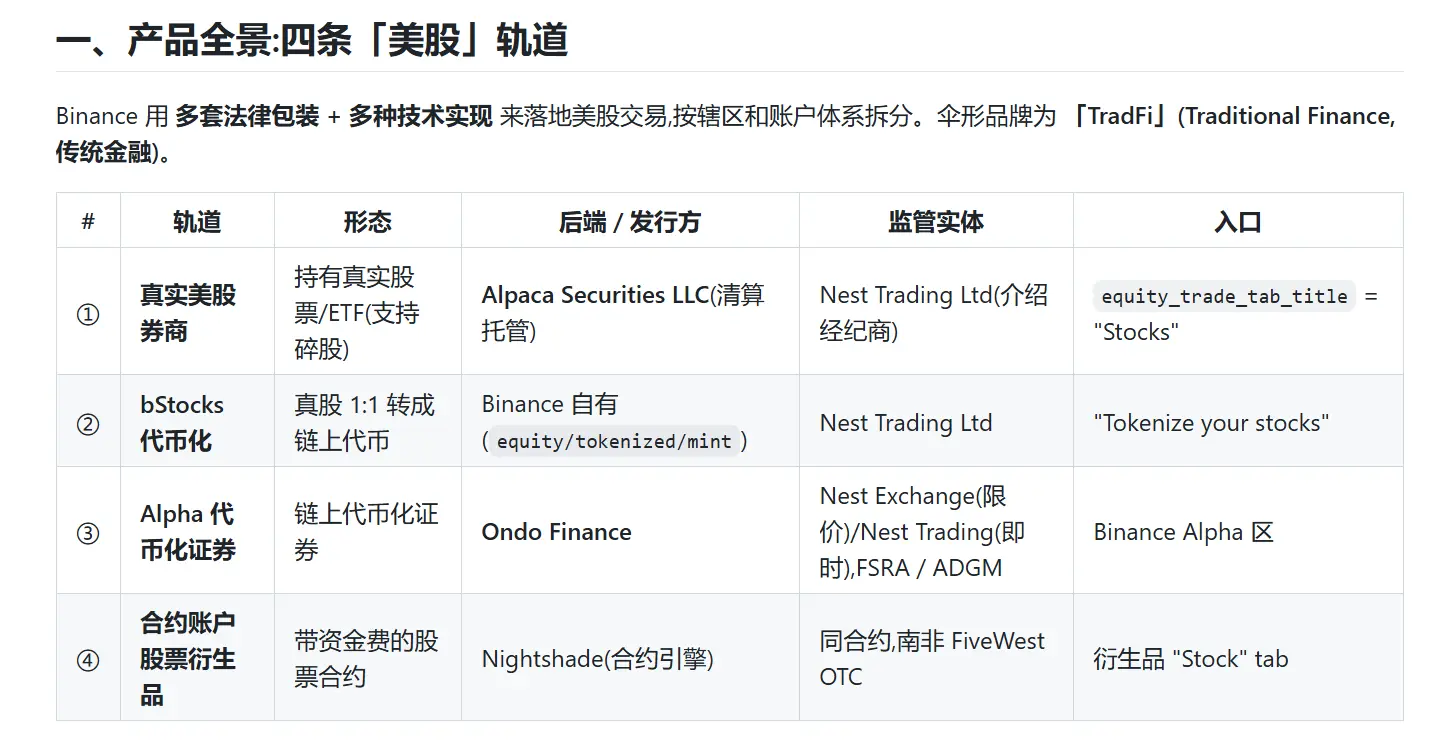
In fact, as early as 2021, Binance briefly launched stock tokens for Tesla and Apple, which were delisted three months later under regulatory pressure from multiple countries.
The biggest difference between these two attempts lies in the underlying structure. The 2021 version had no compliance custody support, while this time, it is reported that Alpaca Securities holds the stocks as a licensed broker, with the issuing entity regulated by FINRA and SIPC.
Changes in the regulatory environment are also an important background. The SEC has clearly stated its support for the issuance of tokenized stocks this year, and Nasdaq's pilot proposal for tokenized securities has been approved by the SEC. The parent company of NYSE, ICE, has also announced the construction of a tokenized trading platform, with traditional financial systems actively moving towards on-chain solutions.
Will U.S. Stock Business Drain Liquidity from Altcoins?
Last weekend, discussions around the impact of U.S. stock trading on altcoins became a focal point in the market.
One viewpoint suggests that users on the same platform can directly buy and sell Nvidia and Apple with stablecoins, which, compared to high-risk altcoins, offers better certainty in returns for quality U.S. stocks. The entry of leading exchanges into the tokenized U.S. stock space may lead to a further decline in the value and liquidity of non-leading assets in the crypto space.
Chen JianJason also pointed out that this poses a clear negative for many altcoin projects, but it may also represent the last opportunity for some projects to perform.
There are also opinions that Binance's move is less about proactive expansion and more about retaining existing liquidity on the platform to prevent funds from flowing out to other channels. Under this logic, the current market's expectation of a huge benefit from this is worth caution, as it leads to a frenzy of buying BNB.
If a large amount of crypto funds ultimately flows into U.S. stocks, the liquidity of crypto assets on the platform may continue to shrink, raising questions about the valuation logic of BNB.
Phyrex offers another perspective. He believes that users who engage with altcoins are pursuing asymmetric returns of 10x or 100x, which U.S. stock spot trading cannot provide. The key is not that U.S. stocks completely replace altcoins, but that the overall liquidity in the crypto space is currently at a low level. Once overall liquidity returns, altcoins will naturally regain attention.
Regulation and Taxation: The Cost of Compliance
According to the decompilation report, Binance has decentralized the regulatory registration locations of different businesses across multiple jurisdictions such as Abu Dhabi and South Africa, reflecting a strategy to mitigate legal risks.
Analysis indicates that while Alpaca provides real custody, the legal attributes of on-chain bStocks tokens are closer to debt or derivatives. The product includes features like free minting, perpetual contracts, and DeFi collateral, which may be viewed by regulators as unregistered securities, requiring ongoing attention to related risks.
At the same time, compliance not only promotes product rollout but also opens the door for tax authorities to intervene.
The U.S. IRS has required crypto brokers to report customer transaction data starting in 2026, with crypto gains taxed at capital gains rates. The EU DAC8 directive requires crypto platforms to report user information to tax authorities starting this year, with some member countries having tax rates as high as 52%. Japan classifies crypto gains as miscellaneous income, with a maximum tax rate of 55%.
In contrast, Singapore and Hong Kong currently do not tax individual crypto capital gains, remaining Asia's low-tax compliance hubs.
However, regulatory trends are clear; statistics show that about 60% of major tax authorities worldwide have established or are developing formal reporting frameworks for crypto transactions. Starting January 2026, 48 countries will begin collecting transaction data according to the OECD's Crypto Asset Reporting Framework (CARF) to prepare for cross-border tax information sharing.
This means that the tax compliance obligations for individual cross-border crypto transactions will significantly increase, and the previously relied-upon anonymity for tax evasion is gradually narrowing.
Overall, Binance's entry into the U.S. stock business represents a compliance layout conducted by the exchange in collaboration with licensed institutions. For investors, this provides new asset allocation options, with the combination of quality U.S. stocks and crypto wallets significantly lowering the barriers to cross-border investment.
For exchanges, in the context of declining narratives around crypto-native assets and shrinking liquidity, leading exchanges need new growth stories to maintain platform valuations and market positions. Accessing the vast U.S. stock market is currently the most immediate and convincing answer.
However, taking this step will accelerate the dissolution of boundaries between the crypto industry and traditional finance, leading to more regulatory scrutiny, more transparent data, and higher compliance costs.

 Risk warning




Popular articles





