








What has happened in the crypto market during previous World Cups? Huobi HTX brings you a data review (including exclusive analysis for 2026)
 Historical data reveals the "World Cup curse" in the cryptocurrency market, and the 2026 market is brewing a brand new change. Hurry to participate in the event betting on Huobi HTX and grab a massive prize pool of $600,000.
Every four years, the competition on the green field quietly influences another global market—cryptocurrency. From 2014 to 2022, during three World Cups, Bitcoin and the entire crypto market experienced varying degrees of turbulence during the events. The 2026 World Cup in the US, Canada, and Mexico officially opened on June 11, marking the largest tournament in history with 48 teams and 104 matches, and it is also the most integrated edition of the crypto industry with sports events.
So, what does historical data tell us? What path will this year's market take? Let the data speak; Huobi HTX will guide you through a systematic review.
Is the "World Cup Curse" Real? A Review of Market Data from Three World Cups
In traditional financial markets, the "World Cup Curse" has a long history. According to historical data, from 1994 to 2022, in the eight completed World Cups, the Shanghai Composite Index showed 5 declines and 3 increases. In the cryptocurrency market, the market trends are more complex and volatile. Some research institutions point out that this may be related to the "de-leveraging cycle after inherent market bubbles" coinciding with the "four-year World Cup cycle." Let's look at the market data from each World Cup.
2014 Brazil World Cup: Silence in the First Bear Market
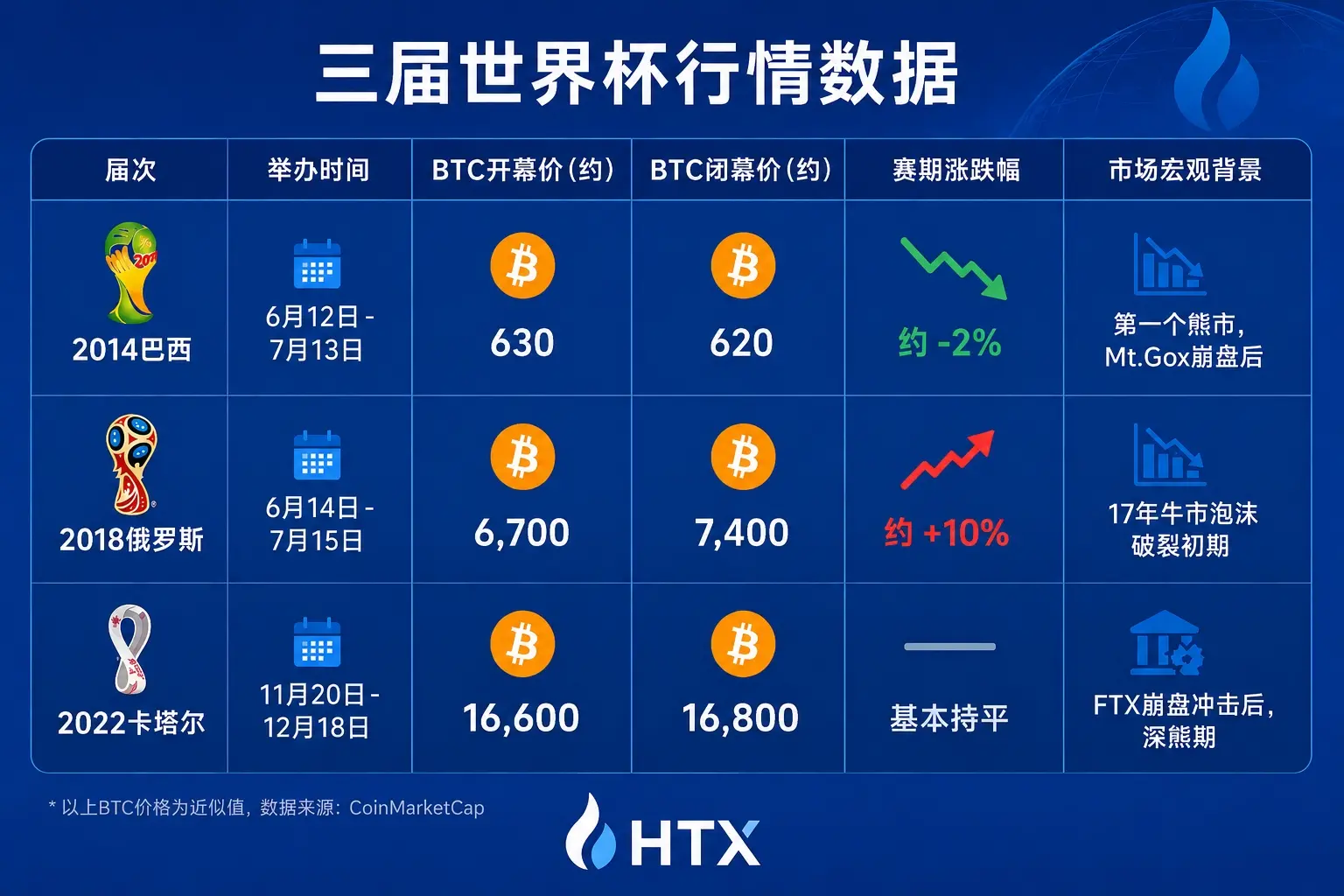
2014 was one of the "darkest moments" for the crypto market. At the beginning of the year, the world's largest exchange, Mt.Gox, declared bankruptcy due to the theft of 850,000 Bitcoins, severely damaging market confidence. Bitcoin fell from its historical high of $1,156 at the end of 2013, reaching a yearly high of only $1,017, and ended the year at around $320.
During the World Cup (June - July), Bitcoin's price fluctuated sideways in the $600 - $650 range, remaining almost indifferent regardless of how many goals were scored on the field. Therefore, the macro bear market combined with black swan events meant that the World Cup hype could not change the trend.
2018 Russia World Cup: A Brief Rebound
2018 marked the beginning of another brutal bear market in crypto history. Bitcoin plummeted from nearly $20,000 at the end of 2017 to about $3,200 by the end of the year, with an annual decline of over 70%.
However, during the World Cup period (June 14 - July 15), Bitcoin experienced a brief rebound, rising from about $6,700 to around $7,400, an increase of nearly 10%. But the good times didn't last long; after August, the market continued to decline, falling below $4,000 by the end of the year. The World Cup rebound in a bear market was more about oversold recovery rather than a trend reversal, and those who chased the highs often found themselves trapped.
2022 Qatar World Cup: Despair at the Bottom Under the FTX Black Swan
The crypto market backdrop for this World Cup was particularly unique. Just before the opening, the world's second-largest crypto exchange, FTX, declared bankruptcy in November 2022, causing systemic shocks in the market. Bitcoin fell from $21,000 to below $16,000, with the total market value evaporating by over $150 billion throughout November.
During the World Cup, Bitcoin basically fluctuated between $16,000 and $17,000, with price changes close to flat. More notably, fan tokens were significantly hyped before the tournament, only to crash collectively after it began. CHZ (Chiliz) saw a 42% increase in the week leading up to the World Cup and a 95% increase in the month prior; however, after the opening, CHZ dropped by 17.19%, Spain's national team fan token SNFT fell by 27.40%, Brazil's national team fan token BFT dropped by 17.20%, and Argentina's national team fan token ARG decreased by 13.21%. The phrase "buy the expectation, sell the fact" was vividly illustrated.
Summary of Patterns: Common Logic Behind the Three Sets of Data
By looking at the data from the three World Cups together, we can extract the following meaningful patterns:
Pattern One: The World Cup market in crypto is essentially an extension of macro cycles. All three World Cups coincided with bear or adjustment periods in the crypto market (2014, 2018, and 2022 were all years of annual declines for Bitcoin). This is not a coincidence— the World Cup occurs every four years, and the de-leveraging cycle in the crypto market and the transition between bull and bear markets also roughly operate on a four-year dimension (highly consistent with Bitcoin's halving cycle). When the overall trend is downward, the World Cup hype can only create local fluctuations, unable to change the overall direction.
Pattern Two: Sports-themed tokens strictly follow the logic of "expectation leads, facts sell." This pattern was most evident in 2022: the 1-3 months before the tournament was a window for fan tokens to rally, with the start of the tournament signaling a selling opportunity. In participating in such thematic speculation, the most important factor is not "what to buy," but "when to sell."
Pattern Three: The correlation between the crypto market and global stock markets continues to strengthen. With institutional funds entering the market, the correlation between cryptocurrencies and US stocks has significantly increased. This means that analyzing the crypto market can no longer be done in isolation; it is essential to simultaneously pay attention to macro indicators such as Federal Reserve policies and global risk sentiment.
Huobi HTX Perspective: The 2026 World Cup Faces a Completely Different Background
With historical patterns in mind, let's look at this year's unique aspects.
Background One: Bitcoin is in a "consolidation period" after halving.
The fourth Bitcoin halving will occur in April 2024. Historically, significant bull markets often emerge within 12-18 months after each halving (as evidenced in 2013, 2017, and 2021). In 2025, Bitcoin briefly surpassed the historical high of $126,000 but then entered a correction, fluctuating between $60,000 and $80,000 in the first half of 2026. This is in stark contrast to the deep bear market backdrop of the previous three World Cups—the market is in a "high-level correction" rather than a "systemic collapse."
Background Two: Crypto infrastructure has matured comprehensively, with unprecedented participation depth.
Before the 2026 World Cup, the cumulative trading volume of the "World Cup Champion" contracts on just one platform, Polymarket, approached $1.6 billion, with on-chain prediction markets becoming one of the most watched emerging forms of participation during the World Cup. The integration of the crypto industry with sports events has evolved from superficial marketing like sponsoring jerseys and issuing NFTs to a genuine value network and settlement infrastructure.
Background Three: Institutional funds and the compliance process are accelerating.
After the approval of Bitcoin spot ETFs in the US, the continuous inflow of institutional funds has fundamentally changed the market structure. The volatility of the crypto market is systematically decreasing, and the frequency of "extreme one-sided markets" is reducing, which means strategies need to be adjusted accordingly.
Ultimately, even the best strategies require a stable and secure platform for execution. Huobi HTX, established in 2013, is one of the oldest leading crypto exchanges globally, with no security incidents for 30 consecutive months since the end of 2023, serving over 50 million registered users across more than 130 countries and regions. In the special market conditions driven by global events like the World Cup, Huobi HTX's advantages are particularly prominent, including deep liquidity, comprehensive risk control tools, real-time market data and news, and a one-stop ecosystem. From spot trading, contracts, and leverage to earning coins and lending, Huobi HTX has built a comprehensive one-stop service system covering the entire asset management cycle, ensuring that whether you are a trader or a long-term holder, you can find suitable products here.
Notably, during the World Cup, Huobi HTX has launched the "World Cup Prediction Red Packet Activity," allowing participants to engage in predictions and share a prize pool of 100,000 USDT. The activity runs from June 12 to July 20, 2026 (UTC+8), covering 34 match days during the World Cup. Users only need to enter the Huobi Square activity area, participate in the prediction for the first match of the day, and complete the voting to qualify for the red packet the next day; sharing analysis and opinions in the comments section also offers opportunities for more community interaction exposure; participating for 7 days will automatically unlock eligibility for a large red packet on the 8th day.
Additionally, Huobi HTX has simultaneously launched the "US-Canada-Mexico World Cup Prediction Activity," running from now until July 20 at 3:00 (UTC+8). Eligible users can register and complete specified tasks to receive prediction tickets, participating in both champion predictions and single-match predictions, sharing a total prize pool equivalent to $500,000 in $HTX. Users who successfully predict the final champion can win up to $15,000 in equivalent rewards. Lock in Huobi HTX to watch the games while sharing exclusive World Cup benefits.
Conclusion: History Does Not Simply Repeat, But Patterns Never Lie
History does not provide standard answers but leaves behind clues worth referencing. The data from the three World Cups tells us that the crypto market will not change its macro trend due to the arrival of the world's largest sporting event, but it will indeed create phase opportunities on an emotional level—the key is whether you have understood the patterns in advance and prepared accordingly.
The backdrop of the 2026 World Cup is different from the past three— a consolidation cycle after halving, a more mature market infrastructure, broader institutional participation, and an expanding global crypto user base. This means there are new opportunities, but also new uncertainties. The whistle for the World Cup has already blown, whether it’s seizing event highlights, capturing market opportunities, or participating in prediction interactions to share benefits, Huobi HTX will accompany users to witness this global festive moment together.
 Risk warning



Popular articles





