








As AI Narratives Rotate, How Do You Position? Four Ways to Access U.S. Stocks via MEXC

 Seize the opportunity of AI narrative rotation, and unlock four new investment methods in US stocks on MEXC: spot trading, contracts, tokenization, and Pre-IPO.
1. Understand the AI Value Chain in 60 Seconds: Where Is the Momentum?
AI is not just a story about NVIDIA. When you type a prompt into ChatGPT or Claude and receive an answer within seconds, the experience feels simple. Yet behind that output, an entire ecosystem of companies is at work.
NVIDIA and AMD provide the "brain" of AI: GPUs that perform the computation behind each query. But even the fastest processors need a constant flow of data. If data cannot be delivered quickly enough, GPUs are left waiting. This is where HBM and high-performance memory from companies such as Micron, SK Hynix, and Samsung become critical—they continuously feeding massive volumes of data to GPUs at high speed.
GPUs and memory alone, however, cannot power AI. They must first be manufactured, packaged together, and assembled into servers. This requires advanced manufacturing from TSMC, advanced packaging providers, and a wide range of semiconductor equipment and testing processes. Finally, these servers need to be deployed in data centers, connected to sufficient power supply, and continuously cooled to operate without interruption.
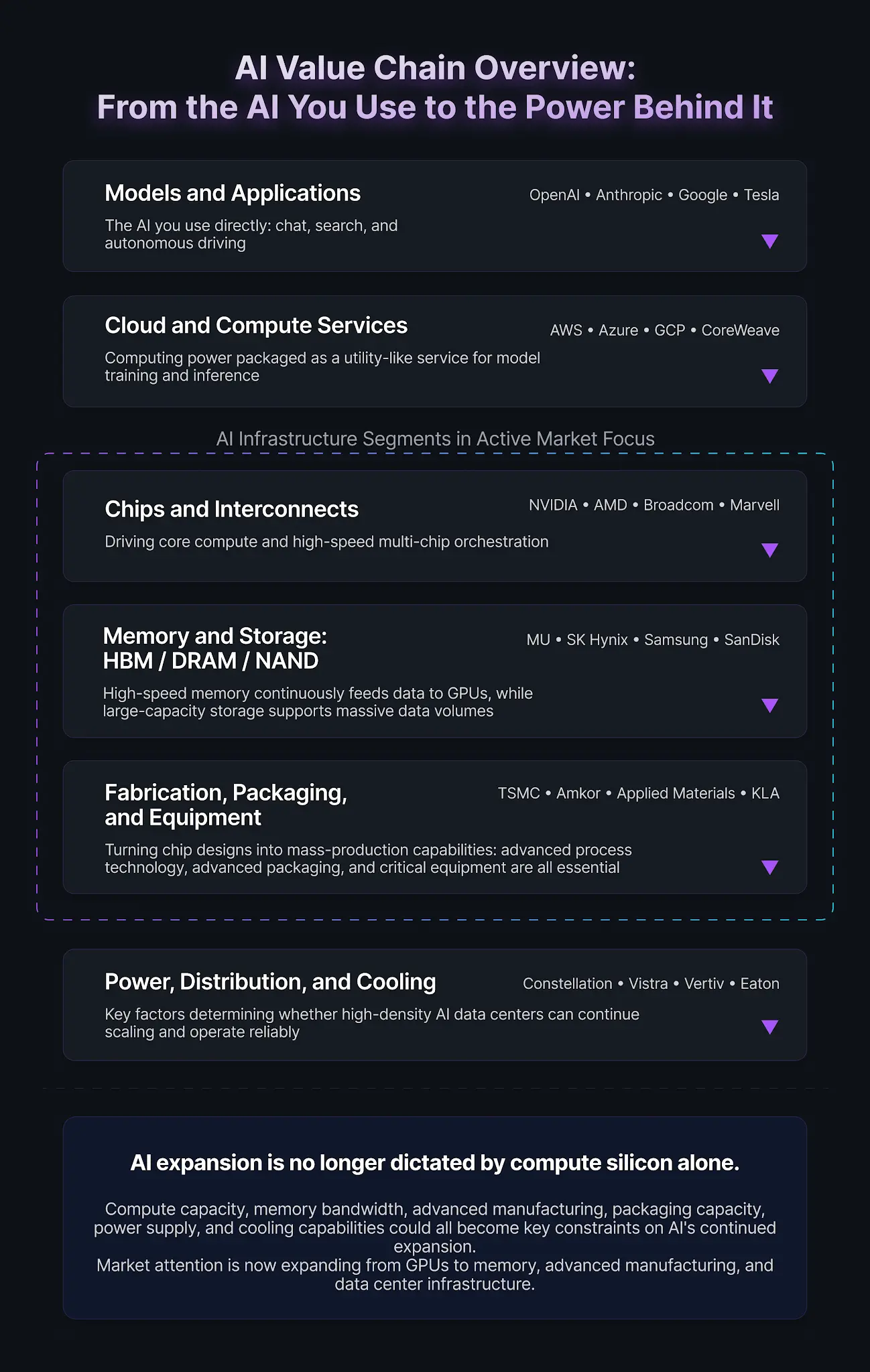
So when the market starts to believe that AI demand will continue growing, the next questions often become: Who will supply memory for GPUs? Who can manufacture and package these chips at scale? Who can power and cool the expanding wave of data centers? As a result, market attention is moving beyond U.S. GPU companies and extending to memory makers such as Micron and SK Hynix, manufacturing and packaging leaders such as TSMC, as well as power, data center, and cooling infrastructure providers.
Once you understand how momentum ripples through the value chain, a more important question follows: how should you participate? Below, we will look at different user needs and explore how to choose a U.S. stock access method that better fits your strategy.
2. Don't Wait for the Market Open to React: Stock and Index Futures
U.S. companies often release earnings before the market opens or after it closes, while major economic data such as nonfarm payrolls and CPI are also frequently released before regular trading hours. In other words, information that can significantly reshape market expectations often appears outside normal trading sessions.
Take Micron as an example. Its latest earnings were released after the U.S. stock market closed. Once the results came out, the impact was not limited to Micron itself. If HBM demand exceeded expectations, memory-chain names such as SanDisk, SK Hynix, and Samsung could also be repriced. If the results were weaker than expected, expectations for semiconductor-related ETFs such as DRAM ETF and SOXL could also adjust accordingly.
But even when the information is already available, the market is not always open at the same time. U.S. stocks enter after-hours trading, while the Korean and Japanese markets have not yet opened. Even if users understand how the news may transmit across the value chain, they may not be able to trade all the assets they are watching at the same moment.
Stock and index Futures are designed to bridge this time gap. What they offer is not long-term ownership of a stock, but a way to trade potential price movements across different parts of a value chain when new information emerges. If earnings beat expectations, users can go long on Micron or extend that view to other names in the same sector. If earnings miss expectations, or if the market has already priced in too much optimism, users can go short or adjust positions in time.
Trading activity reflected this shift. On the full trading day after Micron released earnings, the combined trading volume of four memory-chain-related Futures on MEXC, including Micron, SanDisk, SK Hynix, and DRAM ETF, doubled from the previous day. When earnings changed market expectations for memory demand, users were not only trading Micron itself, but also the potential chain reaction across the entire value chain.
The same logic also applies to weekends.
During the first weekend after SpaceX went public, traditional stock markets were fully closed, but SPCX Futures trading on MEXC remained active. This shows that trading demand does not disappear simply because traditional markets are closed. For users accustomed to the 24/7 rhythm of the crypto market, weekend closures in traditional markets are themselves a form of friction. Futures are designed to reduce exactly this kind of friction.
MEXC Stock and Index Futures currently cover 150+ assets, support 24/7 trading, use USDT settlement, and offer up to 100x leverage, allowing users to control larger positions with less capital, while recognizing that leverage also magnifies losses. In addition to U.S. market assets, MEXC also covers multiple Asian memory and semiconductor companies. Users do not need to switch accounts back and forth to trade assets across different markets. Instead, they can form views, adjust exposure, and hedge around the same value chain on one platform.
3. Own Stocks and Receive Dividends: RealStocks
Looking at the same Micron earnings report, another group of users may think very differently.
They may not care how much the stock moves tonight, nor do they plan to trade frequently around short-term volatility. Instead, they may have a longer-term view on the structural demand driven by HBM, advanced manufacturing, and AI data center expansion over the next two to three years, and want to include Micron, TSMC, or NVIDIA as part of their long-term allocation. In this case, what they need is not a contract position, but real stock ownership.
For many crypto users, however, their funds originally sit in a USDT account. Moving from USDT to real U.S. stocks usually means opening a brokerage account, completing identity verification, handling cross-border deposits and FX conversion, and using an entirely separate brokerage and settlement system. The goal may be as simple as buying and holding one stock, but there are still multiple barriers in between.
RealStocks is designed to solve these barriers. Users can place orders with USDT and access real U.S. stock trading through licensed brokers partnered with RealStocks. Orders are connected to U.S. securities market liquidity, with pricing and execution depth supported by external market sources rather than a standalone platform quote. USDT conversion is handled in the backend, so users do not need to manage FX conversion or cross-border transfers on their own. Where applicable, users may also receive corresponding dividend entitlements. This means users are no longer only holding short-term price exposure linked to Micron, NVIDIA, or TSMC, but real stock positions established through the traditional securities system.
In terms of trading experience, RealStocks supports regular-hours, pre-market, and after-hours trading, and currently offers 0 fees. Users can build medium- to long-term U.S. stock positions without leaving MEXC.
In the first two weeks after launch, RealStocks attracted more than 100,000 cumulative users. A total of 814 stocks and ETFs recorded actual trades, with more than 7,000 tradable assets available. Over 76% of individual trades were concentrated in the $100 to $10,000 range. From the distribution of trading amounts, user participation was not limited to small-scale feature testing. Instead, it reflected real demand from users with genuine allocation needs.
4. Crypto-Native Stock Exposure: Tokenized U.S. Stocks
This may be the most misunderstood product category.
Both RealStocks and tokenized U.S. stocks can be traded with USDT, and both allow users to participate in popular assets such as Micron, NVIDIA, and Tesla. But what users buy through the two products is not the same.
With RealStocks, users hold real stocks through the securities system. Tokenized U.S. stocks, by contrast, are on-chain tokens. Users gain economic exposure tied to the underlying stock, not direct shareholder status in the traditional sense.
Some users may ask: if real U.S. stocks are already available, why choose tokenized U.S. stocks?
First, access. Due to KYC and regional eligibility rules, RealStocks may not be available to all users. For users who cannot trade real U.S. stocks in their region but still want to participate in related price movements, tokenized U.S. stocks offer a crypto-native path. Users may not need direct shareholder status, voting rights, or cash dividend distributions from a traditional securities account. They may simply want to trade and hold U.S. stock price exposure in a familiar crypto environment using USDT or USDC.
Second, on-chain composability. Traditional stock positions remain inside securities accounts and cannot natively enter on-chain applications. Tokenized U.S. stocks are different. Where supported by the platform, network, wallet, and relevant protocols, users can transfer tokens to self-custody wallets and further use them in lending, liquidity, or other DeFi strategies. In other words, beyond holding and trading, tokenized U.S. stocks can support more flexible on-chain financial use cases.
Of course, on-chain composability also introduces additional risks. In addition to price fluctuations of the underlying stock, users should also pay attention to short-term price deviations, issuance structure, liquidity, oracle risks, and risks associated with relevant DeFi protocols.
In addition, many users wonder whether tokenized U.S. stocks may trade at prices that diverge from their underlying shares. Actual data after Micron's earnings offers a useful reference. Under the same information-driven market move, RealStocks traded around $1,237 in pre-market trading, Futures around $1,235, and the tokenized version around $1,233, with a difference of less than 0.4%. Of course, differences in trading hours, liquidity, and pricing mechanisms may still lead to short-term price gaps. Still, under the same market catalyst, all three products stayed within a narrow range, reflecting similar expectations for the underlying company.
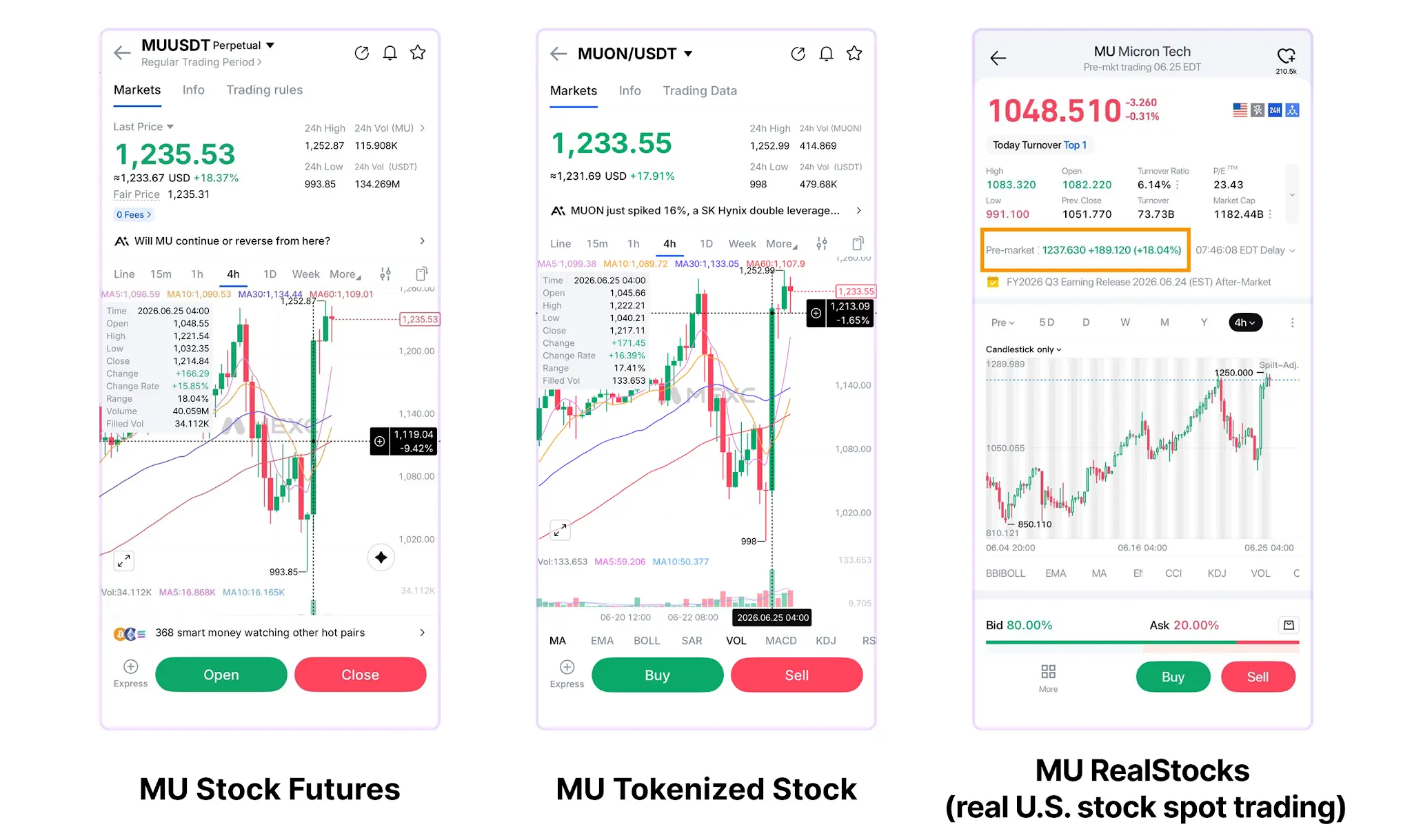
Currently, MEXC has listed over 200 tokenized U.S. stock trading pairs, including 192 Ondo tokenized U.S. stock pairs and 11 xStocks pairs. These products support 24/7 trading, with selected pairs currently enjoying 0-fee.
5. Invest Before the IPO: Pre-IPO Launchpad
Many users are no longer focused only on publicly traded giants such as NVIDIA, Micron, and TSMC. Instead, they want earlier access to companies such as OpenAI, Anthropic, Stripe, and Databricks, which remain among the most closely watched private companies. Their goal is to gain exposure before these companies go public.
In the past, these opportunities were typically available to institutions, accredited investors, or participants in private secondary markets. For regular users, by the time a company officially lists, the early investment opportunities may have already passed.
MEXC Pre-IPO Launchpad provides an entry point for regular users to participate before listing.
Take SpaceX(PRE) as an example. Across two phases of MEXC Pre-IPO Launchpad events, total subscriptions exceeded $173 million. This shows that for highly watched technology assets that have not yet entered the public market, there is strong demand for earlier access.
It should be noted that Pre-IPO Launchpad is not the same as buying shares directly in a private company. Subscription, allocation, settlement, and risk exposure mechanisms may vary by event. Please refer to the specific rules of each event for details.
6. Conclusion
From NVIDIA to Micron and SK Hynix, and then to the next technology company that has yet to go public, AI investing is no longer just about choosing a single stock.
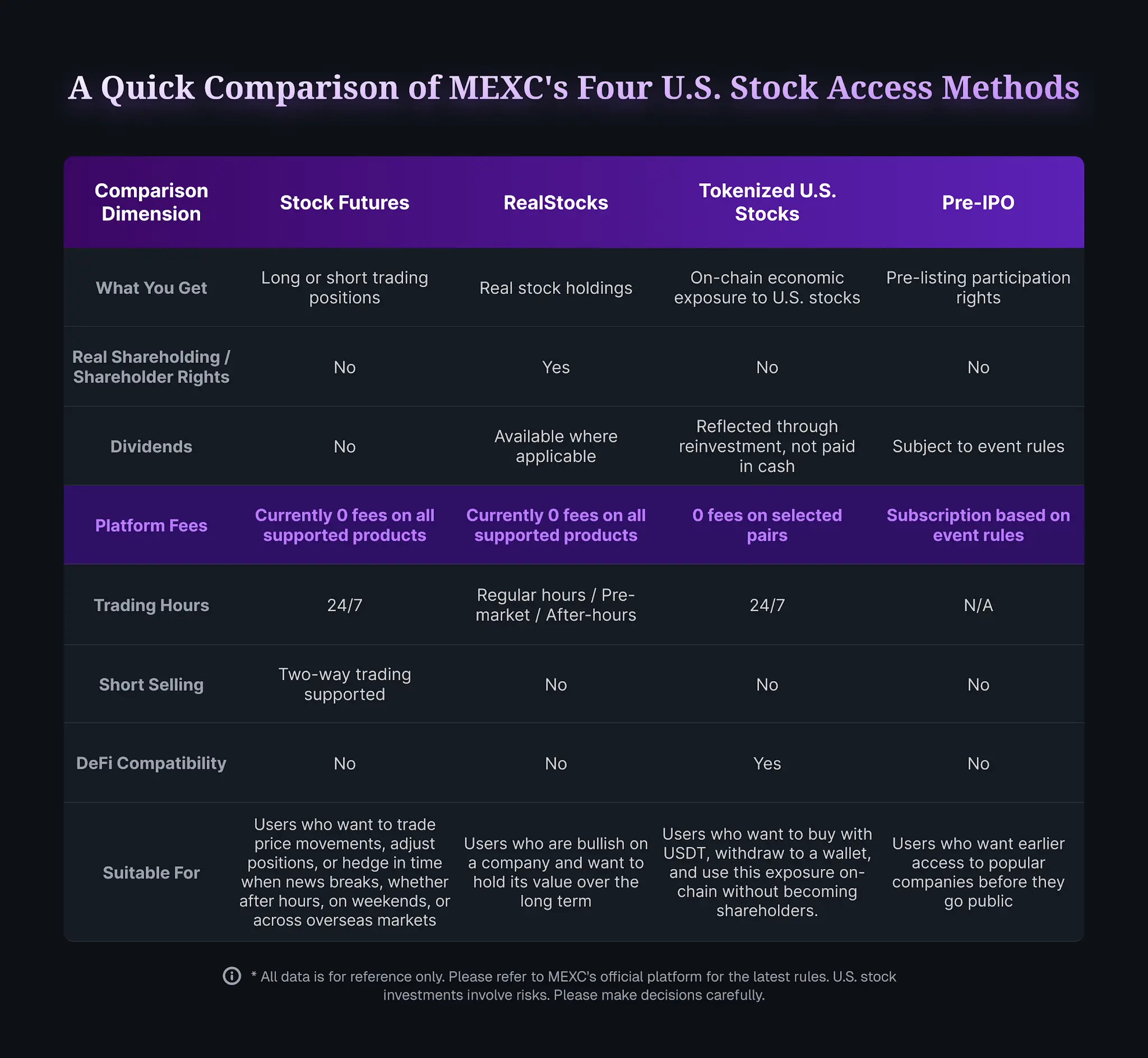
For users who want to hold shares of a company, RealStocks may be the right choice. For those who want to go long, go short, or adjust positions when news breaks, Stock and Index Futures offer a more flexible tool. For users who want to hold stock exposure on-chain, tokenized U.S. stocks provide a crypto-native path. For those looking to get in before a company goes public, Pre-IPO Launchpad provides access to pre-listing opportunities.
Market narratives rotate quickly. What MEXC aims to provide is a range of ways to participate across short-term trading, long-term holding, and early-stage opportunities, allowing users to capture opportunities at their own pace.
 Risk warning



Popular articles





