








U.S. debt approaches 40 trillion, Bank of America’s Hartnett: Going long on gold is the best solution right now
 Core Viewpoint

 U.S. national debt is approaching the $40 trillion mark. Bank of America’s Hartnett believes that "going long on gold" is the optimal solution at present—gold is the best hedge against dollar depreciation, bond collapse, and political risk. Meanwhile, the AI financing frenzy has driven corporate bond supply to surge by 61% year-on-year, structurally squeezing out buyers of government bonds, with debt interest expenses reaching $1.4 trillion. Hartnett warns that the results of the November elections will be the biggest variable determining the market direction at the end of the year.
Author: Long Yue
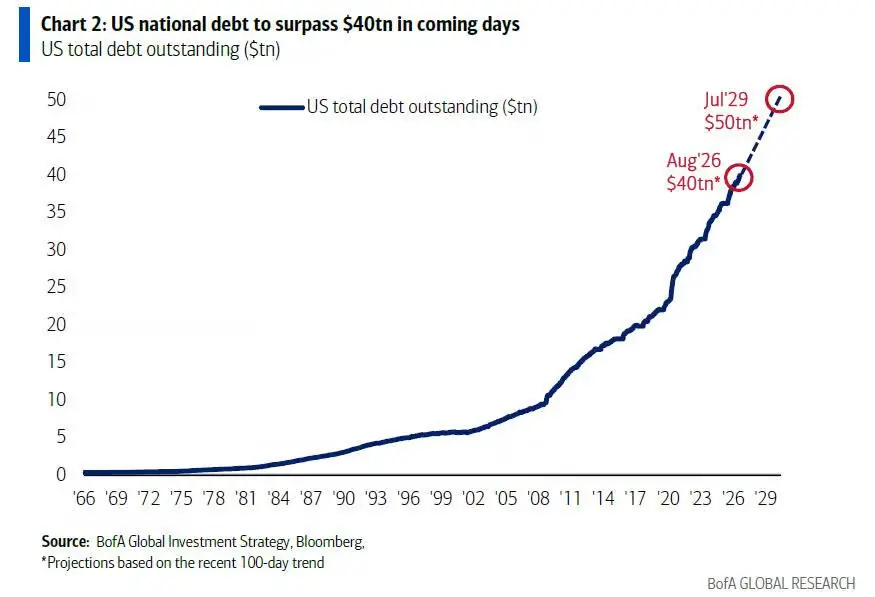
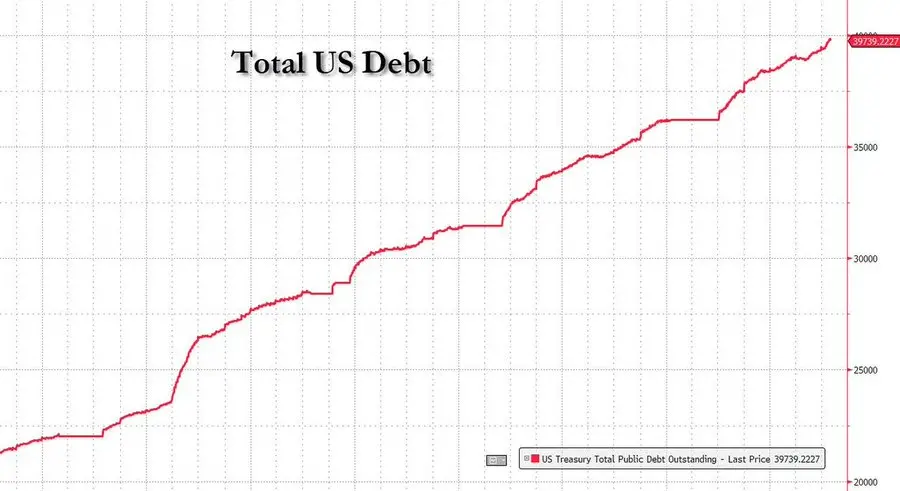
The U.S. national debt is just $65 billion away from $40 trillion. As of last Friday's close, this "historical integer milestone" is within reach. Michael Hartnett, Chief Investment Strategist at Bank of America, titled the latest edition of the "Flow Show" report "Strife Begins at Forty," marking this moment as the core narrative of the current market.
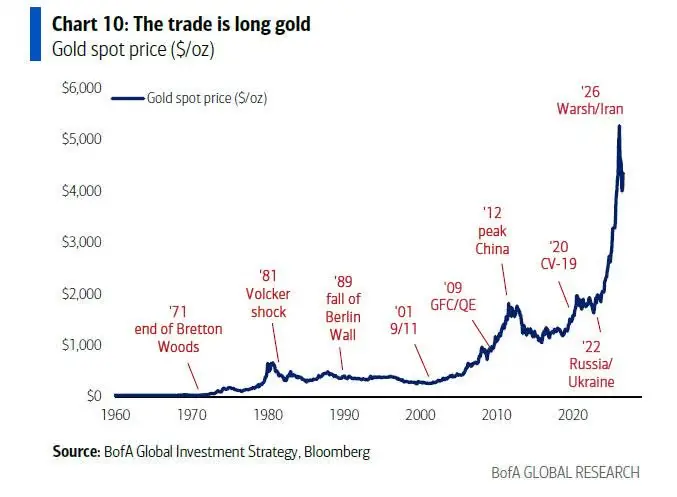
Hartnett pointed out that U.S. national debt will not only surpass $40 trillion in the coming days but will also surge towards $50 trillion around 2029. In such an environment, Hartnett believes that going long on gold is the optimal solution, as gold remains the best tool to hedge against dollar depreciation, bond collapse, and asset inflation.
Debt Interest Has Become the "Largest Expenditure," Bond Market Under Pressure
In the past 12 months, U.S. debt interest expenditures have reached $1.4 trillion, nearing surpassing Social Security to become the federal government's largest single expenditure.
Hartnett clearly stated that this trend will not reverse—unless the 5-year U.S. Treasury yield falls below 3.25%. Without significant deflationary shocks or recessions, this is nearly impossible.
Meanwhile, the 30-year U.S. Treasury was issued last week at a yield of 5.126%, marking a 25-year high. Hartnett summarized this absurdity in one sentence: "U.S. stocks hit a historical high on the same day that U.S. Treasuries were issued at the highest yield in 25 years—this is reality."
The AI Financing Frenzy Is "Driving Out" Treasury Buyers
The pressure on the bond market does not only come from the government. Nomura strategist Charlie McElligott's data shows:
Total corporate bond supply surged 61% year-on-year.
The issuance scale of AI/large-scale data centers/data center-related bonds (investment grade + loans) has reached about 12 times the annual average level from 2015 to 2024, totaling $269 billion year-to-date, which is double the entire year of 2025.
A large influx of corporate bonds into the market is structurally steepening the U.S. Treasury yield curve (bear steepening), pushing out funds that should have been used to purchase long-term Treasuries. CTA trend strategies hold an overall "short" signal on G10 bonds, with nominal positions at the 12th percentile since 2010, and short-term interest rate positions at the 10th percentile.
The result is a vicious cycle: credit spreads widen → long-term buyers are pushed out → yield curve steepens → market concerns about "loss of control" intensify.
Asset Allocation Principle: Gold Is the Core Answer
In the report, Hartnett reiterated several asset allocation frameworks for the 2020s and further strengthened them in 2026:
ABB (Away from Bonds), ABD (Away from Dollars), AI (All In on AI), etc.
The common logic behind these four principles is that decision-makers view "nominal GDP prosperity" as a way to solve the debt problem and see the stock market as "too big to fail." For this reason, Hartnett wrote last week: "Wall Street is trading without fear."
His summary of the current market sentiment is: "A large amount of EPS growth, a $10 trillion increase in wealth by 2026, and AI capital expenditures exceeding $1 trillion in 2027… the door is wide open for bulls, with the only constraints being bonds (yield surging), voters (socialist wave), and the fact that everyone has bet on the upside."
Going Long on Gold: The Optimal Solution Against Dollar Depreciation
Within the "ABD (Away from Dollars)" framework, Hartnett provided a clear trading direction: go long on gold.
His logic is straightforward: gold remains the best hedge against dollar depreciation, bond collapse, asset inflation, and the political game of populism in capitalism and socialism in the 2020s.
The logic for a weaker dollar is equally clear. The U.S. government has signaled through yen exchange rate interventions—hoping to prevent the 10-year U.S. Treasury yield from exceeding 5%. As the midterm elections approach, the CPI is expected to run in the range of 2.8%-3.6%, with core CPI at 2.1%-2.6%, indicating limited tolerance for rising yields from a policy perspective.
Hartnett believes that the hawkish statements from Warsh at the Jackson Hole meeting on August 28, combined with the potential interest rate hike from the Bank of Japan on September 18, may jointly signal "mission accomplished," providing a basis for suppressing yields and ending the risk of yen depreciation.
Under the "Away from Bonds" Framework, Which Assets Are Quietly Outperforming?
Within the "ABB (Away from Bonds)" framework, Hartnett pointed out an interesting phenomenon: despite rising yields in 2026, those long-duration assets that were previously overlooked—REITs, biotechnology (XBI), regional banks (KRE), small-cap stocks—are quietly outperforming the market.
The market is "pricing" the peak of yields through action. Hartnett believes that the next round of significant yield increases is "too dangerous for authorities and will not be allowed to happen," which is precisely why these assets are gaining support.
The Other Side of AI Trading: Shorting AI Bonds
Within the "All In on AI" framework, Hartnett provided a counterintuitive trade: short AI bonds.
The logic is: over $1 trillion in capital expenditures combined with negative free cash flow means AI companies must continuously issue large amounts of debt for financing. This trade was first proposed by Hartnett at the end of 2025, and he stated that it is "far more profitable" than going long on AI stocks in 2026.
He believes the optimal bubble strategy is: simultaneously going long on "arrogance" (AI) and "humiliation" (overlooked cyclical assets). Drawing historical parallels: emerging markets during the 1999 internet bubble and oil during the 2007/08 subprime/China bubble were both beneficiaries of "humiliated assets" at the end of the bubble.
Key Future Nodes: Elections and Policies Are the Biggest Variables
Hartnett listed key market events for the coming months:
August 28: Warsh speaks at Jackson Hole
September 4: August non-farm payroll data
September 11: August CPI data
September 16: FOMC meeting (rate hike probability 35%)
September 18: Bank of Japan meeting (rate hike probability 74%)
September 24: Major diplomatic events between China and the U.S.
October 4: Brazilian elections
Hartnett's final judgment is clear: if the Republicans hold the Senate and Abbott retains the Texas governorship, the stock market (especially the AI sector) is expected to further surge to bubble levels in 2027; if the Democrats win the Senate and Texas governorship on November 3, the stock market, dollar, and bond yields will face a significant decline of over 10% before the end of the year.
 Risk warning



Popular articles





