Huobi Expert Lecture | From Crypto to TradFi: Asset Research Analyst YT Decodes New Opportunities in US Stock Perpetual Contracts and Macro Allocation

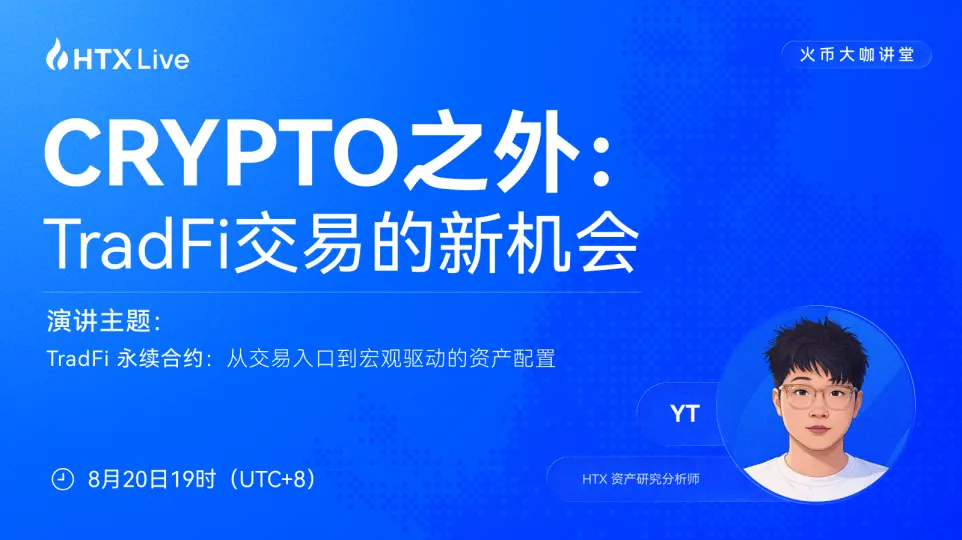
 This event is themed "New Opportunities in TradFi Trading Beyond Crypto," featuring a special guest, YT, an asset research analyst from Huobi HTX, in the live broadcast.
As the connection between cryptocurrencies and the TradFi market becomes increasingly close, more and more Web3 native users are starting to turn their attention to assets such as US stocks, gold, crude oil, and macro indices. Faced with the complex interplay of global macroeconomics, US dollar liquidity, and geopolitical factors, how can crypto traders break the limitations of single assets and move towards a diversified asset allocation driven by macro factors?
On August 20, the sixth session of the long-term educational program "Huobi Celebrity Lecture Hall," carefully crafted by Huobi Growth Academy, concluded successfully. This session focused on the theme "New Opportunities in TradFi Trading Beyond Crypto," inviting Huobi HTX asset research analyst YT to the live broadcast room to delve into the trading logic of US stock perpetual contracts, the AI sector stock selection framework, and macro asset allocation strategies, opening a new investment window for Web3 traders.
Upgrading Trading Entry: How Can Web3 Users Navigate TradFi Assets?
YT began the discussion by addressing the "trading entry," pointing out that participating in trading the same traditional financial asset through different tools corresponds to different rights, costs, and risks.
Taking stocks as an example, traders can gain market exposure through direct stockholding, tokenized stocks, perpetual contracts, and options/leverage.
Among these, direct stockholding allows for relatively complete shareholder rights but is usually limited by trading hours, account, and market access; tokenized stocks map traditional stocks through blockchain, providing Web3 users with an on-chain trading entry, but attention must be paid to issues such as underlying asset custody, compliance, and rights protection; perpetual contracts focus more on price trading, supporting 24/7, both long and short positions, and leveraged trading, but also come with risks such as funding rates, margin, and forced liquidation.
In addition, for seasoned DeFi players, tokenized stocks combined with perpetual contracts can give rise to advanced strategies such as forming liquidity pools (LP) and arbitraging funding rates through spot-futures price differences, greatly broadening the profit dimensions of capital.
YT stated that for most Crypto users, perpetual contracts may be a relatively direct way to enter TradFi trading, but before trading, it is essential to clarify what assets they are trading and the specific rules and risks associated with different trading tools.
Focusing on the Main Line: Allocation Logic of AI Sector Leaders and Macro Mapping Assets
After clarifying the trading entry, YT further extended the discussion to "what to buy."
YT believes that the assets worth focusing on in the current TradFi market can be roughly divided into two categories: one is assets related to the AI industry chain, and the other is macro mapping assets such as gold, silver, foreign exchange, stock index ETFs, and US Treasuries.
For the AI industry chain, YT broke it down into several segments, including computing power chips, high-speed network interconnections, storage and memory bandwidth, manufacturing capacity, electricity and infrastructure, as well as cloud computing, large models, and enterprise applications.
He believes that the trading main line of the current AI industry chain can be summarized as "capital will always chase new bottlenecks; leaders that can convert technological bottlenecks into profits have higher certainty and lower risk."
Therefore, rather than blindly chasing market hotspots, YT prefers to focus on leading companies that master key technologies, supply chain bottlenecks, or market share, and proposed three screening dimensions: "share, profit, certainty."
Specifically, traders need to pay attention to whether the company controls key bottlenecks in the segmented track, whether downstream customers have high replacement costs; simultaneously observe gross margins, free cash flow, and capital expenditure returns; in addition, attention should also be paid to whether order backlogs and management revenue guidance are continuously improving.
"When leaders correct, there is at least fundamental support." YT stated that compared to second and third-tier companies lacking fundamental support, leading companies with market pricing power still have a relatively clear value anchor when market risk appetite declines.
Regarding macro assets, YT used gold, US Treasuries, and index ETFs as examples to outline the data-driven trading logic.
For instance, when CPI is below expectations or the Federal Reserve releases dovish signals, it usually leads to lower real interest rates and a weaker dollar, which benefits gold and non-US currencies; for major US stock indices (such as SPY and QQQ), a comprehensive consideration of overall market earnings expectations and the game without risk discount rates is necessary. When facing an uncertain macro environment, compared to the tech-heavy QQQ, the broader SPY (S&P 500 index ETF) often performs better in diversifying single-sector risks.
Practical Insights: Integrating Trading Knowledge and Risk Management
In this session, the execution of trading and risk management was also an important topic throughout.
On the practical level, YT imparted five core signals for assessing financial reports and valuations to investors: focusing on revenue and order growth, changes in profit margins, capital expenditure return rates, valuation multiples (PE), and the degree of market position crowding. At the same time, clarify the type of trading, choose matching trading tools, and set exit conditions in advance.
YT stated that trading is not about proving oneself right, but about managing risk and participating in trends amid uncertainty. When the initial buying logic has failed, one should exit promptly rather than continue to fight against the market.
In the interactive session, YT further responded to users in the live room regarding TradFi asset selection, funding rates, market volatility, and risk diversification.
YT mentioned that TradFi perpetual contracts, in addition to facing common leverage and forced liquidation risks, also have a problem that Crypto users often overlook, which is the mismatch between traditional financial market trading hours and perpetual contract trading hours.
For example, the stock market typically does not trade on weekends, but related perpetual contracts may still trade continuously. If unexpected events occur over the weekend, related assets may experience significant volatility, and high-leverage positions will further amplify risks.
Moreover, when participating in tokenized stock liquidity mining or funding rate arbitrage, traders also need to consider trading depth, transaction volume, slippage, fees, impermanent loss, capital occupation, and margin risks under extreme market conditions, and cannot simply judge strategy returns based on nominal APR.
Regarding the risk concentration issues that may arise from trading multiple assets simultaneously, YT emphasized that traders need to reasonably control their positions and avoid excessive leverage. Do not go all in; always leave yourself some bullets.
 Risk warning


Popular articles