As AI Moves from Brain to Body: What Four AI Asset Classes Are Really Pricing In

 Behind the Yuzhu IPO: How does AI funding flow from large models to computing power, storage, and embodied intelligence?
Unitree Robotics' IPO has put humanoid robots back at the center of the AI trade.
Before the shares begin trading, several centralized exchanges have already listed Unitree-linked Pre-IPO contracts, allowing crypto markets to trade expectations around the robotics company's debut. That raises a more fundamental question: where does Unitree sit in the AI value chain, and how does it relate to assets such as Anthropic, NVIDIA and Micron?
Using Unitree as a starting point, this article explains how the AI stack works, what drives foundation models, compute, memory and storage, and physical AI, and how crypto users can select the instruments that best match their view.
1. From Infrastructure to Embodiment: How the AI Stack Works
From an industry perspective, the four asset groups span three layers. Compute, memory and storage form the infrastructure layer; foundation models sit at the intelligence layer; and physical AI, including embodied AI, brings intelligence into the physical world.
Physical AI refers to systems that can perceive, understand and act on the real world, spanning robotics, autonomous driving and smart spaces. In this article, embodied AI is treated as one of the branches most closely associated with robotics.
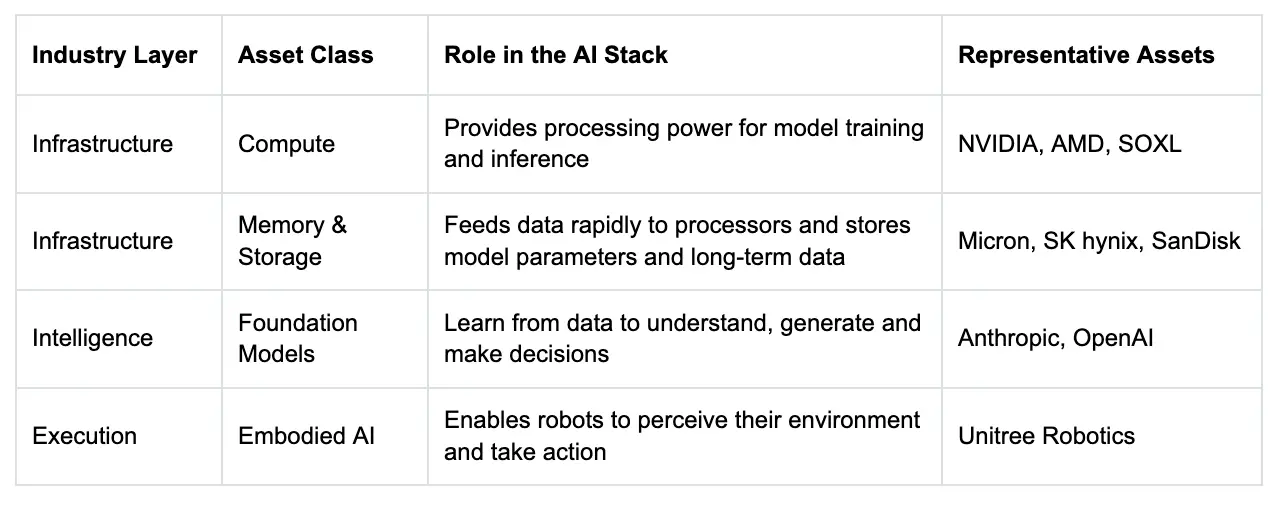
GPUs provide the compute needed for training and inference, while HBM, DRAM and other storage media move and retain model parameters and runtime data. Foundation models turn that infrastructure into intelligence; robots turn decisions into real-world actions. That is how AI progresses from infrastructure to a brain and, ultimately, a body.
2. Why Unitree Is the Latest Focus of the AI Trade
Unitree is attracting attention in part because humanoid robots are beginning to achieve commercial scale. According to its preliminary prospectus, the company generated approximately RMB 1.699 billion in revenue in 2025, including RMB 868 million from humanoid robots, and sold 5,215 humanoid units during the year.
As crypto exchanges expand their TradFi-linked offerings, expectations surrounding Unitree's listing reached derivatives markets before the public share subscription. MEXC listed UNITREEUSDT on July 31, followed by platforms including Bybit and Hyperliquid between August 3 and 5. These Pre-IPO contracts allow 24/7 trading in listing expectations, but they provide price exposure rather than equity and confer no dividend rights.
Cross-platform differences also make this product category easier to compare. MEXC, for example, currently runs a 0-fee promotion on UNITREEUSDT and offers leverage of up to 50x, the highest among the platforms in the comparison. Lower fees reduce transaction costs, while a higher leverage ceiling gives traders more flexibility in sizing positions.
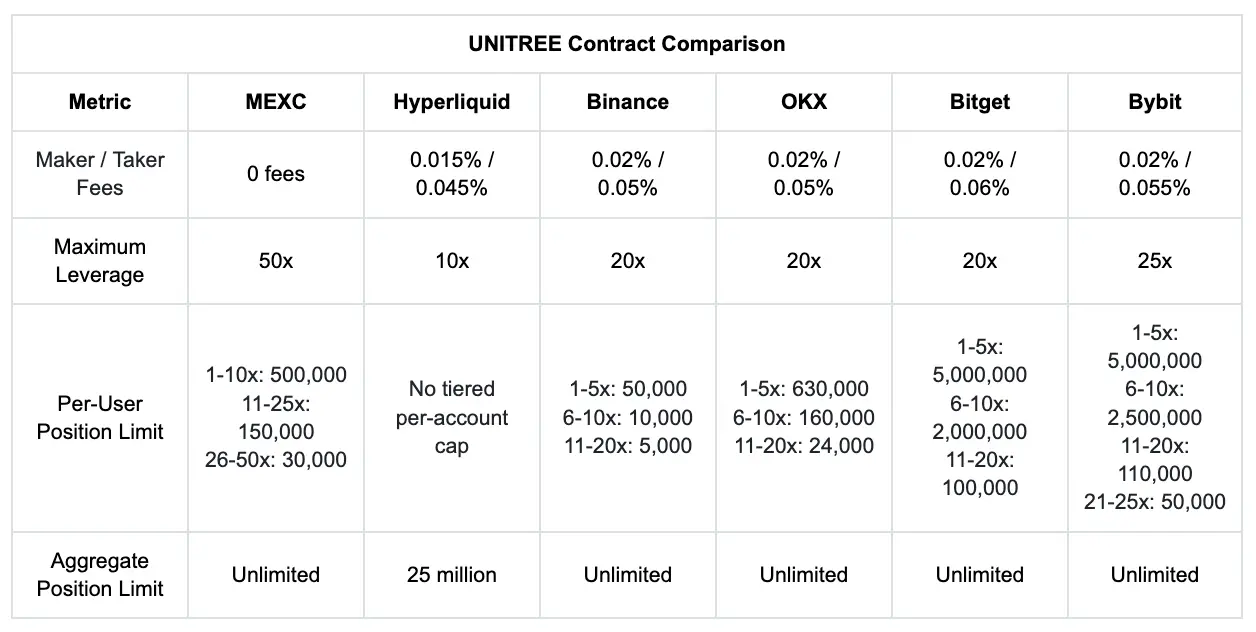
As more platforms listed the contract, trading in Unitree's listing expectations spread across markets. At 12:00 p.m. (UTC+8) on August 17, 2026, combined 24-hour notional volume across MEXC, Bybit, Gate and two UNITREE markets on Hyperliquid was approximately 4.908 million USDT. MEXC accounted for about 2.124 million USDT and Hyperliquid XYZ for approximately 1.687 million USDT; the other three markets ranged from roughly 250,000 to 440,000 USDT.
3. How Capital Rotates from Models to Embodied AI
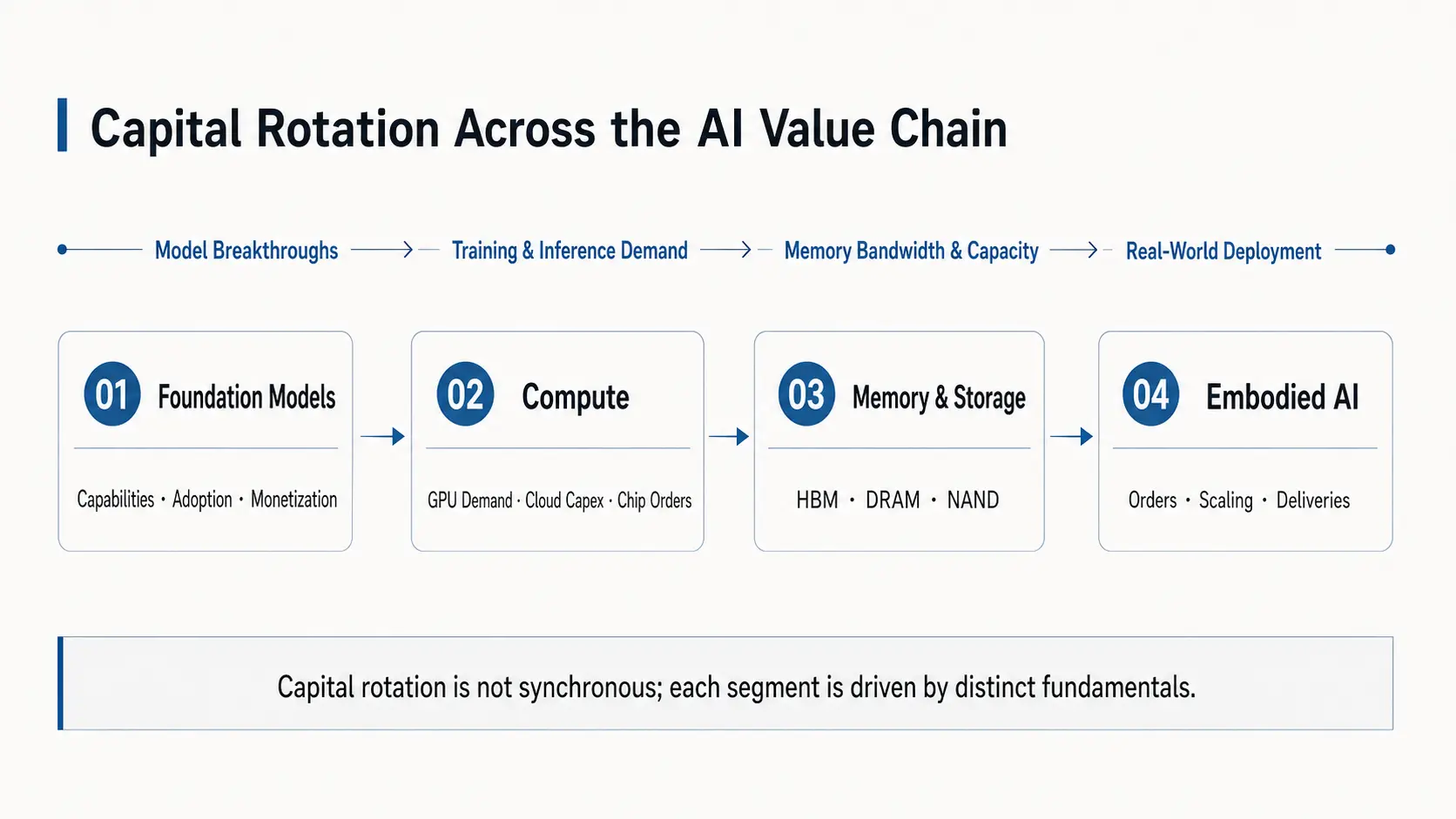
The industry stack runs from infrastructure to models and applications. Market attention often moves in the opposite direction: it begins with a visible model breakthrough, then searches upstream for beneficiaries and downstream for commercial use cases, as shown below.
1. Foundation Models: Capability First, Valuation Second
When OpenAI or Anthropic releases a new model, investors first assess product performance, then ask whether usage and enterprise adoption can keep pace. Rising valuations have a firmer commercial foundation only when models attract sustained use. From there, the market begins to estimate the training and inference resources required.
2. Model Momentum Spills Into Compute
As models demand more training and inference capacity, cloud capital expenditure, GPU orders and chipmakers' forward guidance become the next focal points. Assets such as NVDA, AMD and SOXL provide more direct exposure to AI compute spending and the semiconductor cycle.
3. Beyond GPUs, AI Demand Reaches Memory and Storage
GPUs perform the calculations, but models also need a constant flow of data. This raises bandwidth requirements for HBM and DRAM while expanding demand for NAND capacity. Pricing in this segment also reflects the supply cycle, so new capacity, inventory levels and product pricing matter alongside AI demand.
4. Embodied AI Ultimately Comes Down to Orders and Deliveries
As a major path toward commercializing physical AI, robotics is becoming the next destination for capital moving through the AI theme. For embodied-AI companies such as Unitree, the key questions are whether orders convert into revenue and whether deliveries can scale into a durable business.
4. How Crypto Users Can Trade the AI Theme
Before placing a trade, users need to identify which layer an event affects first, then choose the product that best matches that view. MEXC is used here as a sample because it offers broad coverage across these categories. Representative instruments along the four segments are shown below.
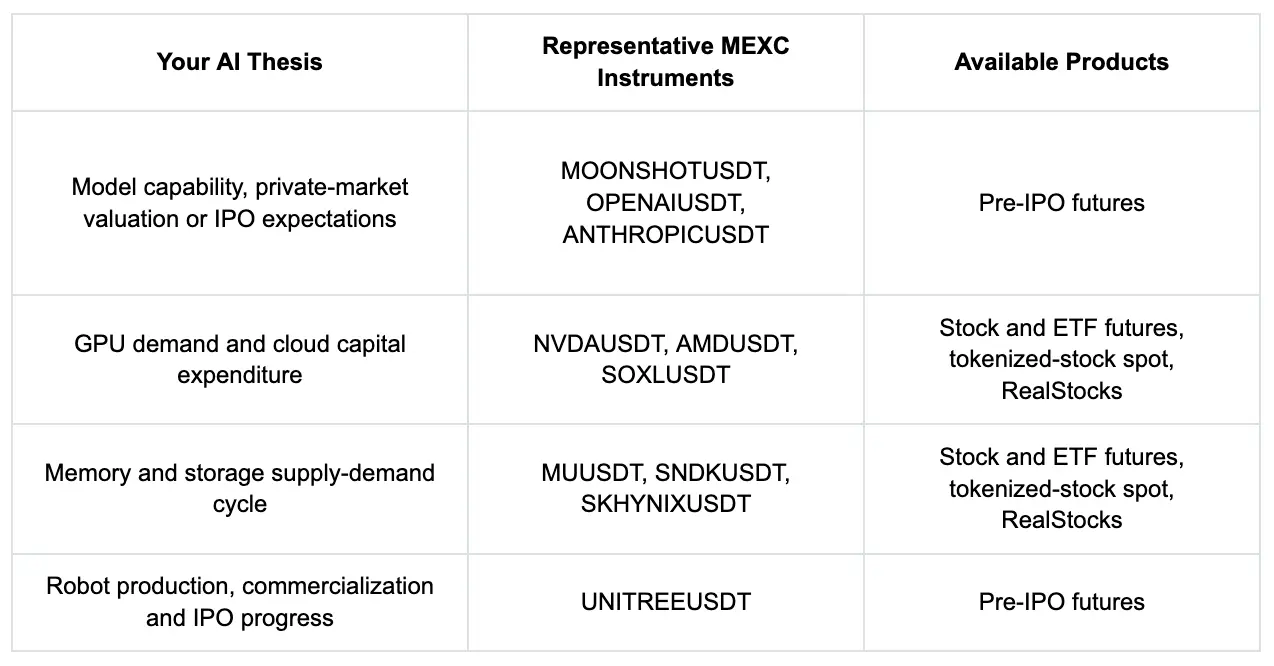
The table answers what to trade. The next question is which product format to use. On MEXC, the AI-linked instruments above can be accessed on one platform and selected according to the trader's needs.
For leverage, short exposure or event-driven tactical trading, users can turn to stock and ETF futures. For companies approaching an IPO, such as Kimi and OpenAI, Pre-IPO futures provide exposure to expectations before listing, without equity ownership or dividend rights. Investors seeking long-term ownership and shareholder rights can consider RealStocks; those who prefer spot exposure with on-chain transferability can consider tokenized stocks. Both track the underlying share price, but their legal rights and custody structures differ.
Take NVIDIA as an example. MEXC offers NVDAUSDT stock futures; NVDAX/USDT and NVDAON/USDT tokenized-stock spot pairs; and NVDA through RealStocks. Traders can choose among leverage, shorting, on-chain holding or direct shareholder rights based on their objective.
5. As AI Enters the Physical World: What Comes Next for the Machine Economy?
Unitree's IPO is shifting AI attention from models and chips toward real-world applications.
For crypto, the most immediate connection is still the ability to trade expectations around robotics companies through derivatives. Over the longer term, the focus may shift to infrastructure that gives robots verifiable identities, data ownership, payments and coordination capabilities. OpenMind, for example, is working on robot operating systems and coordination networks, while PrismaX is exploring the collection of training data.
These projects remain early, but they give the intersection of crypto and robotics a more concrete direction. Unitree's ability to become a long-term winner still needs to be proven; for investors, the more important task is to identify which part of the AI stack a new development affects.
 Risk warning



Popular articles