Latest Interview with Shen Yu: Builders, Long-termism, and Investment Philosophy in the AI Era
 Core Viewpoint

 Cobo co-founder Shen Yu: AI opens up a lot of possibilities, but is still looking for "systematic major events."
Author: Shen Yu, PANews
Recently, Cobo co-founder Shen Yu engaged in an in-depth conversation with Jin Ming, founder of Jichain Technology, about AI, entrepreneurship, investment, Bitcoin, Web3, Agents, and life missions.
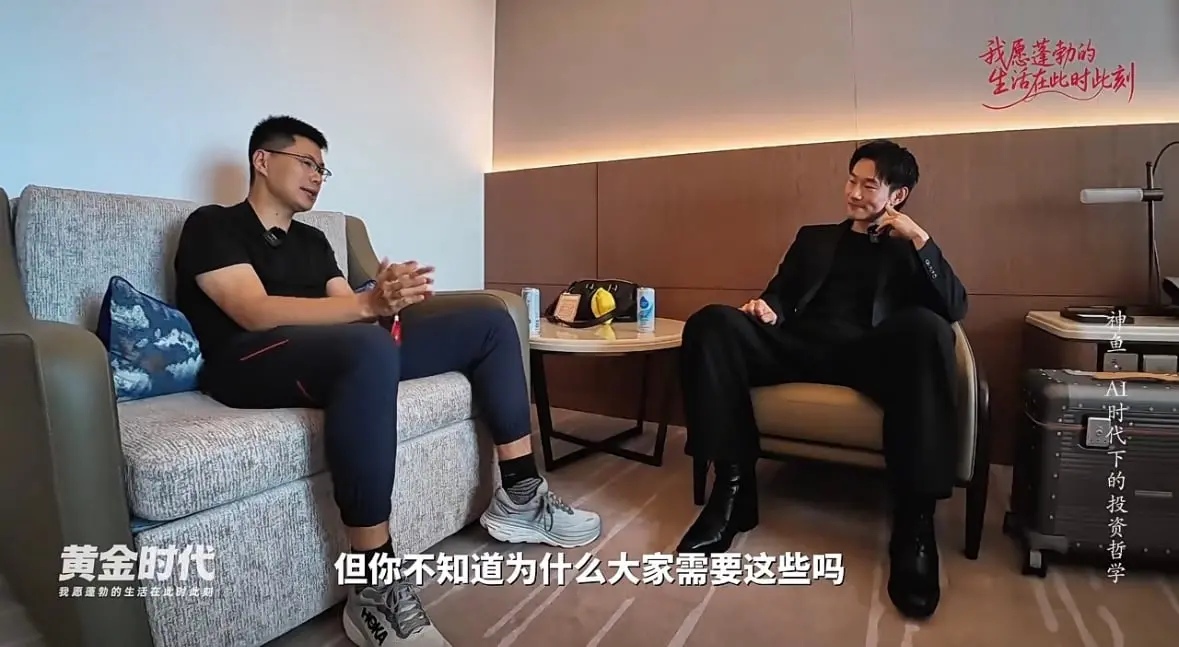
Shen Yu is an early participant in the crypto industry, having been involved in the cryptocurrency field since 2011, and is one of the earliest Bitcoin evangelists and participants in China. Jin Ming is a member of China's national free diving team and the founder of Jichain Technology, focusing on the research and commercial application of video AI technology, and has received investments from institutions such as Alibaba, Yunfeng Fund, and Megvii Technology.
From the sense of mission of entrepreneurs to the relationship between humans and technology in the AI era; from free diving and death anxiety to investment frameworks and asset allocation; and then to BTC, RWA, Agents, and the future of Ethereum, the two engaged in a deep discussion surrounding technology, capital, and individual life experiences.
Shen Yu believes that one of the most significant changes brought by AI is the substantial reduction in the cost of turning an idea into reality. In the past, an idea might remain in one's mind forever due to high execution costs; now, AI is compressing and structuring vast amounts of human knowledge and providing execution capabilities to individuals at a very low cost. The development of technology has made human will even more important. However, he also admits that while AI has opened up many possibilities, it has yet to find a sufficiently large and systematic endeavor. He still defines himself as a Builder, believing that "to be alive, in some sense, is to increase the possibilities of this world a little."
This Builder mentality also permeates his investment philosophy. Shen Yu believes that good assets do not need to rely on continuous narratives; compared to broad diversification, he prefers to concentrate on a few assets that he truly understands, as human energy is limited, and what is truly important is understanding the underlying logic behind the assets.
In the next phase of Web3, the key direction Shen Yu is observing is Agents. He believes that ecosystems like Ethereum may not primarily be for human use in the future, but rather for Agents.
The following is the full interview, compiled by PANews:
In the AI Era, Human Will is Becoming More Important
Jin Ming: The last time you participated in an interview was ten years ago, in 2017. At that time, you had a classic line: "With so much money, I don't know how to spend it."
Shen Yu: Now I know how to spend it. Essentially, I feel that human will is becoming increasingly important. Since the AI era has arrived, many things that used to require a lot of time and cost to accomplish can now be done quickly if you have an idea. This change is very significant.
Yes. Essentially, human will is becoming more important. With the arrival of the AI era, many tasks that you previously thought were particularly difficult can now be accomplished quickly if you have an idea. This change is particularly large. Things we might not have dared to imagine ten or twenty years ago can now be easily delivered. What we might not have imagined ten or twenty years ago can now be quickly delivered as long as there is an idea, as the execution costs have dropped significantly.
Jin Ming: So it's about going from an idea to final implementation.
Shen Yu: Yes. In the past, you had a seed, a dream, but it might forever remain just a dream. Now, the backend costs have dropped significantly, and with AI compressing and structuring a lot of human knowledge, you can call upon these capabilities at a low cost.
It's like having a seed at home; it can quickly take root. In the past, you would say, "Okay, I have a seed, I have a dream," but that was just a dream. Now, the backend costs have dropped significantly, and AI has compressed a lot of human knowledge, so you can call upon this at a low cost. I feel like it has opened up many possibilities. So I feel that AI has opened up many possibilities.
From a Sense of Mission to Confusion, Builders are Also Seeking Answers
Jin Ming: Are you satisfied with your current state of life? Do you feel happy and fulfilled every day?
Shen Yu: It's okay, but there is still a bit of confusion. It's not like when I first started my business, when the sense of mission was particularly strong. Now I've entered a chaotic state: you see AI has opened up many possibilities, and you feel this is the best era, but you don't see a particularly clear path. Whether it's a sense of mission or a specific business path, I haven't fully figured it out yet. So now I'm doing more exploration to improve myself.
Jin Ming: When you first started your business, how did you define your sense of mission?
Shen Yu: At that time, you saw a window of opportunity, which generated a very strong creative impulse. You felt that if this thing was not done, you would definitely regret it in your life. It felt like a force was pushing you, and you couldn't escape, so you went out and did it.
Jin Ming: At that time, the huge demand you saw was mining?
Shen Yu: Initially, it was in 2013, and the core issue was computing power. Mining started in the U.S. and later began to migrate to China. When China first started making ASIC miners, the machines still needed to connect to U.S. mining pools to mine. There were two issues: first, the network problem, where international internet latency and packet loss led to poor mining efficiency; second, the settlement methods in the mining industry at that time were not reasonable. So what we did was solve these two problems.
Essentially, you saw a market gap, a niche market, where there were unmet demands, and you just happened to have the ability to meet them. This creates a very strong impulse to want to build this thing.
Jin Ming: After such a long time, what do you think your mission is now?
Shen Yu: I still feel the need to create something. I always define myself as a Builder. Since the AI era, I have created many small tools and dashboards, but I haven't found something truly large and systematic; I'm still observing.
In fact, after being in entrepreneurship for a while, after doing many things, you end up feeling a lot of confusion and uncertainty. So you have to supplement a lot of knowledge from human history: how similar things happened in the past? How did philosophers think? These things will come back to influence you. At this moment, you can see many possibilities unfolding in the future, but you haven't found that specific path.
Seeking Life's Mission
Jin Ming: When I shared yesterday, I talked about purpose awareness, or the sense of life purpose. I compared it to a balance scale.
Many people initially want to create some big things, hoping to leave a legacy; on the other end of the scale is experience and happiness, and many young people feel that life should be about pursuing happiness. If we put this on the balance scale, where do you think you are now?
Shen Yu: I neither particularly want to leave something behind nor am I particularly pursuing experiences. I have also used AI to analyze many psychological aspects, but I am essentially someone with an inner impulse to build. I just want to build something. When things are created, I feel very satisfied. I hope to present something because I believe that, in some sense, being alive means that your existence has increased the possibilities of this world a little.
Jin Ming: This is actually quite left-leaning, very legacy-oriented. There is an interesting phenomenon in psychological research where many people want to become Builders. One potential psychological characteristic of Builders is that they are prone to anxiety. Because your life purpose is to keep building. When you are not actively moving forward or building, it is easy to enter a state of anxiety. Have you experienced this state? How do you usually resolve it?
Shen Yu: There is definitely some anxiety, but I can switch it off now. Since I was young, I have had ways to empty my mind, such as raising animals or engaging in hobbies. So basically, I enter this state every week. You have to allow yourself to empty your mind. How do you combat fear while free diving?
Re-understanding Fear in Extremes
Jin Ming: When you hold your breath, your body continuously sends you signals; this is a confrontation between rationality and emotion. I think the most straightforward analogy is that free diving is very much like a spiritual practice. First, you have to enter the water with a state of "knowing the outcome." You have to keep telling yourself: you are safe.
The human brain is actually very smart. The human body is controlled by the autonomic nervous system; for example, it is very hard to truly suffocate yourself while holding your breath on land. When you reach your limit, the brain may experience a brief blackout, which is BO, entering a state of temporary shock. About ten seconds later, the airway will reopen, and the person will naturally inhale.
But why can people die underwater? Because when a person loses consciousness underwater, when the airway reopens, what is inhaled is not air, but water. So ultimately, it could lead to drowning. This is also why free diving training must have a buddy, a training partner.
But from another perspective, it is also a very good spiritual practice. You continuously give yourself complete positive psychological suggestions: what you are doing now is meditation; you need to enter a flow state; you are healthy, you are safe; your brain is very smart.
Moreover, initially, no one can directly hold their breath to the limit. At the beginning of training, after ten times, two months, or three months, most people can only reach about 50% of their limit. As training increases, they gradually approach 70%, 80%, or even 90%. Many times, what limits newcomers from surfacing is not physical limits, but unfamiliarity with their bodies. As you become more familiar with your body, you will trust yourself more and get closer to your limits. So the whole process is not as struggle-filled as imagined; many times it is actually very peaceful.
Shen Yu: Doesn't this process help you overcome the fear of death? Or rather, does it make you confront death more directly?
Jin Ming: That's a great question. I think after long-term free diving or breath-holding training, my fear of death has indeed significantly decreased. I haven't really thought about why. In the beginning, during my first few breath-holding sessions, I was still afraid of death, but now I have completely overcome it. I even joke with my parents that I feel my life experience is already very complete and abundant. Even if an accident happens tomorrow and I'm no longer here, I would still feel very happy. In the past, I would have thought that living longer is better, and death is a very regrettable thing. But now I am not so afraid of it. Are you afraid?
Shen Yu: I think on some level, there is still anxiety. Or rather, observers might tell me, my Agent partners might tell me that I actually have a fear of death.
AI Agents are Becoming New Information Gateways
Jin Ming: What channels do you use to collect information every day?
Shen Yu: Almost all of it is AI. When I open my eyes, AI tells me what it read from everything I did yesterday. Now I have three AI Agents. One Agent is tool-oriented; it tells you what you should do; one is more feminine and softer, looking for things deep within you; and another combines what you did yesterday, telling you what blind spots you observed.
For example, it might tell you: historically, there is a good book that discusses a problem in a certain chapter that ancient people also encountered, and it is very relevant to your current state. Would you like to spend 15 minutes reading that chapter? Then three things will pop up, and you can go directly to read them.
Additionally, I have a note-taking system. They use evolutionary thinking to connect things I have focused on in the past with things related to my life. In a sense, my attention is like a "god," deciding which viewpoints or propositions can survive. AI will "crossbreed" a batch of new things every day and then filter one out, telling me: there is an article you can read. So now I hardly read things directly. There are also daily reports and long articles filtered by AI, which AI processes first and then hands over to me. I usually quickly compress it into a PPT to look at.
Establishing an Investment Framework Starting from DeFi
Jin Ming: But this method is more about processing existing information. There is a lot of information that happens in real-time, like a conflict that suddenly occurs a second ago; obtaining this kind of information through AI may not be timely.
Shen Yu: I don't care. The most important information will find you; you will definitely see it. I also don't do short-term trading. I realized a long time ago that I don't have a talent for this. Making some simple decisions is relatively easy, but for longer-term matters, I might be more suited.
I actually started investing after playing with DeFi. DeFi helped me fill in the history of investment. We saw how the "underground Federal Reserve" led to the invention of traditional finance, observing the development over the past two hundred years. In this process, you will have many questions, and then go back to supplement history and financial knowledge. It was only at this point that I began to take investing seriously.
I was just lucky on day one, not knowing how I ended up with some decent methodologies, taking a path that wasn't too wrong. But it was only after completing that wave of DeFi that I began to establish my knowledge structure and investment framework. Before that, I didn't have a complete investment framework.
Jin Ming: So, during your long period of mining, you didn't really form an investment framework.
Shen Yu: At that time, I didn't even think I was investing. I just had a vague intuition: I should hold some Bitcoin, along with a bit of position management thinking.
I am an ISTJ personality; many things are abstracted out during the practical process. I first form some frameworks, then train my intuition; during the process, many new questions arise, and I further abstract new frameworks. The investment framework is formed slowly like this.
From DeFi to RWA, Re-understanding Financial Products Themselves
Jin Ming: Generally, very few people form investment frameworks from DeFi. Because DeFi is often fundamentally about "mining and selling," which is a completely different logic from investing.
Shen Yu: But you have to look at what functions these financial products are actually providing and how they meet market demands. They are essentially building a financial market from 0 to 1 on-chain. I focus on this process, not on arbitrage or mining in DeFi; I think those are more like muscle memory, intuitive things.
But in this process, you accumulate a lot of experiences, which are very valuable; at the same time, you also accumulate a lot of questions, which are equally valuable. Initially, you might not know why people need these things, but later when you figure it out and look back at history, many things start to connect.
Jin Ming: So this round of RWA on-chain, including the introduction of U.S. stocks on-chain, essentially extends your understanding of financial products formed in DeFi to traditional finance.
Shen Yu: Yes, it’s like it puts U.S. stocks in front of you, and you have to understand the logic behind U.S. stocks.
Jin Ming: But when you were mining ten years ago, you never thought about holding U.S. stocks, right?
Shen Yu: I didn't even understand when others asked to borrow money to trade U.S. stocks. I can only say I was lucky to have taken a path that wasn't too wrong. At that time, I was actually quite confused and hadn't figured it out. Later, many questions arose, and just happened to have AI, which sped up my learning, allowing me to quickly read a lot of books and materials to understand why these things happened.
Good Assets Don't Need Continuous New Narratives
Jin Ming: You have been in contact with Bitcoin for over ten years. How has your view on BTC changed?
Shen Yu: No change; it is still digital gold. In this world, assets that you can hold without intermediaries are rare; most other assets have one, two, or even three layers of intermediaries.
Jin Ming: There are quite a few pessimistic people among our group friends now.
Shen Yu: The value of BTC is precisely revealed in extreme situations. So when the market is flourishing, it’s normal for people not to care about it.
Jin Ming: Do you agree with the viewpoint that BTC significantly enhances the capabilities of sovereign individuals under classical liberalism?
Shen Yu: A core aspect of sovereign individuals is the ability to dispose of assets. AI has brought about an enhancement of capabilities, while BTC is a core asset in the way sovereign individuals dispose of their assets. Both are very important.
Jin Ming: I have some friends who were very bullish on BTC early on and had strong faith. But I feel that after this cycle ends, many people start to feel they can't see a new narrative.
Shen Yu: Good assets do not need narratives, and the longer they exist, the more they can prove certain things.
Jin Ming: I think there are two important narratives in this round of Web3. One is the full asset arbitrage done by Ethena, and the other is RWA on-chain. But both are still in their early stages and have not matured yet.
I feel that a truly explosive ToC application in Web3 has not yet emerged. I’m not talking about products used by today's investors and traders, but products that ordinary C-end users can use like WeChat, which can truly change people's lifestyles. I think that thing has not yet appeared.
Shen Yu: I have had a viewpoint for a long time that ecosystems like Ethereum may not be primarily for human use in the future, but for Agents. It may ultimately become a network, and humans may not be the most suitable end users. The requirements for users' professional capabilities and security awareness are often too high when we use on-chain products. If humans directly become end users, the threshold is still relatively high. But if Agents become the intermediary layer, it may be a better presentation.
Jin Ming: If in the future, the main users on Ethereum and Solana are Agents, then the entire Agent ecosystem is developing rapidly. What do you think about the future of ecosystems like Ethereum and Solana?
Shen Yu: I am currently observing one point: whether Agents can achieve large-scale adoption in ecosystems like Ethereum. If that point really comes, it may be a turning point.
Jin Ming: I think Web3 has a value that is greatly underestimated. From 1.0, 2.0 to 3.0, "readable, writable, ownable," it may fundamentally change the way wealth is distributed in society. If we put finance into this framework, my ideal Web3 finance looks like this: today, Chinese people participate in A-shares through trading software, and a large portion of the transaction fees generated ultimately goes to platforms like Dongfang Caifu and Tonghuashun, rather than the participants themselves.
But one of the core values of Web3 is that participants can also become owners of interests. For example, if you participate in trading on Binance or Hyperliquid, the platform earns transaction fees from your trading, and as an ecosystem participant, you may also share in the value brought by the platform's growth through tokens, buybacks, etc. You are both a participant and a shareholder. In the Web1.0 and Web2.0 eras, you were more of a participant; in Web3, you may simultaneously become a participant and a shareholder. I think this is one of the core values of Web3, and it shouldn't only happen on-chain.
Theoretically, in the future, all areas related to money worldwide may see this model: you are both a participant and can receive returns, while also enjoying the dividends of the ecosystem's development. But currently, this mechanism has not been truly applied on a large scale outside of Web3.
Shen Yu: I think it will emerge in the future. For example, the data of the AI era may inherently generate similar mechanisms. The possibility of technological diffusion has already opened up. When it can be adopted on a large scale may still require solving many problems and will take time. But the possibility is already there. We are already seeing successful demos in some marginal scenarios, but they have not yet formed large-scale applications.
Gold or BTC?
Jin Ming: What do you think about gold?
Shen Yu: I don't pay much attention to that. Bitcoin is a better gold.
Jin Ming: I think both share the commonality of consensus, but the groups forming that consensus are different. Bitcoin has formed some consensus at the level of sovereign individuals, while gold has formed a stronger consensus at the level of sovereign states, especially central banks. Central banks around the world are still continuously buying gold.
Shen Yu: Essentially, it can be divided into two factions. One faction is represented by Bitcoin, which is "digital currency + AI," while the other faction is traditional "gold + industrial manufacturing power." If we look at it on a spectrum, we might lean a bit more to the left.
Jin Ming: Do you remember James Tobin's theory related to the Nobel Prize? According to this view, we can buy both Bitcoin and gold. Because both have positive correlations during certain cycles, but over the past year, there has even been a certain degree of negative correlation. If you want to enjoy the so-called "free lunch" of financial markets and achieve well-diversified investments, you should hold more low-correlation or even negatively correlated assets. What do you think?
Shen Yu: I don't think there are truly negative correlated assets. Many assets are indeed diversified under normal circumstances, and their correlations are relatively low, but they always have a few common core constraints. When those core market variables undergo systemic changes and the entire market enters extreme situations, almost all assets will behave similarly.
Jin Ming: But there are counterexamples. For example, oil and many credit assets are inversely related at certain stages. U.S. Treasuries often show an inverse relationship with credit assets.
Shen Yu: But there can also be situations where both U.S. Treasuries and stocks suffer. So I believe what really needs to be resisted are the most extreme situations. Many times, you think two assets are negatively correlated, but in the most extreme cases, they may not truly protect you. So I am not a particularly typical diversification advocate; I prefer a more concentrated approach. Because you can't understand so many things, and human energy is limited. Since the underlying logic is not fully understood, I would rather concentrate my assets on a few things I truly understand.
Investment is Ultimately a Combination of Character, Cognition, and Position Management
Jin Ming: I find this point very interesting. I believe some things don't require you to fully understand them. For example, gold, even if you don't study it, it has already formed a long-term consensus among many sovereign central banks. Since this consensus exists, holding it long-term can also be part of a well-diversified portfolio.
Shen Yu: But when it drops, it will affect your mindset. So you shouldn't let these things affect your mindset; the simplest way is not to hold them. When Bitcoin drops, you won't panic, and you won't experience too much fluctuation in your mindset. But the premise is that you need to have faith. And to truly have that faith, you need to complete a lot of preparatory work.
Jin Ming: For ordinary people, the greater barrier may still be that most are not professional investors. Position management, drawdown control, and mindset management are difficult for them to achieve with true composure.
Shen Yu: Doesn't this also relate to training? In sports like free diving, is it more about training or a person's innate character?
Jin Ming: I think it could be both. I believe that sports will become a necessity for many people in the future. Many will pay more attention to health and wellness, and then truly immerse themselves in a particular sport, gradually becoming a kind of "athlete." It will bring a sense of achievement and also make you happier.
When these things come together, it actually forms a relatively complete trading lifestyle. Coupled with one's own lifestyle, the drawdown of Bitcoin may actually be a better opportunity for A-class investors to accumulate. For example, when Bitcoin was at $120,000, you might find it hard to buy; I personally wouldn't want to accumulate above $100,000. Because I feel it hasn't given me a chance. If it drops below $90,000, I would feel the opportunity has come. Buy at $90,000, $80,000, $70,000, $60,000, and gradually accumulate. Because I still have a long-term positive outlook.
Is AI a Cycle or the "Water, Electricity, and Coal" of a New Era?
Jin Ming: From the current logic, I think it's inaccurate to call AI a pure cyclical stock. I believe AI will definitely become the most important productive force of the next era and will replace many things that run the world today. This change may be even greater than the Industrial Revolution. If this assumption holds, then AI is not a simple cycle but the "water, electricity, and coal" of a new era. Of course, if this assumption does not hold, you can treat it as a cycle. The key lies in your judgment of this assumption itself.
Shen Yu: But if you look at history, many things are actually isomorphic. During the internet bubble in 2000, everyone thought the internet was definitely the future. At that time, network infrastructure was core, and everyone was buying Cisco. As a result, Cisco later went through a long period of valuation digestion. Could something similar happen again?
Jin Ming: One can only say that everything has a probability. But I believe that if the AI era truly arrives, the demand for storage will be enormous. Right now, we are mainly dealing with conversational robots, along with a bit of programming robots. But the truly massive demand for storage in the future may come from embodied intelligence, which means real robots. Today, we do not yet have truly embodied intelligent robots in our homes, and robots in work scenarios are still mainly concentrated in a few factories. Many white-collar office scenarios have not yet been truly replaced.
Furthermore, in the future, human brains may also need more external storage. For example, a person's brain may have multiple backups or have an extra "external brain" through brain-machine interfaces. These demands have not yet truly emerged today. But if the AI era really arrives, the demand space will be very large. So the key actually goes back to one assumption: do you believe the AI era will definitely come? I believe it will come. Moreover, the idea of robots is no longer a wild assumption. Today, looking down the chain of existing human technological development, we can already see the possibility of massive production.
How to Filter Core Assets?
Shen Yu: This actually goes back to the trading lifestyle. Your personality preferences will influence what kind of investment philosophy and framework you choose; ultimately, this will affect your position management and mindset management.
Jin Ming: There are indeed significant differences among individuals. But ultimately, those who truly do well are able to develop a set of core principles that belong to them and suit them. Including what you just mentioned about T0-level assets, its definition is actually not the same. In my framework, what you consider T0-level assets might only be T2 or T3, because they may still belong to very avant-garde things.
Shen Yu: Our thinking is roughly divided into three layers. The first layer is that we may first discover an anomaly: this company is a bit strange. We won't start with a heavy position; we might buy no more than 2%, or even normally only a fraction of that, as an observation position. Then we spend time and energy to understand it. If we feel its logic is correct, we might upgrade it again, gradually increasing from a fraction to a few percent, eventually becoming a single-digit asset allocation, but generally not exceeding 10%.
From around 10%, we further increase to around 20% for core assets, which actually requires experiencing a leap of "faith." Because once you enter a core position, you rely not only on fundamentals and logical deductions but also need something akin to faith. You need to see a sufficiently large vision that can support a huge TAM (Total Addressable Market), and it must also have very good business logic and real key points.
So to summarize, our current core framework is: monopoly + growth. The most core assets must have a particularly large TAM and require a sufficiently large vision to drive them. Otherwise, there is no way to include them in the most core asset allocation.
Jin Ming: According to your framework, what do you currently consider the most core assets?
Shen Yu: The main assets we have included so far are Bitcoin, Ethereum, and Tesla. SpaceX is still in the timing and observation stage and has not yet been upgraded. Ethereum is still in there, but we have also been discussing whether to downgrade Ethereum from this layer.
Jin Ming: Is there also an issue of identity recognition in this? I remember a year ago when you cleared Ethereum, I said in the group "I sleep better," and you also said you sleep better, right?
Shen Yu: Yes, because I stopped mining DeFi. But the core logic we see now is that Agents may run on Ethereum in the future. Of course, this logic has not yet been disproven.
Jin Ming: But why can't Agents run on Base? Why can't they run on Solana?
Shen Yu: They can all run there. But the ecosystem of Ethereum may match better. It still has many decentralized infrastructure layers. Although these things may not have been truly realized in the past period, the foundation is also trying to push in this direction. For example, doing registries and ecological infrastructure around Agents. Although nothing particularly large has been run out yet, at least some work has been done, giving the market a bit of hope.
 Risk warning

Popular articles