Is Binance's Pre-Access the next round of innovative narrative?
 Core Viewpoint

 bStocks' positions and trading volume will directly affect the limits of Pre-Access, so Pre-Access is both a new product and brings users and trading volume to bStocks, forming a closed loop.
Author: Zhou, ChainCatcher
On September 20, Binance Wallet officially announced Pre-Access on X, supported by PancakeSwap, stating that users can gain indirect exposure before popular companies potentially go public. The first project is pPOLY issued by Paimon Finance, pointing to assets related to Polymarket.
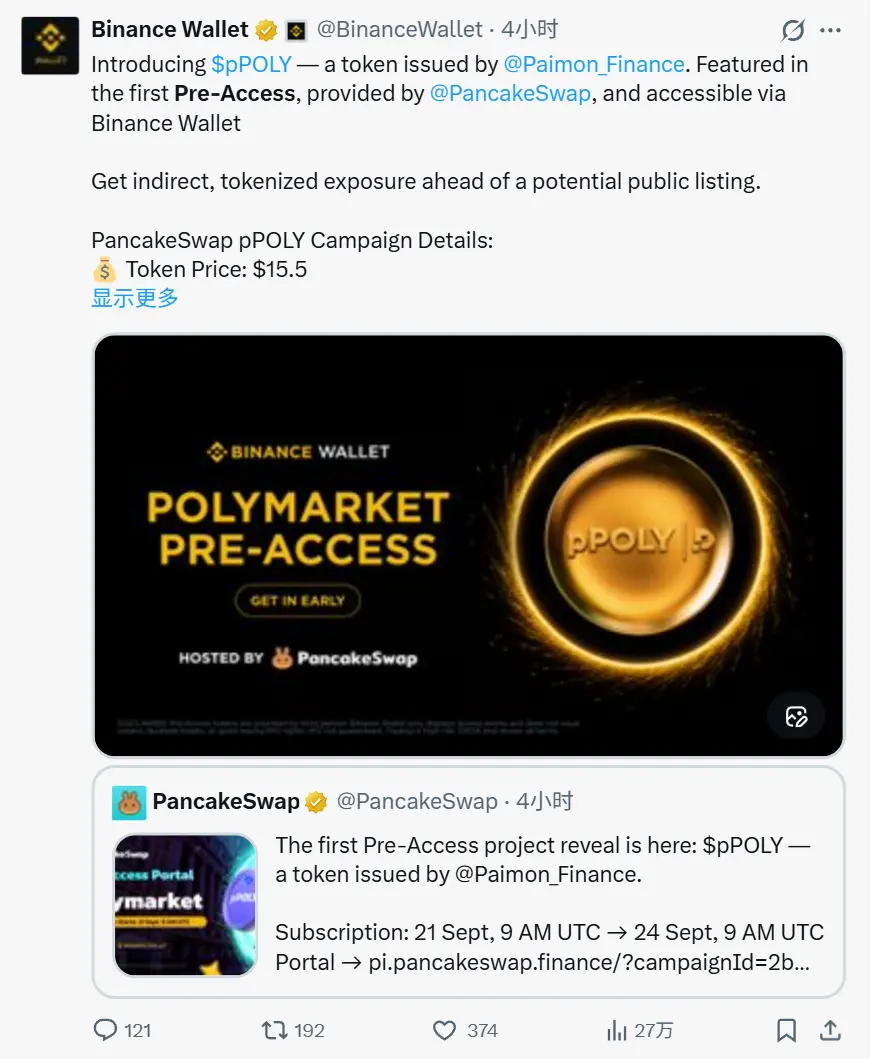
Following the announcement, community discussions quickly centered around new listings. Several crypto KOLs indicated that Binance's next round of innovative narratives has arrived, and the primary equity market is moving on-chain. Some users believe this extends new listings from crypto projects to Pre-IPO, estimating that the first phase will have some potential, and competition for Alpha points will escalate.
It is important to note that Binance's announcement used the term "indirect exposure." The full name of pPOLY is Paimon Polymarket SPV Token. Binance Wallet stated that it only provides access and does not issue tokens, facilitate transactions, or grant equity or IPO rights.
So, what exactly do those who buy this token receive?
According to the official FAQ, the Pre-Access Token is a tokenized asset provided by a third party, offering only contractual, synthetic, or indirect economic exposure, and does not represent shares or equity of the target company, nor does it correspond to fund shares, SPV rights, or any underlying assets.
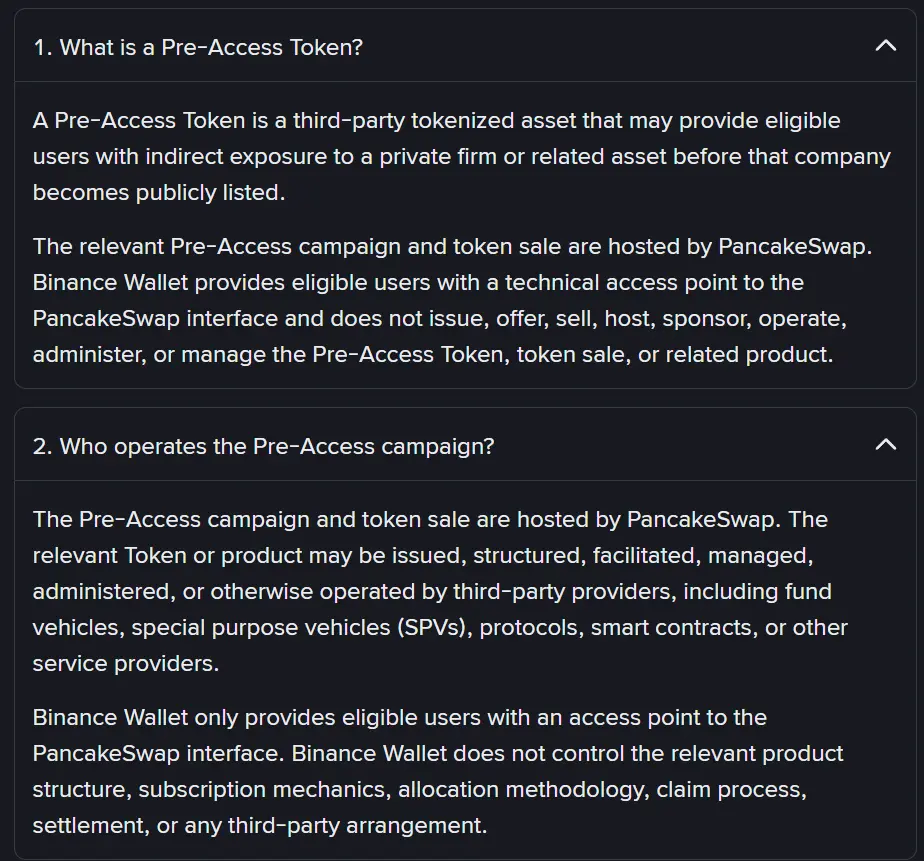
In terms of rights, there are no voting rights, dividend rights, information rights, shareholder rights, or governance rights, and one cannot directly claim against the target company or its affiliates. The PancakeSwap blog also indicated that this activity does not represent an endorsement or collaboration with the target company, nor does it imply that the company has confirmed IPO plans.
Regarding pricing, official information shows that Binance does not verify the subscription price and implied valuation, which may differ significantly from the company's latest private placement valuation, future market price, and redemption price. For exits, redemption, buyback, and conversion may be delayed or may never open.
Even if the company completes an IPO, the token may still face lock-up periods and transfer restrictions, with prices determined by supply and demand in the secondary market, potentially at a premium or discount to the listed stock price. Binance also stated that it does not guarantee that the relevant company will go public, and users may lose part or all of their invested assets.
The Issuance Responsibilities of bStocks and Pre-Access are Completely Different
bStocks are stock tokens within the Binance ecosystem, allowing users to buy with USDT spot and then transfer to Binance Wallet or other wallets compatible with BNB Chain, where they can be traded on platforms like PancakeSwap.
So, are the issuance responsibilities of bStocks and Pre-Access the same?
bStocks are directly issued by Binance, with each corresponding to one share of real stock, counted at a 1:1 ratio, and Binance publicly discloses collateral through the Proof of Collateral page.
The arrangement for Pre-Access is different. Official information indicates that Binance Wallet does not issue, sell, host, operate, or manage the relevant tokens and activities; it only serves as a technical entry point to the PancakeSwap page. The product structure, purchasing rules, allocation methods, claiming processes, and settlements are not controlled by Binance.
Tokens may be issued and managed by third parties such as fund vehicles, SPVs, protocols, or smart contracts, with subscription, allocation, claiming, and refunds handled by PancakeSwap or third-party providers.
The provider for the first project is Paimon Finance, which is reportedly positioned as a private asset tokenization platform, covering private credit and private company exposure, supported by YZi Labs.
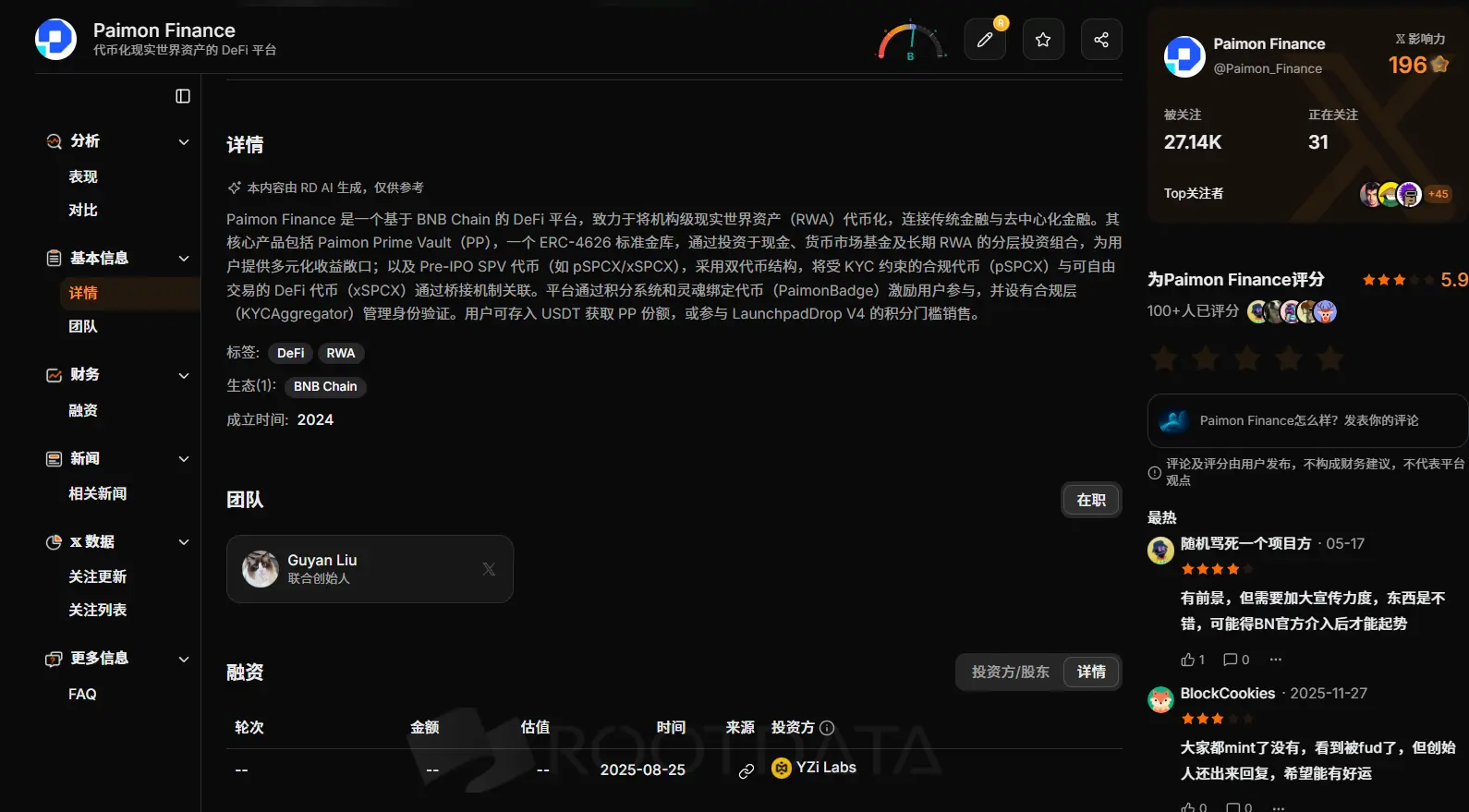
Image source: RootData
If issues arise, remedies are downstream. Official information states that if the underlying exposure cannot be delivered, or if the seller of shares on the chain defaults, refunds, compensation, or recovery will be the responsibility of third-party providers or PancakeSwap, and Binance Wallet does not guarantee this nor verifies whether third-party agreements can be executed.
In terms of risk, if the relevant private company or third party opposes or restricts this structure, users may face delays, forced liquidations, and partial or total losses. Previously, when Robinhood launched the OpenAI token, OpenAI publicly stated that these tokens are not equity of OpenAI, and the company did not participate or endorse them.
Brickken CEO Edwin Mata stated in February this year that tokenizing company shares without the issuer's knowledge and consent could undermine investor protection and market credibility.
Integrating User Points Systems into Private Company Exposure Allocation
After the announcement, how to obtain quotas became the focus of community discussions.
Official information shows that the quota for Pre-Access is determined by Alpha points, Trencher Badge, and bStocks on-chain levels. The higher the points and levels, the higher the quota, and users holding a Trencher Badge receive additional bonuses, with final rules set by PancakeSwap.
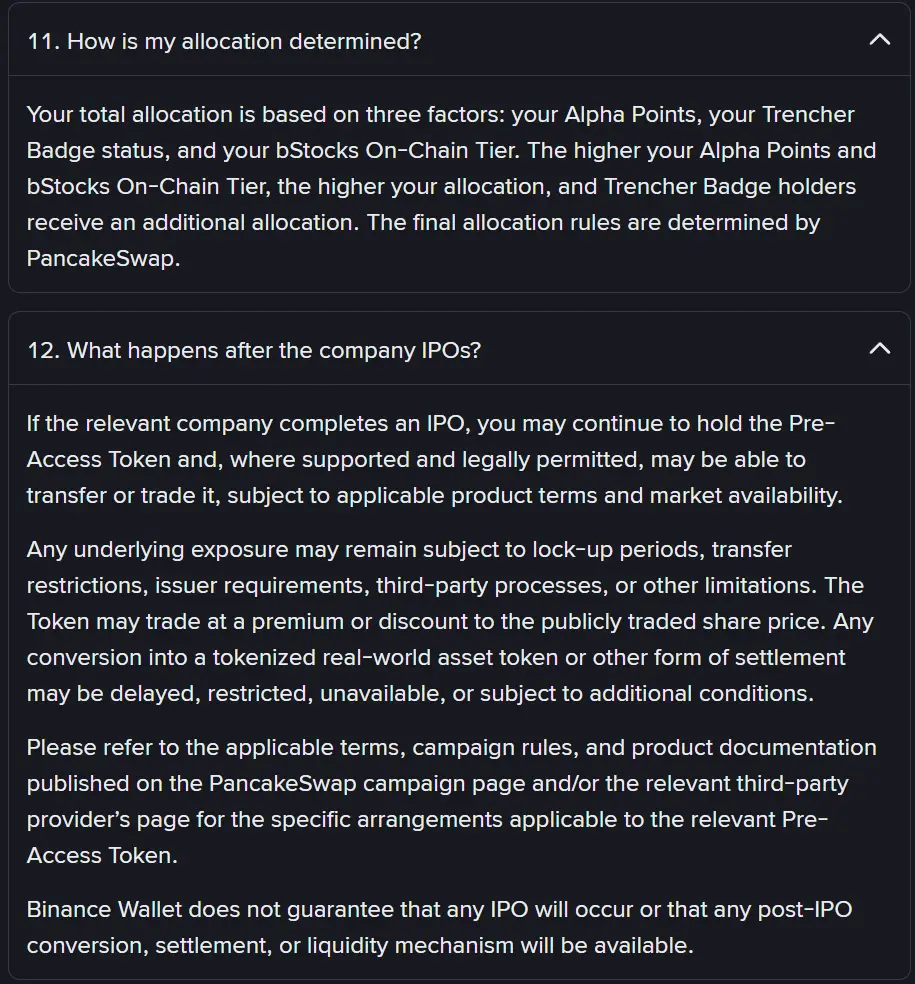
The quota for the first project pPOLY mainly depends on the Alpha points level and bStocks on-chain activity level at the time of the announcement, based on bStocks holdings and trading volume from September 6 to September 20. All users holding Alpha points can subscribe without deducting points.
Among these, the bStocks aspect looks at users' holdings and trading of bStocks on-chain. bStocks indicated that holding and trading bStocks in Binance Wallet can unlock a larger Pre-Access quota.
This means that the statistical period ends at 24:00 UTC on September 20, and any bStocks purchased afterward will not count towards the quota for the first project. Whether subsequent projects will use the same statistical method has not been clarified by the official sources.
In terms of participation, users must enter the activity page through the Binance Wallet in the Binance App, which only supports Binance Keyless Wallet, and must complete eligibility checks and confirm risk disclosures, with risk warnings also mentioning KYC reviews and sanctions screening.
The subscription price for pPOLY is $15.5, with a total scale of $4.8 million, approximately 309,700 tokens. The window is 72 hours, ending at 9:00 UTC on September 24, with token distribution, refund of unallocated funds, and trading opening simultaneously. In case of oversubscription, quotas may be reduced, allocated proportionally, refused, delayed, or canceled.
In comparison, the quotas are based on points, badges, and bStocks levels within the Binance ecosystem, publicly announced by Binance Wallet, and it does not appear that Binance "does not control the allocation method" as stated.
Can Pre-Access Become a New Narrative?
Although the target of the first project aligns with market expectations, there is considerable controversy surrounding it. Some believe that Polymarket has already received billions of dollars in investment from institutions like ICE and may not need to rely on Binance Alpha to complete a so-called IPO.
Moreover, if Polymarket does go public, it is likely that no tokens will be issued, meaning that retail investors and studios that previously engaged with Polymarket would lose out.
On the other hand, discussions quickly shifted from the project itself to the narrative. CZ previously stated that IPOs will move on-chain, and Pre-Access is seen by many as the first realization of this statement, with tokenized IPOs potentially allowing early holders in the private placement phase to exit sooner.
However, some users pointed out that with such a significant event and traffic for Polymarket, other exchanges will certainly find ways to get a piece of the pie, and subsequent new listing quotas and plans will also be launched.
Crypto KOL Yuanshan Insight believes that wallets are transitioning from transaction entry points to asset distribution. When new assets emerge, whoever can bring the first batch of users, funds, and liquidity will hold a more important entry point.
So, does pPOLY count as an on-chain IPO, or is it leveraging Polymarket's popularity?
From the official information, Binance and PancakeSwap specifically mention the indirect exposure tokens issued by Paimon Finance, and pPOLY is not the official token of Polymarket; the issuing entity is a third party.
Looking back at existing pre-IPO products on-chain, the pre-IPO perpetuals on Hyperliquid are continuously matched by traders, forming continuous quotes for private companies, with the contracts themselves not containing real shares and lacking voting rights and IPO allocation rights. SPV tokens like PreStocks claim to hold relevant shares through SPVs and are traded on DEXs like Jupiter and Raydium based on supply and demand, with the order book always open.
Pre-Access is closer to the latter type, changing the selling method. The subscription price is set by the provider, and Binance does not verify it, with quotas allocated based on Alpha points levels and bStocks on-chain activity.
Therefore, whether Pre-Access can become Binance's next round of innovative narrative depends on whether subsequent projects can address the participation of target companies, underlying assets, and redemption arrangements, and whether exits will no longer rely solely on the secondary market.

 Risk warning


Popular articles