The "Rashomon" of US-Iran negotiations: If the blockade is lifted, will the Strait of Hormuz reopen within 7 days?
 Core Viewpoint

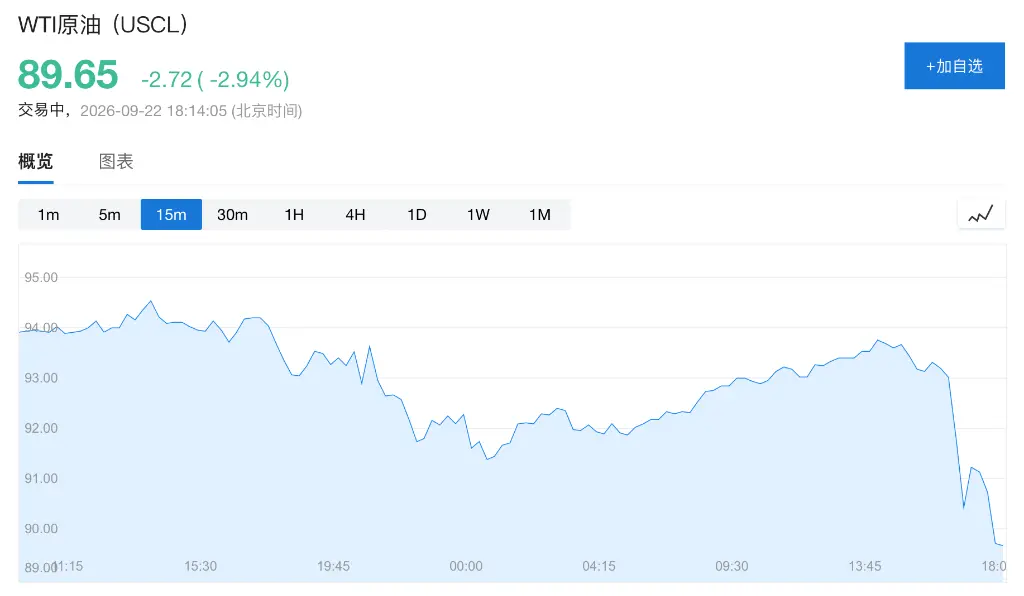
 WTI crude oil fell below 90 USD per barrel, with an intraday decline reaching 2.9%. According to reports, an Iranian official stated that if the United States takes preliminary measures to ease military pressure, including ending the military blockade of Iranian ports and stopping military actions related to the Strait of Hormuz, Iran is willing to reopen the Strait of Hormuz within 7 days. However, Iranian sources later denied reports regarding the reopening agreement of the Strait of Hormuz.
Author: Li Jia, Wall Street Journal
News of the reopening of the Strait of Hormuz has pressured oil prices, and despite Iran denying the news, oil prices continue to decline.
According to a report by CCTV International News citing Reuters today (September 22), a senior Iranian official told the media, "If the United States reduces military pressure and lifts the maritime blockade on Iran, Iran can reopen the Strait of Hormuz within 7 days."
The report states that this senior Iranian official said, "The United States needs to announce 'hopes to resolve the issue through diplomatic means,' formalize it, and then agree on the timeline for the process." He added that the Iranian delegation attending the United Nations General Assembly is already in New York and has full authorization to restore diplomatic negotiations with the United States.
Japan's Kyodo News also cited the same source for a similar report. However, Iran later issued a different statement. According to the Iranian Fars News Agency citing sources, reports regarding the reopening agreement of the Strait of Hormuz are not true.
Affected by the aforementioned reopening news, international oil prices fell sharply. WTI crude oil dropped below $90 per barrel, with an intraday decline of up to 2.9%, reported at $89.65 per barrel; Dow futures shifted from decline to increase, rising by 0.2% at one point. The Strait of Hormuz is a crucial global energy passage, and the potential reopening expectations directly lowered the market's risk premium for supply disruptions.
Preconditions for Strait Reopening, Uncertain Prospects for U.S.-Iran UN General Assembly Contacts
According to Japan's Kyodo News, Iran hopes Washington will send a signal, indicating its readiness to return to the negotiating table and take steps to end the military blockade of Iranian ports and cease military actions related to the Strait of Hormuz. If these steps are implemented, Iran is willing to reopen this strategic waterway within 7 days.
The report cites Iranian officials stating that Iran plans to engage in consultations with relevant countries acting as intermediaries during the UN General Assembly, but he explicitly ruled out the possibility of Iranian President Ebrahim Raisi meeting with U.S. President Trump on the sidelines of the assembly.
However, according to Bloomberg, Trump is scheduled to speak at the UN General Assembly in New York later on Tuesday and may meet with Raisi during the conference. Al Jazeera also cited the Iranian Revolutionary Guard stating that if national interests require, Iran can end the war through negotiations.
According to Reuters, Hamed Hosseini, a senior climate and commodities economist at Capital Economics, stated that this overnight development is a positive signal indicating that diplomatic efforts may be taking effect. He added, "Before a lasting solution is reached, there may be other obstacles, such as tolls and fees."
Iran's Proposal to Reopen the Strait Approved by Senior Leaders, U.S. Response Becomes Key
According to officials cited by Japan's Kyodo News, the new proposal has been approved by Supreme Leader Ali Khamenei and the Iranian Supreme National Security Council, indicating a certain consensus among Tehran's senior leadership on the direction of diplomacy.
However, the situation still carries the risk of escalation. According to the official, the Supreme National Security Council decided on August 16 that if Washington fails to lift the blockade on Iranian ports within 45 days, Iran will retain the option to launch a new round of strikes against U.S. forces. This deadline is now approaching.
Tensions between the two countries have been escalating since late February this year. In June, both sides reached a memorandum of understanding, but it fell apart due to the resumption of hostile actions and unresolved disputes. Since then, intermittent exchanges of fire have continued, and concerns about a renewed escalation of conflict have not dissipated.
Behind Iran's push for diplomacy is also the reality of economic pressure. The ongoing blockade of ports has significantly squeezed Iran's crude oil exports, which is one of Iran's important sources of revenue. Meanwhile, the continued obstruction of the Strait of Hormuz has disrupted global energy transport, and commercial shipping volumes remain far below pre-war levels. For Asian economies that heavily rely on this route for crude oil imports, the direction of the situation is particularly critical.
The market is closely watching the U.S. response. If substantive contacts occur between the two sides, market expectations for energy supply disruptions may further cool down.
 Risk warning