








September new jobs are expected to drop to 90,000: tonight's non-farm payrolls' real "explosive point" may be whether the August data is significantly revised downwards
 Core Viewpoint

 Wall Street generally expects that the new jobs added in September will drop to 90,000, with the unemployment rate remaining at 4.1%. The strong data from August was mainly boosted by unusual seasonal factors, and its revision will directly determine the strength of the September data. As Federal Reserve officials' recent statements have caused the probability of an interest rate hike in October to plummet to 25%, the market focus has shifted to long-term interest rates. Currently, systemic funds hold about $390 billion in global bond shorts, and if the employment data unexpectedly cools, it will trigger severe market turbulence.
Author: Dong Jing, Wall Street Journal
The U.S. non-farm payroll report for September will be released on Friday (October 2), which is the last employment data before the Federal Reserve's interest rate meeting on October 28. However, the market's pricing of its impact has dropped to a recent low—historical experience shows that when the market is least concerned, it is often when the data can most stir the market.
The median expectation on Wall Street is for an increase of 90,000 jobs, a significant drop from 162,000 in August. The market is highly focused on whether the August data will be significantly revised down, as unusual seasonal adjustments previously exaggerated the overall employment performance, leading to great uncertainty regarding the base effect of the September data.
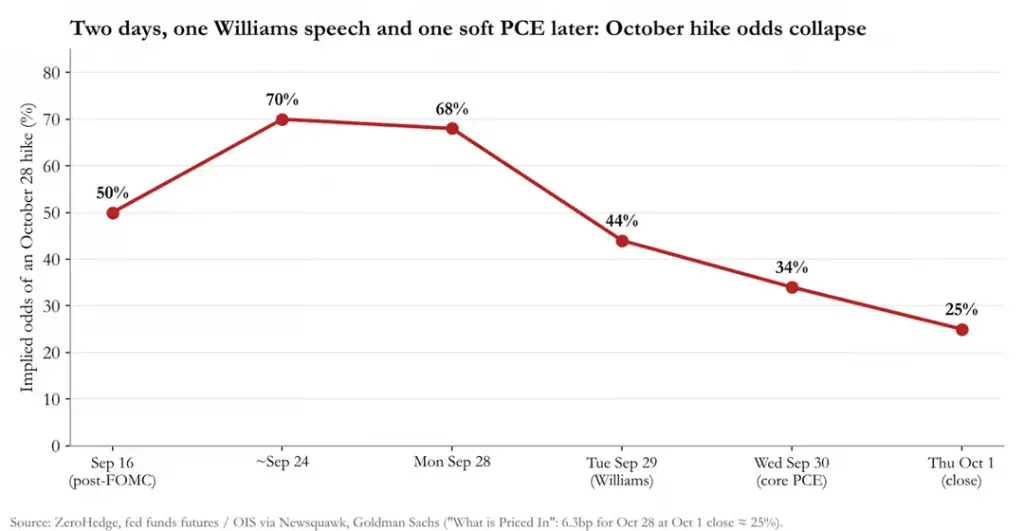
At the same time, the Federal Reserve's policy expectations have undergone a sharp turn in the past week: On Monday, the market priced in about a 70% chance of a rate hike in October, but after New York Fed President Williams stated that he is "not in a hurry to raise rates" and the August core PCE came in mildly, by Thursday's close, the probability of a rate hike in October had fallen to about 25%, with Goldman Sachs pushing back its next rate hike expectation to December.
Seasonal adjustments are the biggest source of uncertainty in this report. Barclays estimates that if the August data were adjusted using this year's seasonal factors, the "impressive" increase of 162,000 would turn into a decrease of 74,000, indicating that the August data is severely overestimated. In this context, whether the August data is revised down will directly determine the interpretation of the September data.
For the market, the real risk may not be at the front end of interest rates but in long-term bonds. Goldman Sachs data shows that CTA trend strategy funds currently hold about $390 billion in global bond shorts, with the short position in U.S. 10-year Treasury bonds at a historic maximum of 99%, and 30-year bonds reaching 100%. If the non-farm data is weak or the unemployment rate rises to 4.2%, a large-scale short covering by systematic funds could trigger violent fluctuations in the bond market.
Expected Numbers: Consensus is Low, Discrepancies are Significant
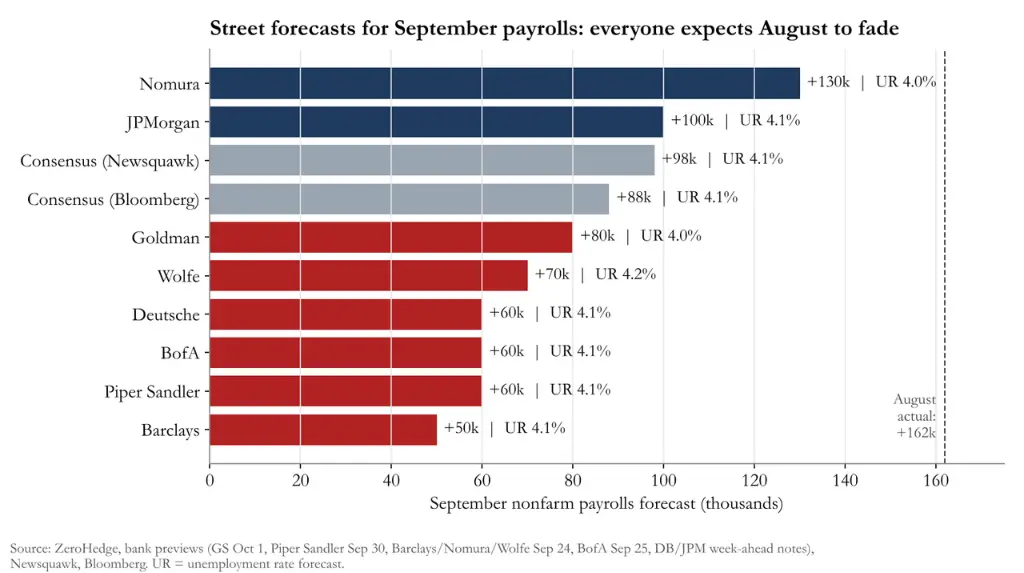
The forecast range from 80 institutions on Wall Street varies from Barclays' +50,000 to Nomura's +130,000, with almost all institutions' forecasts below the August reading, and most below consensus.
Core expected data is as follows:
Non-farm Employment: +90,000 (previous value +162,000); 3-month average 71,000, 6-month average 107,000, 12-month average 50,000
Private Employment: +81,000 (previous value +127,000)
Unemployment Rate: 4.1% (previous value 4.14%, not rounded)
Labor Participation Rate: 61.6% (unchanged from previous value)
Average Hourly Wage: Month-on-month +0.3%, year-on-year +3.2% (previous value +3.1%)
Average Work Hours: 34.3 hours (previous value 34.4 hours)
Goldman Sachs expects an increase of +80,000 jobs, slightly below consensus but above the three-month average, while also lowering its unemployment rate forecast to 4.0%, citing a decline in the number of continuing unemployment claims. Goldman Sachs also expects average hourly wages to rise only +0.2% month-on-month, citing "unfavorable calendar effects" as an explanation.
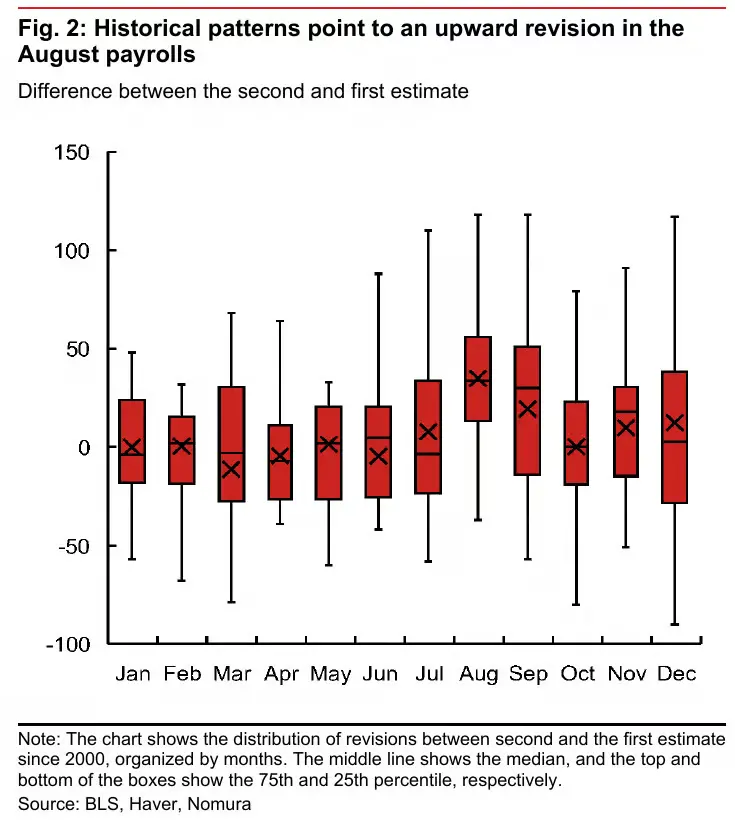
Nomura's forecast of +130,000 is the highest on Wall Street, reasoning that August is historically the month where initial values are most likely to be revised upward.
Unemployment Rate and Wages: Details Determine Market Reaction
The forecast range for the unemployment rate is between 4.0% and 4.2%, with discrepancies stemming from the unrounded 4.14% in August.
Goldman Sachs and Nomura expect 4.0%, based on the decline in continuing claims;
Wolfe Research expects 4.17%, which rounds to 4.2%;
Bank of America expects 4.1% but warns of a potential correction after the surge of 569,000 in the August household employment survey, which could push the unemployment rate to 4.2%; and adds that "even 4.2% is consistent with a healthy labor market fundamental";
Deutsche Bank warns that if the labor participation rate rises slightly, it could lead to the unemployment rate rounding up to 4.2%.
Regarding wages, both Goldman Sachs and Nomura expect a month-on-month increase of +0.2%, while Deutsche Bank is above consensus, expecting +0.4%. Goldman Sachs' broader wage tracking indicator shows a year-on-year increase of +3.5%, with a third-quarter annualized increase of +3.1%. Wolfe Research points out that wage growth remains "below the Fed's preferred range of 3.5%-4.0%", calling it "surprisingly moderate."
Seasonal Adjustment: August "Inflated," September Has Bidirectional Risks
Seasonal factors are the core interpretive difficulty of this report.
Wolfe Research points out that in a typical August, seasonal adjustments usually lower the seasonally adjusted numbers by more than 100,000. However, in August of this year, the seasonal factor actually pushed the data higher—this is the first time this has occurred since 2021.
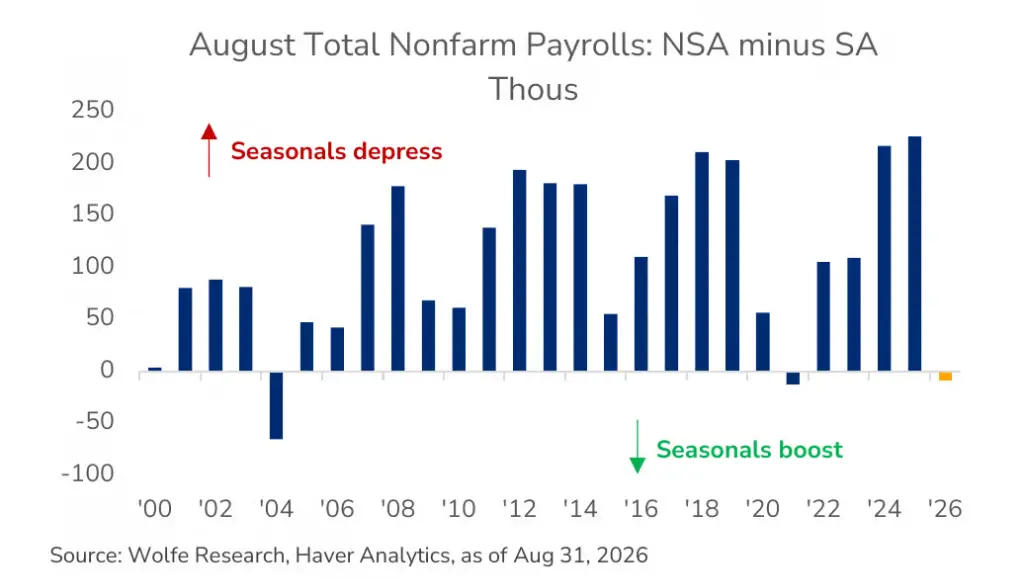
Bank of America economist Shruti Mishra provided the clearest explanation:
The unadjusted employment increase in August was actually lower than the same period last year, but this year's seasonal adjustment was "close to zero," while the adjustment for August 2025 was -178,000, causing this year's unadjusted increase to flow almost entirely into the seasonally adjusted numbers.
Bank of America attributes this anomaly to differences in the survey period—August 2026 had a four-week survey interval, while both 2024 and 2025 had five weeks.
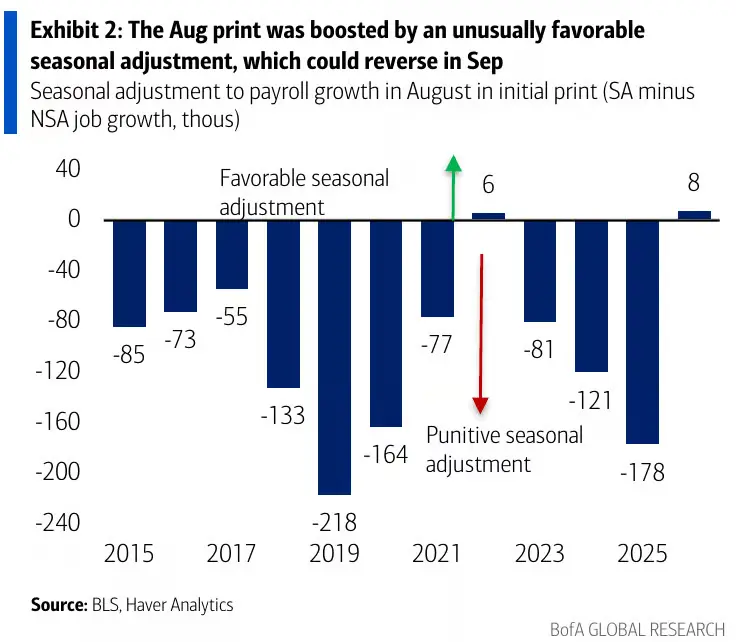
Barclays' conclusion forms a clear logical chain:
If the August data is revised down → the September data may unexpectedly be strong; if the August data is not revised down → the September data may be weak.
Bank of America advises investors "not to be misled by headline numbers" and maintains its estimate of potential job growth at a healthy level of "100,000+."
Additionally, Bank of America also highlights a potential downside risk: about 200,000 Haitian TPS holders lost their work authorization on July 27, primarily concentrated in the food service, healthcare, transportation, and retail sectors. Bank of America's baseline scenario is a gradual drag, but it acknowledges that "the impact on September data may exceed expectations."
High-Frequency Indicators of the Labor Market: Overall Positive, Consumer Confidence is an Outlier
Multiple high-frequency indicators show that the labor market remains resilient:
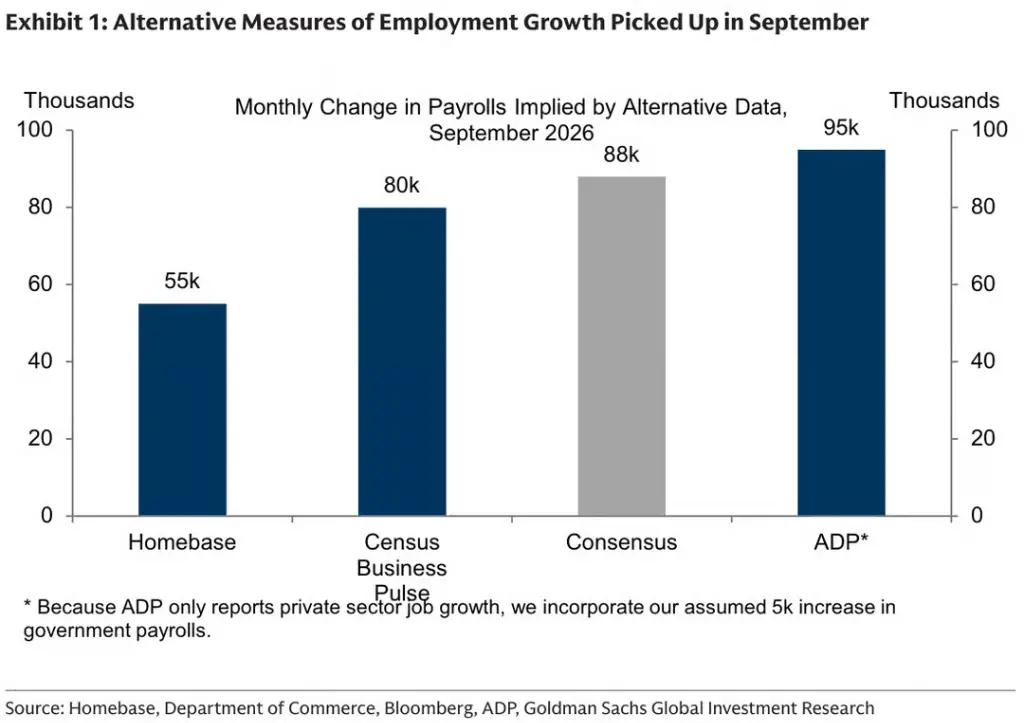
Initial Jobless Claims: The survey reference week was 198,000, lower than the 207,000 in the August survey window; the number of continuing claims fell to 1.719 million, the lowest since March 2023, supporting the forecast of a 4.0% unemployment rate.
ADP: Private employment increased by 90,000 (expected 70,000, previous value 36,000), marking the first acceleration since May, led by education/healthcare and leisure/hospitality.
Revelio: September +56,900, higher than the revised August +40,600, with public administration, healthcare, and construction leading the way.
Challenger Layoffs: Announced layoffs of 43,000 in September, the lowest since 2022, but hiring plans are the lowest for the same period since 2011.
PMI: S&P Global Flash PMI shows the fastest employment growth since June 2022; ISM manufacturing employment sub-index rose to 52.7.
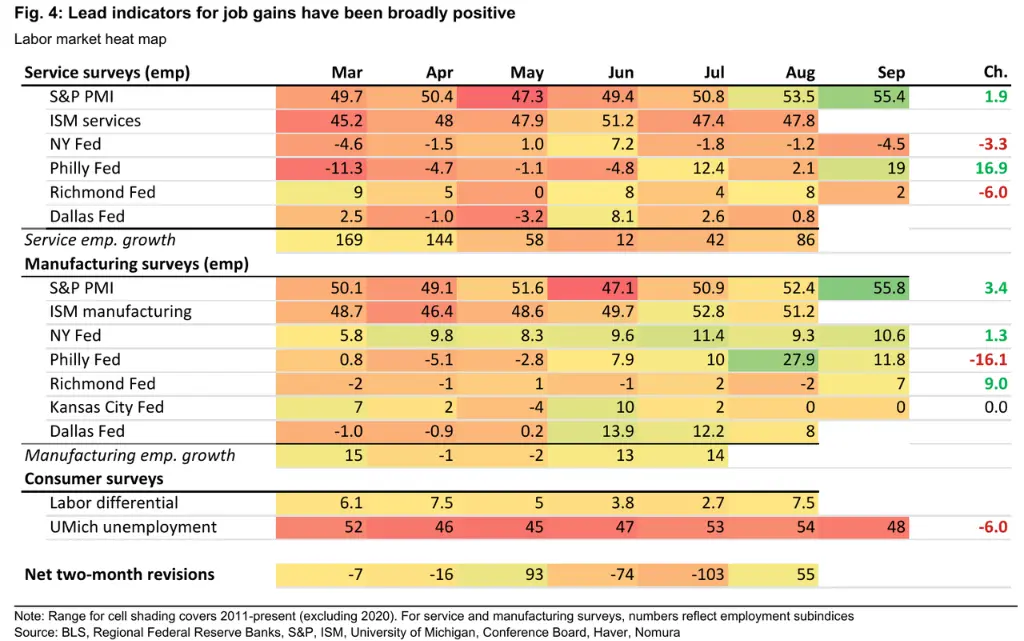
The only contrary signal comes from consumer confidence surveys. In the World Federation of Large Enterprises survey, the gap between "ample employment" and "hard to find employment" narrowed to just +1.7, and the net value of six-month employment expectations fell to -14.4, suggesting that consumers perceive the employment market is still weakening.
Federal Reserve Policy: From "Skipping" to "Rate Hike" Pathway
After the first rate hike in three years, the median of the Federal Reserve's dot plot indicates another rate hike in 2026. The market once priced this in for October but then quickly retreated.
Currently, the market consensus has shifted to "skipping October and raising rates in December." Goldman Sachs economists believe that since core PCE is expected to fall to 3.0% by the end of the year (below the Fed's 3.4% forecast), "the likelihood that the FOMC concludes that no further rate hikes are needed is quite high."
Barclays also expects a pause in October and a rate hike in December. Deutsche Bank's baseline scenario is one rate hike in December and another in March next year.
Bank of America cites Waller's recent statements about the resilience of the labor market, believing that this employment report "is unlikely to be a game changer for pricing in an October rate hike, and the market will focus more on CPI data."
Short Positions in the Bond Market are the Biggest Potential Trigger Point
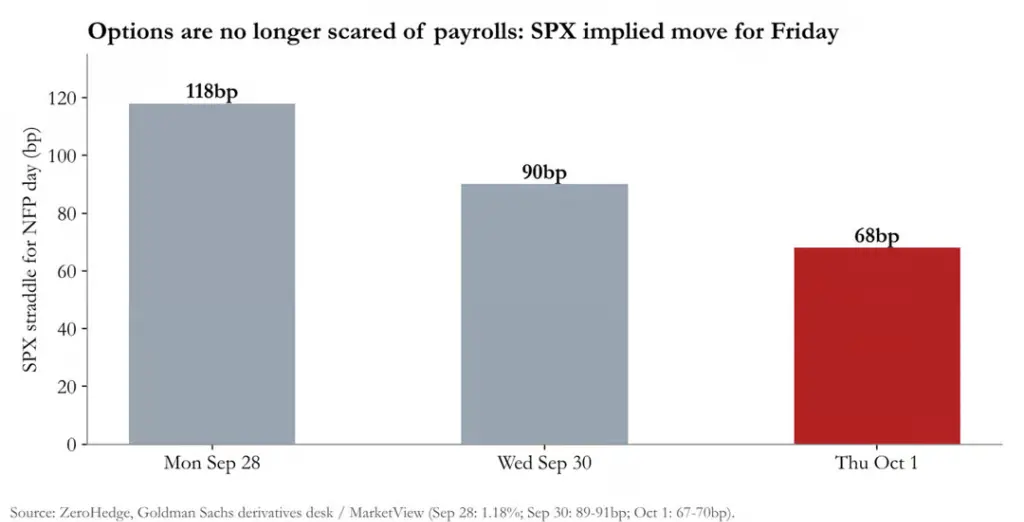
The options market has significantly compressed pricing for this report. According to Goldman Sachs' derivatives team, the implied volatility of S&P 500 straddles dropped from 1.18% on Monday to about 67-70 basis points on Thursday, below the past eight trading days' average of 72 basis points. The Nasdaq 100 straddles are around 95 basis points.
In the foreign exchange market, the implied volatility of USD/JPY is about 42 basis points, and EUR/USD is about 38 basis points, both nearing the upper end of the one-year realized volatility range—the foreign exchange market is currently the only one still pricing in surprises.
Goldman Sachs' Rich Privorotsky pointed out that the real pressure is on the long end rather than the short end:
"Interest rates: There is absolutely no buying on the long end. PCE data is soft, but it has hardly changed the long end's trajectory… The real issue is that the long end simply does not care."
This makes position risk the most concerning variable. Goldman Sachs' Brian Garrett stated that the bank's CTA model shows that systematic funds hold about $390 billion in global bond shorts, with the short position in U.S. 10-year Treasury bonds at a historical maximum of 99%, and 30-year bonds reaching 100%.
If the data performs "just right" (adding 40,000 to 100,000 jobs, unemployment rate 4.0%-4.1%), both stock and bond markets will rise moderately;
If the data is "overheated" (adding more than 120,000 jobs and an unemployment rate of 4.0%), expectations for an interest rate hike in October will quickly return to the market;
If the data is "overcooled" (adding fewer than 20,000 jobs or unemployment rate rises above 4.2%), not only will the expectations for an interest rate hike be completely erased, but it will also trigger a comprehensive short squeeze on CTA bond shorts.
For stocks, Goldman Sachs' Nelson Armbrust pointed out that the S&P 500 is only about 2% away from its historical high, stating, "Any degree of relief in interest rates will become a trigger for the stock market to rise." JPMorgan's Andrew Tyler warned of mirror risks: Strong ADP data could lead to unexpected upward movement in non-farm payrolls, at which point the market may revert to the "good news is bad news" logic.
It is noteworthy that the revision of August data may have a more significant market impact than the September headline numbers themselves. If the August data is significantly revised down, it will confirm that seasonal adjustments distorted the true employment trends, thereby reshaping the market's judgment of the entire employment cycle.
The market is highly focused on whether the August data will be significantly revised down, as the unusual seasonal adjustments previously exaggerated the overall employment performance, which creates significant uncertainty regarding the base effect for September data.

 Risk warning


Popular articles





