








BlackRock: What impact will the Federal Reserve's first interest rate hike in years have on stocks and bonds?
 Core Viewpoint

 In a high-interest-rate environment, bonds offer higher coupon yields, while U.S. stocks favor large companies with stable profits.
Original Title: First Fed rate hike in years: What it may mean for investor portfolios
Original Author: Kristy Akullian
Editor’s Note: The Federal Reserve has raised interest rates again after several years.
In the September meeting, the Federal Reserve raised the target range for the federal funds rate by 25 basis points to 3.75%---4.00%. The background behind this decision is not complicated: inflation remains above target, energy prices have risen again, and the U.S. labor market has not yet shown significant deterioration.
But for investors, the more important question is not "how much was raised this time," but: if the U.S. re-enters a high-interest-rate environment, what will happen to stocks and bonds next?
Kristy Akullian, Head of Investment Strategy for BlackRock Americas iShares, provides a not pessimistic answer in her latest report. Historically, the first rate hike does not necessarily mean that stocks and bonds will decline; on the contrary, as long as the economy remains resilient and interest rate fluctuations are manageable, investment opportunities may still arise in a high-interest-rate environment.
The following is a compilation of the original text:
The Federal Reserve has resumed raising interest rates.
In September, the Federal Reserve raised the target range for the federal funds rate by 25 basis points to 3.75%---4.00%, marking the first rate hike since July 2023.
BlackRock believes that there are three main reasons behind this rate hike: overall inflation remains high, rising energy prices have pushed up price pressures again, and the U.S. labor market remains resilient.
Therefore, the Federal Reserve still has room to continue suppressing inflation without having to worry immediately about significant deterioration in the economy and employment.
However, a more important question has arisen for the market: if interest rates rise again, will stocks and bonds necessarily fall?
BlackRock's answer is: not necessarily.
Rate hikes do not equal guaranteed declines in stocks and bonds
The market typically interprets rate hikes as negative.
The reason is simple. After interest rates increase, the cost of corporate financing rises, which may suppress stock valuations; at the same time, rising bond yields may lead to declines in the prices of existing bonds.
However, historical data shows that there is not such a direct relationship between rate hikes and asset declines.
BlackRock has analyzed seven rounds of Federal Reserve rate hike cycles since 1983. The results show that in the 12 months following the first rate hike, U.S. stocks averaged a 4.7% increase, U.S. bonds averaged a 3.07% increase, and high-yield bonds averaged a 4.68% increase.
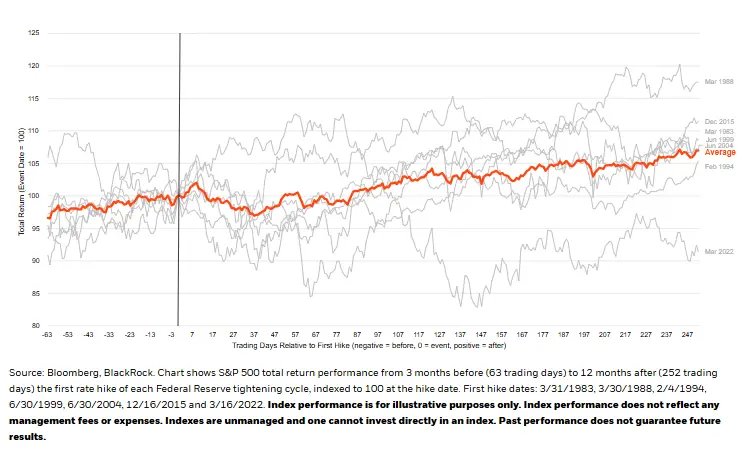
Of course, this does not mean that "rate hikes are actually good for the market." More accurately, a rate hike itself cannot determine the direction of asset prices for the coming year.
The Federal Reserve typically raises rates when the economy is still relatively strong. If corporate profits are still growing and the labor market has not shown significant deterioration, the growth forces of the economy itself may offset some of the pressures brought by high interest rates.
Therefore, rather than simply judging whether "rate hikes are negative or positive," the more important question is: why is the Federal Reserve raising rates? Can the economy withstand higher interest rates?
For bonds, high rates also mean higher interest income
One of the biggest differences in this round of rate hikes compared to previous years is that bonds themselves can now provide higher interest income. BlackRock believes that the currently higher low-risk rates and real yields provide a more attractive starting point for fixed-income assets.
In other words, while rising interest rates may depress the prices of existing bonds, investors preparing to buy new bonds can also obtain higher yields.
Thus, high interest rates are not purely bad news for bonds. BlackRock currently prefers higher credit quality bonds, including investment-grade bonds and higher-quality high-yield bonds, while emphasizing earning income through coupons rather than overly betting on rising bond prices.
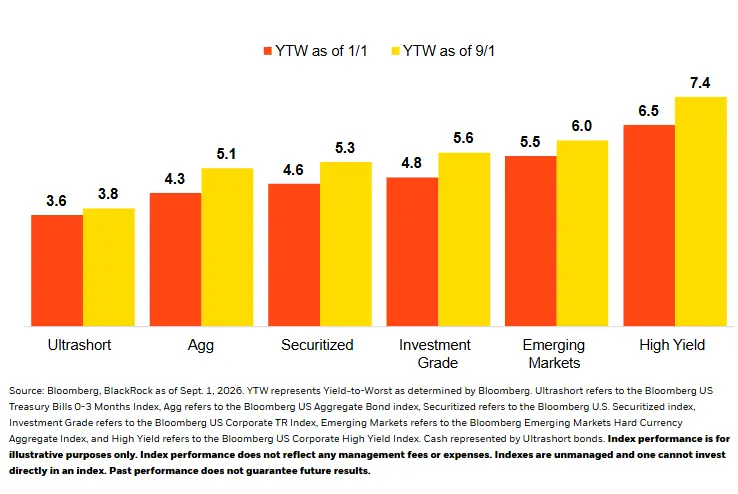
However, the large issuance of U.S. Treasuries and corporate bonds may still push up long-term rates, so BlackRock believes that investors should not simply bet on a rapid decline in long-term rates but need to manage bond durations more flexibly.
It is worth noting that long-term real yields are currently at a high level. BlackRock mentions that the real yield on 30-year U.S. Treasury Inflation-Protected Securities (TIPS) has exceeded 3%.
This means that even without relying on a significant rise in bond prices, long-term bonds themselves are beginning to provide relatively substantial real yields.
What U.S. stocks truly fear may not be high rates
Compared to bonds, the issues facing stocks are somewhat more complex.
BlackRock maintains a relatively positive outlook on U.S. stocks. The reason is that U.S. corporate profits remain strong, and historically, stocks do not automatically enter a downward cycle just because the Federal Reserve raises rates for the first time.
BlackRock's data shows that in the past seven rounds of rate hike cycles, the S&P 500 still tends to rise overall in the 12 months following the first rate hike.
But there is a very important premise: interest rates cannot fluctuate dramatically. The market can actually slowly adapt to a higher but relatively stable interest rate environment. For example, if investors already believe that policy rates will remain around 4% for a while, this level will eventually be reflected in stock valuations and corporate financing costs.
The real trouble arises when the market continuously reassesses how high rates will rise. If inflation repeatedly exceeds expectations, and investors continuously raise their expectations for future rates, long-term U.S. Treasury yields will rise rapidly, necessitating constant adjustments to stock valuations.
Therefore, what BlackRock is truly concerned about is not just "how high rates are," but whether rates will suddenly fluctuate significantly.
In this environment, BlackRock prefers large companies with high profit quality that can consistently pay dividends, while being relatively cautious about small-cap stocks that are more sensitive to financing costs.
Buying stocks and bonds together may not diversify risk as it did in the past
Another change occurring is the relationship between stocks and bonds.
One important reason the traditional 60/40 investment portfolio has been popular is that historically, stocks and bonds have often been able to hedge each other. When the economy worsens, stocks usually decline; but at the same time, the Federal Reserve may lower rates, causing bond prices to rise, thus offsetting some stock losses. However, in recent years, this relationship has begun to become less stable.
According to data from BlackRock and Morningstar, from 2010 to 2019, the correlation coefficient between stocks and bonds was about -0.22; since 2020, this number has risen to 0.51. This means that in recent years, instances of stocks and bonds rising or falling together have become more frequent.
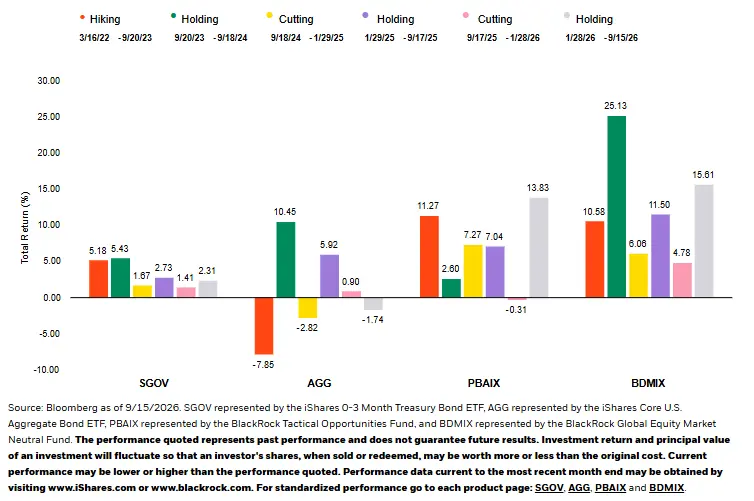
The reason is that the main risks facing the market have changed.
If the market's biggest concern is an economic recession, bonds usually benefit when stocks decline. But if the market's biggest concern is inflation, the situation may be completely different: rising inflation will push interest rates higher, bond prices will fall, and higher rates will also depress stock valuations.
This is also why BlackRock believes that the traditional "stocks + bonds" combination may no longer be as stable as in the past, and there is a need to increase other sources of income from different assets or strategies to further diversify risk.
Moving forward, it’s not just about whether the Federal Reserve will raise rates again
BlackRock's baseline judgment is that the Federal Reserve may raise rates once more in 2026, but currently does not believe this will develop into a very aggressive rate hike cycle.
For the market, what is truly worth observing next may not be "one or two more rate hikes," but three more important variables.
First, will inflation continue to rise?
If energy prices gradually fall and inflation cools again, the pressure on the Federal Reserve to continue raising rates will decrease; conversely, if inflation further spreads, the market may need to raise its expectations for rates.
Second, can the economy and corporate profits withstand high rates?
Historically, stock prices have continued to rise after rate hikes when the economy remains in growth. If employment, consumption, and corporate profits all show significant weakness, then the historical experience may lose its reference value.
Finally, and this is the most important point of BlackRock's report: what we really need to be wary of may not be high rates, but rather rates becoming suddenly very unstable.
If the economy remains resilient and the market can gradually adapt to a higher but stable interest rate environment, then stocks may still rise, and bonds can rely on higher coupons to provide income. However, if inflation repeatedly causes the market to continuously raise rate expectations, leading to a rapid surge in long-term rates, then both stocks and bonds may face renewed pressure.
Therefore, what we should truly focus on in this round of rate hikes is not just when the Federal Reserve will act next. More importantly: can high rates remain stable, and how long can the U.S. economy endure?
 Risk warning

Popular articles





