CPI and the financial reports of the five major investment banks will be released in succession this week, with the probability of an interest rate hike in October dropping to 20%, and approaching 90% in December
 This Monday is Columbus Day, and the U.S. bond market is closed. Before the data-heavy week, the market gave two seemingly contradictory answers regarding the same Federal Reserve: no action in October, tightening as usual in December. This article breaks down this contradiction.
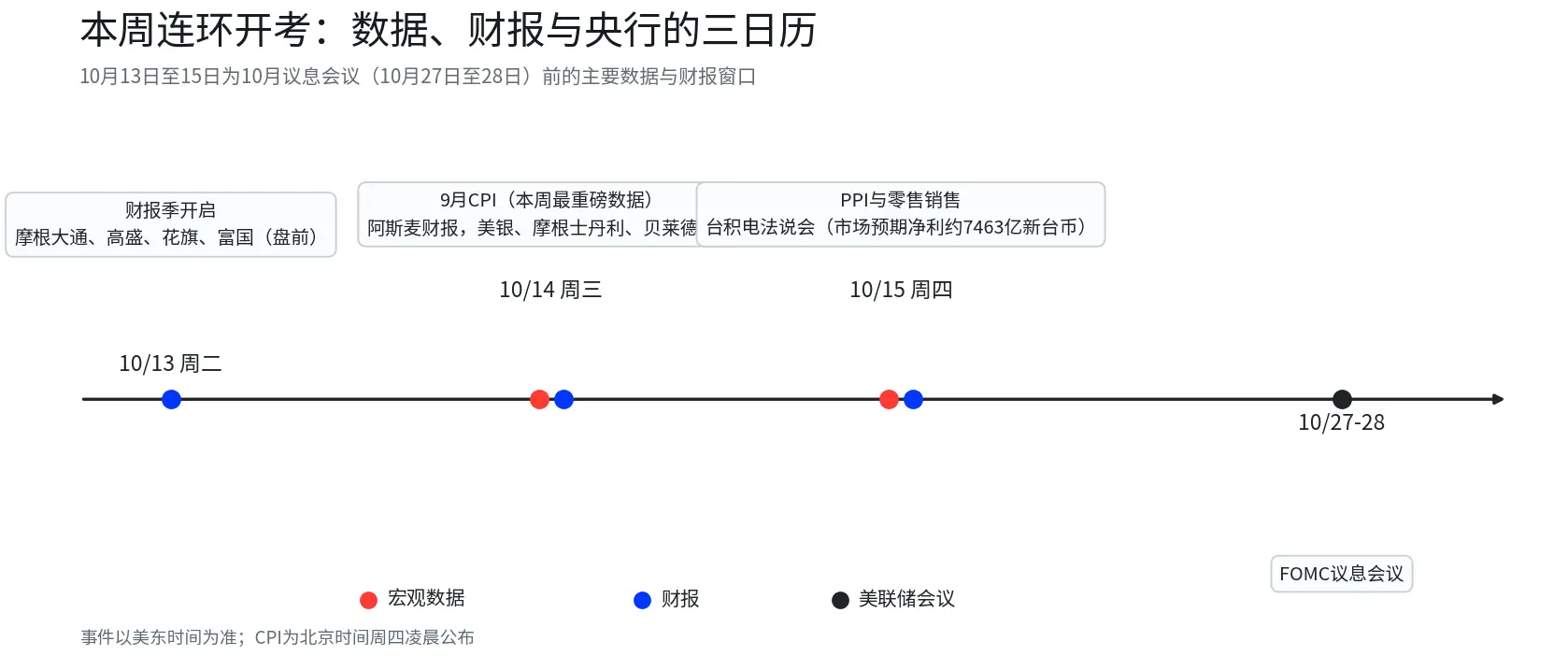
Introduction: This week is the most important data and earnings report window before the Federal Reserve's interest rate meeting on October 27-28. On Wednesday (October 14), the U.S. September CPI will be released, and on the same day, ASML will disclose its third-quarter report. JPMorgan, Goldman Sachs, Citigroup, and Wells Fargo have already reported before the market opened on Tuesday, while Bank of America, Morgan Stanley, and BlackRock will follow on Wednesday. TSMC will hold a conference on Thursday, and there will also be PPI and retail sales on Thursday. Within a week, both the denominator of the interest rate path and the numerator of profit growth will be tested. In terms of market conditions, the 10-year U.S. Treasury yield closed around 5.33% last Friday, briefly dipping before rebounding over 10 basis points on the day of the non-farm payroll release, peaking at 5.357% during trading on October 8. This Monday was Columbus Day, and the U.S. bond market was closed. Before the dense data release, the market gave two seemingly contradictory answers regarding the same Federal Reserve: no action in October, tightening as usual in December. This article breaks down this contradiction.
I. The Roller Coaster of Probability Curves, Two Rounds in One Month
Presenting the timeline of the October interest rate hike probability is more intuitive than any text. A month ago, the market priced in only about 51% for no action in October, with the possibility of a rate hike nearly at 50%. On October 2 (Friday), the September non-farm payrolls were released, showing only 29,000 new jobs, less than one-third of the expected 90,000, with August data revised down from 162,000 to 133,000, and July revised down to a loss of 10,000, totaling a downward revision of 60,000 over two months, while the unemployment rate rose to 4.2%. On that day, the probability of an October rate hike dropped from about 22% to 17%. In the following week, the probability fluctuated between 17.7% and 24.4%, rebounding to 20.5% after comments from Harker on Monday, briefly approaching 22% during trading.
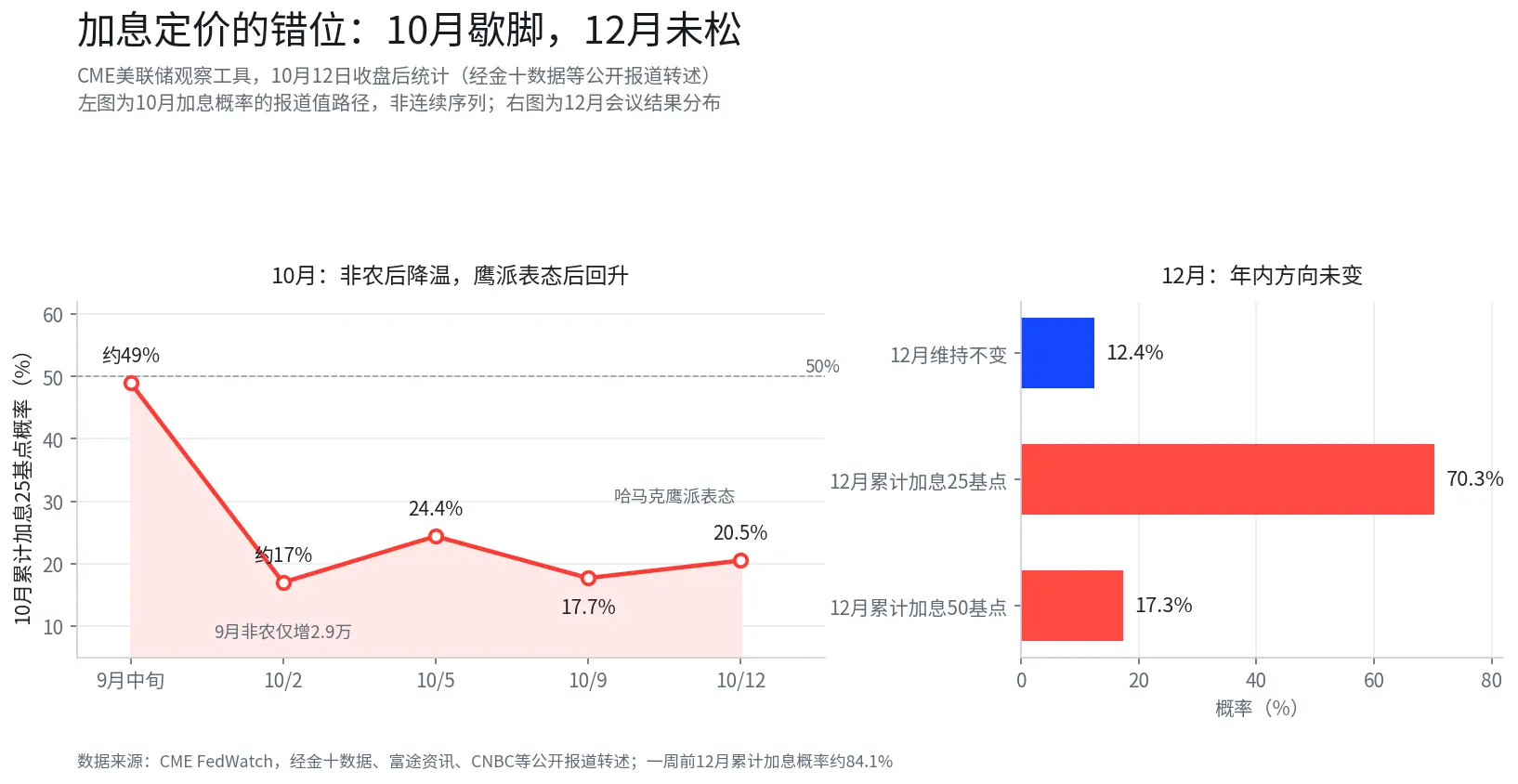 The details of the non-farm payrolls were weaker than the headline. Over the past three months, the average monthly job growth was only 51,000, and the coverage of job growth across industries dropped from 57.6% in August to 49.0%, hitting an 11-month low, with a reduction of 17,000 in government jobs. According to economists' estimates, due to retirements and tightened immigration lowering labor supply, the U.S. needs about 50,000 new jobs per month to maintain balance; while 29,000 is weak, it is not far from the equilibrium line. This explains why the weak employment report only lowered short-term rates.
The long end is another matter. On the day of the non-farm payroll release, the two-year yield fell by 10 basis points to 4.69%, while the 10-year yield rebounded over 10 basis points to 5.30% after a brief dip. The bond market only gave the employment report half a day's respect. From the readings above, the market's real concern is no longer whether to raise rates at the next meeting, but the direction of long-end inflation compensation under energy shocks, which will be more directly tested in Wednesday's CPI.
II. The Focus of Officials' Disagreements is the Pace, Not the Direction
Voices within the Federal Reserve were amplified this week. Cleveland Fed President Harker stated at the annual meeting of the National Association for Business Economics on Monday that a restrictive monetary policy stance is appropriate, preferring to make small, relatively quick adjustments rather than waiting for risks to accumulate and then incurring greater correction costs. In an interview, she added that the demand for electricity and components due to AI data center construction has begun to affect broader industries, with some companies planning price increases that exceed the rise in input costs, raising the risk of entrenched inflation expectations. It is worth noting that she did not explicitly state support for another rate hike in October, only saying she would attend the meeting on October 27-28 with an open mind.
Fed Governor Waller's comments on October 8 formed a contrast. He believes that if the data meets expectations, further rate hikes are still necessary, but not necessarily at consecutive meetings, leaving more actions for the meeting on December 8-9. The minutes from the September meeting (released on October 7) showed that most officials expect one more rate hike this year, with the policy rate raised by 25 basis points to 3.75% to 4.00%, marking the first rate hike since July 2023. Reports indicate that Goldman Sachs maintained its judgment of a 25 basis point rate hike in December after Waller's speech.
Putting these three voices on the same table, the disagreement centers on one word: speed. Harker is concerned about the costs of waiting, while Waller and the minutes provide space for waiting, with the market pricing this debate with an accumulated rate hike probability of about 87.6% for December. Based on the market conditions and officials' wording, a more likely interpretation is that no action in October is a rhythm adjustment rather than a shift in the rate hike cycle. If Wednesday's core CPI is significantly below expectations or subsequent employment data continues to deteriorate, this interpretation will need to be revised.
III. CPI Preview: Overall Almost Certain to Accelerate, Core is the Test
Wednesday's CPI is the most critical data of the week. The market consensus expects the overall CPI for September year-on-year to rise from 3.4% to 3.7%, with a month-on-month increase of 0.5% to 0.6%, mainly reflecting the rise in gasoline and energy prices. The overall reading being on the high side is already within market expectations; the real divergence lies in the core. The consensus for core CPI month-on-month is about 0.2%, with reports indicating that Barclays and Morgan Stanley's predictions are around 0.24%, citing a partial retreat in the price increase of wireless communication services; the year-on-year core is expected to be between 2.4% and 2.5%.
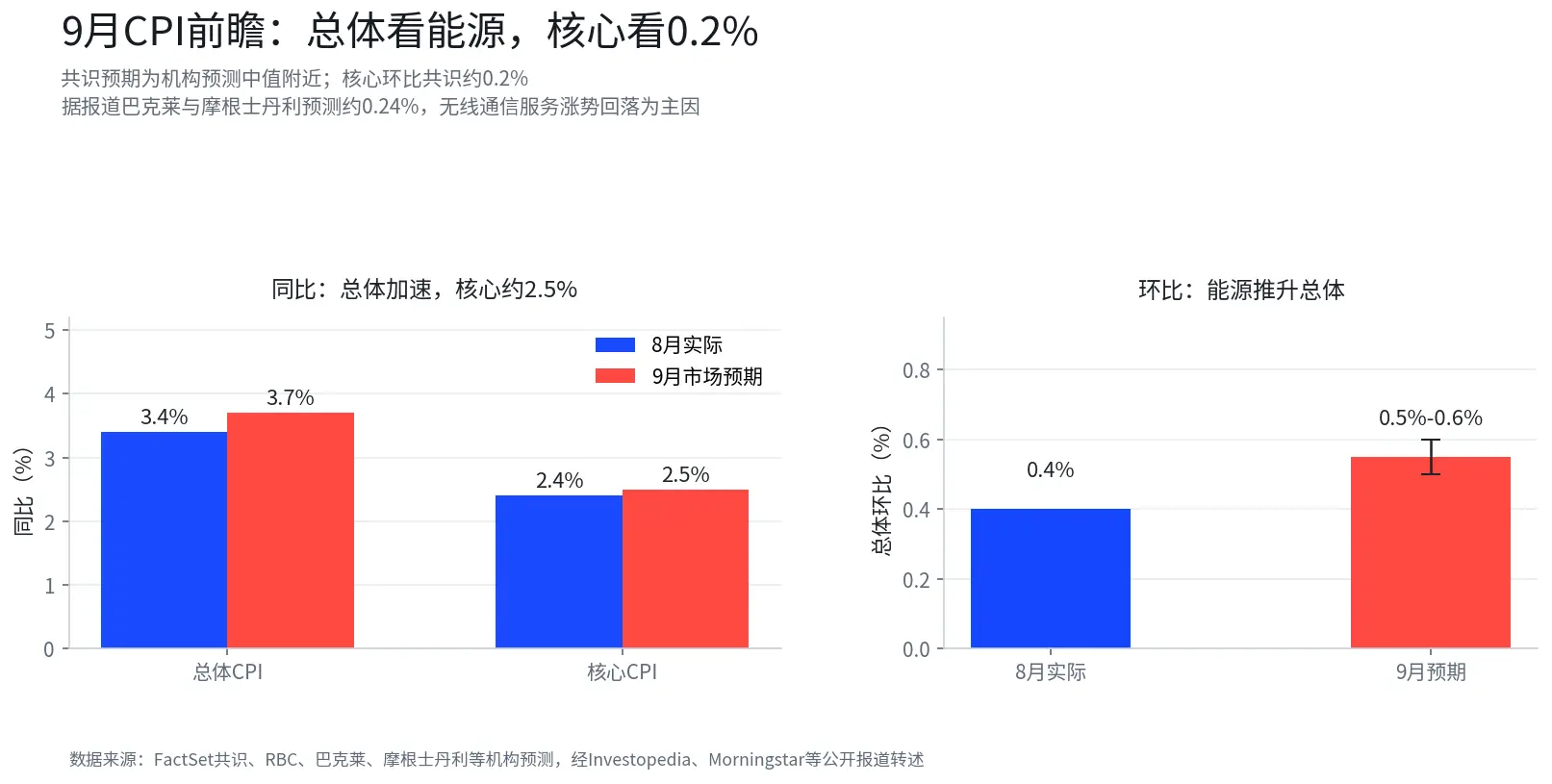
Two directions correspond to two market scenarios. If the core meets or falls below expectations, the probability of an October rate hike may be further revised down, with long-end yields and the dollar potentially retreating in sync, allowing risk assets to catch a breather. If the core unexpectedly rebounds, confirming the transmission of energy to the core, the approximately 87.6% probability of a December rate hike may continue to rise, with long-end yields possibly approaching the high point of 5.357% again, putting more pressure on high-valuation assets. Bloomberg's previous analytical framework is worth referencing; this round of inflation acceleration mainly stems from localized projects like energy, differing from the widespread price increases in 2022, which is also the premise for the Federal Reserve to maintain patience. This premise itself has vulnerabilities; if oil prices continue to spiral out of control, localized hotspots may evolve into widespread pressure, at which point the narrative of rhythm adjustment will face re-examination.
IV. Two Questions for Earnings Season
The question for banks is the depth of transmission of high interest rates. JPMorgan, Goldman Sachs, Citigroup, and Wells Fargo reported earnings before the market opened on Tuesday, while Bank of America, Morgan Stanley, and BlackRock will follow on Wednesday. In an environment where the 10-year U.S. Treasury yield is around 5.3% and the policy rate is between 3.75% and 4.00%, the market's focus has shifted from profit growth to credit demand, deposit costs, capital market business, and asset quality. The statements on credit costs from the five major investment banks may become the first window for judging whether high interest rates have begun to materially affect businesses and consumers.
The question for chips is the sustainability of AI orders. ASML will release its third-quarter report on Wednesday, with the company previously providing revenue guidance of 11 to 12 billion euros. TSMC's conference on Thursday is expected to attract more attention; according to Reuters, 16 analysts' LSEG SmartEstimate predicts a net profit of about 746.3 billion New Taiwan dollars (approximately 23.4 billion USD) for the third quarter, a year-on-year increase of about 65%, likely setting a record for the sixth consecutive quarter. TSMC previously announced third-quarter revenue of about 1.49 trillion New Taiwan dollars (approximately 46.7 billion USD), a year-on-year increase of about 50.9%, with September's monthly revenue growing by 54.6% year-on-year. The highlights of the conference may focus on the expansion of CoWoS advanced packaging, the pace of N2 process, and the capital expenditure statements for 2027.
It should be noted that before the chip earnings reports are released, the secondary market has already provided a round of pricing. On Monday, the Philadelphia Semiconductor Index fell by 2.67%, with optical communications and storage leading the decline; discussions on related transmission and funding can be found in the same day's AI hardware article, which will not be elaborated here.
Next Steps
The core month-on-month CPI on Wednesday is the first testing point of the week; a deviation from the direction of 0.2% may determine whether the October probability continues to be revised down or rebounds. The bank earnings reports on Wednesday evening and TSMC's conference on Thursday will provide a second set of signals, with the former focusing on credit costs and deposit competition, and the latter on CoWoS expansion and capital expenditure statements. Furthermore, the relative changes in the probabilities for October and December in the FedWatch tool are worth continuous tracking; if the October probability breaks above 30% again, the interpretation of rhythm adjustment may need to be reassessed. Before the data is released, any position in either direction may simultaneously expose itself to the risks of inflation exceeding expectations and deteriorating employment; the extent to which repricing has been factored into the market remains to be observed.
Data Explanation
Rate Hike Probability: CME "FedWatch," statistics after the close on October 12, as reported by Jinshi Data and others.
Non-farm Payrolls and U.S. Treasuries: September non-farm payroll data as reported in public reports; the 10-year U.S. Treasury yield of 5.33% is from the close on October 9 (market interface), with the U.S. bond market closed on Monday.
CPI Expectations: FactSet, RB consensus; Barclays and Morgan Stanley's predictions are around 0.24%, as reported.
Officials' Statements and September Meeting Minutes: As reported in public reports.
Earnings Reports: Calendar verified by Futu and Morningstar; TSMC's forecast is reported by Reuters' LSEG SmartEstimate.
Disclaimer: The content of this article is for general information and market commentary only, compiled based on publicly available information as of the time mentioned in the article. Relevant market data, expectations, and probabilities may change with market conditions. The views and investment strategies cited from third-party institutions, analysts, or other individuals represent the views of the relevant third parties at a specific time and do not represent the views or recommendations of BIT. This article does not constitute investment advice, investment research, an offer, solicitation, or recommendation for any securities, investment products, or trading strategies, nor should it be the basis for any investment decision. Financial markets carry risks, and securities prices and market performance may fluctuate; past performance and historical market trends do not represent or guarantee future results. Investors should independently assess the relevant risks based on their own circumstances and seek professional advice when necessary. BIT's Hong Kong stock trading services are not provided to residents of Hong Kong or users from other restricted jurisdictions.
 Risk warning