Jensen Huang's troubles have just begun
 Core Viewpoint


 If Congress uses this opportunity to re-examine NVIDIA's chip sales to China, Jensen Huang's previous lobbying activities, and the decision-making process of the Trump administration in approving related export licenses, things will become much more complicated.
Author: Black Mario
NVIDIA was originally scheduled to hold the AI Day Seoul 2026 event on November 9, and Huang Minshan, the eldest daughter of NVIDIA's Senior Director and Founder Jensen Huang, was planned to attend this event.
According to previous arrangements, Huang Minshan was to participate in the event in Seoul and meet with South Korean government officials to discuss cooperation in the field of artificial intelligence.
South Korea itself is an important semiconductor cooperation market for NVIDIA, with companies like Samsung and SK Hynix maintaining close business relationships with NVIDIA. Huang Minshan has also participated in various artificial intelligence industry activities in South Korea, making this event quite significant for her.
However, the day before her departure, her entire schedule was suddenly canceled. At that time, Yonhap News Agency cited sources stating that the cancellation might be related to family issues, but did not disclose specific reasons.
Looking at it now, the reasons for Huang Minshan's cancellation involve both public and private matters.
The private matter is that her 63-year-old father had an affair with a Chinese woman named Huang Le, who was formerly an executive at the Singapore data center company Megaspeed.
On November 8, Jensen Huang personally sent an apology letter to all NVIDIA employees. The founder of this technology giant, who has led NVIDIA for over thirty years, publicly admitted his infidelity in the letter.
He stated that his actions hurt his wife and children, and there is no excuse for this, apologizing to his family, employees, the board of directors, and shareholders.
In fact, Jensen Huang met his wife Lori during college, and they have lived together for decades, raising a son and a daughter. Both children later joined NVIDIA. Now, this technology entrepreneur, once seen as successful in both career and family, must publicly face his marital crisis.

As for the public matter, it is likely related to the troubles NVIDIA is facing.
On November 7, the Financial Times cited informed sources revealing that a previously obtained internal memorandum by U.S. intelligence agencies indicated that the woman Huang Le, who was in a relationship with Jensen Huang, was suspected by U.S. intelligence of being recruited by Chinese intelligence agencies, attempting to get close to Jensen Huang to obtain information related to NVIDIA and advanced AI chips in the U.S.
Meanwhile, NVIDIA's board of directors is also in a difficult position. They have formed a committee composed of independent directors and hired external lawyers to investigate whether Jensen Huang has become a target of foreign intelligence operations.
As a Senior Director, Huang Minshan naturally needs to return to help deal with this mess.
Thus, Jensen Huang's infidelity has already far exceeded the scope of personal family life.
The complexities behind this matter involve intricate strategic logic, and Jensen Huang's troubles may have only just begun.
What kind of company is Megaspeed?
Why did U.S. intelligence agencies focus on Huang Le? This actually starts with the company Megaspeed.
Initially, Megaspeed had no connection to artificial intelligence.
In 2015, a company named 7Road International was registered in Singapore, backed by the Chinese gaming company 7Road. 7Road was once an important player in China's web game industry, having developed games like "Dantang" and "Shenqu," and later received support from state-owned investment institutions.
In 2023, with the global AI boom triggered by ChatGPT, this Singapore company shifted its business direction.
In March of that year, 7Road International officially changed its name to Megaspeed International and began entering the AI computing power and cloud computing industry. The aforementioned Huang Le also took on the role of Managing Director during this period.
Subsequently, the company's equity was transferred to the Singaporean company Swiftdata, and Huang Le exited the board of directors. In early 2024, Megaspeed established a subsidiary, Speedmatrix, in Malaysia, responsible for local equipment procurement and related business.
This company, which previously had little recognition in the global tech industry, then began to conduct remarkably large-scale business.
In June 2024, Speedmatrix started large-scale procurement of AI servers equipped with NVIDIA GPUs.
According to an investigation by The New York Times into ImportGenius trade records, from June 2024 to February 2026, Megaspeed's Malaysian affiliate purchased at least $4.8 billion worth of advanced AI equipment, including a large number of NVIDIA chips and related technologies.
For a company that had just recently transitioned to the AI business, this procurement scale is quite astonishing.
However, Aivres, as a company operating in the U.S. and not listed on the same restriction list, was still able to purchase NVIDIA chips while complying with relevant export regulations.
Thus, a transnational supply chain was formed.
NVIDIA provides GPUs, Aivres and other server suppliers handle equipment integration, and then export the related products to Speedmatrix located in Malaysia.
These servers are subsequently used for data center operations in Southeast Asia.
Megaspeed's business model primarily involves renting out GPU computing power to other companies. It is responsible for purchasing chips and servers, deploying the equipment in data centers, and providing remote computing services to clients.
Clients do not need to purchase chips; they simply access computing resources over the network.
Megaspeed has provided computing services to Chinese companies, including Alibaba, at its data centers in Malaysia and Indonesia.
This involves a question related to U.S. chip export controls.
Since 2022, the U.S. has restricted the export of certain advanced AI chips to China, but these restrictions do not mean that all Chinese companies cannot use computing resources located overseas.
If Chinese companies rent GPUs through Malaysian data centers, and the chips remain in Malaysia, whether the related transactions violate U.S. regulations needs to be judged based on export licenses, end users, and actual transaction arrangements.
However, if a company were to transport controlled chips that should have been deployed in Malaysia back to China without permission, it could directly violate U.S. export control regulations.
U.S. investigators suspect that some of Megaspeed's business may involve the latter situation.
In fact, the U.S. government's attention to Megaspeed began even before the exposure of Jensen Huang's personal relationship scandal.
In 2024, officials from the U.S. Department of Commerce's Bureau of Industry and Security visited Malaysia to inspect a data center used by Megaspeed. Investigators found that some of the purchased NVIDIA equipment was still in its packaging and had not been put into operation, raising suspicions.
By October 2025, The New York Times published an investigative report on Megaspeed.
In the same month, Republican Senator Tom Cotton formally wrote to U.S. Secretary of Commerce Gina Raimondo, requesting an investigation into whether Megaspeed was using complex corporate relationships and cross-border transactions to help Chinese clients circumvent U.S. advanced chip export restrictions.
Cotton specifically mentioned the company's connections with suppliers related to Inspur Group and the difficulty in confirming the ultimate use of the chips.
As the investigation deepened this year, the U.S. Department of Commerce's investigation into Megaspeed has been handed over to the Department of Justice, and related issues have entered the scope of investigation by U.S. judicial authorities.
In response to U.S. concerns, NVIDIA has consistently maintained its position.
On October 29, Jensen Huang stated in an interview with Bloomberg that NVIDIA's business dealings with Megaspeed were completely normal. He emphasized that the company had checked Megaspeed's GPU deployment situation and verified the related equipment, finding no evidence of chips being illegally transported to China.
Thus, based on the currently available information, U.S. investigators are primarily focused on two issues:
First, whether the advanced AI equipment purchased by Megaspeed has been illegally transported to China.
Second, whether the computing power services provided by this equipment involve helping restricted entities evade U.S. export regulations.
The related investigation has yet to reach a final conclusion, but Megaspeed's experience already reflects the real issues faced by U.S. chip controls.
Even if chips are restricted from being exported to a certain country, local companies may still obtain computing power through data centers in other countries.
The reason the U.S. places such importance on these chips can be traced back to the chip blockade against China that began a few years ago.
U.S. Chip Blockade Against China
On October 7, 2022, the U.S. Department of Commerce announced a new export control measure.
According to the regulations, the export of advanced computing chips such as NVIDIA's A100 and H100 to China requires prior approval from the U.S. government. Some semiconductor manufacturing equipment and supercomputing-related technologies were also included in the restrictions.
Previously, the U.S. had already restricted Chinese tech companies like Huawei from obtaining certain advanced technologies through the entity list and other means. However, this time, the scope of restrictions expanded to advanced computing chips and related supply chains, directly impacting China's access to high-performance computing power in the AI industry.
The U.S. Department of Commerce cited national security as the reason.
The U.S. government believes that advanced computing capabilities can not only train AI models but also be used for military simulations, intelligence analysis, weapon development, and supercomputing. If China can continue to obtain the most advanced chips from the U.S., it may narrow the gap between the two countries in related technology fields.
Therefore, the U.S. hopes to delay China's development in these areas by restricting the supply of advanced chips and semiconductor manufacturing technologies.
However, this policy soon encountered NVIDIA.
At that time, NVIDIA had already occupied an important position in the global AI computing market, with China being one of its key markets.
To maintain its business in China, NVIDIA began to adjust its product designs, launching chips like the A800 and H800 that complied with the then-current export regulations.
These products had certain performance limitations, allowing them to meet U.S. export requirements while continuing to sell to Chinese customers.
However, the U.S. government quickly discovered that Chinese companies could still use these products to build large AI computing clusters.
On October 17, 2023, the Biden administration further tightened controls, adjusting the performance thresholds and applicable scope for advanced chips, which also affected the new restrictions on NVIDIA's A800 and H800 specifically designed for the Chinese market.
NVIDIA subsequently launched products like the H20, continuing to try to retain the Chinese market.
This led to a prolonged situation where the U.S. government continuously adjusted export regulations, while NVIDIA modified product designs based on the new regulations to keep its business in China operational.
By 2025, with Trump back in power, NVIDIA had hoped that the U.S. government would relax some restrictions, but things did not go smoothly.
On April 9, the U.S. government notified NVIDIA that the export of the H20 chip to China would also require a license, directly impacting NVIDIA's already arranged production plans and customer orders.
According to documents submitted by Nvidia to the U.S. Securities and Exchange Commission, the company confirmed approximately $4.5 billion in expenses for the first fiscal quarter of the year due to H20 inventory backlog and procurement commitments.
At the Taipei International Computer Show a month later, Jensen Huang publicly expressed dissatisfaction with U.S. export policies.
He believes that the continued restrictions on U.S. companies selling AI chips to China are forcing Chinese customers to turn to domestic suppliers like Huawei.
Jensen Huang revealed at the time that Nvidia's market share in the Chinese AI chip market had dropped from about 95% to 50%.
He also predicted that the scale of the Chinese AI market could reach $50 billion by 2026. In his view, if U.S. companies withdraw from this market for a long time, they will lose not only chip sales revenue but also the future dependence of the Chinese AI industry on the U.S. technology system.
This also involves Nvidia's own business model.
One of Nvidia's most important competitive advantages is its long-established software ecosystem, CUDA.
Developers use Nvidia GPUs to train and deploy AI models, often requiring supporting software, development tools, and technical support.
As more and more companies use Nvidia products, the related software and computing infrastructure will continue to develop around it, helping Nvidia maintain a long-term competitive advantage.
China has a large group of internet companies, AI developers, and researchers.
If these users are unable to purchase Nvidia chips for an extended period, they will have a stronger motivation to seek alternatives.
Once domestic AI companies gradually adapt to local computing platforms like Huawei, even if the U.S. reopens some chip exports in the future, Nvidia may not easily regain its original market.
Therefore, Jensen Huang also directly urged the U.S. government to relax restrictions more actively.
In July 2025, things finally took a turn.
After communicating with the Trump administration, Nvidia announced that the U.S. government had assured the company that it would approve H20 export license applications that met the requirements.
In August, the U.S. Department of Commerce began issuing relevant licenses, allowing Nvidia to regain the opportunity to sell H20 to some Chinese customers.
By December 8, 2025, Trump announced that the U.S. would allow Nvidia to sell the more powerful H200 chip to approved Chinese customers, while proposing that the U.S. government receive 25% of the sales revenue from related transactions.
On January 13, 2026, the U.S. Department of Commerce officially adjusted its licensing review policy, changing the principle of rejecting licenses for products like the H200 to case-by-case reviews.
Applying companies still need to meet conditions such as customer screening, product safety testing, and domestic supply assurance in the U.S.
However, the policy relaxation did not immediately allow Nvidia to resume its business in China.
On one hand, the U.S. still restricts the export of the most advanced chips. On the other hand, China is also promoting the development of its domestic AI computing industry, implementing reviews and restrictions on the procurement of certain U.S. chips.
Nvidia's financial report released in August 2026 showed that as of the quarter ending July 26 of that year, the company's total revenue reached $96.2 billion, but revenue from the Hopper products in Chinese data centers accounted for less than 1% of its data center business revenue.
The company's performance forecast for the next quarter did not include revenue from Chinese data center computing.
On October 13, 2026, Reuters cited data from market research firm IDC, reporting that in the first half of 2026, Nvidia's market share in the Chinese data center AI chip market had dropped to 34%, while Huawei's share had risen to 28%.
The gap between the two was only 6 percentage points.
Nvidia's AI accelerator chip shipments in the Chinese market in the first half of the year were about 678,000 units, a year-on-year decline of 44%, while Huawei's shipments reached about 572,000 units, showing significant growth compared to the previous year.
These numbers can explain why Jensen Huang places such great importance on the Chinese market.
Years of export restrictions are changing the procurement choices and technology routes of the Chinese AI industry.
For the U.S. government, restricting advanced chip exports can reduce China's direct access to U.S. leading computing technology.
For Nvidia, however, this policy may help competitors gain more customers and accelerate the development of the domestic computing ecosystem in China.
Thus, there are clear differences in goals between the two sides.
Jensen Huang is also very aware that the key to whether Nvidia can continue to sell chips to China is no longer within the company.
Chip performance can be adjusted, products can be redesigned, but export licenses are in the hands of the U.S. government.
To change the policy, it is necessary to influence decision-making in Washington.
As a result, Jensen Huang began to frequently engage with Trump and U.S. government officials, actively seeking to relax restrictions on AI chip exports to China.
His relationship with Trump gradually developed against this backdrop.
Jensen Huang and Trump
On January 31, 2025, just over ten days after returning to the White House, Trump hosted Jensen Huang.
Just a few days earlier, the AI model released by the Chinese AI company DeepSeek had shaken the U.S. tech industry.
Since DeepSeek claimed it could achieve performance close to that of leading U.S. models at a relatively low cost, the market began to question whether the business model of U.S. tech giants investing hundreds of billions of dollars in AI computing power truly had long-term advantages.
On January 27, Nvidia's stock price plummeted nearly 17% in a single day, evaporating about $593 billion in market value, setting the record for the largest single-day market value loss for a U.S. publicly traded company at that time.
In Washington, the emergence of DeepSeek also prompted the U.S. government to reevaluate its export policy for AI chips to China.
The first White House meeting between Trump and Jensen Huang took place against this backdrop.
During this meeting, they discussed DeepSeek, the development of the U.S. AI industry, and further restrictions on advanced chip exports to China.
After the meeting, Trump told reporters that their exchange was very pleasant and referred to Jensen Huang as a gentleman. Nvidia stated that both sides discussed how to strengthen U.S. leadership in the semiconductor and artificial intelligence fields.
In the following months, Jensen Huang gradually became one of the entrepreneurs frequently engaged by the Trump administration in the AI industry.
In April 2025, Nvidia announced plans to expand its production layout in the U.S. in collaboration with partners like TSMC, Foxconn, and Wistron, planning to produce AI infrastructure products worth up to $500 billion through the U.S. domestic supply chain over the next four years.
This plan involves chip manufacturing in Arizona and AI supercomputer production in Texas.
This news greatly pleased Trump.
On April 14, the White House issued a statement, calling Nvidia's plan to expand U.S. manufacturing a success of Trump's industrial policy.
This also reflected the gradually forming intersection of interests between the two.
Trump's political stance is to hope for advanced manufacturing to return to the U.S., to encourage U.S. tech companies to increase domestic investment, and to create jobs and economic growth through the development of the AI industry.
Jensen Huang, on the other hand, needs to gain support from the White House to minimize the impact of export controls on Nvidia's global business.
Both sides have what the other needs.
In May 2025, Trump visited Saudi Arabia, and Jensen Huang was also part of the accompanying U.S. business delegation.
At the U.S.-Saudi Investment Forum held in Riyadh, Trump publicly mentioned Jensen Huang, calling him his friend, and introduced Nvidia's position in the global AI chip market.
At that time, the U.S. was promoting AI infrastructure cooperation with Gulf countries, and Nvidia was an important technology supplier in this regard.
However, despite their increasingly close relationship, the Trump administration did not immediately relax restrictions on chip exports to China.
As mentioned earlier, Nvidia's H20 faced restrictions in April and did not see a turnaround until July.
On July 10, Jensen Huang visited the White House again to meet with Trump. According to the original plan, he would subsequently visit China.
Four days later, Nvidia announced that the U.S. government had guaranteed that it would approve H20 chip export license applications that met the requirements.
Jensen Huang then traveled to Beijing to communicate with representatives from the Chinese government and technology industry.
This time, he brought back the policy signals that Nvidia hoped to receive from Washington.
But Trump clearly had his own business calculations.
In August 2025, Reuters revealed that Nvidia and AMD agreed to pay the U.S. government a portion of their sales revenue from chip sales to China, at a rate of 15%, as part of the arrangement to obtain relevant export licenses.
This move sparked considerable controversy in the U.S.
Because in the past, U.S. export restrictions on sensitive technologies primarily revolved around national security and technology risks, rarely making it a condition for companies to pay a certain percentage of sales revenue to the government for licenses.
But Trump was willing to consider such an arrangement.
In his policy logic, as long as the relevant technology risks could be controlled, the U.S. government could also gain economic benefits by allowing certain commercial transactions.
The H200 export arrangement later proposed by Trump also reflected this thinking.
For Trump, allowing China to purchase some U.S. AI chips has another layer of consideration.
If Chinese AI companies continue to use Nvidia GPUs, they may continue to rely on U.S. software ecosystems, technical standards, and supply chains.
U.S. companies can earn revenue from this, and the U.S. can maintain significant influence over the global AI industry.
Compared to completely cutting off technology supply, this is a different competitive path.
Of course, this policy also has its controversies, as chip sales could also help Chinese companies enhance their computing capabilities.
But at least from Trump's perspective, there is clearly some room for negotiation regarding the export controls on advanced technologies.
Jensen Huang evidently agrees with this business logic.
Their cooperation in the AI industry has also brought Jensen Huang closer to the White House.
On October 8, 2026, Trump personally awarded Jensen Huang the National Medal of Science at a science and technology awards event held in Washington, which is one of the highest honors awarded to outstanding contributors in the fields of science and engineering in the U.S.
The White House's award statement recognized Jensen Huang's contributions in promoting GPUs from graphics processing devices to general computing architectures, laying an important foundation for artificial intelligence and scientific computing.
Also awarded that day were Elon Musk, Google co-founder Sergey Brin, and AMD CEO Lisa Su.
However, just a month later, Jensen Huang became embroiled in a political storm involving Chinese intelligence agencies due to personal relationships.
On November 8, reporters asked Trump about this matter.
Trump stated that he had not yet spoken with Jensen Huang regarding the relevant accusations but still considered him a respected person.
He also specifically praised Jensen Huang for his contributions to the U.S.
When reporters further asked whether he would be willing to bring Jensen Huang along on his upcoming visit to Asia, Trump replied that although specific arrangements were still uncertain, he would certainly be willing to take him along.
From Trump's attitude, it is clear that he currently has no intention of cutting ties with Jensen Huang.
This is actually not difficult to understand.
Trump needs NVIDIA to continue expanding domestic manufacturing in the United States, support the construction of AI infrastructure in the U.S., and help maintain the technological advantage of the U.S., while Jensen Huang also needs the White House to provide support on chip exports, international cooperation, and industrial policy.
In the nearly two years of interaction between the two parties, a fairly clear common interest has formed.
However, Trump's support certainly has its limits. If subsequent investigations find serious national security issues with Jensen Huang, Trump will still have to face pressure from U.S. regulatory agencies and the political system.
Moreover, in the U.S., the decision on whether advanced chips can be exported to China is far from solely resting with the White House.
Although Jensen Huang has gained Trump's support, there is another group in Washington that consistently opposes his claims.
Many of these individuals come from the Republican Party, to which Trump belongs.
Another Force in Washington
In July 2025, Jensen Huang had just secured the reopening of some H20 chip exports to China from the Trump administration when a Republican congressman publicly expressed opposition a few days later.
This person is John Moolenaar, from Michigan, who serves as the chairman of the House Special Committee on China.
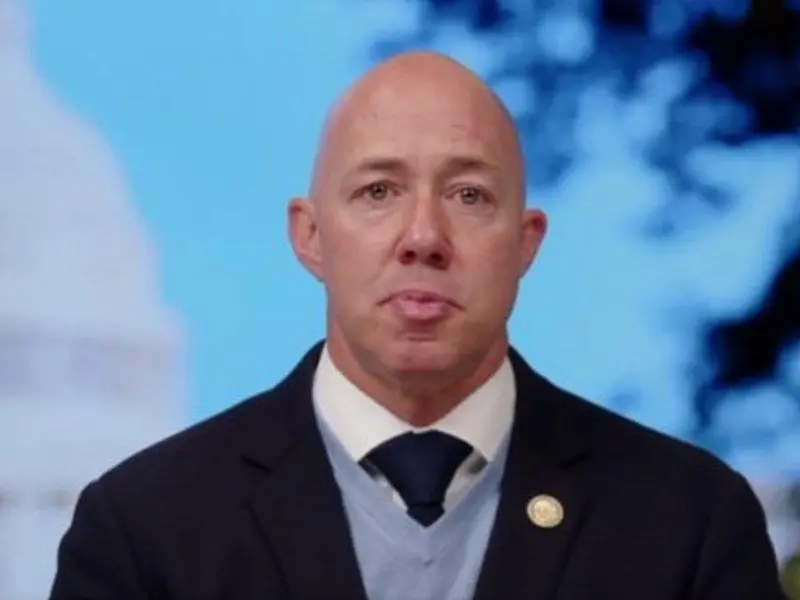
Moolenaar believes that the U.S. Department of Commerce's previous decision to restrict H20 exports was entirely correct, and now allowing these chips to enter China is tantamount to weakening the U.S.'s technological advantage in artificial intelligence.
He specifically wrote to U.S. Secretary of Commerce Gina Raimondo, requesting the government to reconsider this decision.
The policy support that Jensen Huang had just secured from the White House was thus opposed by members of Trump's own party.
Moolenaar is a representative figure in Congress advocating for stronger technology restrictions on China.
In his policy stance, the development of China's artificial intelligence industry has become an important issue for U.S. national security. Advanced GPUs can be used for commercial model training and can also be applied in military computing, intelligence analysis, and cyberattacks.
Therefore, he has long advocated for strict limits on China's access to advanced U.S. computing technology.
In fact, as early as the beginning of 2025, when DeepSeek sparked controversy, Moolenaar, along with the Democratic chief member of the Special Committee on China, Raja Krishnamoorthi, jointly requested the government to tighten export controls related to the chips used by DeepSeek.
This also indicates that there is a certain bipartisan consensus on Congress's hardline stance on technology policy toward China.
By December 2025, when Trump announced the allowance of some H200 chip exports to China, Moolenaar stood up again.
On December 12, he wrote to the U.S. Secretary of Commerce, requesting an explanation of the basis for the government's approval of H200 exports.
In Moolenaar's view, the previous export controls had forced Chinese companies to accelerate their search for alternative technologies, and this process precisely indicates that the restrictions are working.
If the U.S. reopens exports of higher-performance chips, it could help China narrow the gap in computing power with the U.S.
This time, the Republican congressmen opposing Trump's policies were not just Moolenaar.
On January 21, 2026, the House Foreign Affairs Committee held a meeting to review a bill called the "AI OVERWATCH Act."
The bill was proposed by the committee chairman Brian Mast, who is also a Republican.
This bill aims to strengthen Congress's oversight of advanced AI chip exports, requiring that exports of certain sensitive chips must obtain permission, while granting Congress the power to review and even block relevant permits.
According to Mast's perspective, advanced AI chips already have obvious military applications and cannot be managed entirely like ordinary commercial goods.
He even suggested that relevant exports should draw on the oversight mechanisms of U.S. foreign military sales.
This is essentially a struggle for an important power:
Should the decision on whether advanced AI chips can be exported to China be made by the White House and the Department of Commerce, or should Congress have more intervention rights?
For Trump, export permits can serve as a policy tool in U.S.-China trade negotiations.
But for Mast and other congressmen, if the president has too much discretion, he might approve transactions that they believe pose national security risks for economic gain.
This disagreement quickly became public.
Trump's White House AI and cryptocurrency special advisor David Sacks publicly opposed Mast's bill, arguing that it could limit the president's flexibility in using export control policies.
Mast responded that Sacks could suggest Trump sell H200, but his own suggestion was exactly the opposite.
Ultimately, the House Foreign Affairs Committee approved the advancement of this bill to the subsequent legislative process with a vote of 42 in favor, 2 against, and 1 abstention.
At that time, the bill had not yet officially become law, but such a lopsided vote result already indicated broad support for strengthening oversight of AI chip exports within the committee.
Democrats also supported strengthening regulations.
In September 2026, during a visit by a Chinese delegation to the U.S., Senate Democratic leader Chuck Schumer publicly criticized Trump for relaxing advanced chip export restrictions to China.
Democratic Senator Elizabeth Warren directly pointed her finger at Jensen Huang (the one who is very tough on Crypto).
She argued that tech entrepreneurs like Jensen Huang should not be allowed to participate in determining U.S. AI export policy for their own commercial interests.
In her view, national security policy should be formulated through government and legislative processes and should not be overly influenced by lobbying from large tech companies.
Thus, the political differences surrounding Jensen Huang in Washington have become quite clear.
The White House hopes to retain some policy space between national security and commercial interests.
The hardliners in Congress wish to tighten restrictions further and strengthen oversight of the executive branch.
Moreover, these hardliners exist within both the Republican and Democratic parties.
While both sides may argue endlessly over issues like taxes, immigration, and fiscal spending, there is considerable consensus on restricting China's access to advanced AI technology.
In this political environment, even if Jensen Huang can gain Trump's support, it is difficult to eliminate the pressure from Congress solely based on the president's personal attitude.
By November 2026, the situation changed again.
On November 3, the U.S. midterm elections concluded, with the Democratic Party gaining a majority in both the House and Senate, set to take control of the new Congress starting January 2027.
Trump is about to face a Congress controlled by the opposition party, and the Democrats will gain greater committee investigation and oversight power.
And just the day after the election, on November 4, Jensen Huang received a letter from the U.S. Congress.
The letter was signed by three individuals:
House Foreign Affairs Committee Chairman Brian Mast, House Special Committee on China Chairman John Moolenaar, and House Intelligence Committee Chairman Rick Crawford.
All three are from the Republican Party.
They requested Jensen Huang to attend a joint closed-door briefing from the three committees on November 18 and to confirm by November 11 whether he could attend.
The letter specifically requested Jensen Huang to explain the nature of his contacts with Megaspeed executive Huang Le and what security measures NVIDIA has established against foreign intelligence activities.
The three congressmen believe that recent media reports have raised national security concerns about sensitive technologies and information potentially being acquired by China, and Congress needs to understand the actual risks.
It is noteworthy that when this letter was sent, Jensen Huang had not publicly acknowledged marital infidelity, and NVIDIA's board had not yet announced the establishment of an independent investigation committee.
Congress's actions had already preceded Jensen Huang's later public apology.
In fact, what the congressmen are concerned about, besides the nature of the relationship between Jensen Huang and Huang Le, is whether this relationship could affect NVIDIA's information security and business decisions.
They want to know what measures a CEO responsible for the world's most important AI chip company has taken to prevent sensitive information from being acquired by foreign intelligence agencies during long-term interactions with overseas clients.
NVIDIA also emphasized that the company's dealings with relevant clients are normal business activities, and clients cannot obtain sensitive technological information as a result.
However, the investigation by the U.S. Congress does not necessarily need to wait for an actual leak to be initiated.
When congressmen believe that a certain business relationship may pose security risks, they can use the committee's oversight powers to require companies to submit explanations, accept inquiries, and even further promote regulatory measures.
For Jensen Huang, this has already marked a significant difference from the previous process of seeking chip export permits.
Earlier, he primarily explained to the U.S. government, as an entrepreneur, why allowing NVIDIA to continue selling chips to China could benefit the U.S.'s technological competitiveness.
Now, he needs to explain to congressional members whether he and NVIDIA have properly managed potential national security risks.
What complicates matters further is that after the new Congress is sworn in in 2027, the Democrats will have more investigative resources.
Thus, a rather unique situation has emerged.
Trump still publicly affirms Jensen Huang, while the hardliners within the Republican Party have demanded he undergo an investigation, and the Democrats are about to take over Congress, having long opposed certain advanced chip export policies to China.
For Jensen Huang, the relationships built with the White House over the past few years are no longer sufficient to cope with all political pressures.
And this investigation against him happens to occur during a special period when the power in the U.S. Congress is about to change hands, and the debate over U.S.-China chip policies continues to heat up.
As for why the relevant intelligence has been concentrated and exposed at this time, whether there are more complex political factors behind it is worth further investigation.
Why Now, Targeting Jensen Huang?
In fact, U.S. intelligence agencies began paying attention to Huang Le as early as 2025, and Trump himself had been informed of the relevant situation. In the spring of 2026, U.S. officials compiled an internal memorandum concerning the private relationship between Jensen Huang and Huang Le.
However, these matters have never been made public, and Jensen Huang has not been significantly affected by them; he even received the National Medal of Science from Trump himself in October of this year.
Until October 29, when The New York Times suddenly exposed the relevant intelligence, followed by media such as the Financial Times, and then came congressional intervention, Jensen Huang's public apology, and NVIDIA's board initiating an independent investigation.
In just ten days, such a significant change occurred.
I personally tend to believe that the concentrated outbreak of this incident is likely related to the political struggle within the U.S. surrounding AI chip export policies.
As mentioned earlier, Jensen Huang has been actively lobbying the Trump administration over the past two years to ease restrictions on advanced chip exports to China.
He has indeed achieved considerable results, but has also offended a group of congressmen who have long advocated for strict technology restrictions on China.
For these individuals, Jensen Huang's greatest advantage in the past was his ability to directly engage with Trump and persuade the White House to adjust policies through commercial interests.
And this intelligence storm has precisely struck at his Achilles' heel.
In the early days, Congress wanted to oppose NVIDIA's sale of chips to China, and it needed to engage in debates with the White House regarding technical performance, national security, and economic interests.
Now, they can directly question whether Jensen Huang himself poses a security risk, and even further inquire whether his past lobbying of the U.S. government has been unduly influenced.
Therefore, once Jensen Huang's personal credibility is seriously questioned, even if he continues to lobby Trump in the future, he may face greater political resistance.
Moreover, this turmoil has intensified after the U.S. midterm elections, where the Democratic Party won a majority in both the House and Senate, and Trump is about to face stronger congressional oversight.
However, the three committee chairs who first called for an investigation into Jensen Huang all come from the Republican Party.
This indicates that dissatisfaction with Jensen Huang likely transcends the partisan divides of the two major U.S. parties.
On the issue of advanced chip exports to China, there is already a similar stance between hardliners within the Republican Party and some Democratic lawmakers.
Thus, the timing of this intelligence being concentrated and exposed may involve certain political forces pushing or amplifying the event.
At least from the current developments, it is clear that the U.S. tech hardliners can leverage this turmoil to gain more support for their long-held policy positions.
Trump's situation is equally awkward; he previously established a good relationship with Jensen Huang and indeed hopes NVIDIA will continue to help the U.S. expand its AI industry advantage.
However, if subsequent investigations escalate, Trump's continued support for Jensen Huang could lead to political opponents questioning his excessive protection of tech giants, even neglecting national security risks.
In other words, this turmoil is simultaneously increasing the political costs for both Jensen Huang and Trump, and the extent to which this will develop ultimately depends on how the U.S. Congress plans to utilize this matter next.
If the investigation only stays at the level of personal relationships and corporate security systems, the impact on NVIDIA may be relatively limited.
But if Congress uses this opportunity to re-examine NVIDIA's chip sales to China, Jensen Huang's previous lobbying activities, and the decision-making process of the Trump administration in approving related export licenses, things will become much more complicated.
Personally, I believe this latter possibility is more likely. For the political forces that have long opposed loosening chip restrictions on China, rather than repeatedly debating with Jensen Huang about whether selling chips is beneficial, directly undermining his political influence in the White House may be more effective.
Jensen Huang's greatest advantage in the past was NVIDIA's unique position in the global AI industry and the relationships he established with the White House.
Now, both of these advantages may be subject to new political scrutiny due to a personal controversy.
And Jensen Huang's troubles may have only just begun.
 Risk warning
 Risk warning




Popular articles