The payment company can borrow 30 million USDC, but cannot purchase the limit that will still exist tomorrow
 Core Viewpoint


 Nikos believes that payment companies can borrow $30 million USDC from Aave or Morpho in one go today, but cannot obtain a commitment for a continuously available credit line at known prices for the next year. He proposed a four-tier credit framework: committed credit line, priority loss layer, borrowing interest rate cap, and accounts receivable recovery and data triggers, and pointed out that the competitive advantage lies in underwriting data, bilateral capital, API integration, and legal packaging, rather than the contracts themselves.
Author: nikos, focusing on DeFi, Vaults, and RWA, previously worked at BitstampUK, InfraredFinance, and Fuel Network
Compiled by: Gu Yu, ChainCatcher
A payment fintech company can borrow $30 million in USDC through a single transaction on Aave or Morpho today. What it cannot obtain anywhere on-chain is a promise: that this $30 million will be there tomorrow morning and every morning for the next year, at a price it already knows. This promise is the product that banks sell to it and is the piece that the lending stack has yet to build.
Yesterday, I broke down fixed-rate working capital: how TradFi funds it, how Aave V4 Spokes, Avon, and Morpho Midnight will carry it, and where their respective shortcomings lie. This article discusses what should be built on top of it. It covers still unresolved issues, a four-layer product, and where the moat will fall.
What Remains Unresolved
Four gaps were identified in comparison, each located one layer above the lending market.
No one promises capacity. A V4 Spoke limits how much a borrower can withdraw, but nothing guarantees that liquidity will be there when it is withdrawn. The quotes signed by Midnight lenders can be canceled at the last moment before the borrower needs them. Avon will route to any party that is quoting. A fintech company that pre-funds $10 million daily needs this line of credit to exist even on its worst day, which is the day lenders withdraw.
Isolation stops at Spoke. On V4, a Spoke loss that fails to be recovered will fall on every supplier of that asset in the Hub. In Midnight and Avon, losses remain in a market where lenders bear all the losses. Neither has set a first-loss layer between the borrower and priority funds, which is how every warehouse credit line and conduit is constructed in TradFi.
The initiator's funds float among its holders. About $600 million in tokenized working capital credit is held by those who cycle it with floating USDC debt. When borrowing rates soar, they sell, and the initiator loses what it thought was stable funding. The fixed-rate market can only solve this when it is deep enough at the right term. Setting a cap on borrowing rates can solve it without such depth; however, there are no running products that sell such a cap for borrowing rates against Aave or Morpho.
Accounts receivable cannot be liquidated within an hour. On-chain liquidation assumes there is a price and a buyer. Accounts receivable tokens have an NAV report and a redemption queue measured in days. The tools used by banks (stopping advances, taking over collections, allowing asset pools to naturally expire, selling to pre-arranged buyers) currently have no on-chain equivalent.
What the Foundation Layer Has Accomplished
Most of the difficult mechanisms already exist.
The previous two attempts set the benchmark. Wildcat allows borrowers to set their own terms (capacity, APR, reserve ratio, withdrawal period) in their own market. When Kinto defaults in 2025, it will be its first default since 2023, and losses will remain in that market, with lenders expected to recover 76% of their principal. 3Jane offers unsecured USDC lines backed by on-chain data and bank data, allowing unutilized funds to earn yields on Aave, and divides lenders into 85% priority and 15% subordinate. Both have proven parts of the tech stack are feasible. Neither sells committed capacity to fintech companies, routes between V4 and Midnight, nor operates in conjunction with accounts receivable collateral.
Four Layers
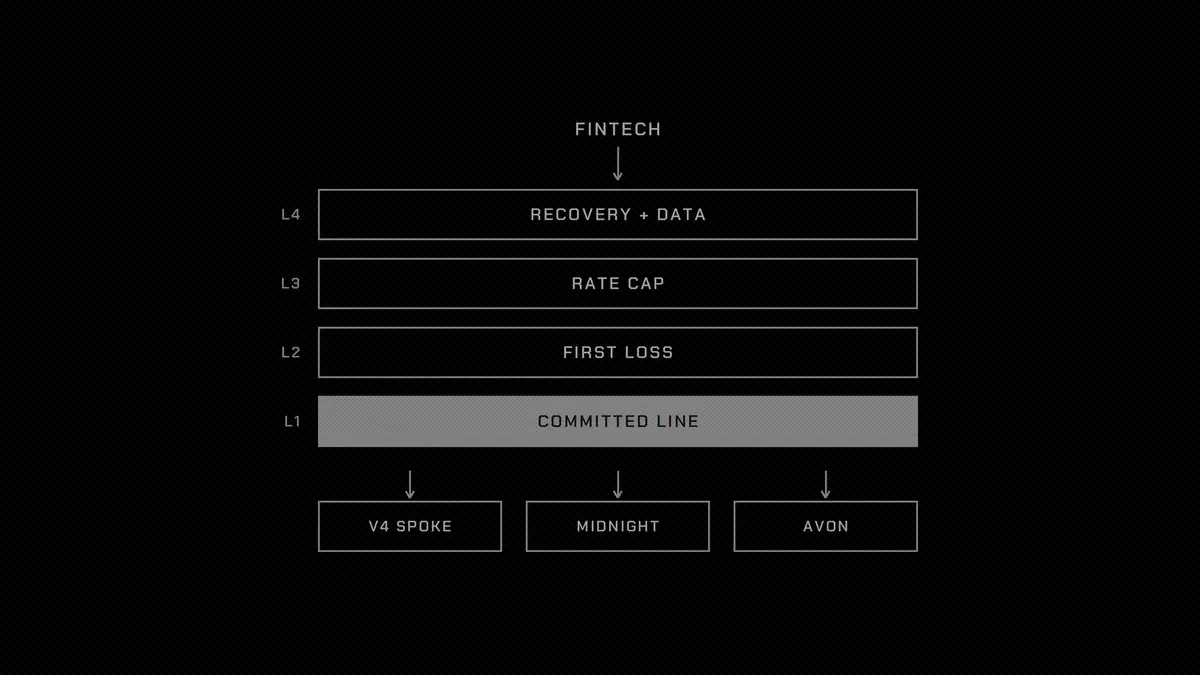
This product is a credit platform situated between fintech borrowers and the lending market, built as four layers, each of which can operate independently but is stronger together.
Layer 1: Committed Capacity
A financing facility is a treasury with an authorized range. Depositors fund it, and it commits to a borrower to provide up to X at an agreed spread above the reference rate, or at a fixed rate, within 6 to 12 months, accessible via API for withdrawals and repayments. Unutilized funds are placed in the deepest floating market and earn the market's interest rate. Each withdrawal goes to the cheapest place for that collateral and term: a dedicated V4 Spoke or a Midnight market matching the withdrawal's maturity date. The borrower pays the spread on the withdrawn portion plus a commitment fee on the unutilized portion, which is what makes this commitment worth adhering to.
On a financing facility with an average withdrawal of 60% of $30 million, the spread is 4%, and the commitment fee is 0.5%, earning the depositor relative to the floating rate
60% × 4% + 40% × 0.5% = 2.6%
which amounts to $780,000 per year. The risk is the option that the treasury has already sold. Borrowers withdraw the most under pressure, so this financing facility must withstand a jump from $18 million to the full $30 million on the worst day. This means determining the commitment size based on the liquidity the treasury can draw from the floating market under stress scenarios, rather than based on average usage. It also means that the withdrawal queue cannot block an already committed withdrawal.

Layer 2: First Loss of Each Financing Facility
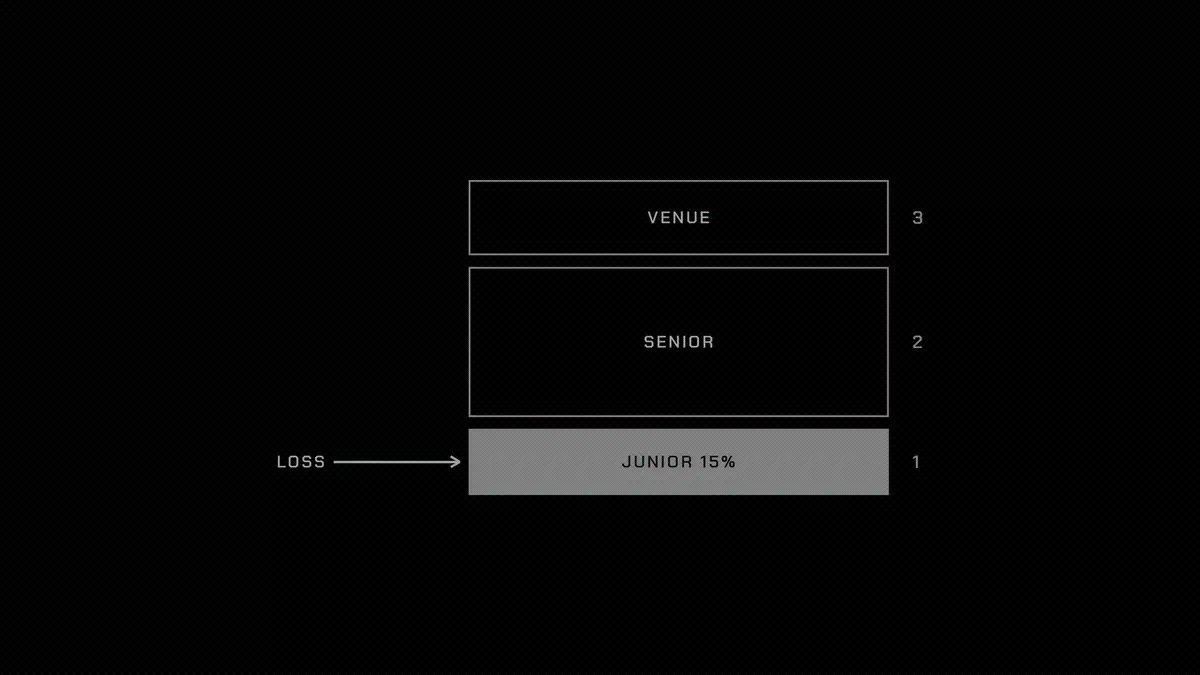
Each financing facility has a subordinate tranche that absorbs losses before priority depositors and also before the Hub or market below it. It is the equity layer of warehouse credit lines, made explicit and placed on-chain. It can be contributed by initiators, specialized credit funds, or both parties together.
Setting the subordinate tranche size at 15% of the withdrawn amount, which is $2.7 million on an $18 million withdrawn amount, and giving it 60% of the $720,000 spread. It earns
432,000 ÷ 2,700,000 = 16%
above the floating rate. A 5% loss on the withdrawn book, or $900,000, would take away a third of it, while there would be no losses on the priority side. On V4, the subordinate tranche makes the isolation of Spoke losses from Hub suppliers real. On Midnight, it allows a curated treasury to provide depositors with a priority claim on a market, otherwise they would bear all of that market's risks.
Layer 3: Borrowing Rate Cap
When a borrowing index at a venue runs above the strike price, the cap pays its holders:
payoff = max(0, r_b − K) × N × t
At a 7% strike price, if the USDC borrowing rate averages 9% over 30 days on a nominal principal of $100 million, the cap pays
100,000,000 × 2% × 30/365 ≈ $164,000
If a large portion of an initiator's tokens is held in circulation, it can purchase caps for its holders, so that when borrowing rates soar, they pay out to them instead of forcing them to sell. The sellers are those who naturally go long on high rates: floating rate lenders, fixed rate treasuries, and the idle capital warehouse of the financing facility itself. These components exist in Kairos-style permissionless swaps and Boros's rate engine. What does not yet exist is a liquid standardized cap for borrowing indices against Aave and Morpho.
Layer 4: Recovery and Data
This layer turns accounts receivable into collateral that the lending market can bear. It has three parts.
Standby Buyers: An access list for liquidation that only accepts pre-committed buyers (issuers, backup service providers, distressed credit funds), transacting at an agreed discount and earning a standby fee for being present. It replaces the Midnight 60-minute climb to full liquidation mechanism with a transaction sold to those who can wait for collections.
Valuation: Collateral pricing based on NAV minus expected losses, with discounts widening as the report age increases, and adjusting based on actuals when collections are received, rather than accounting for worst-case scenarios from day one.
Triggers: Proven accounts receivable, guaranteed fund balances, and settlement delay data feeds that automatically reduce drawCaps, treasury caps, and financing facility limits when asset pools deteriorate. This is the stop-advance clause of warehouse credit lines, connected to various venues.
Where the Moat Lies
Contracts will not be the moat. The lending market is converging on the same components, and Aave Labs acquiring Avon indicates that these venues intend to own fixed rates themselves. Anything built on top of it must be valuable because of what it knows and who it has signed, not because of what it has deployed.
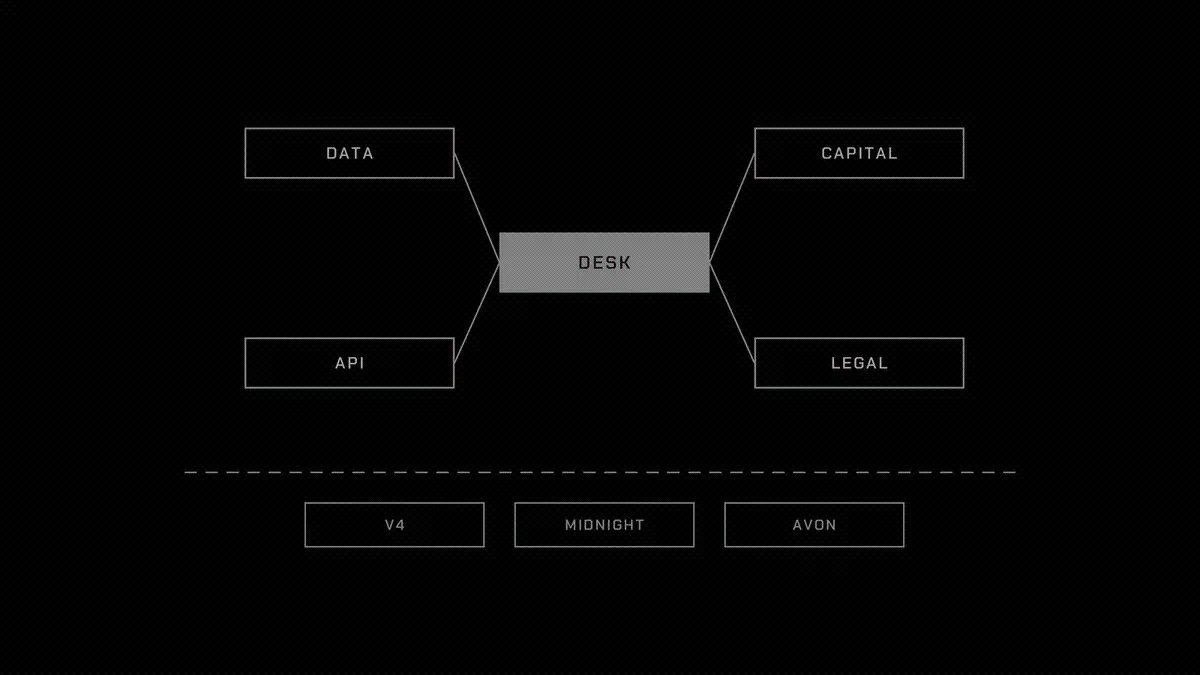
Insured data comes first. This credit platform sees every withdrawal, repayment, and settlement delay of its borrowers, and this loss history will continuously accumulate. Two years later, it can price a payment corridor or an accounts receivable pool better than newcomers, who cannot see this data.
The capital network is bilateral. Priority depositors want a first-loss layer in front of them. Subordinate capital and standby buyers want a stable, already insured flow of financing facilities. Whoever first brings both sides together sets the terms for pricing the next financing facility.
Then there is integration. Fintech companies integrate a credit API instead of three lending markets. Once a borrower's treasury withdraws daily through this credit platform and its triggers are connected to its settlement data, the switching costs become real.
Finally, there is legal packaging, which is also the hardest part. Providing unsecured loans to payment companies, a receivable claim that stands in its jurisdiction, KYC for both parties: these take time and expertise, and they keep fast replicators at bay.
Where the Challenges Lie
Commitment is an option. Pricing for stress withdrawals and holding liquidity against it, while not stifling depositor returns, is the core risk issue. If you get it wrong, this credit platform will happen to breach its commitment in the most critical week.
The recovery of unsecured or accounts receivable credit is slow and legal, rather than on-chain. Wildcat's first default recovered 76%. 3Jane sells bad debts to licensed collection agencies. The waterfall for repayments must be priced for this period.
The foundational layer is changing. Aave's fixed-rate plan after the Avon trade, Morpho's adapter launching this quarter, and the Midnight market collateralized by accounts receivable, each could absorb a part of this tech stack. This credit platform must be a router and underwriter, not just a feature that will be launched next quarter in some venue.
Regulation lies beneath all of this. Lending to licensed payment institutions is the cleanest entry point, and it is precisely the type that the counterparties' regulators will go to read the terms list.
I am interested in building this and exploring this idea among several others, and I am looking for people who are interested in pushing it forward. If you are building any layer of these, or want to build, please DM me. The four questions above are worth solving, no matter who ultimately solves them.
 Risk warning Risk warning



Popular articles