High interest rates collide with high leverage: From tonight's CPI to CoreWeave's financial report, how much longer can the AI bull market hold up?
The U.S. October CPI will be released tonight at 21:30. The market expects the overall and core month-on-month rates to be 0.3% and 0.2%, respectively. Due to the lack of price data collection during the government shutdown in October last year, there will be no official year-on-year figures released this time. Around 6 AM Beijing time tomorrow, CoreWeave will hold a conference call for its third-quarter earnings. What the market is really looking at has now shifted to another number: the quarterly interest expense of $860 million to $940 million, and whether it can be covered by the adjusted operating profit of $200 million to $260 million.
At 21:30 Beijing time tonight, we will first look at the CPI. Around 6 AM Beijing time tomorrow, CoreWeave's earnings call will follow. The real concern is whether the valuation logic of AI assets will continue to tighten after putting the two answers together.
1. CPI lacks year-on-year data; the market is really focused on core month-on-month data tonight
The biggest peculiarity of this CPI is that it lacks a familiar market indicator: year-on-year data.
In October 2025, the U.S. federal government experienced a 43-day shutdown, during which the Bureau of Labor Statistics did not complete the CPI price collection for that month and did not make it up afterward. Therefore, this October's CPI lacks a real benchmark from October 2025, and the Bureau of Labor Statistics will not publish the 12-month year-on-year changes for overall and core CPI. The latest official data from September still shows an overall year-on-year rate of 3.7% and a core year-on-year rate of 2.6%. The report released tonight will directly enter market pricing based on month-on-month data.
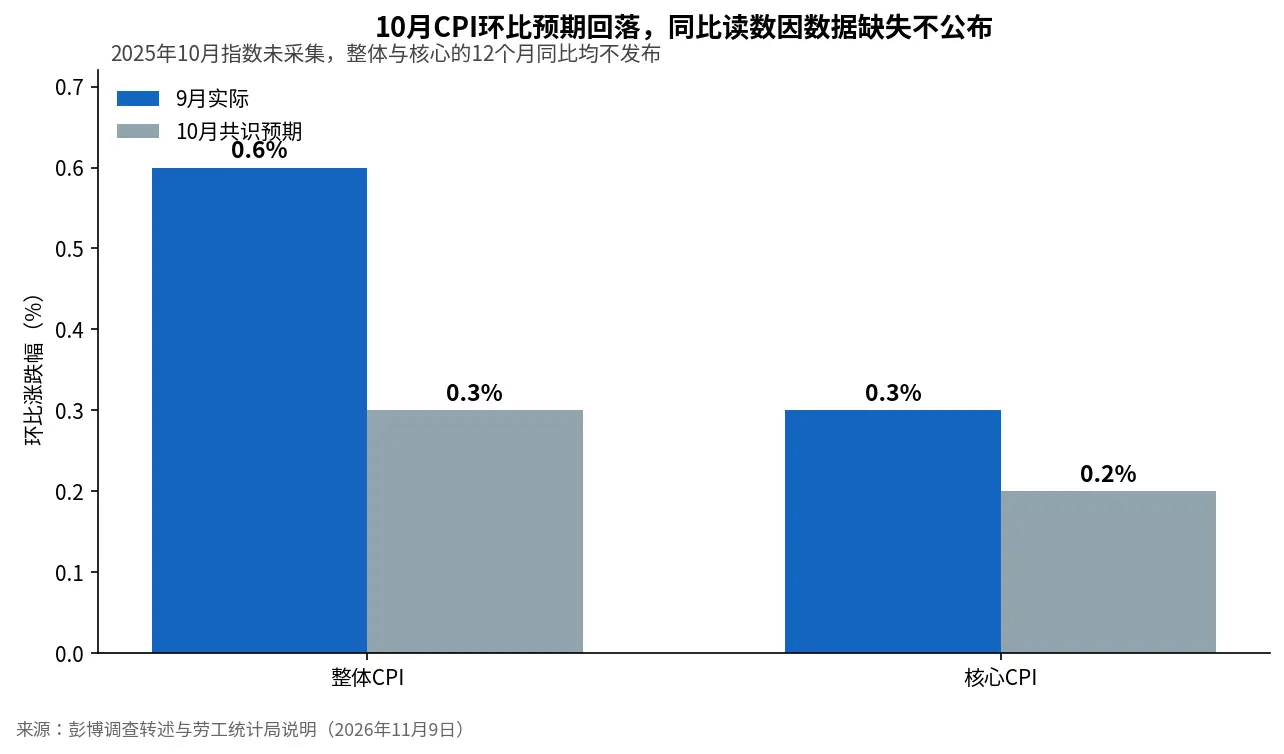
The market currently expects the overall CPI for October to rise by 0.3% month-on-month and the core CPI to rise by 0.2%, a significant cooling compared to September's 0.6% and 0.3%. The drop in gasoline prices will help slow down the overall CPI. For the Federal Reserve, what really matters is still the core inflation excluding food and energy, especially whether the prices of housing, transportation services, and other sticky services can continue to slow down.
This is also where the data tonight may show a contrast; a number below expectations does not necessarily mean that interest rate pressure is relieved. A core month-on-month rate of 0.2% basically meets expectations but may not be enough to loosen the pricing for a rate hike in December. What can truly drive the repricing of interest rate trades is if the core CPI is significantly below 0.2% or conversely returns to above 0.3%. Previously, 165,000 non-farm jobs were added in October, exceeding market expectations, and a December rate hike has become the mainstream pricing in the market, with the latest market pricing around 84% (CME data, as of November 9, before the non-farm report it was 72.8%).
The real impact of tonight's CPI is not just on the December rate hike but whether the interest rate path for 2027 can continue to be revised upward. Bank of America and Morgan Stanley currently expect one rate hike each in December and March, with a terminal rate of 4.25% to 4.5%. If the core month-on-month rate is only 0.2% or even lower, long-term U.S. Treasury yields, the dollar, and high-valuation tech stocks may have a chance to catch a breather. If core inflation rises back to 0.3% or even higher, the market will revisit the discussion of maintaining high rates for a longer period, and the AI sector is precisely one of the assets that responds fastest to changes in funding costs.
In other words, the CPI answers whether money is expensive. CoreWeave's earnings report needs to answer whether AI infrastructure can still be profitable even if money is expensive.
2. CoreWeave's biggest challenge has shifted from revenue to interest
CoreWeave's revenue growth has become less of a suspense. The company's revenue for the second quarter was $2.575 billion, a year-on-year increase of about 112.5%. As of the end of June, the revenue backlog was about $104 billion, and over $25 billion in customer commitments were added at the beginning of the third quarter. The active power installed capacity reached 1.5 gigawatts, with contracted power capacity of about 3.7 gigawatts. The demand-side story remains strong.
However, what the market is really concerned about now is how much funding is needed to fulfill these orders and who will bear the financing costs incurred before fulfillment.
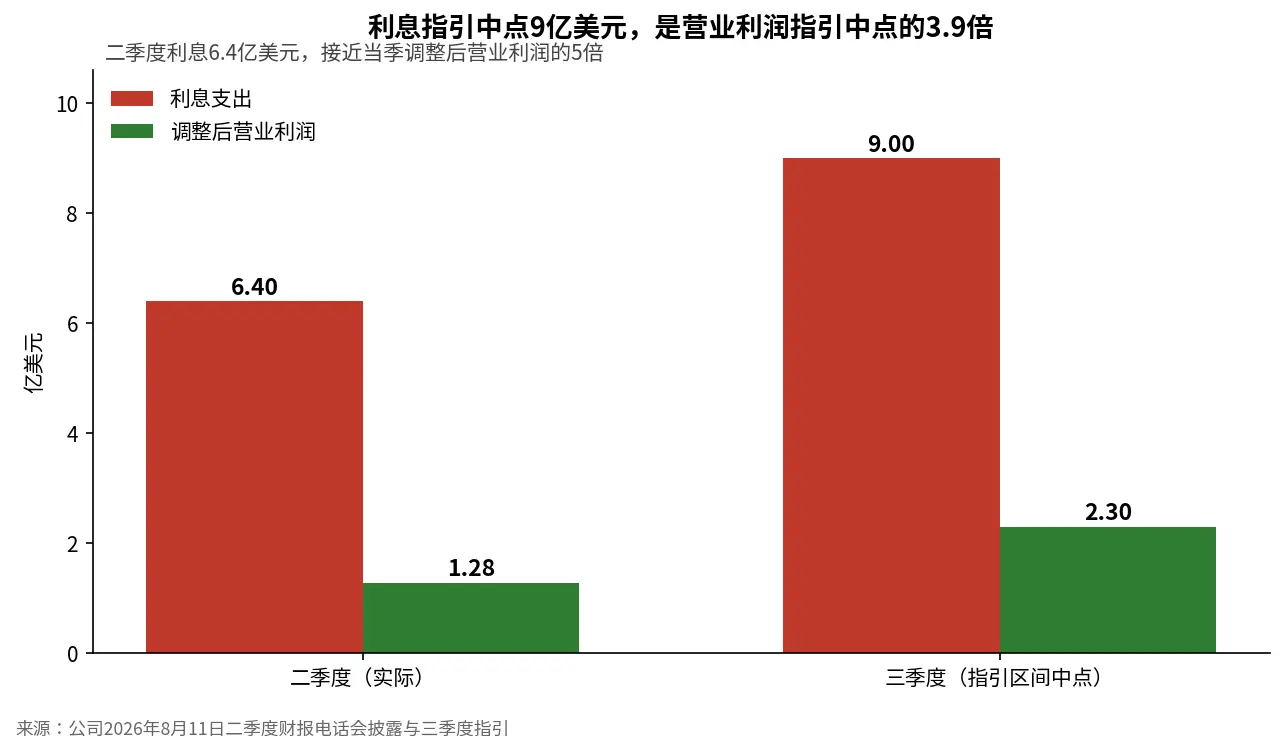
The company's previous guidance for the third quarter was revenue of $3.45 billion to $3.6 billion, interest expenses of $860 million to $940 million, and adjusted operating profit of $200 million to $260 million. Based on the midpoint of the range, $900 million in interest corresponds to $230 million in adjusted operating profit, about 3.9 times. This figure itself is enough to illustrate the problem; CoreWeave is in a phase of rapid revenue growth while financing costs simultaneously erode operating profits.
The actual data from the second quarter is more intuitive. The company's revenue for the quarter was $2.575 billion, with a GAAP operating loss of $49 million and interest expenses of $640 million. The adjusted operating profit was $128 million, with interest nearly five times that amount. The adjusted EBITDA reached $1.51 billion, which superficially seems sufficient to cover interest, but this does not solve the real problem; CoreWeave still needs to continuously invest massive capital to turn orders into revenue-generating computing power.
This is why looking solely at EBITDA can easily underestimate risks. Capital expenditures for the second quarter were about $9.4 billion, slightly exceeding the upper limit of guidance (disclosed during the company's conference call). Capital expenditures for the first half of the year were about $14.1 billion (cash flow statement), while operating cash flow during the same period was only about $3.66 billion. The company has the ability to generate cash, but the speed of cash generation is far behind the speed of funding needed for expansion.
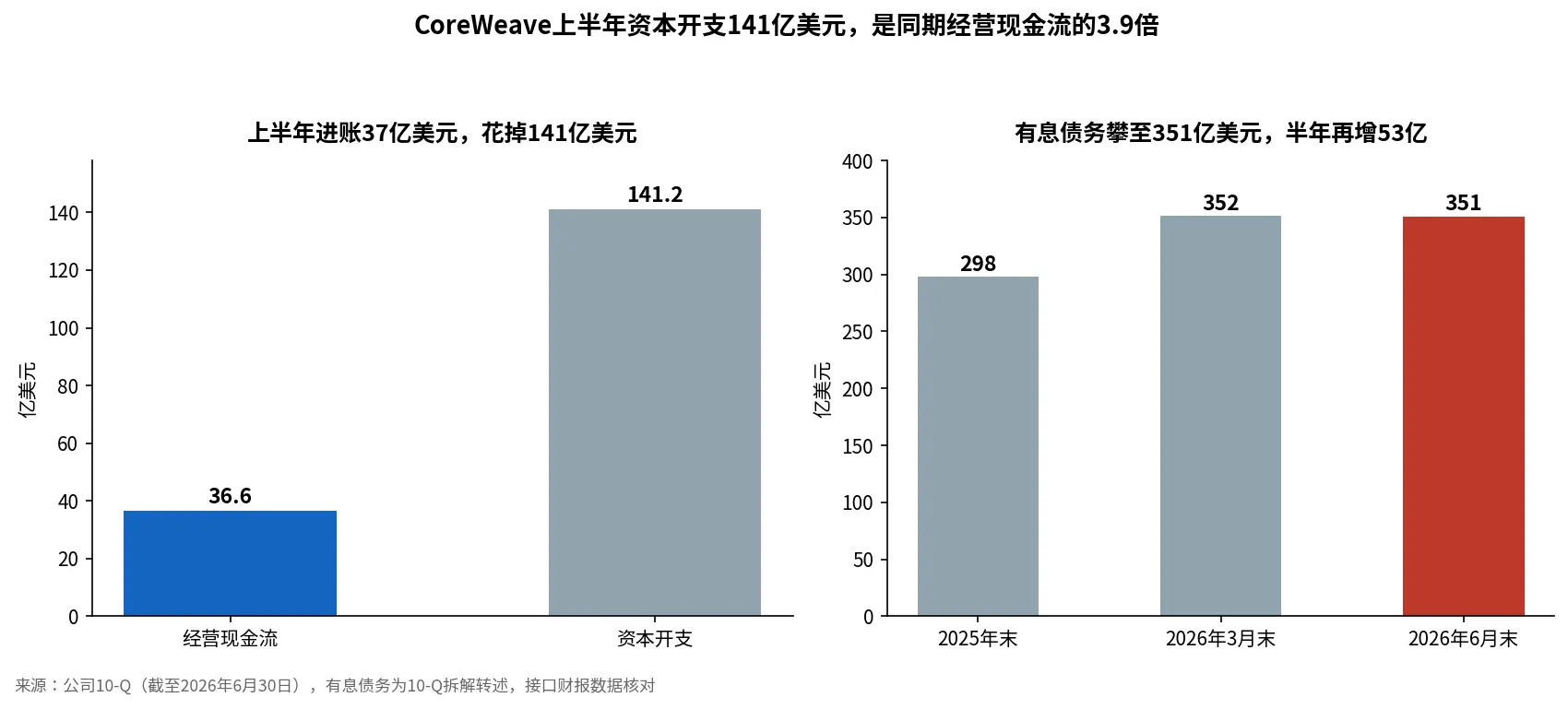
Therefore, the most worth reading in tomorrow's earnings report has shifted from revenue to three other things: where the actual interest expenses for this quarter land, how much new capacity has gone live and started contributing revenue, and to what extent the financing preparations needed for continued expansion in 2027 have reached.
The $104 billion backlog is real, and the 1.5 gigawatts of active installed capacity is also real, but orders are not cash, and installed capacity does not equal profit. Only when new data centers are delivered on time, customers pay as per contracts, and operating cash flow begins to catch up with capital expenditures can CoreWeave's high leverage truly be considered leverage.
3. Bonds vote before stocks; the market is worried about the financing chain
If we only look at the U.S. stock market on Monday, it is easy to think that last week's AI decline has ended. SOXX rose 7.49%, AMD rose 13.26%, Broadcom rose 8.78%, and CoreWeave rose 5.56%, showing a clear rebound from the deep decline (market data interface, November 9 close).
However, the signals from the credit market are not so optimistic: CoreWeave's 8.5% coupon, maturing in 2032, previously fell to about 71 cents, dropping about 8.5 points in a week. The yield on unsecured debt has risen from about 10% to around 15%, and the five-year CDS spread has surpassed 1100 basis points. This pricing does not indicate that there is no demand for AI. It indicates that the market is beginning to require AI infrastructure companies to pay a higher price for high leverage, high capital expenditures, and refinancing risks.
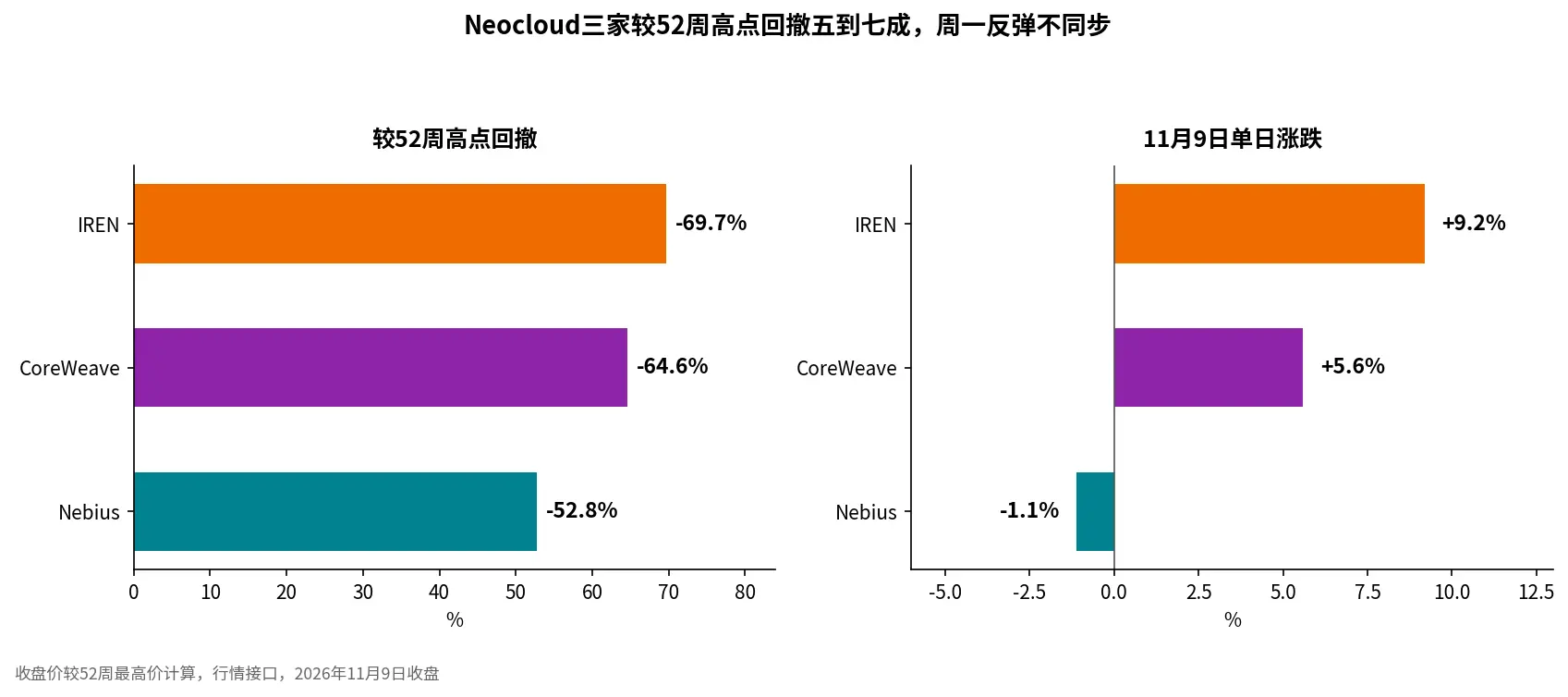
An even more critical signal is that this pressure is spreading to other parts of the industry chain. Goldman Sachs' recent credit market observations show that the CDS spreads for the chip sector have surpassed those of large cloud providers for the first time in three months. The market previously understood the financing risks of AI as cloud providers needing to borrow money to build data centers, but now it is further questioning how fast Neocloud's orders can grow if cloud providers control capital expenditures themselves, and whether the credit risks of chip manufacturers, data center operators, and GPU clouds will rise simultaneously if financing costs continue to increase.
Microsoft's actions have also made this issue more realistic. According to a report by CNBC on November 6, Microsoft is reevaluating its Neocloud partner list and is inclined to prioritize using its own data center resources. Microsoft has not decided which specific suppliers to eliminate but has already abandoned a site from the UK-based Nscale and has not renewed contracts related to Texas.
This does not mean that Microsoft is abandoning Neocloud, nor does it imply that AI demand has suddenly disappeared. The real change is that customers are beginning to examine the economics of purchasing computing power from third parties versus building their own computing power more seriously than before. For companies like CoreWeave, how large of an order customers are willing to sign is one thing, but whether orders can be delivered on time, whether customers will continue to add more, and whether financing institutions are willing to provide funding for the next batch of data centers is another matter.
Therefore, the valuation logic of AI infrastructure is changing, shifting from how strong the demand is to whether demand, financing, and cash recovery can coexist.
4. What to watch for AI trading after tonight?
Putting CPI and CoreWeave together, tonight is actually a very clear stress test, with results roughly falling into four combinations.
If CPI is below expectations and CoreWeave's earnings report is solid, it is the most comfortable combination for AI assets. If core CPI is below expectations, long-term yields will fall. If CoreWeave simultaneously provides lower interest expenses, smoothly launched capacity, and clear financing arrangements, the market will regain confidence that high capital expenditures are just a temporary phenomenon in the expansion phase. In such a combination, we cannot rule out the possibility that CoreWeave, AMD, Broadcom, data centers, and other high-beta AI assets will continue to rebound.
If CPI is above expectations and CoreWeave's earnings report remains solid, the market will begin to differentiate. Interest rates will continue to be high, and companies that truly have cash flow, customer quality, and financing ability may continue to secure funding, while the valuation recovery of high-leverage Neocloud will be limited. The AI market will not end because of this, but the overall strategy of buying AI stocks will become increasingly difficult, with the market placing more emphasis on who can truly convert orders into cash.
What we really need to be wary of is if CPI is above expectations and CoreWeave simultaneously exposes financing pressure. If core inflation rises back to 0.3% or even higher, long-term interest rates will continue to rise, and if CoreWeave's interest expenses exceed the upper limit of guidance, capacity delivery is delayed, or management cannot provide sufficiently clear answers regarding financing arrangements for 2027, last week's AI decline may exceed the range of position liquidation, and the valuation system will begin to contract further.
Conversely, if CPI is below expectations but CoreWeave's earnings report is weak, it cannot simply be understood as a comprehensive positive for the AI sector. A decrease in interest rates can alleviate valuation pressure but does not solve the company's cash flow and debt issues. In this case, funds are more likely to shift from high-leverage AI infrastructure to AI beneficiaries with healthier balance sheets and stronger free cash flow.
This is also the most worth watching aspect tonight: CPI determines the cost of capital, and CoreWeave determines whether AI expansion can still be viable under high capital costs. The former affects the valuation denominator of the entire market, while the latter directly tests whether AI infrastructure companies' profits and cash flows can cover this expansion model.
Monday's rebound indicates that the market is willing to re-buy the AI assets that were hit hard, but whether the rebound can turn into a trend recovery cannot be judged solely by stock prices. First, we will look at core CPI at 21:30 tonight, and then at CoreWeave's interest, capacity, and financing tomorrow morning. For high-beta AI assets, the combination of these two numbers is more meaningful than a single earnings report or macro data.
5. In conclusion: AI demand has not disappeared; what is expensive is the money paid for AI.
CoreWeave's most concerning issue right now is not the sudden disappearance of the $104 billion order backlog, nor is it the disproof of AI demand. The real problem is that the revenue realization from AI infrastructure takes time, while debt interest and capital expenditures need to be paid immediately.
In the second quarter, $640 million in interest corresponds to $128 million in adjusted operating profit, and in the third quarter, the company's own guidance pushes this ratio to nearly four times. The approximately $14.1 billion in capital expenditures in the first half corresponds to about $3.66 billion in operating cash flow. As long as capital expenditures continue to grow rapidly, the company will need to continuously enter the debt and equity financing markets. If financing costs continue to rise, the valuation based on high growth will increasingly depend on whether cash flow can be realized smoothly in the coming years.
Therefore, tonight's reading is not just about whether the CPI is 0.2% or 0.3%, nor just about CoreWeave's after-hours fluctuations. What really needs to be checked is whether the four variables of interest rates, interest, capacity, and financing can all hold simultaneously.
If the CPI cools down and CoreWeave's financing ability stabilizes, AI trading may shift from last week's panic deleveraging back to fundamental trading. If the CPI continues to exceed expectations while CoreWeave's financing pressure is further exposed, the market will need to reprice high-leverage AI infrastructure.
This time, the question the market needs to answer has changed to a more realistic one: How much money is needed to sustain the prosperity of AI?
Disclaimer: The content of this article is for general information and market commentary purposes only, compiled based on publicly available information as of the time mentioned in the text. Relevant market data, expectations, and probabilities may change with market conditions. The views and investment strategies cited from third-party institutions, analysts, or other individuals only represent the views of the relevant third parties at a specific time and do not represent the views or recommendations of BIT. This article does not constitute investment advice, investment research, an invitation, solicitation, or recommendation for any securities, investment products, or trading strategies, nor should it be the basis for any investment decision. Financial markets carry risks, and securities prices and market performance may fluctuate; past performance and historical market trends do not represent or guarantee future results. Investors should independently assess the relevant risks based on their own circumstances and seek professional advice when necessary.
 Risk warning Risk warning


Popular articles