After Jensen Huang stepped down, 14 investment banks quickly interpreted: No one can wear his leather jacket, bottom consensus around 150 dollars
 Core Viewpoint


 14 Wall Street firms made urgent statements: 3 downgraded ratings, 6 lowered target prices, but most maintained a buy rating, with the logic being "orders are booked until 2028, profits remain unchanged, only the valuation multiple is compressed." The real concern is the lack of successors and the AI ecosystem financing system built by Jensen Huang himself.
NVIDIA has announced that the company's co-founder and sole CEO for 33 years, Jensen Huang, has resigned immediately and also stepped down from the board. CFO Colette Kress will serve as interim CEO, while Harvey Jones, a veteran from Synopsys, will become the company's first board chairman. Candidates for the permanent CEO position will consider both internal and external candidates.
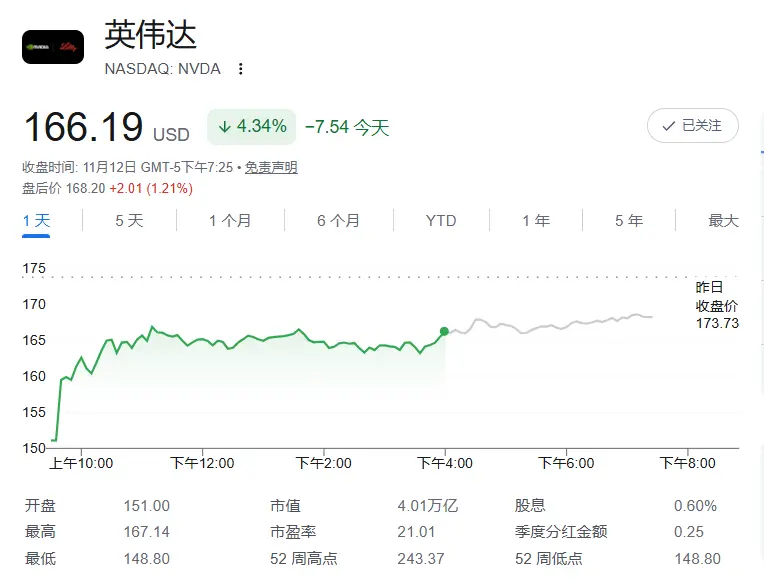
The news broke at 8:48 AM Eastern Time on the 12th. Before the market opened, NVIDIA's stock price had already dropped about 10% to around $156, falling below the 52-week low of $164.27. The company's market value evaporated by about $420 billion in a single day, and over the past month, the company's market value has shrunk by about one-third.
That evening, research reports from 14 Wall Street investment banks flooded analysts' and fund managers' inboxes.
Three firms downgraded NVIDIA's rating: Bernstein, KeyBanc, and William Blair. Six firms lowered their target prices: Bernstein, JPMorgan, RBC, Cantor, Goldman Sachs, and Citigroup. However, the vast majority maintained a buy rating—the core logic being "orders are filled until 2028, and the fundamentals are secure in the short term." The average target price from 13 investment banks is about $260, representing about a 50% upside from the pre-market price.
Regarding who can succeed Jensen Huang, Seaport's Jay Goldberg wrote in a research report—"In short, no one can fill Jensen's leather jacket." With 60 direct subordinates, there is almost no successor. Bernstein's analyst Stacy Rasgon lamented, "Where does he find the time?"
The real concern is that the AI ecosystem financing system built by Jensen Huang will suddenly come into question with his departure.
Goldman Sachs: Departure is significant but manageable—like Apple after Jobs
Goldman Sachs chose to wait until the press release was officially issued before writing. Analyst James Schneider characterized Huang's departure as "a significant but manageable negative event."
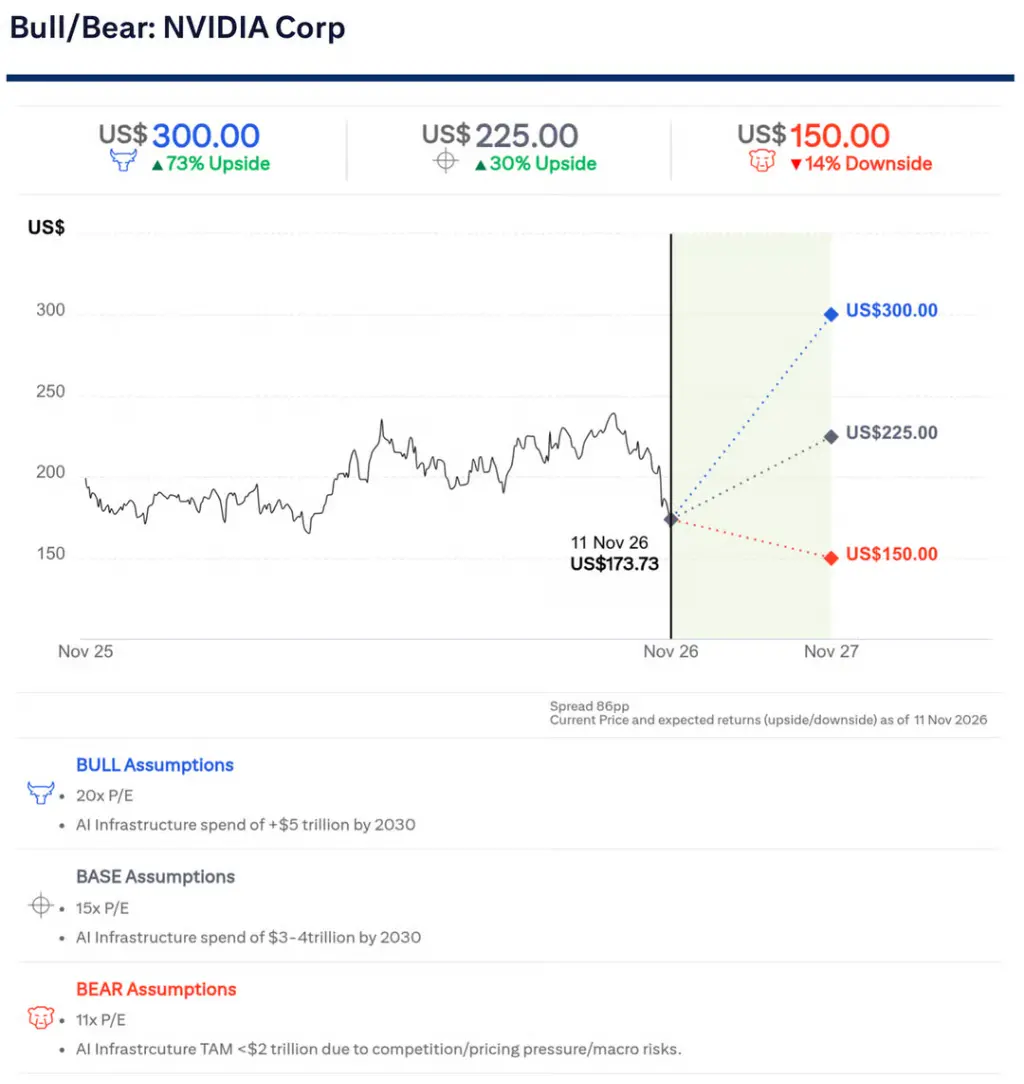
He maintained a buy rating but lowered the target price from $300 to $220. His valuation logic is clear: EPS forecasts remain unchanged at $10.00; however, the valuation multiple has been compressed from 30 times to 22 times due to decreased visibility and increased execution risk during the management transition.
In one sentence, the sell-side consensus is summarized as: E (earnings) unchanged, P/E (valuation multiple) significantly lowered.
Schneider compared this event to Apple losing Jobs. Around 2011, Apple's forward P/E ratio fell from about 17 times to 12 times, hitting a low of 9 times in 2013, until the market confirmed that the iPhone was not stalled by Jobs' departure, and the valuation gradually recovered to about 15 times.
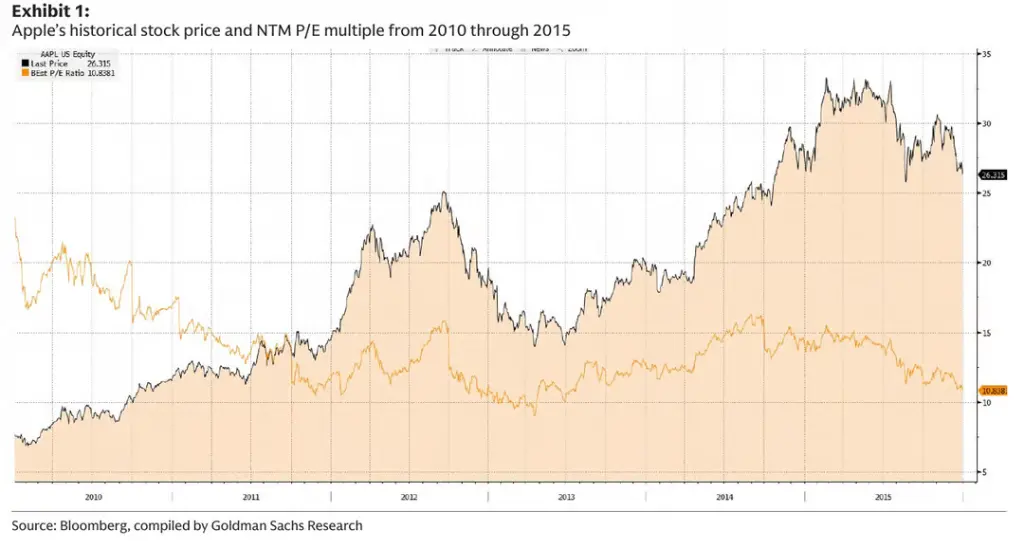
Schneider believes that NVIDIA's market will undergo a similar "search for a reasonable multiple" process until leadership and business momentum regain clarity.
However, Schneider himself admits that this analogy is not perfect—Apple had a pre-selected successor, no Department of Justice investigation, and no congressional subpoena threats.
Bernstein's long-term bullish stance turns: "Where does he find the time?"
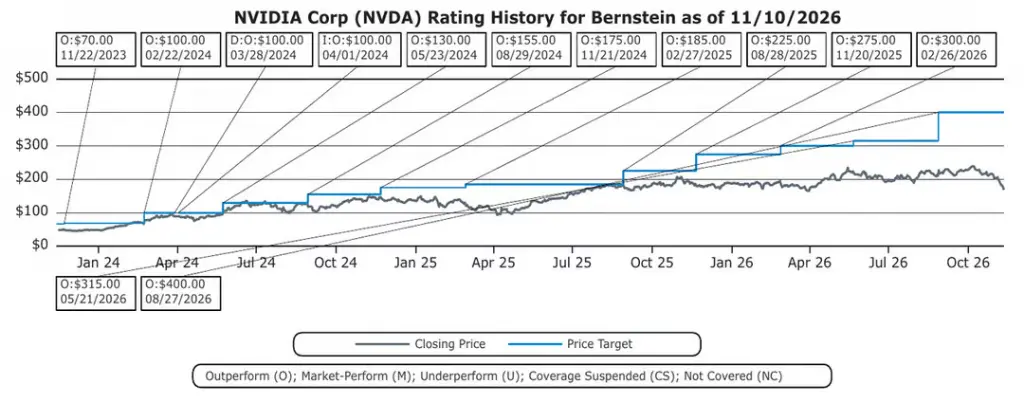
Bernstein's Stacy Rasgon has been one of Wall Street's most respected NVIDIA bulls for years. This time, he downgraded the rating to market perform, slashing the target price from $400 to $200. The report's title contained only one sentence: "Where does he find the time?"
He wrote:
The new allegations make us feel that the board can no longer allow him to remain in this position (we have seen other CEOs fired for far less…). If the board does not take action now, the subsequent risks will only increase, as more allegations seem likely to surface.
He also used a metaphor, which might be the most memorable line for NVIDIA holders this week:
If you find two ants in the kitchen, the best estimate of the total number of ants in the kitchen is definitely not two…
The implication: more allegations, more investigations, and what new leadership will discover—uncertainty is far from bottoming out.
"Sold out until 2028"—the core argument of the bulls
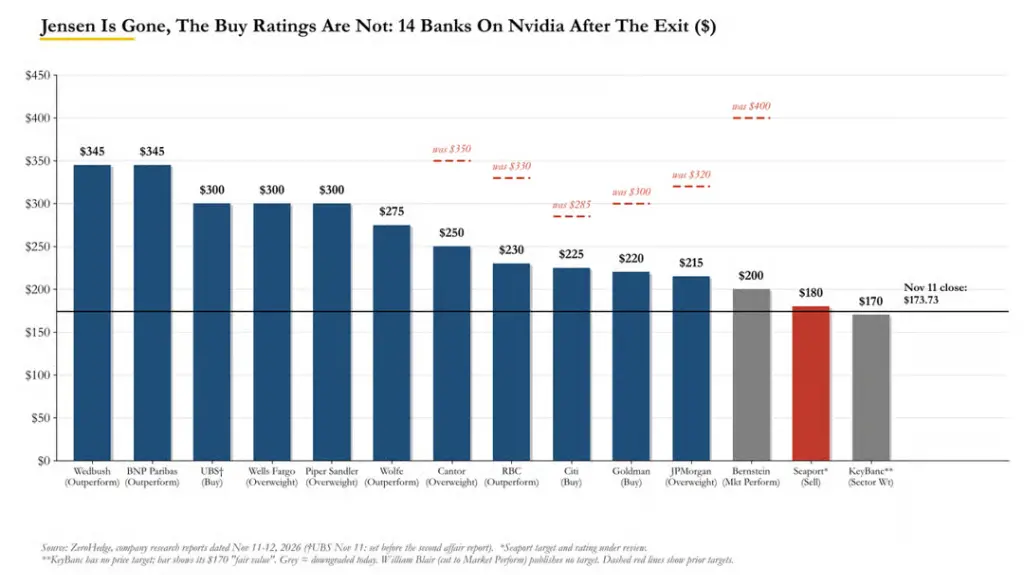
Bernstein, KeyBanc, and William Blair chose to downgrade NVIDIA; Bernstein, JPMorgan, RBC, Cantor, Goldman Sachs, and Citigroup lowered their target prices, with reductions ranging from $60 to $200.
However, the average target price given by 13 investment banks is still about $260 (median $250). Wedbush and BNP Paribas both set target prices at $345, more than double the pre-market price.
Most firms still maintain a buy rating. The only sell rating comes from Seaport's Jay Goldberg, with a target price of $180—ironically, this price is still above the market price.
So, why is almost everyone still bullish?
The bulls' logic boils down to one point: Jensen Huang is gone, but the orders remain.
David O'Connor from Piper Sandler (overweight, target price $300) put it bluntly:
The platform and architecture decisions for the next two generations of products have already been made, and the company's orders for 2027 are completely sold out, and 2028 is basically the same. What is being discussed with customers now is about 2029 and beyond.
Chris Caso from Wolfe (outperform, target price $275) was even more direct:
If the CEO is asked to step down, we believe that at least until 2028, the fundamentals and earnings will be completely unaffected—because NVIDIA is essentially sold out during this period. The CEO transition will not impact orders or even the product roadmap; the roadmap has already been clearly planned through 2028.
RBC estimates that current demand exceeds supply by about 50%. JPMorgan pointed out that the production ramp-up paths for Vera Rubin, Rubin Ultra, and Feynman have been clarified.
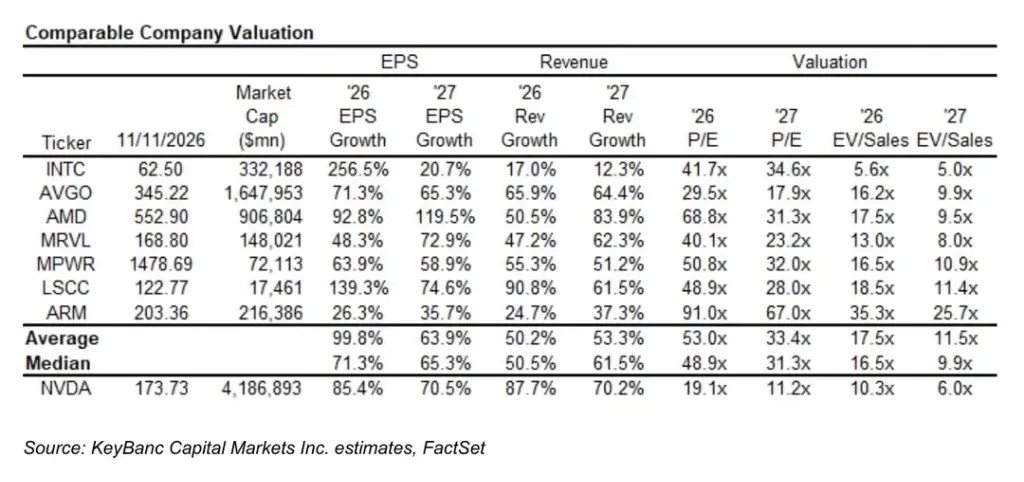
In other words, E is fine, the only thing moving is P/E. And there isn't much multiple left to compress: at Wednesday's close, NVIDIA's expected P/E for 2027 was about 10 times, which Piper called a 20-year low, while William Blair referred to it as a historical low (with a consensus earnings of only 7 times for 2028).
"No one can fill Jensen's leather jacket": 60 direct subordinates, zero successors
If the next two years are safe, what is Wall Street really worried about?
One major concern is the organizational structure. Seaport's Goldberg characterized this issue in one sentence:
In simple terms, no one can fill Jensen's leather jacket. no one can fill Jensen's leather jacket
He acknowledged that many executives can operate NVIDIA, but no one holds the same weight in the entire industry. The issue is both personal and structural:
This island-like structure will lead to any internal candidate being deeply entrenched in their own area of expertise while being completely unaware of most other business areas. This will not be a permanent barrier, but it will take several quarters to reorganize the company around a new leader. Beyond that, it will be a different company—capable, but far less vibrant than it is now.
Wells Fargo provided a number: about 60 executives report directly to Jensen Huang. Analyst Quatrochi stated that this structure is "unsustainable and cannot be replicated," which may impact coordination speed and time to market.
As for the list of successors, the most mentioned internally is Ian Buck—who has worked at NVIDIA for 22 years, is responsible for large-scale and high-performance computing, and is widely regarded as the creator of CUDA. Piper called him "well-regarded by investors." William Blair added Jonathan Ross (founder of Groq and TPU architect, who only joined NVIDIA last December). Among external candidates, reports suggest that Apple's Tim Cook, AMD's Lisa Su, Arm's Rene Haas, and Micron's Sanjay Mehrotra have all been mentioned.
JPMorgan divided this issue into short-term and long-term dimensions:
We believe that the most important question for the stock price in the near term is whether NVIDIA's board can successfully form an interim management team that can maintain the company's strong execution and continue to advance the existing roadmap. However, beyond the next 2-3 years, the core focus will shift to whether the management team has a forward-looking vision and can identify the next turning point in accelerated computing, and build a complete system that includes not just chips, but also ecosystems and platforms.
In other words: an interim team might still be able to get the Rubin product line out; but whether they can predict the "next CUDA" a decade ahead of everyone else is the real reason this company became a $5 trillion market cap company.
Wedbush reviewed historical precedents: Marvell (which prospered under an external CEO after the founding family exited), Apple (where Cook performed excellently under an existing succession plan), HP and Intel (both lost their CEOs hastily due to executive misconduct, with no ready successors, and subsequently fell into what Bryson called "disastrous periods").
But Wedbush's conclusion is: no case perfectly fits the current situation:
In this case, uncertainty may further escalate, as we cannot think of any historical precedent that simultaneously meets the following conditions: a founder CEO with comprehensive dominant influence over the company's direction, a company (and its CEO) that is so crucial to technology and tech policy, and almost no clear succession plan at the time of transition.
NVIDIA is the "central bank" of AI, and that bank only has one credit officer
Wall Street has another heavy concern: what about the money?
NVIDIA is not just a chip-selling company. Over the years, Jensen Huang has continuously injected NVIDIA's free cash flow—about $50 to $60 billion each quarter—into the entire AI ecosystem: making equity investments in OpenAI, Anthropic, and xAI, providing asset backing to emerging cloud computing companies like CoreWeave, and prepaying and holding shares in fiber optic device suppliers Lumentum, Coherent, and Corning.
UBS's Tim Arcuri lists it as the top of the three most impactful aspects:
NVIDIA has become a key source of funding for many participants in the AI industry, including emerging cloud service providers, large language model developers, ecosystem partners, and suppliers. We have always believed that Jensen Huang is the driving force behind this effort. Even if new leadership ultimately maintains similar practices, a 'pause period' is likely to occur… We estimate that NVIDIA generates about $50 to $60 billion in free cash flow each quarter, a significant portion of which is being reinvested back into the entire system. This could easily withdraw $50 billion or more from the system—precisely at a critical moment when interest rates are rising and liquidity is tightening in certain areas of the credit market.
William Blair's conclusion is more direct, which is also the core reason for its downgrade:
Existing contracts will continue to be executed after the CEO transition, but what is truly at risk is the next round of deals—and NVIDIA's ability to defend its market share in 2027 and beyond. Without Jensen Huang, or if he is severely restricted due to investigations and scrutiny, we believe NVIDIA may open a larger gap for competitors like Broadcom and AMD.
Seaport's Goldberg further points out that a $500 billion financing platform plan announced by Jensen Huang two months ago, involving six private equity funds, has yet to be finalized. He believes that without Jensen Huang, this plan is likely to dissipate.
On the day the news broke, CoreWeave's stock fell over 11%—ironically on the same day it was marketing a more than $4 billion investment-grade loan to the market.
Government Investigations Did Not Disappear with Resignation
Jensen Huang's resignation does not mean regulatory pressure has lifted.
The independent board investigation led by Joon Kim from Wachtell is still ongoing, the Department of Justice's Megaspeed investigation is still in progress, the House of Representatives has requested a closed briefing on November 18, and Senators Warren and Coons have requested relevant records.
Two investment banks provided specific financial quantifications:
Goldman Sachs pointed out that NVIDIA's FY26 annual report shows total sales exposure to mainland China, Hong Kong, Taiwan, and regions outside the United States is about 11%, and it expects business in jurisdictions like Singapore to face more scrutiny.
UBS believes that stricter rules may affect shipments to places like Singapore and Malaysia, estimating that about 10% of revenue is at risk.
RBC noted that China accounted for about 1% of data center revenue in the last quarter and has been excluded from performance guidance.
Wolfe holds a different view, believing that export concerns are exaggerated, as the shipment volume of AI chips to China has already been minimal.
NVIDIA's Pain, Competitors' Opportunity
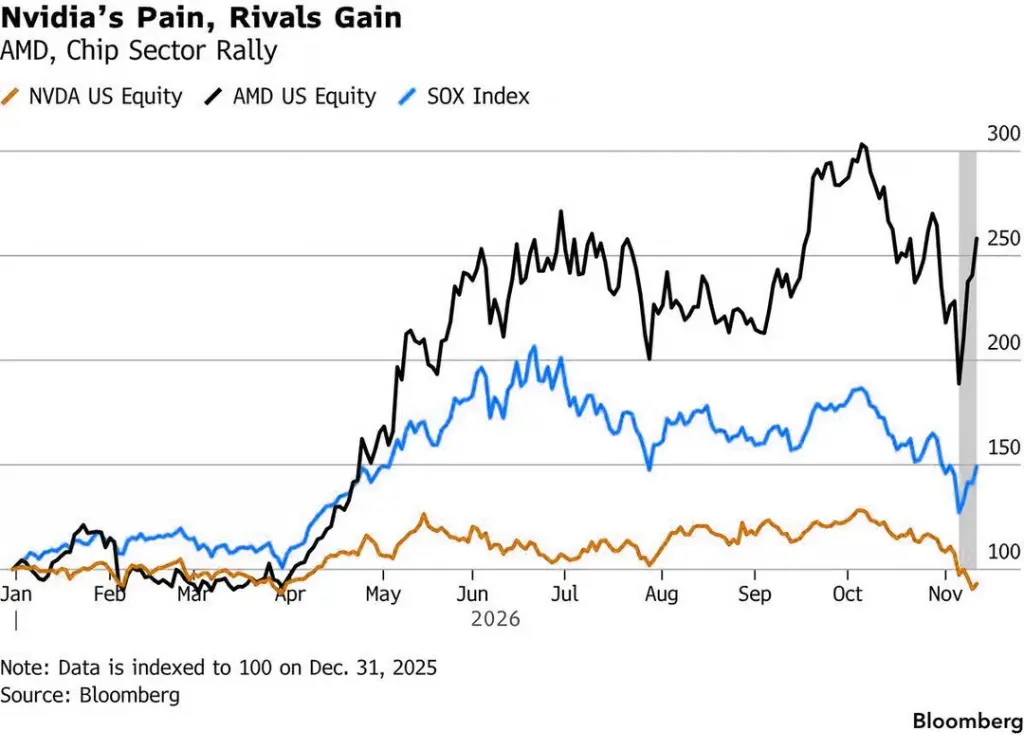
Almost all institutions agree on one thing: competitors benefit.
BNP Paribas, Seaport, and William Blair all named AMD and Broadcom as the most direct beneficiaries, as hyperscale cloud providers and AI labs have more reasons to diversify their chip sources. BNP Paribas predicts that by 2030, custom chips could account for nearly three-quarters of AI accelerator shipments.
William Blair also pointed out a deeper logic: the moat of CUDA is essentially built on the high cost of porting code to other chips. Now, AI programming assistants are rapidly reducing this porting cost. Anthropic mentioned in its IPO roadshow materials that it used to take 6 to 12 months to get a new accelerator running, while its Claude Mythos Preview model reportedly took only about three days to achieve prompt processing on the AMD MI355X.
Analyst Naji cautiously pointed out that this case is somewhat limited. However, the spread of this news in the same week as the founder's departure is itself intriguing.
Everyone Points to the Same Bottom
So where is the bottom for the stock price?
Wall Street's answer is surprisingly consistent—and based on experience, this consistency itself is not a good sign.
Cantor believes that a reasonable bottom corresponds to about $150 at 9 times the expected EPS for 2027. Piper set $150 as the support for a 10 times cyclical bottom valuation. KeyBanc's bear market scenario is also $150. Citigroup is the same, corresponding to an 11 times valuation.
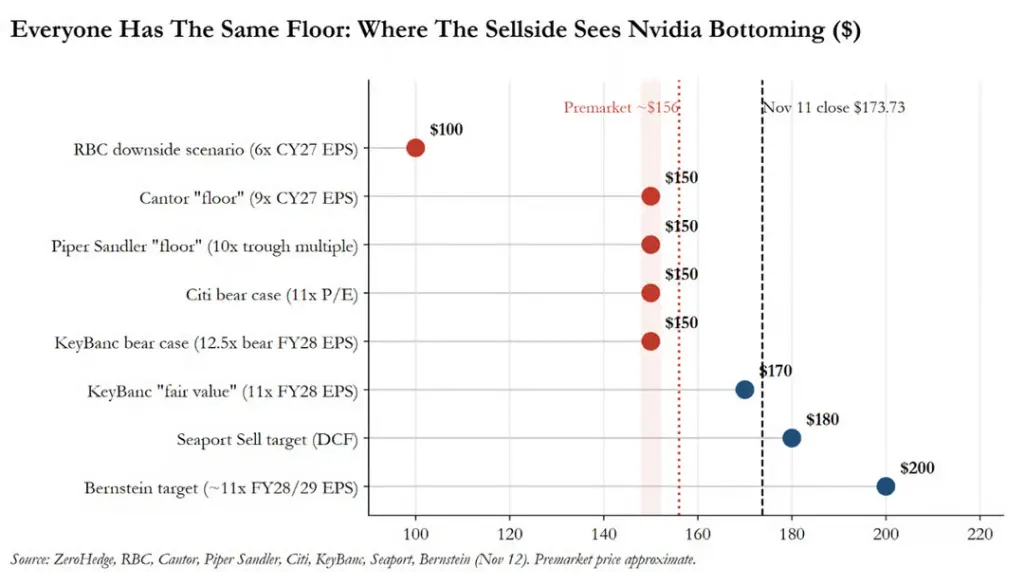
With a pre-market price of $156, there is only a 4% buffer to Wall Street's consensus bottom. The only one giving a lower target is RBC, whose downside scenario is $100, corresponding to 6 times the expected EPS for 2027, below NVIDIA's five-year historical valuation low.
Goldman Sachs refused to provide a bottom number and used that Apple stock chart to remind the market: cyclical bottom valuations can remain low for years.
 Risk warning Risk warning


Popular articles