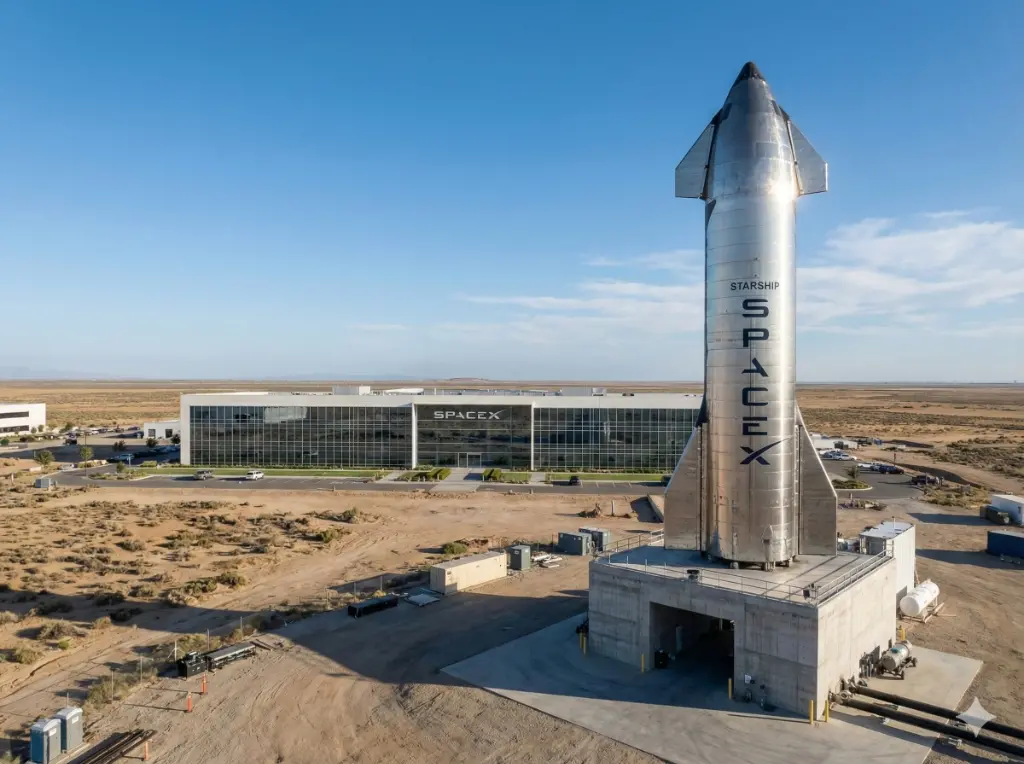
NVIDIA's quarterly revenue surpasses 100 billion for the first time: Q4 guidance exceeds expectations again, and the growth target for fiscal year 2028 is raised to 75%
 Core Viewpoint


 NVIDIA's revenue for the third quarter of fiscal year 2027 was $115.8 billion, a year-on-year increase of +103%, with an EPS of $2.68 and data center revenue of $107.6 billion; Q4 guidance is $130 billion (+3.8% vs expectations), and the growth target for fiscal year 2028 has been raised from over 70% to about 75%, but the gross margin guidance has been lowered to 71%-72%.
After founder and CEO Jensen Huang resigned amid controversy, NVIDIA temporarily eased market concerns about the company's leadership vacancy and the sustainability of AI investments, once again delivering a quarterly performance that exceeded expectations on a high baseline and raised its annual revenue guidance for the following fiscal year.
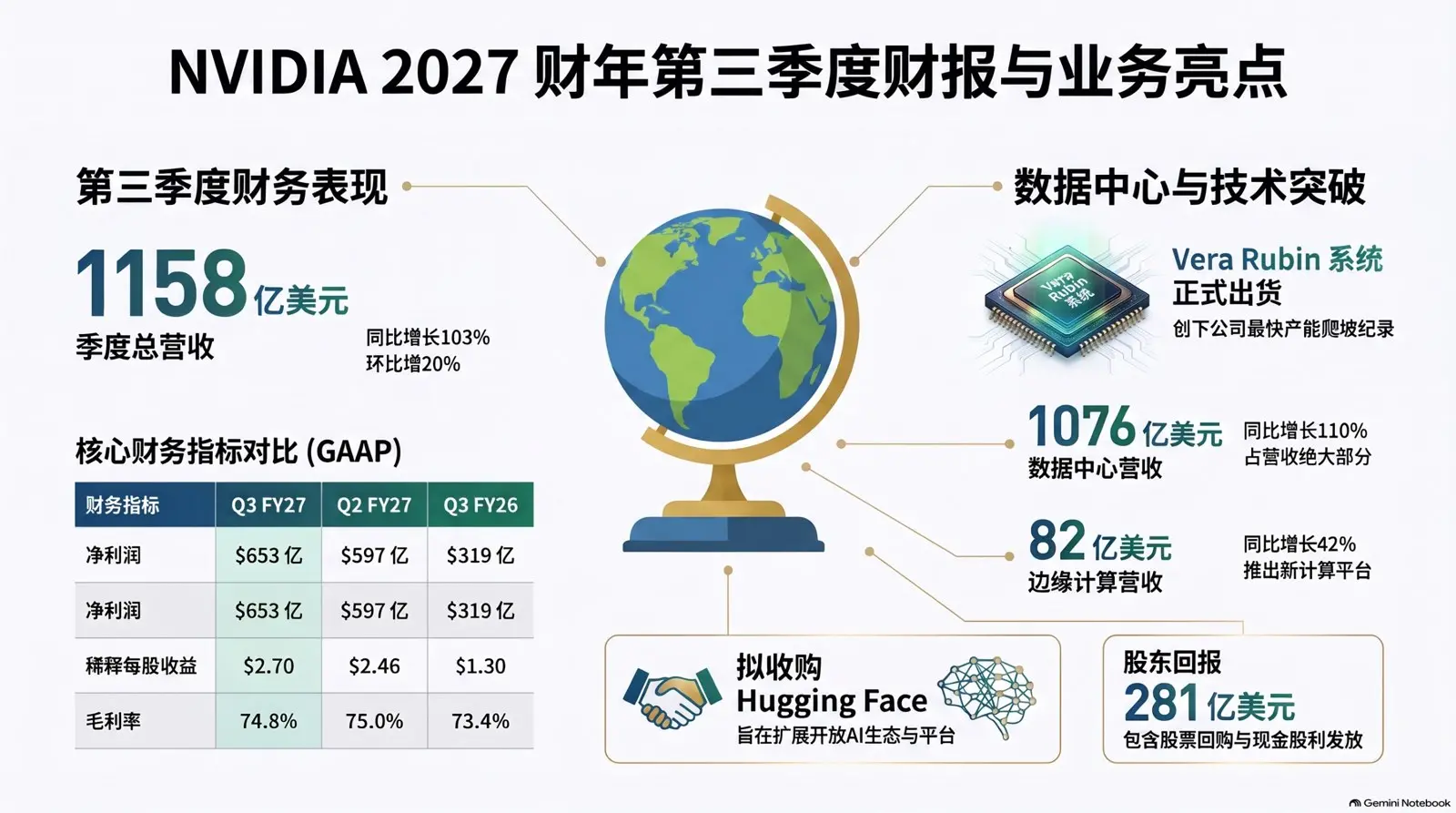
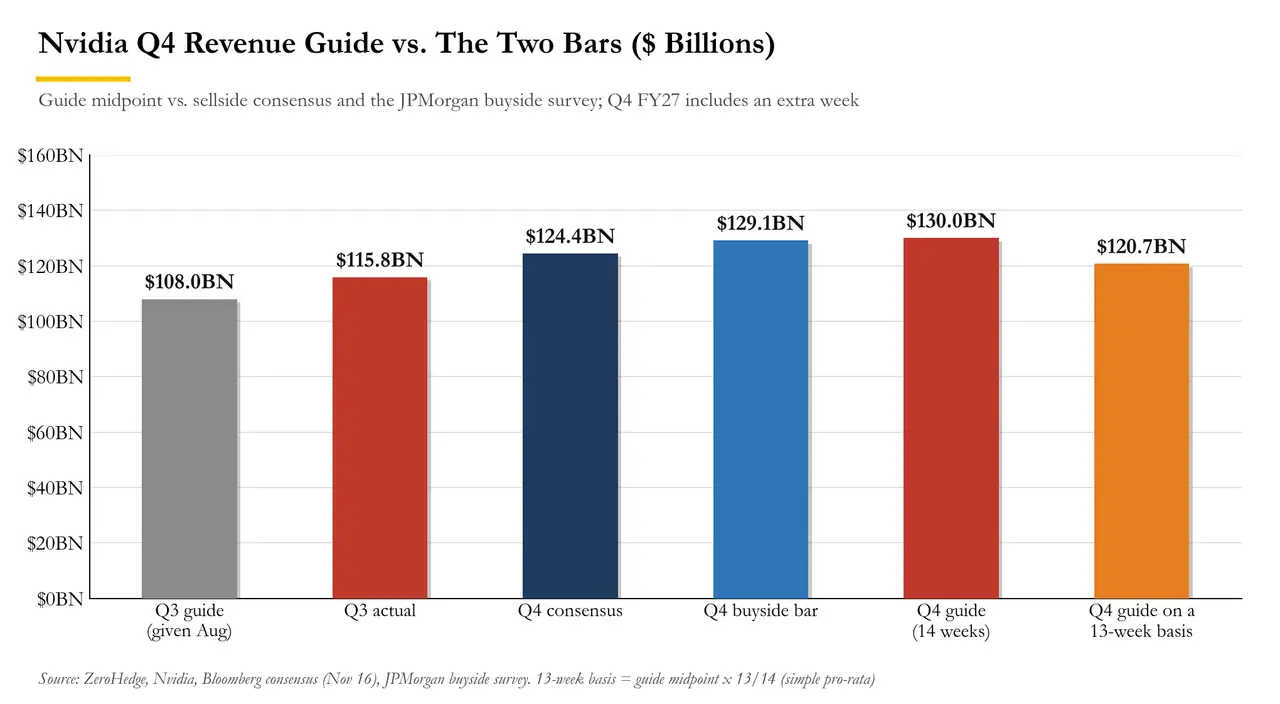
On Tuesday, Eastern Time, NVIDIA announced that for the third quarter of fiscal year 2027, ending October 25, 2026, revenue grew 103.1% year-over-year to $115.8 billion. This marks the first time in the company's history that quarterly revenue surpassed $100 billion, exceeding analyst expectations by approximately 5.9% and significantly higher than the company's own guidance midpoint of $108 billion.
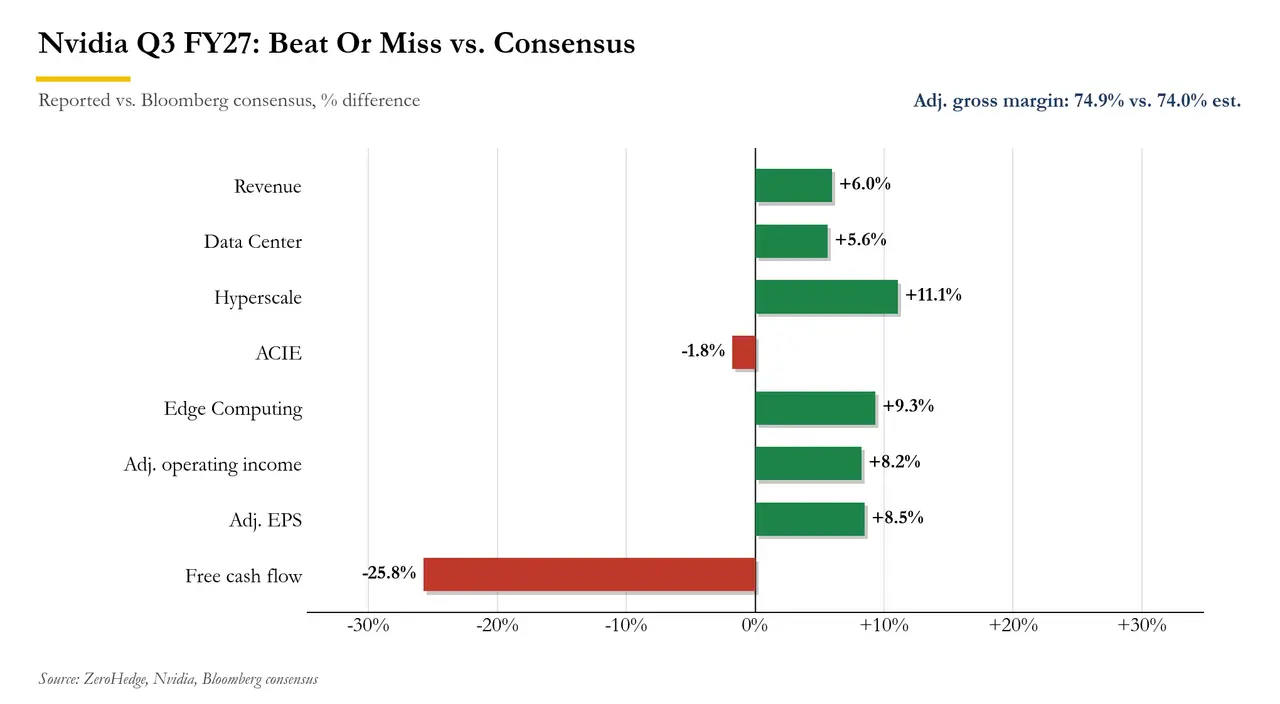
The earnings side was equally strong. The adjusted non-GAAP earnings per share (EPS) for the third quarter grew 111% year-over-year to $2.68, exceeding market expectations by 8.1%; the adjusted gross margin was 74.9%, slightly lower than the previous quarter's 75.0%, but still above the market expectation of about 74%.
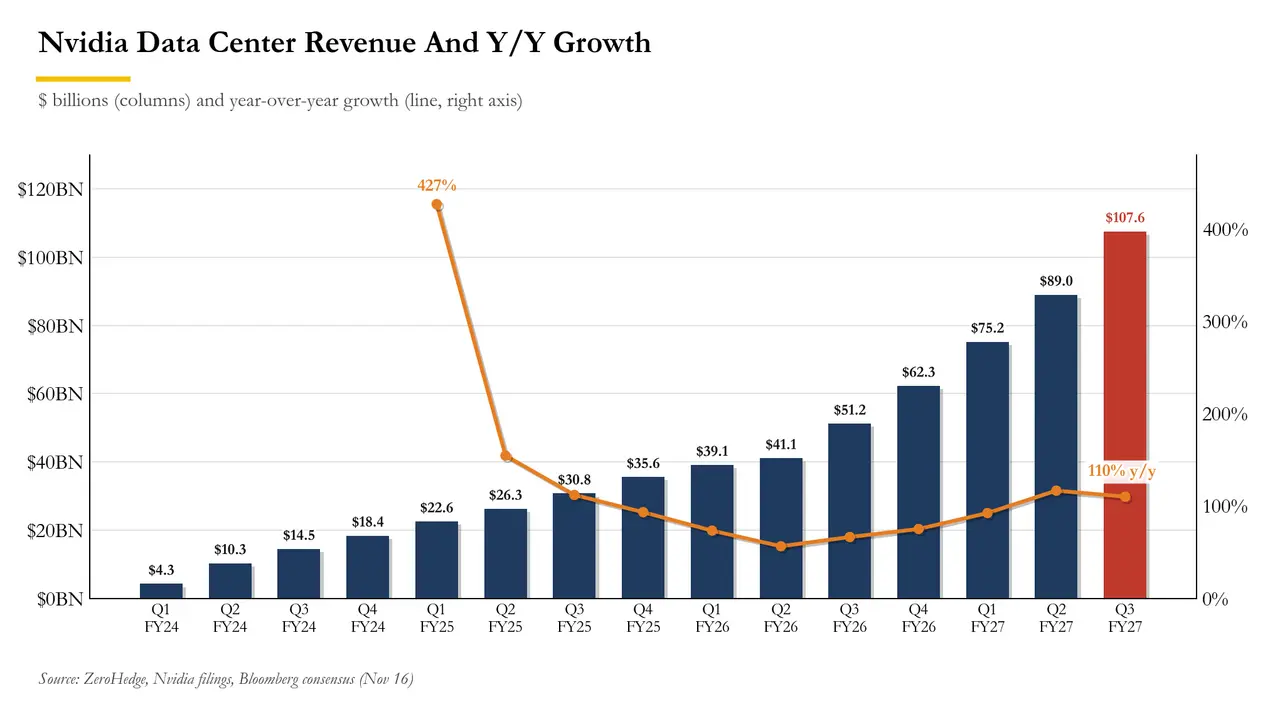
The core data center business continued to be the growth engine. Third-quarter data center revenue doubled year-over-year to $107.6 billion, exceeding market expectations by 5.6%, and continued to account for about 90% of the company's total revenue. Computing and networking revenue was $106 billion, exceeding market expectations by 7.9%; Graphics revenue was $9.8 billion, exceeding expectations by 10.9%.
NVIDIA's Chief Financial Officer (CFO) Colette Kress, who is also serving as interim CEO, specifically mentioned the key data center product Vera Rubin, stating that it "has achieved an explosive start, our product roadmap is progressing as planned, and our ambitions are unprecedentedly grand."
More importantly, NVIDIA's guidance for fourth-quarter revenue was again stronger than market expectations: the midpoint for fourth-quarter revenue is expected to be $130 billion, easily setting a new record for quarterly revenue, exceeding analyst consensus expectations by 3.8%, and aligning with the highest expectations from sell-side analysts, which was also $130 billion from UBS. Like the third quarter, NVIDIA noted that this quarter's guidance does not include revenue from data center computing in China.
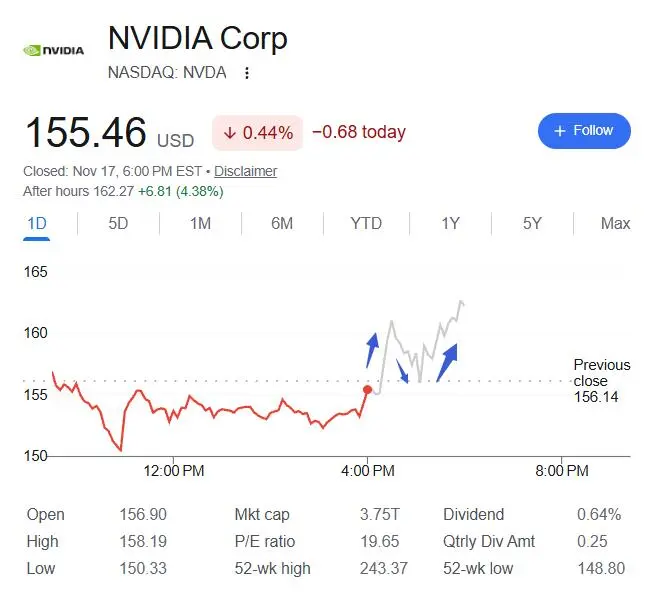
After the earnings report was released, NVIDIA's stock price, which had fallen over 0.4% during regular trading hours on Tuesday, rose in after-hours trading, with gains reaching about 4% at one point. During the earnings call, the chairman of the board clearly stated there was no intention to reinstate Jensen Huang, causing the stock price to briefly give back some gains. As Kress further raised the revenue growth target for fiscal year 2028 from over 70% to about 75%, market sentiment improved again, and the stock price's after-hours gains expanded to over 4%.
Analysts believe that in addition to the upward revision of the revenue growth target for fiscal year 2028, several data points have alleviated market concerns. NVIDIA's performance in the last fiscal quarter and the guidance for the current fiscal quarter both exceeded expectations, and although the gross margin guidance continued to decline sequentially, it was roughly in line with expectations and consistent with NVIDIA's statement during the second fiscal quarter earnings call about gross margins reaching a temporary bottom. At the same time, NVIDIA's comments regarding the shipment of Vera Rubin and "fastest ramping" products indicate that the new generation platform has begun to enter the infrastructure construction cycle for cloud service providers and AI cloud customers.
Overall, NVIDIA's report not only delivered revenue and profit that exceeded expectations but also made a strong bet on the future growth of AI infrastructure. Moving forward, investors will still need to observe whether the mass production of Rubin, the recovery of gross margins, customer payment capabilities, and long-term capital commitments can truly translate into sustained cash returns.
Revenue, EPS, and Gross Margin All Exceed Expectations; Quarterly Revenue Surpasses $100 Billion for the First Time
From an overall performance perspective, NVIDIA's third-quarter core characteristics are: revenue exceeded expectations, profit exceeded expectations, gross margin exceeded expectations, and the guidance for the next fiscal quarter also exceeded expectations.
NVIDIA's third-quarter revenue was $115.8 billion, the first time a single fiscal quarter's revenue surpassed $100 billion, continuing to grow significantly from $96.2 billion in the second quarter, with a sequential growth rate of about 20.3% and a year-over-year growth rate of over 100%. In comparison, NVIDIA's second-quarter revenue grew 106% year-over-year, already achieving a high growth rate at that time; entering the third quarter, despite the high baseline, the company maintained over 100% year-over-year growth.
The resilience on the profit side is also evident. Under non-GAAP measures, NVIDIA's third-quarter net profit was $64.87 billion, a year-over-year increase of 109% and a sequential increase of 20%; the adjusted EPS was $2.68, a year-over-year increase of 111% and a sequential increase of 21%. Under GAAP measures, the diluted EPS was $2.70, a year-over-year increase of 108%.
Expenses did not significantly erode profits. Third-quarter non-GAAP operating expenses were $8.84 billion, a year-over-year increase of 52%, lower than the revenue growth rate of 103% year-over-year; non-GAAP operating profit reached $77.88 billion, a year-over-year increase of 116%. This indicates that, driven by AI computing demand, NVIDIA is still enjoying significant economies of scale.
It is important to note that starting from the first quarter of fiscal year 2027, NVIDIA's non-GAAP financial metrics no longer exclude stock-based compensation expenses, and the company has restated historical non-GAAP data. Therefore, the adjusted EPS and profit margins this time are more aligned with the true cost structure.
Data Center Revenue Exceeds Expectations by $5.7 Billion; Demand from Hyperscale Cloud Providers and AI Cloud Both Strong
The data center business remains the most critical part of the earnings report. Third-quarter data center revenue was $107.6 billion, with a sequential growth of 21% and a year-over-year growth of 110%, exceeding market expectations by about $5.7 billion.
In terms of structure, hyperscale cloud service providers contributed significantly. NVIDIA's third-quarter hyperscale revenue was $60.1 billion, while AI cloud, industrial, and enterprise-related revenue was $47.5 billion. Together, these constituted the main sources of revenue for the data center business and indicated that AI infrastructure demand is not limited to a few internet giants but is expanding to more scenarios such as AI cloud, industrial, enterprise, and sovereign AI.
From the customer structure perspective, hyperscale cloud service providers remain the main source of demand, contributing $60.1 billion in revenue in the third quarter, a year-over-year increase of 71%; AI cloud, industrial, and enterprise customer-related business revenue reached $47.5 billion, a year-over-year increase of 195%.
This set of data indicates that NVIDIA's growth momentum is expanding from traditional large cloud computing enterprises to AI-native companies, specialized AI cloud service providers, industrial, and enterprise customers.
Recently, concerns about the return on investment in AI infrastructure have intensified, with tech giants like Microsoft, Google, Amazon, and Meta continuously increasing capital expenditures, while some emerging AI cloud providers face doubts regarding their financing capabilities and cash flow. NVIDIA's data center revenue continuing to significantly exceed expectations shows that, at least from the perspective of chip sales and revenue recognition, the demand for AI computing procurement has not noticeably cooled.
It is worth noting that NVIDIA's edge computing business also performed strongly, with third-quarter revenue of $8.2 billion, a year-over-year increase of 42% and a sequential increase of 14%, exceeding market expectations of $7.5 billion. Although the scale is much smaller than that of data centers, its growth reflects that AI PCs, local AI, robotics, autonomous driving, AI-RAN, and other edge applications are contributing incremental growth.
The company stated that strong sales of Blackwell workstation products and the demand for edge computing driven by physical AI applications have jointly propelled this growth. Meanwhile, rising prices for memory and systems continue to affect consumer PC demand.
From an overall business structure perspective, AI demand is no longer limited to large data centers but is also expanding to enterprise computing, edge devices, robotics, and other physical AI scenarios.
Vera Rubin Begins Shipping; NVIDIA Claims Fastest Product Ramp in History
In addition to the financial figures, the most important product signal from this earnings report is that the Vera Rubin NVL72 has begun shipping.
NVIDIA stated that the Vera Rubin NVL72 is the fastest ramping product in the company's history, with related racks already operating at partners such as CoreWeave, Google Cloud, Microsoft Azure, Oracle Cloud Infrastructure, and Nebius, and is set to go live on SpaceXSI soon.
This directly addresses one of the market's main concerns prior to the earnings report: whether the transition to the new generation of products after Blackwell is smooth and whether Rubin can expand supply as planned.
NVIDIA stated that the Vera Rubin NVL72 is the fastest ramping product in the company's history. Currently, related racks are already operating at partners such as CoreWeave, Google Cloud, Microsoft Azure, Oracle Cloud, and Nebius, and are planned to go live on SpaceXSI soon.
The company also announced the expansion of the Vera Rubin cloud ecosystem:
Oracle Cloud launched the Vera Rubin NVL72 system and Vera CPU.
Google Cloud launched A5X instances powered by Vera Rubin.
Companies such as Cisco, Google, Meta, and Microsoft have joined the infrastructure construction of Vera Rubin.
AI companies and cloud service providers such as CoreWeave, Meta, Nebius, Nscale, and OpenAI are also building computing infrastructure based on NVIDIA Vera CPU.
NVIDIA also announced plans to expand key manufacturing capabilities with supply chain partners such as Amkor, IBIDEN, King Yuan Electronics, Samsung Electro-Mechanics, Siliconware Precision Industries, and Unimicron Technology to meet future infrastructure demands.
This is particularly important for the market. Previously, investors had been focused on whether the product transition after Blackwell would be smooth and whether Rubin could expand supply as planned. Now that NVIDIA has confirmed that the new generation platform has begun shipping, it alleviates some concerns at least from the product progress perspective.
Additionally, NVIDIA announced the launch of the Vera CPU rack-level platform for high-performance computing and the Rubin HPC GPU designed for scientific computing, engineering simulation, and data processing, attempting to further extend the application range of AI infrastructure to scientific research and high-performance computing.
Fourth Quarter Revenue Guidance Continues to Exceed Expectations; Growth Target for Fiscal Year 2028 Raised to 75%
Compared to the exceeded expectations achieved in the third quarter, NVIDIA's outlook for future performance is even more noteworthy.
The company expects that revenue for the fourth quarter of fiscal year 2027 will reach $130 billion, with a fluctuation of 3%, corresponding to a range of approximately $127.4 billion to $132.6 billion.
This midpoint guidance is nearly 4% higher than the analyst expectations compiled by Bloomberg, which are around $125.25 billion, and also indicates that revenue will grow approximately 12% quarter-over-quarter compared to the third quarter.
It is important to note that the fourth quarter includes an additional week, so the quarter-over-quarter growth rate cannot be fully compared to a typical quarter.
Another detail worth noting is that NVIDIA has explicitly stated that the revenue outlook for the fourth quarter does not include any income from data center computing in China. This means that the company still expects to achieve further growth without relying on this portion of revenue.
More importantly, NVIDIA further raised its revenue growth expectations for fiscal year 2028 during the earnings call.
Interim CEO Kress stated that the company currently expects revenue for fiscal year 2028, ending in January 2028, to grow approximately 75% year-over-year, up from the previously stated target of over 70% growth.
She attributed the upward revision to multiple factors, including a higher revenue base expected for this fiscal year compared to previous models, strong computing demand from hyperscale cloud service providers, leading AI labs, AI-native enterprises, general businesses, and government clients, as well as more support from supply chain partners.
This adjustment is particularly significant. Previously, the market was concerned that Jensen Huang's sudden resignation might lead NVIDIA to avoid long-term performance outlooks in this earnings report, or even retract previously stated growth targets. However, the company not only maintained its original framework but also further raised its expectations.
According to Business Insider's report on the earnings call, NVIDIA also expects that leading AI labs will contribute approximately 15% of the company's data center revenue.
This means that developers of leading models such as OpenAI and Anthropic are becoming an increasingly important customer group for NVIDIA's data center business.
However, the market still needs to pay attention to whether such high growth targets can be sustained, and whether the company can maintain profitability while rapidly expanding its product supply.
Gross margin expected to decline to 72%, pressure from memory costs and new product ramp-up
Despite the strong revenue guidance, NVIDIA's outlook for gross margin in the fourth quarter is relatively cautious.
The company expects gross margins for the fourth quarter, on both GAAP and non-GAAP bases, to be between 71% and 72%, significantly lower than the 74.8% and 74.9% in the third quarter.
This indicates that gross margins may decline by approximately 3 percentage points quarter-over-quarter.
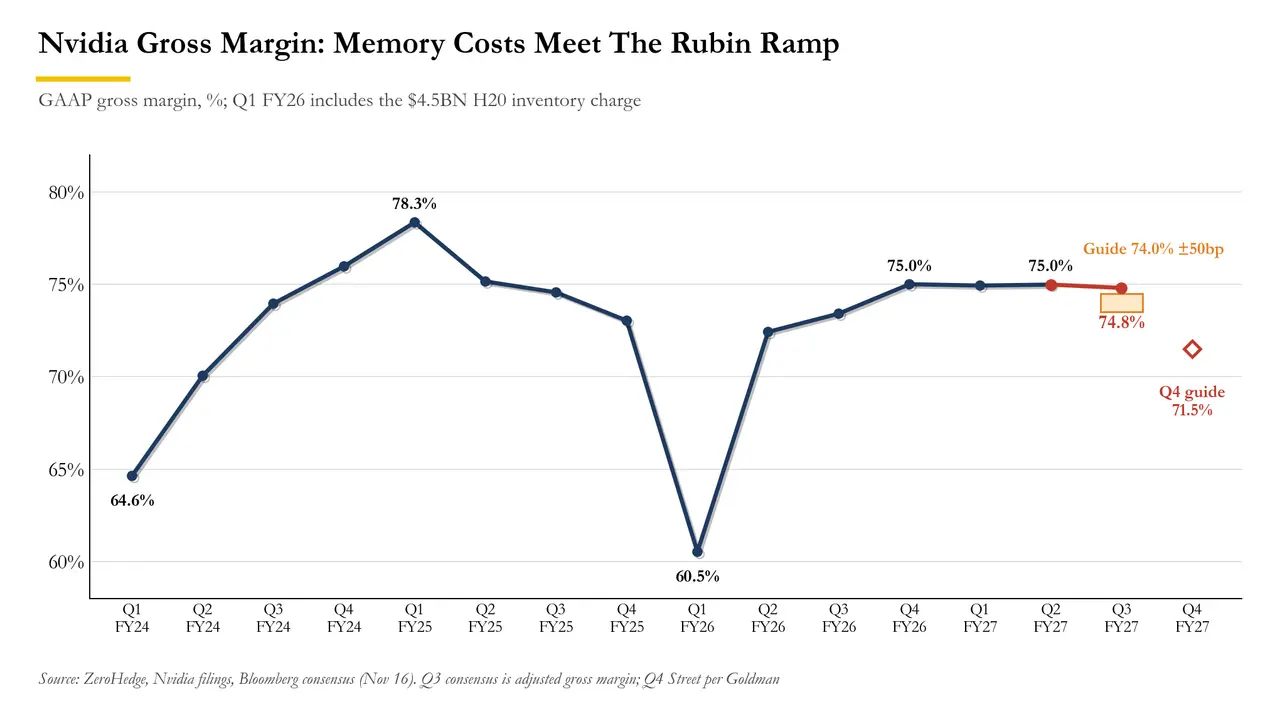
The pressure on gross margins is mainly related to two factors: first, the rise in memory prices, and second, the new generation of Rubin products being in the early ramp-up stage, with relatively high associated production and supply chain costs.
Additionally, the company expects GAAP operating expenses for the fourth quarter to be approximately $11 billion, and non-GAAP operating expenses to be approximately $10.7 billion, which is also higher than some analysts' previous expectations.
Therefore, NVIDIA's current growth is not without costs. As product iterations accelerate and investments in R&D and infrastructure increase, the company needs to strike a balance between meeting customer demand and maintaining profit margins.
For investors, it is important to observe not only whether revenue can continue to exceed expectations but also whether gross margins can gradually recover after the scaling of Rubin shipments.
Supply commitments rise to $390 billion, with an additional $118 billion in guaranteed exposure
Another detail worth closely examining in this earnings report is that NVIDIA is deeply involved in AI infrastructure construction through long-term procurement, cloud service agreements, data center leases, equity investments, and financing guarantees.
According to the comments from the company's CFO, NVIDIA's supply commitments as of the end of the third quarter increased from $279 billion in the previous quarter to $390 billion, primarily related to multi-year memory procurement.
Additionally, the company's cloud service agreements and data center lease commitments totaled $102 billion, up from $74 billion in the previous quarter.
If we further include equity investments, capital expenditures, and other items, NVIDIA's disclosed future commitments total $518 billion.
NVIDIA's future commitments as of October 25, 2026
Item | Amount
Supply and capacity commitments | $390 billion
Cloud service agreements | $28 billion
Data center leases not yet started | $74 billion
Equity investments | $20 billion
Capital expenditures | $6 billion
Total | $518 billion
This set of data indicates that NVIDIA is not only selling AI chips but also locking in production capacity and business demand for the coming years through long-term supply contracts and infrastructure arrangements.
At the same time, the company also disclosed a maximum of $118 billion in third-party financing guarantee exposure.
Among these, the largest involves a data center park being built by SB Energy in Ohio. The related guarantees provided by NVIDIA could reach up to $105 billion, with the project set to build approximately 4.25 gigawatts of data center capacity and provide infrastructure for OpenAI through a leasing arrangement lasting up to 20 years.
However, these guarantees are not one-time payment obligations but will take effect in phases as the related buildings are completed and put into use. NVIDIA stated that it has not yet made any payments related to these guarantees.
The company also disclosed that commitments related to emerging cloud service providers (Neoclouds) reached $32 billion. Interim CEO Kress stated that NVIDIA will continue to support this ecosystem but will take a more cautious and selective approach.
She pointed out that the business growth rates of some emerging cloud providers and leading AI labs have already exceeded the levels that their balance sheets and long-term credit conditions can support. NVIDIA will focus on supporting projects with clear and sustainable demand.
This also reveals the changes occurring in the AI industry chain: chip manufacturers are no longer just selling hardware to customers but are gradually participating in the expansion of the entire AI computing ecosystem through supply commitments, infrastructure construction, and financing support.
However, this model also means that NVIDIA is taking on more risks related to customer credit, long-term leasing, and capital allocation.
Accounts receivable and inventory reach new highs, capital return efforts continue to expand
Rapid growth has also brought about the issue of increased working capital usage.
As of the end of the third quarter, NVIDIA's accounts receivable reached $81 billion, further increasing from the previous quarter, with days sales outstanding (DSO) rising from 60 days to 64 days.
The company explained that this is related to the shipping rhythm following the launch of Rubin products and the extended payment terms adopted by some large customers under multi-year agreements.
During the same period, inventory reached $39.7 billion, up from $31.6 billion in the previous quarter, primarily to support the ramp-up of Rubin products.
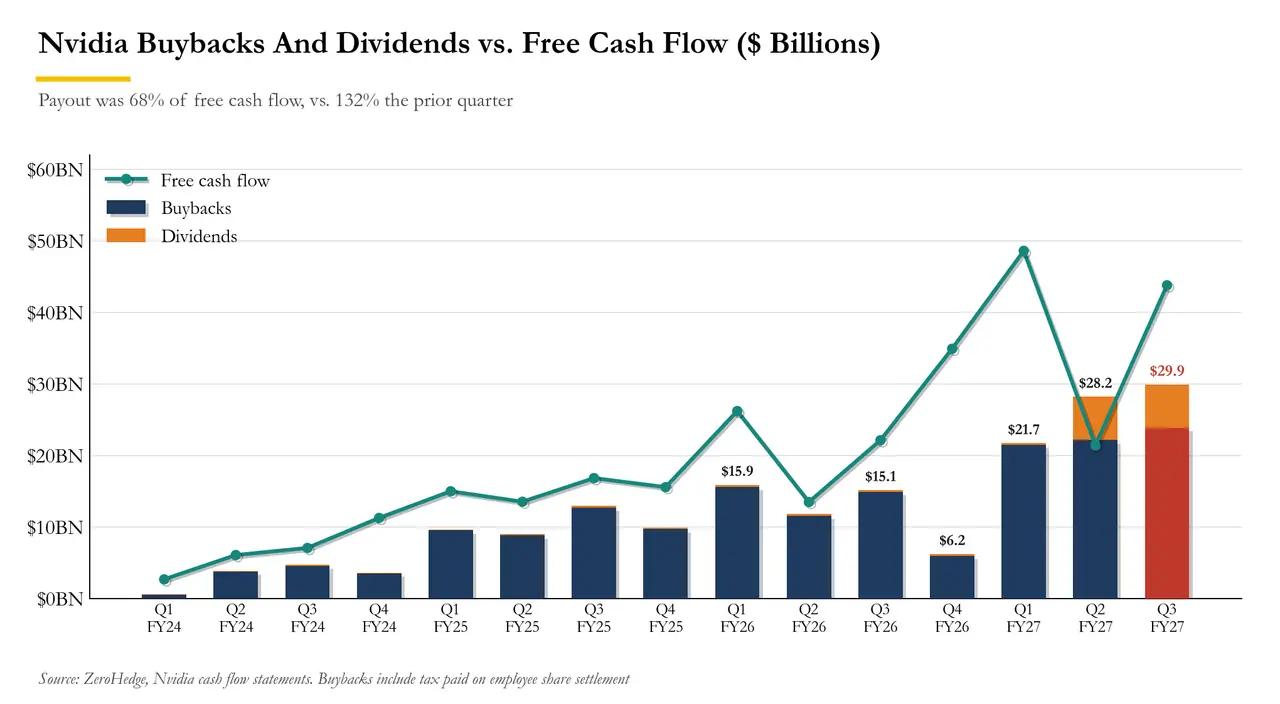
In terms of cash flow, NVIDIA's operating cash flow for the third quarter reached $48.3 billion, with free cash flow around $43.8 billion, still maintaining strong cash generation capabilities.
The company also returned $28.1 billion to shareholders through stock buybacks and cash dividends in the third quarter. As of the end of the quarter, the remaining stock buyback authorization was approximately $227.3 billion.
It is important to note that the board's decision to increase the stock buyback authorization by $150 billion was actually approved in September 2026, and is not a new buyback plan announced in this earnings report.
Additionally, NVIDIA disclosed an $1.8 billion impairment in non-public equity investments for the third quarter. This also indicates that as the investment scale in the AI industry chain rapidly expands, the valuation fluctuations and return risks associated with these investments are also worth paying attention to.
 Risk warning
ChainCatcher reminds readers to view blockchain rationally, enhance risk awareness, and be cautious of various virtual token issuances and speculations. All content on this site is solely market information or related party opinions, and does not constitute any form of investment advice. If you find sensitive information in the content, please click , and we will handle it promptly.



Popular articles