Chinese Concept Stocks Earnings Week: Baidu AI Cloud Revenue Soars by 94%, Who Will Be Next to Turn Growth into Profit?

Source: BIT Special Analyst
On November 16, Baidu was the first to report, with AI business revenue accounting for 53% of general business revenue. AI cloud infrastructure revenue grew by 94% year-on-year, but capital expenditure still exceeded operating cash flow. Tonight, JD.com and Tencent Music will take over, with Alibaba, Pinduoduo, and NetEase disclosing results on November 19. What truly deserves attention during earnings week is not just revenue and earnings per share, but where the growth comes from, whether profit margins can improve, whether cash flow can keep up, and the management's guidance for the next phase.
1. Earnings Week Officially Enters Intensive Period: The Market Shifts from Growth to Realization
The highlights of this round of earnings week for Chinese concept stocks are not just the performance announcements from several leading internet companies, but the changing growth logic of different companies happening simultaneously. Baidu reported first on November 16, followed by JD.com and Tencent Music tonight, with Tencent disclosing results afterward, and Alibaba, Pinduoduo, and NetEase making their appearances on November 19. Goldman Sachs' latest industry judgment predicts that after adjustments in the third quarter, the net profit of the Chinese internet sector is expected to grow by about 9% year-on-year, ending the year-on-year decline of the previous two quarters. This indicates that the market's focus is shifting from whether the internet industry has resumed growth to which companies' growth can truly translate into profits.

In the past, it was easiest to focus on revenue growth rates, GMV, advertising revenue, user numbers, and transaction volume for Chinese concept stocks, but now simply comparing scale has become increasingly difficult to explain stock prices. For the same 10% revenue growth, if one company's profit margin improves and operating cash flow increases, while another company needs to continuously expand capital expenditure and marketing investment to achieve growth, the market will not assign the same valuation to both. Especially in the context of high AI investment, the real questions investors need to answer have become: where does growth come from, what costs are associated with growth, and how much profit and cash can ultimately be retained from this growth.
Therefore, this week when looking at earnings reports, instead of chasing every number for surprises, it is better to observe the company within a complete profit chain: whether there are new growth drivers in core business, whether growth has led to profit margin improvement, whether profits have converted into cash, whether capital expenditure is generating corresponding returns, and whether management's judgment for the next quarter has changed. This framework can also be used to evaluate the Chinese concept stocks that will successively announce earnings reports.
2. Baidu Reports First: Advertising Down 22%, AI Cloud Truly Covers the Gap for the First Time
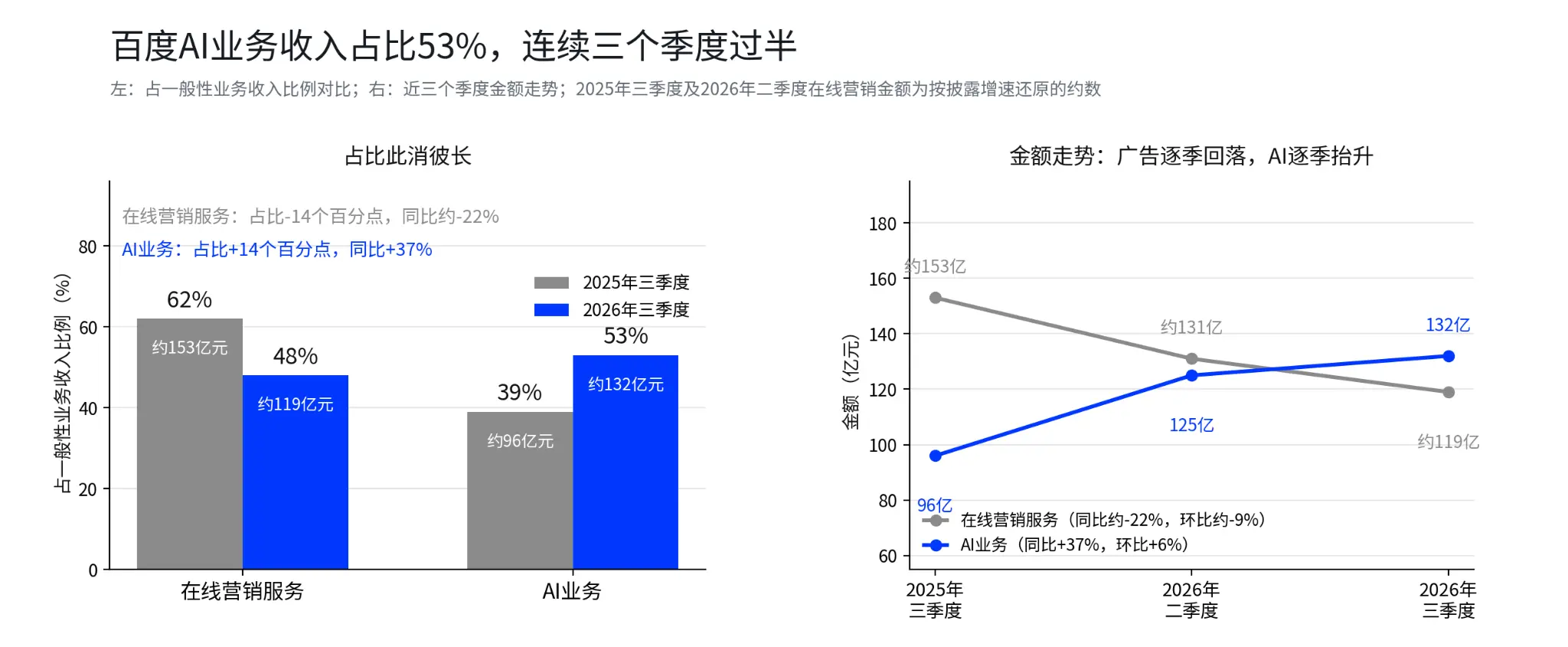
Baidu's total revenue for the third quarter was 30.807 billion yuan, a year-on-year decrease of 1%. The overall performance is not strong, but when breaking down the revenue structure, the market sees a company undergoing a significant business shift. Online marketing service revenue was 11.9 billion yuan, down 22% year-on-year, accounting for 48% of general business revenue, down from 62% in the same period last year. Meanwhile, AI business revenue was about 13.2 billion yuan, up 37% year-on-year, accounting for 53% of general business revenue, exceeding half for three consecutive quarters. On the surface, total revenue did not grow, but internally, there has been a noticeable shift in revenue structure.
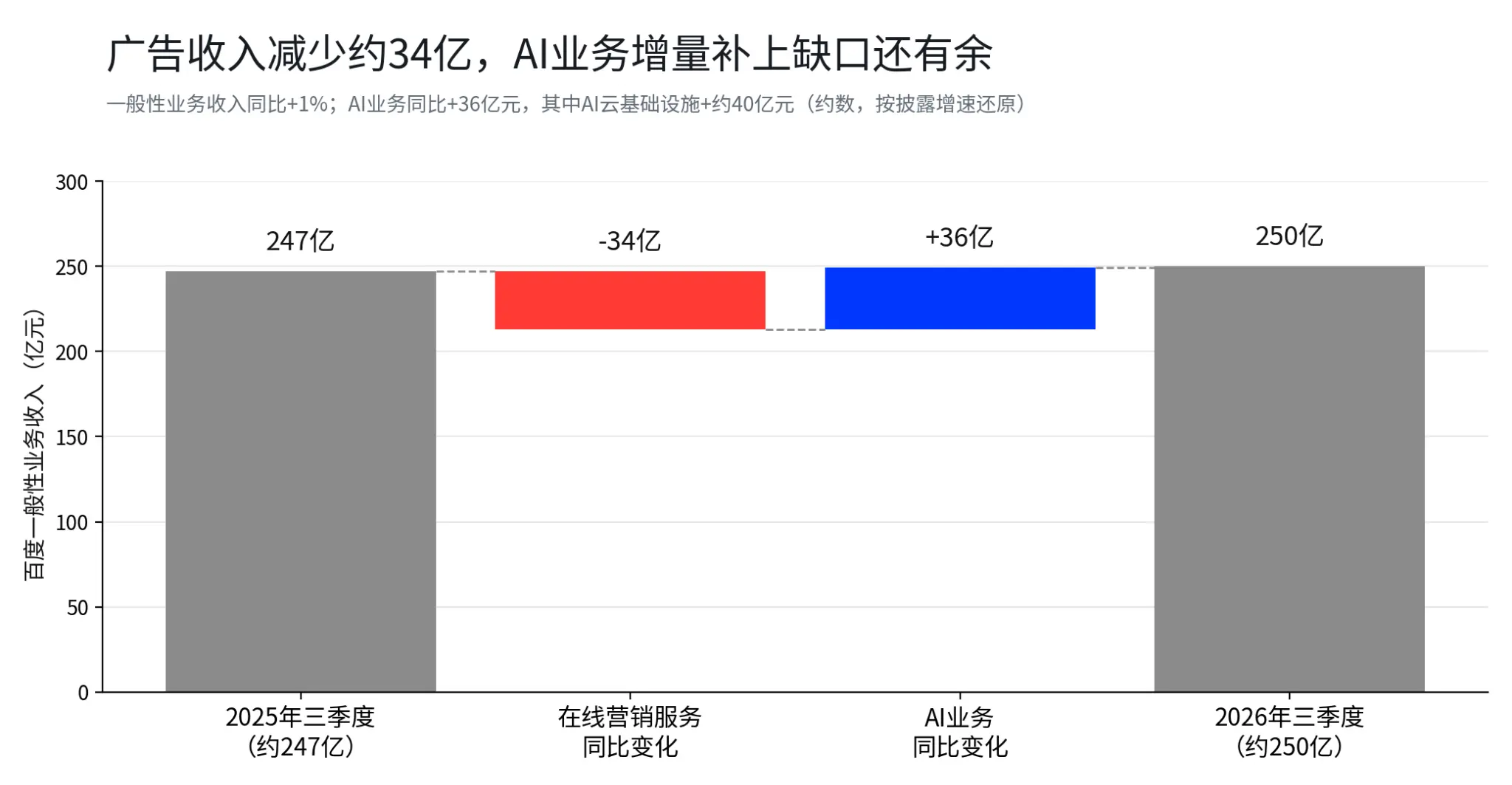
This change is more intuitive from an incremental perspective. According to market estimates of itemized data, AI cloud infrastructure revenue increased by about 4 billion yuan year-on-year, while online marketing revenue decreased by about 3.4 billion yuan year-on-year. The new revenue from AI cloud business basically covered the gap left by traditional advertising business and further contributed to incremental growth. Compared to the second quarter, when the incremental growth of AI cloud business was not enough to fully offset the decrease in marketing revenue, this quarter marked the first clear sign that new business is catching up with old business for Baidu. For the market, this is more important than simply seeing total revenue decline by 1% year-on-year, as it begins to change investors' judgments about Baidu's future revenue structure.
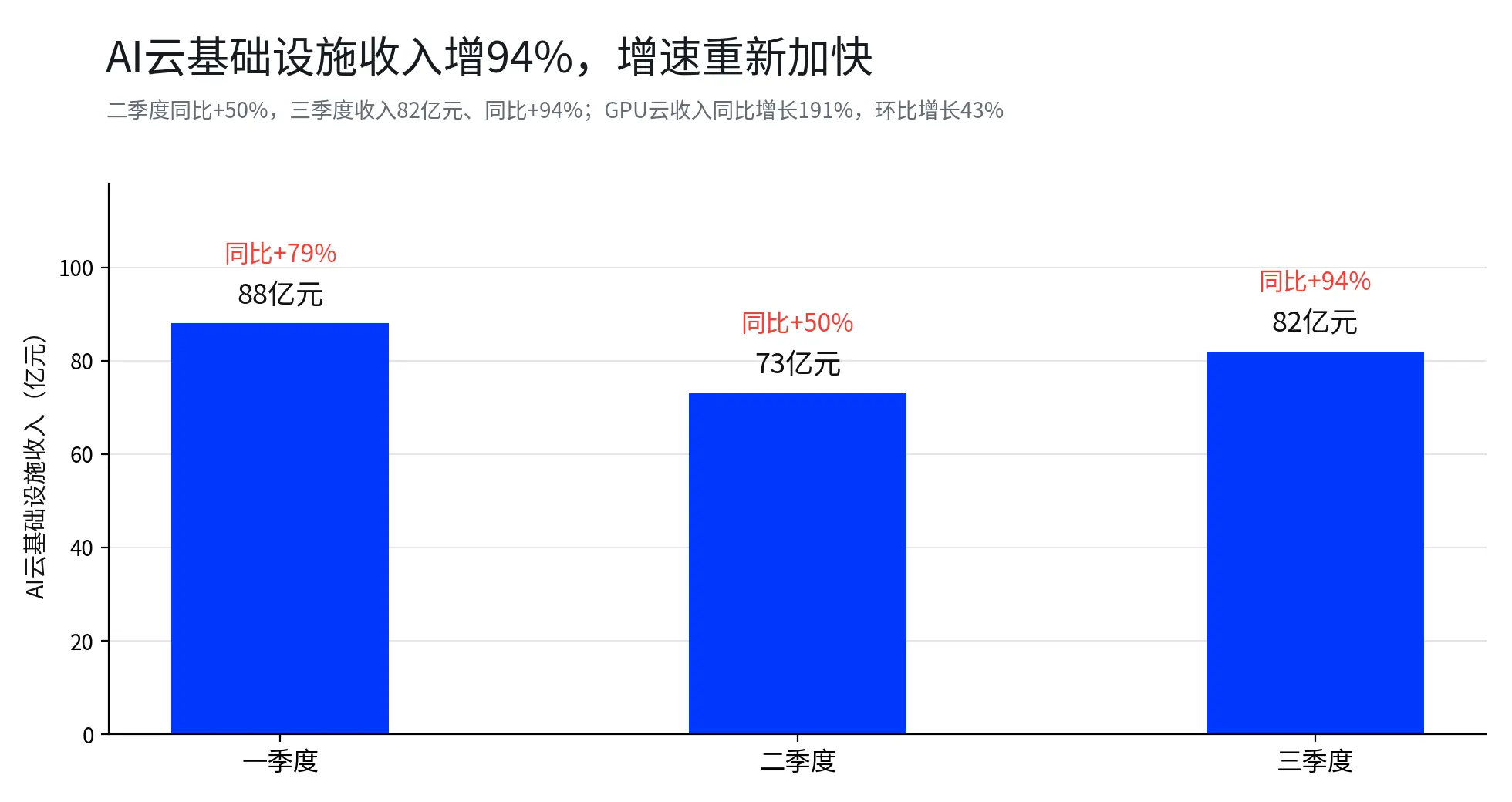
The most noteworthy aspect is AI cloud infrastructure. In the third quarter, AI cloud infrastructure revenue was about 8.2 billion yuan, up 94% year-on-year, significantly accelerating from about 50% growth in the second quarter. GPU cloud revenue grew by 191% year-on-year despite a high base last year, with a quarter-on-quarter growth of 43%. Revenue from external customer token calls on the Qianfan MaaS platform increased by 1159% year-on-year. Meanwhile, AI application revenue was about 2.6 billion yuan, remaining stable, while AI-native marketing service revenue was about 2.4 billion yuan, down 15% year-on-year. Baidu's AI business growth is not concentrated in all segments; computing power, cloud infrastructure, and model invocation demand are currently the strongest growth areas, while applications and traditional marketing businesses are still in an adjustment period.
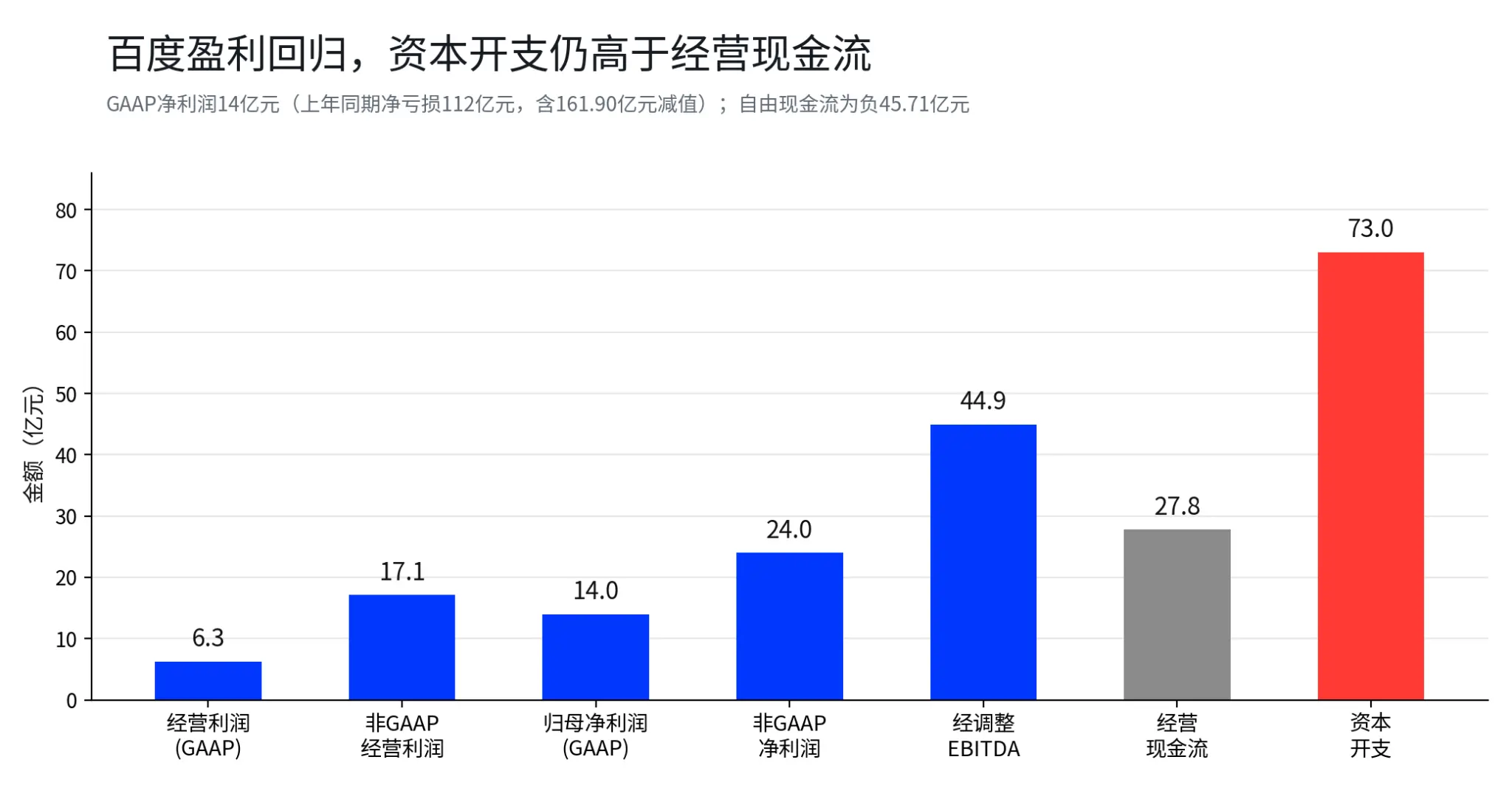
This is also the most worthy aspect of Baidu's earnings report to study: the rapid growth of AI revenue has been validated by data, but AI growth has not yet fully equated to profit growth. Adjusted earnings per ADS were 6.78 yuan, higher than the market expectation of 6.02 yuan. Adjusted EBITDA was about 4.49 billion yuan, also exceeding the market estimate of 3.96 billion yuan, with non-GAAP operating profit of 1.712 billion yuan and an operating profit margin of 6%. However, at the same time, sales costs reached 19.9 billion yuan, up 9% year-on-year, mainly affected by increased costs related to cloud business and traffic acquisition. R&D expenses were 4.8 billion yuan, down 7% year-on-year, and selling and administrative expenses were 5.5 billion yuan, down 17% year-on-year. The company's operating cash flow was 2.778 billion yuan, up 121% year-on-year, while capital expenditure reached 7.3 billion yuan, although it significantly decreased from 11.4 billion yuan in the second quarter, it still exceeded the operating cash flow for the same period, resulting in negative free cash flow of 4.571 billion yuan.
What Baidu's earnings report truly leaves behind is a question worth following up: AI cloud has been able to fill the revenue gap caused by the decrease in advertising, but when will it further fill the gaps in profit and cash flow? If AI cloud continues to maintain high-speed growth while gross margin, operating profit margin, and free cash flow improve simultaneously, the market will have reason to further increase the valuation of AI business. If revenue continues to grow but capital expenditure remains long-term higher than cash generation capability, the market will still be cautious about the return cycle.
Baidu App's monthly active users reached 604 million in September, Luobo Kuai Pao covered 30 cities globally as of October, and the autonomous driving mileage was about 34 million kilometers in the third quarter. These data indicate that Baidu continues to expand its AI applications and ecological layout. However, from a stock pricing perspective, what truly needs to be validated in the coming quarters is whether the chain of revenue growth, profit growth, and cash flow growth can be connected. This is also the first exam that Baidu leaves for the subsequent Chinese concept stocks.
3. Alibaba, JD.com, Pinduoduo: Three Completely Different Questions in the Same Earnings Week
Next, Alibaba, JD.com, and Pinduoduo will successively announce their performance, but they cannot simply be ranked by who has the higher revenue growth rate, as the three companies are currently at different profit stages, and the answers the market is truly waiting for are different.
Alibaba's core issue is whether AI investment can begin to enter a profit model. After the earnings report is released on November 19, the market will not only look at whether the group's revenue and earnings per share exceed expectations but will also need to break down the cloud business revenue, AI-related demand, cloud business profit margins, and the company's statements on AI capital expenditure and future investments. Alibaba's subsidiary, Pingtouge Semiconductor, plans to advance an IPO on the Hong Kong Stock Exchange, which also makes the relationship between AI chips, computing power, cloud business, and capital expenditure more worthy of attention. Baidu has already demonstrated a real issue: cloud revenue can grow rapidly, but the growth of cloud business itself will also bring about costs related to servers, GPUs, depreciation, and operational costs. Therefore, while the growth rate of Alibaba's cloud revenue is important, whether the profit margin of cloud business improves and whether the growth in AI demand has begun to raise profit expectations may be the most watched variables in the market on Thursday.
JD.com is more suitable for examining the relationship between revenue growth and profit efficiency. E-commerce revenue itself is still a scale indicator, but investments in logistics, instant retail, and other new businesses, as well as marketing expenses, service revenue, and operating cash flow, can more directly reflect whether the company is using more investment to exchange for growth or has begun to release profits through economies of scale. The market's current focus on JD.com is no longer just whether consumption has recovered, but whether profits can continue to outpace revenue. Reports indicate that Goldman Sachs expects JD.com's net profit to grow by 39% year-on-year in the third quarter. If the final data continues to show that profit growth significantly exceeds revenue growth, the market's focus may further shift from market share to profit improvement. Conversely, if new business investments rise significantly again, the sustainability of profit margin improvement will need to be reassessed.
Pinduoduo needs to find a balance between high growth and investment. Domestic e-commerce competition and Temu's overseas business remain significant variables affecting profits, so the earnings report cannot only look at revenue growth but must also consider marketing expenses, operational investments, and profit margins together. If revenue maintains rapid growth while the expense ratio begins to decline, the market may reassess the company's future profit potential. If revenue growth still relies on large-scale marketing and overseas investments, pressure on the profit side may continue to limit valuation expansion. For Pinduoduo, what is truly worth paying attention to is whether the marginal cost of high growth has begun to decline.
Thus, although these three companies are in the same earnings week, they should each answer three different questions: Alibaba looks at whether AI cloud can transition from revenue growth to profit growth, JD.com examines whether operational efficiency can continue to release profits, and Pinduoduo seeks to find a better balance between high growth and investment. This is closer to the aspects of earnings reports that truly impact stock prices than simply comparing which company has the highest revenue growth rate.
4. Look at What the Market Has Already Bet Before Earnings, and What Needs to Be Reassessed After Earnings
Earnings reports reflect the operational results of the past three months, but stock prices trade on expectations for the next few quarters. Therefore, the most important task before earnings is not to guess a number, but to clarify what expectations the market has already factored into the stock price.
If the market has given a very high expectation for a company's revenue, earnings per share, and AI business growth, then even if the company achieves double-digit growth, as long as there is no further upward revision of future expectations, the stock price may still experience a realization of good news. Conversely, if the market has previously lowered expectations, as long as the company provides positive changes in profit margins, cash flow, or guidance for the next quarter, it may trigger an upward revision of profit forecasts. In other words, the core of trading earnings reports lies in how much the actual results have changed relative to the original expectations.
Baidu is a good case in point. Before the earnings report was released, the market had already anticipated a significant weakening of its advertising business, and the core issue of concern for institutions was whether AI and cloud business could offset the pressure from traditional advertising. Ultimately, Baidu's revenue basically met expectations, but adjusted profits significantly exceeded market estimates. More importantly, the proportion of AI business in general business revenue rose to 53%, and AI cloud infrastructure revenue grew by 94%. What truly changed the market's judgment was the change in revenue structure: the AI business has begun to possess a sufficiently large scale to offset the decline of traditional business.
This is also the preparation that other companies should do before their earnings reports this week. Alibaba needs to closely monitor cloud business revenue, AI demand, and capital expenditure expectations in advance. JD.com should look at revenue, profit margins, and new business investments. Pinduoduo should focus on observing the impact of Temu and domestic business investments on profit margins. Content platforms like Tencent Music and NetEase should pay more attention to paid users, ARPU, content costs, and cash flow. This way, after the earnings reports are released, investors can directly judge whether the concerns the market originally had have improved, whether the expected growth has been realized, and whether new sources of growth have emerged.
5. What Really Needs to Be Deep-Dived Is Whether Profit Margins and Cash Flow Can Keep Up
Revenue is the entry point of financial reports, but profit margins and cash flow determine how much value growth can ultimately retain. This is especially true for Chinese tech companies currently in the AI investment cycle, where there may be a significant time lag between revenue growth and profit growth, and capital expenditures and free cash flow may also show temporary divergence. Therefore, one cannot directly infer valuation increases from revenue growth alone.
Profit margins first reflect growth efficiency. If revenue grows by 20%, but gross margins decline and sales expenses increase significantly, then the new revenue may not bring corresponding profit increments. Conversely, if revenue only grows by a single digit percentage, but gross margins and operating profit margins continue to improve, along with rapid growth in earnings per share and free cash flow, the market may still assign a higher valuation. What the market is truly willing to pay for is how much profit can be retained from revenue growth.
Cash flow is a further important indicator to validate profits. Net profit can be affected by depreciation, stock-based compensation, investment income, foreign exchange, and one-time items, while operating cash flow is closer to the actual cash-generating ability of the core business. Baidu's operating cash flow in the third quarter was 2.778 billion yuan, a year-on-year increase of 121%, showing significant improvement, but capital expenditures still reached 7.3 billion yuan, with free cash flow at negative 4.571 billion yuan, indicating that AI investments are still at a high level. This figure is not simply a negative signal, as the AI cloud business is still in an expansion phase, but it means the market needs to continue observing: whether these capital expenditures can lead to higher revenue and profits, and when cash flow can complete its reversal.
Capital expenditures cannot be viewed in isolation. AI companies increasing investments in GPUs, data centers, and servers may be proactively expanding during a phase of rapid demand growth. If revenue, orders, and customer demand grow in sync, the market may interpret this as a proactive layout for future revenue. However, if capital expenditures continue to increase while revenue growth, profit margins, and cash flow do not improve in tandem, the lengthening return cycle will become a valuation pressure. Therefore, the most noteworthy combination in this week’s financial reports is whether revenue growth, profit margin improvement, and operating cash flow growth can occur simultaneously.
6. The True Trading Window of Financial Reports Often Appears When Expectations Are Forced to Change
For investors, the most common misconception during earnings week is to think that if earnings per share exceed expectations, the stock price should rise, and if revenue falls short of expectations, the price will drop. In reality, the market often trades part of the results in advance; what truly drives prices is how much the financial report changes future profit forecasts.
The judgment after a financial report can be distilled into a chain: how actual revenue and earnings per share compare to expectations, whether there have been structural changes in core business, whether profit margins have improved, and whether management's guidance for the next quarter and the full year has changed. If past performance was good but the company lowers future guidance, the market may still reduce positions. Conversely, if past numbers were average but profit expectations for the next few quarters begin to be revised upward, the stock price may gain greater revaluation space.
Baidu is a typical case. Total revenue decreased by 1% year-on-year, which does not stand out at first glance, but the proportion of AI business increased to 53%, and AI cloud revenue grew by 94%, prompting the market to rethink Baidu's future revenue composition. If in the next few quarters AI cloud's high growth can continue to translate into profit margins and free cash flow, it could indicate a change in the profit model that exceeds the scope of single-quarter performance improvement. Conversely, if the AI business continues to grow rapidly but requires substantial capital investment to maintain, the market will continue to assign it a more cautious valuation framework.
Therefore, the most valuable aspect of trading around financial reports lies in whether they force the market to revise its original profit forecasts. This is also why it is necessary to study expectations before the financial report and to analyze guidance afterward, rather than just looking at the numbers that have already occurred.
7. How to Follow This Week: Finding the Next Company That May Experience a Discrepancy in Expectations from Baidu's Answers
This week's observations can focus on who is experiencing new profit drivers. Baidu has already reported, and the next step is to continue verifying whether the high growth of AI cloud can translate into profits and cash flow, while also observing whether the decline in traditional advertising revenue continues to narrow. Alibaba is an important verification point for AI this week, focusing on whether AI cloud growth, capital expenditures, and cloud business profit margins can form a better combination. JD.com should focus on changes in consumer demand, service revenue, profit margins, and new business investments. Pinduoduo needs to pay attention to the impact of Temu and domestic e-commerce investments on expense ratios and profits. For content platforms like Tencent Music and NetEase, the focus is on user payments, ARPU, content costs, and cash flow.
More importantly, trading before and after financial reports can be separated. Before the report, the market trades on expectations and potential catalysts, focusing on determining which companies have been fully priced and which companies still have low expectations. After the report, the trading logic shifts to actual results, management guidance, and whether future profit forecasts need to be adjusted. For companies that have already seen significant price increases and have high market expectations, exceeding expectations may only maintain the existing valuation. In contrast, for companies with previously low expectations and improving fundamentals, a turning point in profit margins, cash flow improvement, or upward guidance may bring greater revaluation potential.
This is also the most noteworthy aspect of this round of Chinese concept stock earnings week: the market may no longer just trade on the overall positive outlook for Chinese concept stocks but will further trade on the profit differentiation between companies. When AI investments, consumer recovery, and platform competition gradually enter the profit and loss statement, those who can convert revenue growth into profits and cash flow will have a better chance of obtaining sustained valuation support.
In Conclusion: The Next Phase Will Be About Who Can Retain Growth
Baidu has provided a case worth referencing throughout the earnings week: traditional online marketing revenue decreased by 22% year-on-year, while AI business revenue accounted for 53% of general business revenue, and AI cloud infrastructure revenue grew by 94%, indicating that new business has begun to take on increasingly important growth responsibilities. However, capital expenditures are still higher than operating cash flow, and free cash flow remains negative, indicating that the rapid growth of AI revenue is still some distance from being fully realized as profit.
The upcoming earnings reports from Alibaba, JD.com, Pinduoduo, NetEase, and others will further expand this verification. What the market truly needs to look for are signals of improving revenue structure, rising profit margins, improving cash flow, and upward revisions in future guidance.
To distill this round of earnings week into an observation chain: look at revenue for growth, business structure for direction, profit margins for efficiency, cash flow for realization, capital expenditures for future investments, and management guidance for next phase expectations.
If a company can gradually make this chain work, the financial report will not just be a performance announcement, but may become the starting point for the next phase of valuation re-pricing.
Disclaimer: The content of this article is for general information and market commentary only, compiled based on publicly available information as of the time mentioned in the text. Relevant market data, expectations, and probabilities may change with market conditions. The views and investment strategies cited from third-party institutions, analysts, or other individuals represent the views of the relevant third parties at a specific time and do not represent the views or recommendations of BIT. This article does not constitute investment advice, investment research, solicitation, or recommendation for any securities, investment products, or trading strategies, nor should it be the basis for any investment decision. Financial markets carry risks, and securities prices and market performance may fluctuate; past performance and historical market trends do not represent or guarantee future results. Investors should independently assess the relevant risks based on their own circumstances and seek professional advice when necessary. BIT's Hong Kong stock trading services are not provided to Hong Kong residents or users in other restricted jurisdictions.
 Risk warning
ChainCatcher reminds readers to view blockchain rationally, enhance risk awareness, and be cautious of various virtual token issuances and speculations. All content on this site is solely market information or related party opinions, and does not constitute any form of investment advice. If you find sensitive information in the content, please click , and we will handle it promptly.




Popular articles