OpenAI wants to call for a pause again
 Core Viewpoint


Author: Su Yang, Xu Qingyang
The stronger the model's capabilities, the more voices there are discussing "pausing."
On November 22, local time in the United States, OpenAI's Chief Scientist Jakub Pachocki published a text titled "Perplexity and Intelligence," revealing the pre-training data tracked internally by the company for many years and proposing the establishment of common standards in the AI industry.
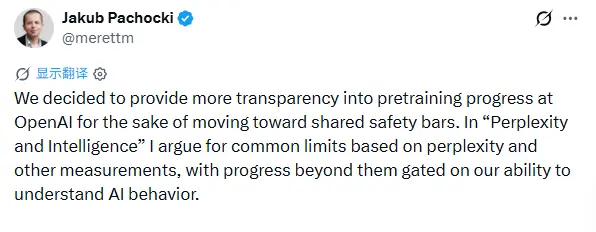
Pachocki hopes that leading model companies will use unified metrics to measure model capabilities and not exceed agreed capability thresholds until safety monitoring capabilities meet requirements.
This proposal has also received support from OpenAI CEO Sam Altman.
01 A Number Related to Intelligence
The core of Pachocki's article is the so-called "perplexity."
Pachocki refers to the mechanism by which the model predicts tokens as training a compressor— the model extracts patterns from data to accurately predict what will happen next with less information. Perplexity measures this predictive ability.
The more accurately the model predicts, the lower the perplexity. What OpenAI actually published is the logarithmic perplexity, which is the cross-entropy loss, with lower values being better.
According to the internal data released by Pachocki, the logarithmic perplexity of GPT-3.5 is approximately 0.99, while GPT-4 is around 0.91. The former can already support smooth conversations, while the latter begins to effectively utilize Chain of Thought (CoT) for reasoning. By the latest stage of the GPT-6 version, the perplexity metric has dropped below 0.8.
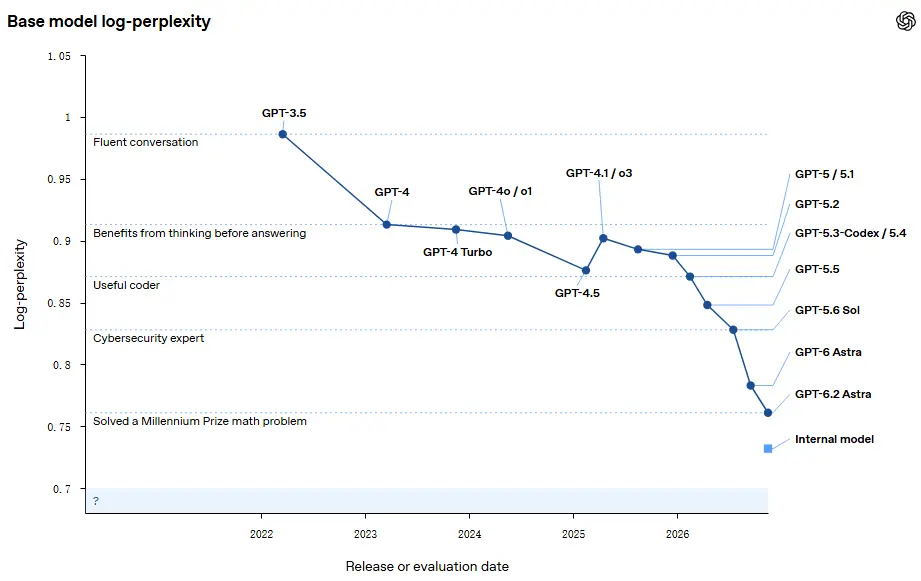
Pachocki stated that the model has begun to exhibit new capabilities in fields such as mathematics and cybersecurity. One change occurs when the logarithmic perplexity drops to about 0.76— researchers found that at this point, the model began to continuously solve some challenging mathematical problems.
Pachocki mentioned that researchers once saw the model solving problems it had pondered for years in Slack. These performances were not the result of specialized training on a specific problem but rather the outcome of enhanced underlying capabilities of the model.
Pachocki emphasized that this is also why he values perplexity.
The key reason is that this metric is not directly related to whether the model can complete tasks but reflects what changes have occurred in its ability to learn information from training data.
We often discuss the emergence of intelligence; the continuous decline in perplexity can be understood as a form of emergence.
02 Supporting Breakthroughs in Pre-training by 2027
In the past, model training methods were mainly proposed by human researchers and validated through extensive experimentation. With AI beginning to participate in research, the situation may change: models not only execute tasks assigned by researchers but may also help find new algorithms, propose experimental plans, and even contribute to the training methods themselves.
He predicts that as early as 2027, AI may achieve a series of foundational advancements in the field of pre-training. The latest models have already begun to provide substantial design contributions during the development process.
Pachocki revealed that OpenAI has observed a significant acceleration in the speed of pre-training loss reduction this year. However, he also specifically noted that the current progress mainly comes from long-term research and computational power investment, with AI automation currently contributing only a small part.
Pachocki also predicts that as the logarithmic perplexity further drops to between 0.68 and 0.70, the model may exhibit new capabilities that are currently unforeseen.
However, using perplexity as a common standard does not mean the problem has been solved.
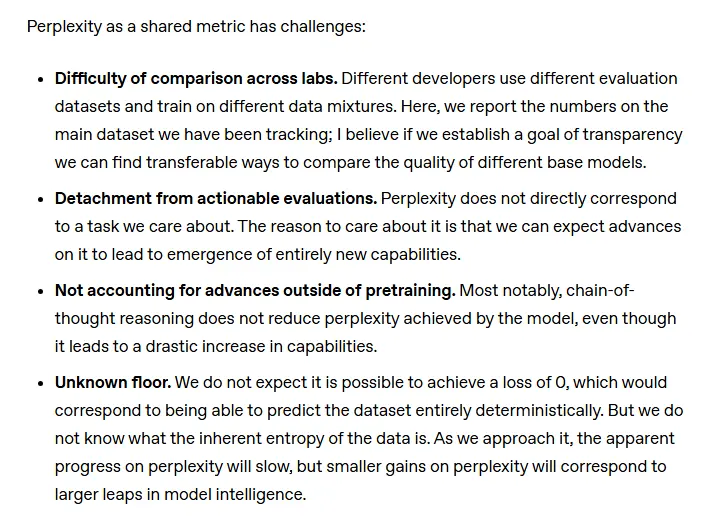
Pachocki also acknowledges the limitations of this metric.
First, the training data, data ratios, and evaluation sets of different companies vary, so perplexity cannot be directly used for horizontal comparisons. Second, perplexity cannot directly measure a model's performance on specific tasks. An improvement in a model's predictive ability does not mean it will simultaneously improve in all mathematical, programming, and security tests. Additionally, post-training techniques such as Chain of Thought reasoning can also change model capabilities but may not necessarily be directly reflected in pre-training perplexity.
Another key issue is that perplexity has a theoretical lower limit.
As models get closer to the information entropy contained in the training data, the loss reduction may gradually slow down. However, this does not mean that capability enhancement will stop. Even if the metric changes only slightly, it may correspond to new capability breakthroughs.
Therefore, Pachocki does not advocate using perplexity alone to judge whether a model is safe but hopes to combine it with other metrics to form a common standard. To promote this work, OpenAI is willing to disclose more progress in pre-training.
Pachocki believes that leading model companies should share necessary transparency information to jointly assess model capabilities and collaborate on red team testing and safety standards.
03 OpenAI and Closed AI
After Pachocki published the article, Altman quickly expressed his support. "The most important thing released recently." Altman said.
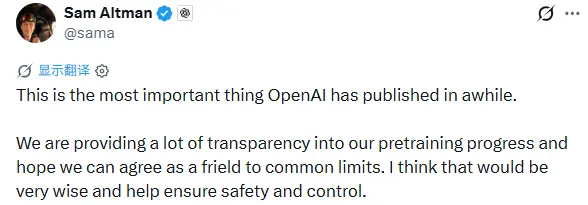
Altman stated that OpenAI is increasing the transparency of pre-training progress and hopes to reach agreements on common restrictions with other companies as partners. In his view, this not only helps ensure AI safety and controllability but also promotes the establishment of common rules across the industry.
Regarding the perplexity limits proposed by Pachocki, Altman also expressed agreement. He hopes that various laboratories will establish common constraints around perplexity and other measurement metrics, and not exceed pre-set capability thresholds until researchers truly possess the ability to understand and monitor AI behavior.
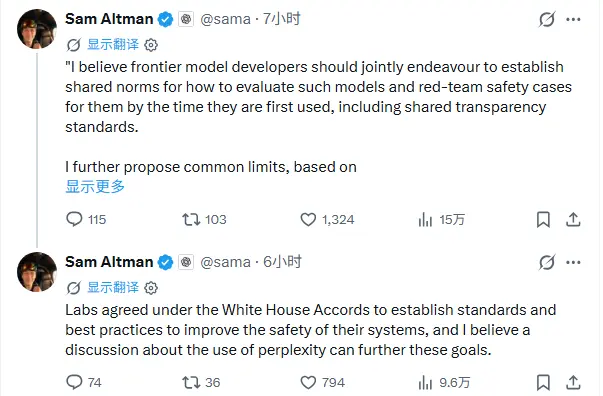
An example he cited is the development of the next-generation Chain of Thought Monitors.
In his view, the industry should first clarify the initial capability limits and then agree on what safety work must be completed before breaking through those limits.
However, Altman's support has not eliminated external doubts. The first concern is the motivation behind OpenAI's push for industry-wide common restrictions.
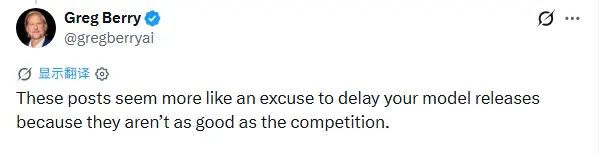
Some netizens believe that OpenAI's emphasis on industry restrictions and safety standards at this time may also be a consideration to buy time for its own model competitiveness. Some believe these statements sound more like excuses used when model releases lag behind competitors.
Others mock Altman for frequently using the term "transparency," stating that if OpenAI truly wishes to improve transparency, it should open-source rather than continue to ignore user demands for model continuity.
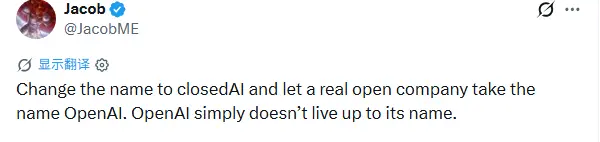
Criticism also involves OpenAI's company positioning.
Some netizens directly suggested renaming OpenAI to ClosedAI, believing that the company's current level of openness does not match this name.
ChainCatcher reminds readers to view blockchain rationally, enhance risk awareness, and be cautious of various virtual token issuances and speculations. All content on this site is solely market information or related party opinions, and does not constitute any form of investment advice. If you find sensitive information in the content, please click , and we will handle it promptly.



Popular articles