Written in the Eye of the Storm: Why I Don't Think the Current Decline is a Short-Term Risk
 Core Viewpoint


 Grasping the overall trend is sometimes far more valuable than focusing on short-term signals.
Author: WhosCalvin
The poem says: "When the time comes, heaven and earth work together; when the opportunity goes, heroes are not free." Especially in the stock market, grasping the overall trend is sometimes far more valuable than focusing on short-term signals. Every time I see many people emotionally fluctuating over things that have already been predetermined due to one or two news items, I can't help but feel regret. This includes several finance influencers with hundreds of thousands of followers.
I previously promised to write a long article clarifying the current market's main line. This article will string together a series of viewpoints from after the INTC earnings report at the end of October, warning about AI hardware risks, to the Democratic election victory announcing an explanation for the AI hardware market, and finally to Jensen Huang stepping down and directly stating that the market is underestimating the impact. Perhaps a month or even six months later, you will find that everything that has happened is just an extension of this main line. Many research reports or influencers may only realize and reiterate my viewpoints weeks or even a month later.
Without further ado, let’s get straight to the point. The only main line in the current market is:
The United States, unable to afford the accelerated AI capital expenditures, is deliberately slowing down the pace of AI. Slowing down AI construction is a good thing for cloud companies, hardware manufacturers, model companies, and even the United States (except for shareholders).
I. The Dilemma of Mid and Downstream
The first sign that there might be signs of a bubble bursting was after the INTC earnings report, which saw a post-market drop of 25% that day. After carefully reviewing the earnings report and the conference call, I found several issues:
In simple terms, the earnings report shows that INTC is aggressively ramping up production: the firm purchase orders (Firm POs) issued to semiconductor equipment suppliers in Q3 surged nearly 40% quarter-over-quarter, while also expanding capacity on multiple fronts. This directly leads to a high probability of negative free cash flow (FCF) by 2027.
However, if we only look at this earnings report, it only indicates that INTC is currently encountering some issues in its capital cycle, and that expanding production due to strong demand seems like a reasonable response. But if we look at the earnings reports of leading cloud companies (Hyperscalers + representative small and medium AI clouds Neoclouds) together, we find that the AI bubble has already shown cracks: four out of the five largest cloud companies (AMZN, GOOGL, META, ORCL) have officially seen their quarterly free cash flow turn negative due to capital expenditures, indicating that the industry is shifting from "tech giants relying on their own cash flow for internal growth" to a new phase of "external equity and debt financing":
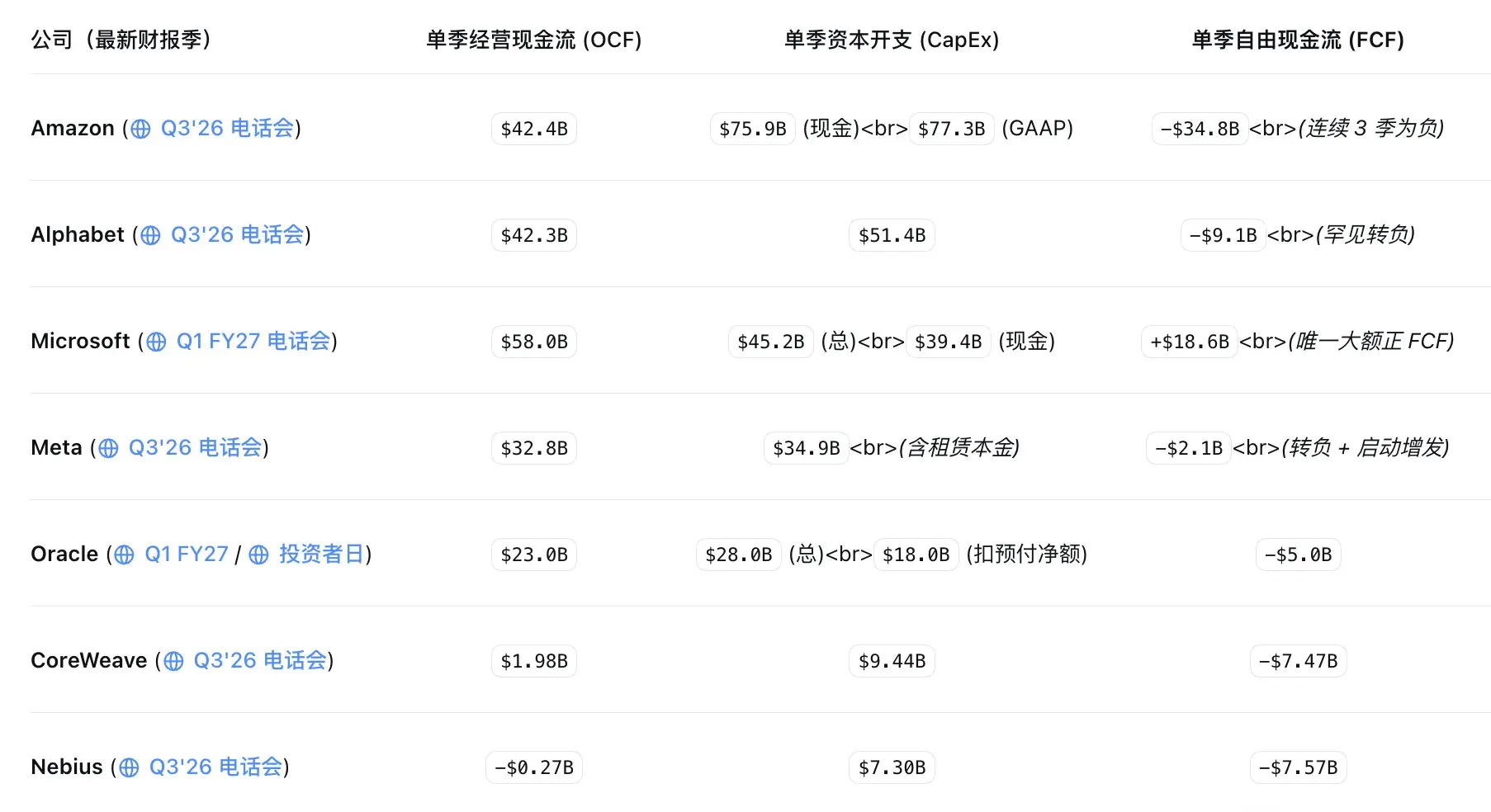
Summary of the FCF situation of leading cloud companies in AI
Before this quarter, everyone believed that the driving force for the sustainable development of AI came from the fact that most of the industry-leading computing power providers are cash cow giants with super cash printing machines (search advertising, e-commerce, enterprise software), which is fundamentally different from the tech bubble of 2000. Now, this annualized $800 billion of self-owned cash flow has been completely drained.
As the five major cloud companies continue to accelerate towards $820 billion+ or even nearly a trillion dollars in capital expenditures by 2027, while Neoclouds and large model unicorns are also investing hundreds of billions to compete for chips, all excess incremental funds can only be filled by leveraging. Meanwhile, outside of the earnings reports, according to the latest report from the Federal Reserve, the off-balance sheet "uncommitted lease commitments" of the seven giants have exceeded $1 trillion, with guarantees and other contractual commitments exceeding $2 trillion.
Of course, when downstream companies are forced to leverage due to the capital expenditure competition, is the midstream doing well? Not at all. The midstream heavy asset segment has also become a "negative FCF disaster area," where hardware manufacturers that build factories, purchase wafer equipment, expand production lines, and finance assembly are burning their FCF into negative numbers to compete for AI capacity:
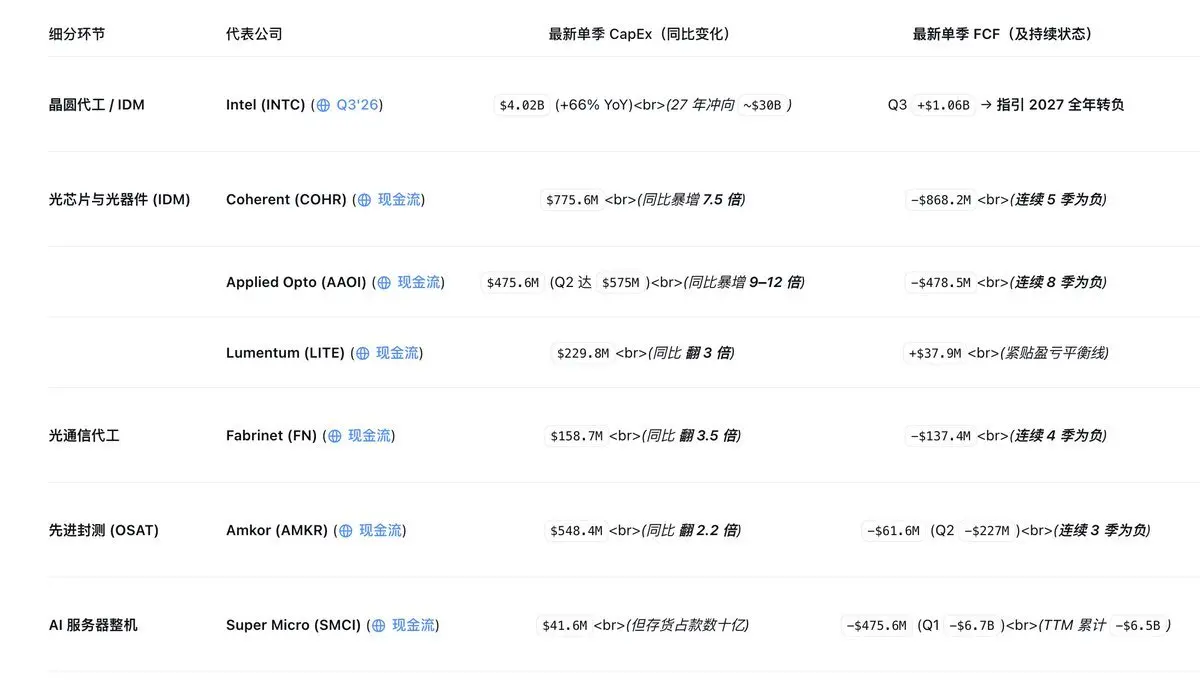
Summary of the FCF situation of leading hardware manufacturers in AI
The vast majority of these companies are aggressively expanding capacity to take on massive orders, and most of their operating cash flow has been consumed by this expansion; some smaller companies are even undertaking extreme expansions far beyond their own scale.
Of course, looking at this data alone indicates strong short-term demand, the industry is in a high boom, and they have irrevocable prepayments and guaranteed long-term contracts from downstream. However, when these optical chip wafer fabs, advanced packaging lines, Intel's new production lines, and storage clean rooms, which take 1.5 to 2.5 years to build, begin to release supply in the second half of 2027 to 2028, if they happen to coincide with downstream cloud companies slowing their CapEx growth due to financing costs and depreciation pressures in 2028, these midstream heavy asset manufacturers, which currently have thin profit margins and rely on burning FCF for expansion, will be the first to bear the dual squeeze of "capacity coming online and prices dropping + high depreciation backlash."
All of this is being quietly priced in by smart money in the market after the earnings season. Meanwhile, those upstream monopolistic hardware manufacturers (NVDA, MU, TSMC, AVGO) appear to have mountains of net cash and almost no debt on their earnings reports; even if AI cools down tomorrow, they will at most earn slightly less profit and will not face a debt crisis.
But when we combine our analysis above, we find that these very few monopolistic rent-seekers at the top of the upstream pyramid are able to maintain their position by sucking the blood of the mid and downstream. However, you cannot have a building with only the fifth floor; when the first and second floors and the foundation start to shake, it is likely that the fifth floor will be the first to collapse.
Currently, Micron's 81.1% gross margin, SK Hynix's nearly 80% operating profit margin, and NVIDIA's 74.8% gross margin are essentially scarcity premiums under extreme shortages, rather than the norm in manufacturing. Once the top five cloud giants, which account for 60% of your revenue, can no longer absorb goods, no upstream supplier will dare to take their clients to court to force them to take delivery; almost 100% will compromise—allowing for delayed delivery or renegotiating prices.
Therefore, assuming that next year the top five cloud companies do not collapse but decide to cut their annual total CapEx by 20% (for example, from $820 billion down to $650 billion) to restore their negative free cash flow to positive, the already built data centers will continue to generate revenue, and the cloud revenues of AWS, GCP, and Azure may still grow by +20%; but for upstream hardware manufacturers, it would be a disaster: once downstream discovers that chips are no longer in short supply, they will immediately stop panic ordering and duplicate orders, prioritizing the consumption of their accumulated inventory (for example, Google currently has a large stockpile of TPUs for external sale). A 20% reduction in downstream terminal CapEx, when transmitted to upstream chip, storage, and optical module manufacturers, often results in a 40% to 60% drop in new orders. This is the "bullwhip effect."
So the current AI chain can be summarized in one sentence: the "strong AI demand" that has been magnified layer by layer is forcing downstream cloud companies and midstream manufacturers to burn through cash flow or even take on debt to unilaterally support the very few upstream monopolistic oligarchs.
In theory, as long as this demand continues, this story can keep going. But in reality, the most critical link in this entire chain is also the most precarious one.
II. Building Towers on Sand: AI Demand
Currently, there is only one genuine and tangible AI hardware demand in the entire industry: AI Coding. There is ample evidence that companies are very willing to pay for alternatives or enhancements to high-salaried programmers. Personally, I also spend thousands each month on various AI subscriptions.
However, even so, relying solely on "helping programmers write code" and "helping giants sell more ads" is far from filling the $800 billion+ capital expenditure pit of the cloud companies.
What’s worse is that even the current strongest demand is entirely subsidized and cannot form a positive cycle. Computing power consumption has indeed surged tenfold, but why do we not see an equivalent increase in revenue? Because the giants are simply too afraid to charge ordinary users at real costs. Currently, all coding plans from model companies are losing money while gaining attention. Meta borrowing money to issue shares and heavily investing in Muse AI is the same—computing power is indeed being burned at multiples, but essentially, the giants are borrowing to subsidize global users to use AI for free, which is a "survival tax" rather than a proven business return.
The ultimate buyers at the very bottom of the chain are these continuously loss-making model companies, not real demand entities. Their money comes from VCs, sovereign funds, bond issuance, and even from investments made by MSFT, AMZN, GOOGL, NVDA, TSMC themselves. Essentially, it is: large companies and the capital market provide money to model companies → model companies use this money to sign five-year large contracts for computing power with cloud companies → cloud companies take these contracts to borrow money to buy upstream chips.
Additionally, in a detail that went unnoticed, this quarter's earnings report has an extremely surreal detail: CRWV proudly announced in its conference call that over 75% of its $133 billion backlog orders come from "investment-grade large enterprises"—and these major clients are precisely the large cloud companies themselves, like Microsoft, Google, and Meta! GOOGL also admitted that due to insufficient capacity in its own data centers, it began renting computing power from third parties starting at the end of Q3.
Thus, a cycle that deceives the entire capital market has begun: even if the terminal has only $100 worth of model invocation demand → model companies sign a $100 contract with large cloud companies (counted in the large cloud companies' earnings reports) → large cloud companies, unable to build their data centers in time, turn around and sign an $80 long-term lease with Neoclouds (also counted in the new cloud earnings reports) → both sides simultaneously take their respective surging orders to the midstream optical module and upstream chip manufacturers to compete for goods. The same demand has been repeatedly magnified several times in the industry chain's accounts.
To be frank, you can interpret the above part as a collection of AI ghost stories, or you can say it is merely a summary of the negative news over the past two months. But behind this has already laid the conditions for a slowdown: for the downstream and midstream, a slowdown is definitely a good thing.
If the downstream reduces CapEx, their free cash flow will instantly revive. If the midstream experiences a slowdown in demand, although short-term performance will be affected, they will no longer need to spend money to expand capacity, avoiding the situation where new production lines face order cuts right after being put into operation; whereas if demand continues to surge, facing the triple blow of "sudden drop in orders + declining gross margins + valuation cuts" is just a matter of time.
Meanwhile, outside of the upstream and downstream of computing power, the root of these AI chains, the leading model companies, are seeing their training costs decrease exponentially:
Of course, in Anthropic's own FWP, their quarterly computing power expenditure has increased about 11 times over six quarters, from $900 million to $9.9 billion. Because they need to invest more money into training to maintain their leading position. So as long as the frontier competition continues and inference demand continues to grow, total demand will keep rising.
But outside the industry chain, can this illusory frontier competition continue?
III. The Empire Cannot Bear the Lightness
Now we come to the main topic: why I say the United States can no longer afford the accelerated AI capital expenditures, and thus is deliberately slowing down the pace of AI.
I will elaborate on my viewpoint from two aspects: why the United States wants to slow down and how it is specifically doing so.
First, why? This is actually quite obvious: AI has transformed from the "debt relief remedy" hoped for by Washington and Wall Street into the "largest source of vulnerability" in the U.S. economy and financial system. The Financial Stability Report released by the Federal Reserve on November 13 has saved me a lot of words; if you're interested, you can take a look yourself, and I won't elaborate further.
The rapid construction of AI data centers is continuously pushing U.S. inflation through multiple price transmission chains, such as "the channels of electricity, grid capacity, and municipal water," "the price increase channel of 'capacity crowding out' for storage chips and IT hardware," and "the physical extrusion channel for engineering materials, grid equipment, and technical blue-collar workers." It has become a threat on par with the energy price increases caused by the war in Iran.
In fact, in the second half of the year, many roles within the Federal Reserve have been vocal about AI driving U.S. inflation, supporting this argument. Federal Reserve Vice Chair for Supervision Bowman disclosed on November 10 that, within the year leading up to September 2026, AI-related price pressures alone contributed about a quarter of the excess above the 2% target for U.S. core PCE, comparable to energy.
Last year and even in the first half of this year, the widely held belief that "the productivity gains brought by AI will ultimately lower costs, increase total supply, and thus reduce inflation" has shown no signs of materializing. Instead, the development of AI currently seems to be replacing more and more jobs.
If the above is merely theoretical deduction, a series of events that occurred this month serves as evidence for this theory.
Assuming the U.S. discovers that accelerating AI will lead to a wave of corporate failures and continued inflation affecting the U.S. economy, thus needing to slow down the pace of AI, this initiative cannot be initiated by the former president himself or his faction, as he is one of the biggest promoters of the AI bubble. Therefore, a group of people must step forward to play the villain—namely, the Democratic Party.
This is also why the former president has hardly made any effort in this midterm election, even allowing oil prices to soar to 120. If he wanted to lower oil prices, he could achieve that in the short term by sending a couple of taco signals, but he even stated before the election that he would strike hard at Iran. His complete inaction has led to a significant victory for the Democratic Party, giving them enough voice to apply the brakes on the nationwide AI frenzy. Meanwhile, the former president, who was constantly rallying support in the first half of the year, has found that he hasn't supported AI companies for at least a quarter.
Of course, the Democratic Party does not genuinely want to kill AI; they just do not want the aforementioned mid- to downstream corporate failures to occur during their term. So what they will do is merely slow down the pace.
The U.S. hegemonic status has begun to shift from military strength and dollar hegemony to technological hegemony—specifically, global top-tier AI capabilities. This has basically become a consensus. The core of current U.S. Treasury bonds is that the U.S. must maintain a leading position in the AI field. And now, to actually start slowing down the pace of AI, does that mean they are not taking the only competitor in the AI field, China, seriously?
When the first place does not want the second place to surpass them, aside from working hard to study, the best method is actually to prevent the second place from learning.
Thus, you can see the two-pronged approach the U.S. has taken this month: impeaching Huang Renxun, the top chip dealer to China and the biggest promoter of the AI bubble, and the BIS introducing new regulations on remote computing power access, closing the arbitrage window for China's remote computing power. Prior to this month, the U.S. had been turning a blind eye to all of this.
The above is a deduction based on the combination of theory and actual events. My theory was born earlier, and the subsequent events have been confirming my viewpoint. This includes the Nvidia conference call early this morning, where the interim CEO stated, "The internal view on 'revolving financing' has changed over the past quarter; guarantees to customers will tighten, and support for neocloud will be 'selective.'"
Many people think this is short-sighted from the CFO, but I dare say that even if a real CEO is elected, or even if there is a very small chance of Huang Renxun returning, this strategy will not change.
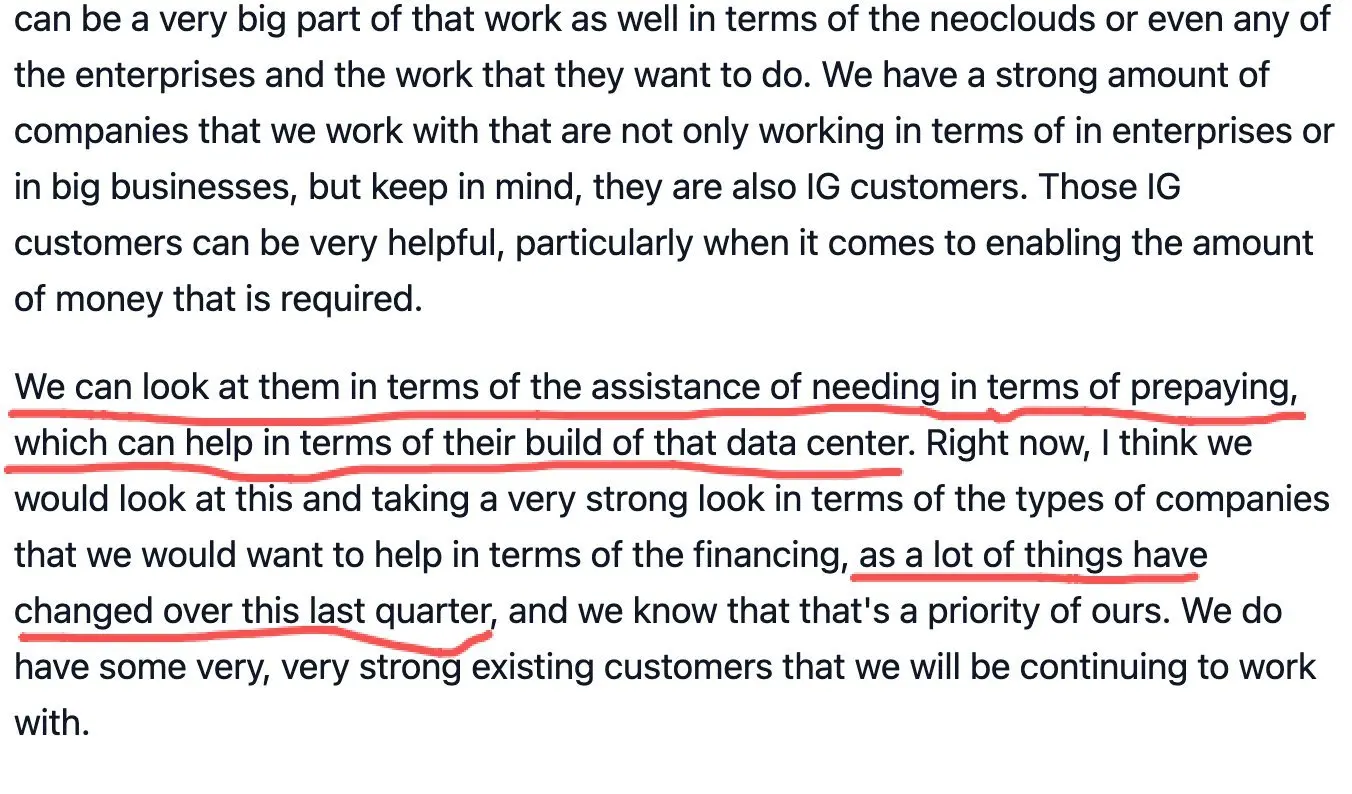
The interim CEO stated that guarantees will tighten
IV. Postscript: What happens next?
The above is merely my deduction based on the industrial chain and macro background, combined with actual events that have occurred, which cannot be stopped from being validated. If this theory is true, then the following events are highly probable:
Huang Renxun is unlikely to return; because no one can guarantee that he won't export advanced chips to China again. The conference call early this morning confirmed this once again.
Chip policies towards China will continue to tighten. Previously, it seemed there were ways that were just not taken seriously, and they could also earn some premiums. Now, it concerns the foundation of the U.S., so naturally, they will not loosen their grip.
They will try every means to obstruct China's AI development and data center construction, possibly starting with public opinion. For example, promoting the idea that AI leads to unemployment and that data centers affect residents' lives.
The U.S. public opinion will reduce or no longer promote favorable news for the AI industry, focusing more on negative news (this is also why there have been so many negative reports recently).
Public figures who previously praised AI will go silent or shift their rhetoric.
In the next stage:
The Democratic Party will substantively execute bills to pause or slow down data center construction.
The mid- to downstream AI industry chain will slow down capital expenditures for financial security reasons.
At this stage, it will already be quite clear. It may even evolve into a situation where all negative news has been fully priced in.
Currently, my position is light on stocks + investing in companies that can fully benefit from the current level of AI or companies that will benefit from slowing down CapEx. Of course, this is just my personal operation and does not constitute investment advice; I will not analyze buy or sell points.
The main reason for writing this long article is that every time I see bloggers shouting "short-term risks," "all negative news has been priced in," or "Huang Renxun is coming back," I find it amusing; at the same time, I feel a bit annoyed. I simply wanted to organize my viewpoints completely, so if they are validated again later, I won't have to type a lot of words. Of course, I also welcome being proven wrong, so that my friends in hardware can make money.
Everyone needs to take responsibility for their own viewpoints and trades. I also do not wish for anyone to cut losses after reading my article, only to come back and blame me for causing them to miss out on a rebound. Although I don't have many fans, I will definitely block them.
Trading is solely about self-reliance.

ChainCatcher reminds readers to view blockchain rationally, enhance risk awareness, and be cautious of various virtual token issuances and speculations. All content on this site is solely market information or related party opinions, and does not constitute any form of investment advice. If you find sensitive information in the content, please click , and we will handle it promptly.





Popular articles