








Technical details of the newly launched Fei Protocol's operating mechanism and token economic model

 Fei Protocol achieved its issuance target of 100 million FEI just a few hours before its genesis launch, understanding why it is favored from the perspective of mechanism design.
This article was published on ChainNews, author: Zhong Jie, partner at Zonff Partners.
Rai stone or Fei stone is one of the many large handicrafts made and cherished by the local residents of the Yap Islands in Micronesia, and they are also known as Yap stone money. RAI (Reflexer Labs) and FEI (Fei Protocol). Today we are going to learn about Fei.
To fully understand this article, please read the complete white paper and project announcement in advance. The content already present in the white paper will be briefly mentioned if referenced in this article, and differing opinions or further extensions of the white paper's content will be highlighted.
Schedule and Basic Concept Introduction
Basic Introduction to the Fei Protocol
The goal of the "Fei" protocol is to keep the trading price of ETH/FEI closely following the price of ETH/USD while maintaining high market liquidity. FEI adopts a new type of stablecoin mechanism, which we call the direct incentive mechanism to achieve this purpose. This mechanism uses dynamic liquidity mining rewards and a destruction penalty mechanism based on DEX trading volume to anchor to a fixed price (1 USD). Initially, we will launch this protocol on Uniswap, and later, other DEX platforms and liquidity incentives can be added and updated through governance as needed. The initially circulating "Fei" token FEI can only be purchased through a joint curve priced in ETH, and we define the ETH acquired through these purchases as Protocol Controlled Value (hereinafter referred to as PCV).
PCV is the asset that is completely owned and controlled by the protocol and locked in smart contracts, rather than the previously widespread IOU notes. The former can be understood as a more powerful subset of Total Value Locked (TVL). At the genesis of the FEI protocol, all PCV assets will be used to provide liquidity for ETH/FEI on Uniswap, which is a "liquidity collateral" model that does not require over-collateralization.
As supply increases, the token price of the joint curve approaches the fixed price of the oracle. When the Uniswap price is above the pegged price, arbitrage opportunities can be ensured, and if the Uniswap price is below the pegged price for a period of time, PCV can provide liquidity to support its return to the pegged price.
The governance token of the FEI protocol is called the TRIBE token, which rewards LP holders of FEI/TRIBE on Uniswap. The FEI "Fei" protocol has core advantages that other stablecoin protocols do not possess; it guarantees decentralization and scalability while fairly distributing new token supply to new demand parties. PCV provides greater flexibility for the "Fei" protocol to ensure the project's long-term goals, and FEI token holders truly benefit from a stablecoin protocol with high stability and high liquidity.
PCV
PCV is the most important concept in the FEI protocol (this section is lengthy). One of the most obvious use cases for PCV is to allow the protocol to act as a liquidity provider (LP) for automated market makers (AMM) like Uniswap. Under sufficient trading volume, the protocol will essentially control the exchange rate of the trading pair. It can use its PCV to act as a counterparty in the market to rebalance prices, locking or burning excess tokens. For example, if the Fei protocol owns 90% of the liquidity, it can automatically execute the following trades:
- Retrieve all liquidity (990 FEI and 900 USDC)
- Swap ~5 USDC for ~5 FEI (remaining liquidity ~105/105 FEI/USDC)
- Supply 895 FEI and 895 USDC at a 1:1 exchange rate. The net effect of the above trades is that the protocol spent 5 USDC of PCV to restore the pegged price, meaning FEI remains at a 1 USDC exchange rate (1000 FEI:1000 USDC).
Of course, the example given in the white paper does not consider the constant product and slippage issues of the Uniswap AMM algorithm (ignoring gas). The process is illustrated in the figure below.
Figure 1.1 PCV liquidity ratio 0.9 initial price FEI/USDC=0.91, PCV resupply maintaining exchange rate price process (ignoring AMM characteristics), source: Zonff Partners
When considering the constant product and slippage of the Uniswap AMM algorithm, it can be seen that 4.88 USDC was swapped for 5.12 FEI.
Figure 1.2 PCV liquidity ratio 0.9 initial price FEI/USDC=0.91, PCV resupply maintaining exchange rate price process (considering AMM characteristics), source: Zonff Partners
When the PCV liquidity ratio is 0.0465 of the total Uniswap liquidity, we can see that all USDC (46.54) in the FEI protocol is used for resupply. This means that at this point, the USDC in the Fei protocol has been exhausted to restore the FEI/USDC=1 exchange rate.
Figure 1.3 PCV liquidity ratio 0.0465 initial price FEI/USDC=0.91, PCV resupply maintaining exchange rate price process (considering AMM characteristics), source: Zonff Partners
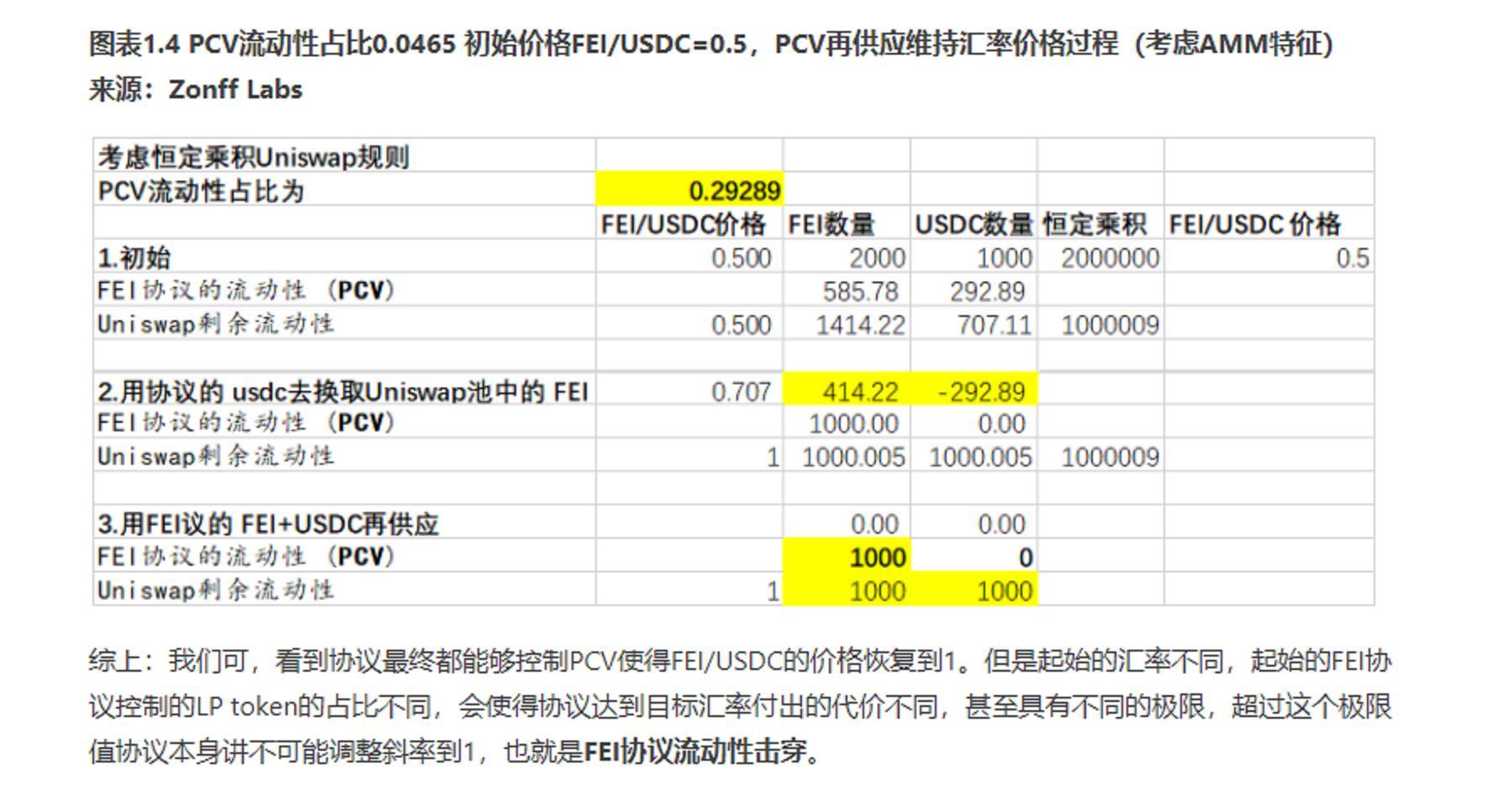
Figure 1.4 PCV liquidity ratio 0.0465 initial price FEI/USDC=0.5, PCV resupply maintaining exchange rate price process (considering AMM characteristics), source: Zonff Partners
In summary, we can see that the protocol can ultimately control PCV to restore the price of FEI/USDC to 1. However, different initial exchange rates and different proportions of LP tokens controlled by the FEI protocol will result in different costs for the protocol to achieve the target exchange rate, and even have different limits. Beyond this limit, the protocol itself cannot adjust the slope to 1, meaning the liquidity of the FEI protocol has broken down.
Without considering the above transaction fees, we can mathematically formalize the above process to simulate and derive the liquidity breakdown process of the FEI protocol.
PCV Breakdown Process
When the relationship (1.1.10) is satisfied, it means that the Z used to maintain the target exchange rate P~end~ in PCV has been exhausted. The FEI protocol will not be able to maintain the target exchange rate, which will cause the PCV to break down, meaning it can no longer maintain the price of FEI against USDC. The price of FEI will depend on the quantity of FEI and ETH in Uniswap, making it very easy to cause a run, where external inflows of FEI will continue to exchange for ETH. This will cause the value of FEI to drop, and the drop in the value of FEI will accelerate people's panic selling of FEI, further spiraling down the value of FEI.
Protocol Design Mechanism
The Fei protocol has several core components: Fei core, Fei stablecoin, bonding curves, PCV Deposits, PCV Controllers, Fei Incentives, TRIBE governance token, and DAO organization.
Figure 1.5 FEI Protocol Design Mechanism Source: FEI White Paper
The Fei protocol manages the operation of the entire system through the TRIBE Token. The core infrastructure running FEI on Uniswap consists of the FEI core, FEI stablecoin, and price oracle; the incentive system is composed of Staking Pool and incentive smart contracts; the PCV protocol-controlled asset value consists of bonding curves, PCV deposits, and PCV controllers.
Fei Core
Fei Core is the access control center of the Fei protocol. It defines the roles below and what each role can do. It also controls which contract corresponds to which role. The various roles are as follows:
- Mining Minter - Mint FEI to any address
- Burning Burner - Burn FEI from any address
- Control Controller - Move PCV in and out from the initial deposit
- Governance Governor - Can grant/revoke any role and upgrade protocol components, further discussion in the TRIBE and DAO section.
FEI Token
FEI is the pegged stablecoin of the Fei protocol, following the ERC-20 standard. The supply of FEI is unlimited, and the Minter and Burner contracts control its issuance through bonding curves and trading incentives. The FEI token has some non-standard ERC-20 functions, but only for certain transactions. Dynamic incentives will be given to specific contract addresses that the Fei protocol wants to incentivize certain behaviors. The incentive contract controls the flow and amount of each incentive. The incentive contract is designated as the minting Minter and burning Burner. If a user sends FEI to an incentive address, their balance will be affected by the minting Minter or burning Burner process. The main incentive addresses of the Fei protocol are in the FEI/ETH Uniswap pool.
- FEIp: Protocol-controlled FEI, deployed in LP pools or other pools controlled by different PCVs
- FEIb: FEI allocated to users through bonding curves, each bonding curve calculates its own quantity
- FEIu: User-controlled FEI, total supply of FEI minus FEI held
Bonding Curve
Figure 1.6 FEI Bonding Curve Source: FEI White Paper
Once the bonding curve reaches the Scale stage, it will fix the exchange rate at 1 USD + b. b is a buffer value that keeps the average price around 1 USD. When any secondary market price exceeds $1 + b, there is a risk-free profit opportunity. Arbitrageurs can buy FEI on the bonding curve and then sell it on the secondary market for profit. When b = 0, the price variance is mostly below 1 USD. By adding a buffer b (initially set at 1%), there is also some price variance space above $1. Considering this price adjustment mechanism, the pricing function is modified to
Equivalent Transformations of the Bonding Curve
Transforming (1.6.1) gives the USD price per unit FEI as
Integrating the bonding curve determines the amount of USD Q(USD) required to move from a given supply r to another supply s:
The transformed bonding curve in USD is more intuitive.
FEI Incentives
We will discuss the mechanism of the FEI incentive contract in the FEI token section. This section mainly discusses how the incentive contract maintains the pegged exchange rate. Initially, there is only a single incentive for the Uniswap ETH/FEI pool. If the price is below the pegged exchange rate, the incentive contract will provide FEI minting to traders, and the next trader buying FEI will receive that minting as a reward for helping to restore the pegged price. This incentive is a time-weighted average of the distance from the pegged price.
The burning mechanism has been updated in the official announcement:
Any fluctuations below the pegged price should lead to net deflation. At this point, any incentives related to purchases should not exceed the amount burned to reach that price, thus leading to token deflation. The total incentive is updated to:
Every time a Uniswap trade restores the pegged price, the time variable t will reset to 0. If a trade partially approaches the pegged price, t will be multiplied by a mend/mstart coefficient. If the trading volume needs to approach 40% of the pegged price, the time variable t will decrease by 40%, and t will recover at a rate r.
PCV Controllers
Adjusting weights means that the protocol uses its controlled PCV to pull the spot price of ETH/FEI back to the pegged price. This point is important under the assumption that traders are unwilling to support pulling back the pegged price under adverse conditions. Even under the maximum time weight of I(x,t) = B(x) (the same state of burning and incentives), the incentives for FEI may not be sufficient. In this case, the protocol will use the PCV controller to pull the price back to the pegged price. The specific process is detailed below.
Early Participation in FEI's Three Stages
Genesis Stage
Anyone can obtain FEI by committing ETH to sign for FEI on the DApp (according to ETH share and not according to the bonding curve). Everyone will receive the same price for FEI during the genesis stage. The bonding curve's genesis target issues 100,000,000 FEI, starting at a price of 0.50 USD. The maximum price that participants in the genesis can pay is $1.01/FEI.
FEI and TRIBE will be released at 12:01 PM (Pacific Time) on April 3, 2021. In Beijing time, it will be 4 AM on April 4.
IDO
The role of IDO is to provide initial liquidity for TRIBE-FEI and prepare for the Pre-Swap. The listing price of IDO is determined as follows: take the fully diluted valuation of TRIBE at Genesis and set it as the amount of FEI purchased on the Genesis bonding curve. Therefore, in IDO, 20% of TRIBE will be put into Uniswap along with 20% of FEI from Genesis to provide Tribe-FEI liquidity. IDO is to prepare for Pre-Swap and is unrelated to users.
Pre-Swap
To prevent some people from front-running trades in the initial FEI-TRIBE pool, the Fei protocol allows users to choose to directly exchange their FEI for TRIBE from the Genesis allocation. Users can Pre-Swap any percentage of their FEI from Genesis for TRIBE. The Pre-Swap will exchange the FEI obtained by participants in Genesis for TRIBE when initializing the liquidity pool. The purpose of Pre-Swap is to prevent front-running, ensuring that everyone receives the same TRIBE price after Pre-Swap. The operation is also completed in the DApp. After the genesis stage is completed, Pre-Swap will follow immediately.
Common Conceptual Misunderstandings
Entering the protocol on any day during the genesis stage is the same.
The role of the bonding curve is to price FEI based on the total amount of ETH, and the final pricing result depends on the price of ETH and the amount of ETH at the end of the genesis, not like a capital pool.
IDO and Pre-Swap are different. IDO provides price discovery and some liquidity for Pre-Swap.
When Pre-Swap is completed, the price at which everyone exchanges for Tribe is consistent.
After Pre-Swap is completed, the Tribe from the genesis airdrop can be traded.
TRIBE Economic Model Introduction and Analysis
Figure 2.1 Introduction to the TRIBE Economic Model, Source: Zonff Partners
It can be easily seen that the Staking APY of TRIBE is very low compared to traditional liquidity mining projects. The APY in the first year is around 10%-20%. In the short term, the initial price of TRIBE will strongly support FOMO buying of TRIBE staking, but…
FEI Token Pricing Process
According to sections 1.6 and 1.7, we already know that the total value of ETH during the genesis process determines the specific issuance value of FEI.
The target issuance amount of FEI is 100 million. The initial issuance price is 0.5. The maximum issuance price is 1.01 USD.
0.5 FEI/USD Initial Issuance Process
The FEI project adopts method one rather than method two. This issuance theoretically allows FEI to have a lower price in the bonding curve, meaning more valuable USD is needed to touch the price of 1.01. However, in practice, such methods will cause the bonding curve to reach the pricing of Q(USD)/1.01.
Following method one, we continue to derive when the value of ETH in the genesis pool reaches how much USD, the exchange rate of FEI will become 1.01? S=100,000,000 K=1/3 S=33,333,333.33 substituting into (3.1.3), let
Solving gives:
When Q=223,601,552 USD, the bonding curve pricing of FEI is 1.01 USD.
Similarly, under method two, when Q=167,701,164 USD, the bonding curve pricing of FEI is 1.01 USD.
If Starting from 0 USD for FEI's Genesis Issuance
Starting from 0 USD for the genesis issuance, denoted as method three, the final number of FEI obtained in the genesis process is y3 when
Similarly, it can be solved that when Q= USD, the bonding curve pricing of FEI is 231,817,725 USD.
Why Should FEI Start Genesis Issuance from 0 USD
Personally, I think there is not much necessity.
Method one: Q=223,601,552 USD, FEI=1.01 USD, method three: Q=231,817,725 USD, FEI=1.01 USD.
We know that method three is equivalent to flattening the bonding curve more.
We already know the functional relationship between the issuance amount Y of FEI and the value Q(USD) of deposited ETH. The economic significance of Q(USD)/Y is the amount of USD value needed to generate a unit of FEI in the bonding curve.
This can be visually illustrated to see why the project party does this. If the target of 220 million USD value ETH deposit is not reached, the cost of FEI in method three has a better effect. However, we know that the most favorable method for the project party is actually method two. However, the project party has not discovered this plan.
In the same coordinate system, taking Q(USD) as the horizontal axis and Q(USD)/Yn as the vertical axis, we obtain the following relevant relationship, showing the relationship between Q(USD) and FEI.
Figure 3.1 Q(USD) Different Bonding Curve FEI Genesis Price. Source: Zonff Partners
Understanding and Analyzing the Burning Function and Incentive Function
Burning Function
We know that when FEI is below 1 USDC, whether sending FEI to Uniswap or adding liquidity, a portion of FEI will first be burned to complete subsequent operations. In section 1.8, we transform formula (1.8.3).
It can be seen that equation (4.2) is very close to equation (1.8.2).
Figure 4 FEI Price and Burning, Data Source: Zonff Partners
Incentive Function
When the price of FEI is below 1 USDC, those providing ETH to buy FEI in Uniswap will receive rewards, with the upper limit of this reward being the burning of FEI. This is to ensure the net deflation of the FEI protocol.
When the values of the incentive function and the burning function are equal, it means that the incentives related to purchasing FEI have reached their limit, and at this time, the price still has not reached the pegged price. The PCV will need to use the ETH-FEI owned by the protocol to carry out rebalancing operations. The rebalancing operation is detailed in section 1.2. PCV has a limit position, meaning there is a theoretical possibility of liquidation.
Relationship Between IDO and Pre-Swap and Its Impact on Tribe Price
IDO is Initial Dex Offering. The role of IDO is to provide initial liquidity for TRIBE-FEI and prepare for Pre-Swap. The listing price of IDO is determined as follows: take the fully diluted valuation of TRIBE at Genesis and set it as the amount of FEI purchased on the Genesis bonding curve. Therefore, in IDO, 20% of TRIBE will be put into Uniswap along with 20% of FEI from Genesis to provide Tribe-FEI liquidity. IDO is to prepare for Pre-Swap and is unrelated to users.
Figure 5.1 Pre-Swap Calculation Source: FEI Community
IDO and Pre-Swap Calculation Relationship
IDO FEI = FEI generated by Genesis * IDO TRIBE % IDO TRIBE = TRIBE supply * IDO TRIBE % Pre-swapped FEI = FEI generated by Genesis * Pre-swap % TRIBE out for Pre-Swap = IDO TRIBE - (IDO TRIBE * IDO FEI) / (IDO FEI + Pre-swapped FEI) avg TRIBE price per FEI = Pre-swapped FEI / TRIBE out for Pre-Swap
The larger the Pre-swap% and Value Committed, the higher the price of Tribe during the Pre-Swap phase. Note that the price of Pre-Swap is the cost for users to obtain Tribe; the higher this price, the greater the user cost and risk. The holding risk of Tribe is directly proportional to Pre-swap% and Value Committed.
Assuming that Value Committed is between $250,000,000 and $2,500,000,000. The Pre-swap% ratio is between 10% and 90%. By substituting specific data into the IDO and Pre-Swap calculation relationship, we derive the Pre-Swap cost of Tribe as:
avg TRIBE price per FEI = (Value Committed/1.01)*Pre-swap% /[200,000,000 - 200,000,000 * (Value Committed/1.01)*0.2 / ((Value Committed/1.01)*0.2 + (Value Committed/1.01)*Pre-swap%)]
Using Python to create a 3D graph yields:
Figure 5.2 Tribe Price - Preswap_percentage - Total Deposited ETH Value and Tribe Relationship
The code used for modeling is as follows:
 import matplotlib as mpl
 import numpy as np
 import matplotlib.pyplot as plt
Value_Committed = np.linspace(250, 2500, 19)
 Preswap_percentage = np.linspace(0.1, 0.9, 8)
 Value_Committed, Preswap_percentage = np.meshgrid(Value_Committed, Preswap_percentage)
 Value_Committed[:2].round(1)
 Tribe_FEI = (Value_Committed/1.01*Preswap_percentage)/ (200-200*Value_Committed*0.2/(Value_Committed/1.01*0.2+Value_Committed/1.01*Preswap_percentage))

 from mpl_toolkits.mplot3d import Axes3D
 fig = plt.figure(figsize=(10, 6))
 ax = fig.gca(projection='3d')
 surf = ax.plot_surface(Value_Committed, Preswap_percentage, Tribe_FEI, rstride=2, cstride=2,
 cmap=plt.cm.coolwarm, linewidth=0.5,
 antialiased=True)
 ax.set_xlabel('Value_Committed(million$)')
 ax.set_ylabel('Preswap_percentage')
 ax.set_zlabel('Tribe_FEI_price')
 fig.colorbar(surf, shrink=0.5, aspect=5);
Through formula reasoning, we know that the TRIBE bought during Pre-Swap is a number that only relates to the Pre-Swap ratio and is unrelated to the value of deposited ETH.
 Risk warning
 Risk warning



Popular articles





