








SushiSwap: Innovation in Rebellion, the Fastest Growing Decentralized Exchange

 The development of SushipSwap is somewhat legendary.
Author: Mario Gabriele, The Generalist
Compiled by: Overseas Unicorn Team
It initially emerged as a mimic and challenger to the decentralized exchange Uniswap, finding a way to liberate power and wealth. The liquidity raid on Uniswap by Sushi was one of the most thrilling battles in DeFi last year. Just five days after its launch, Sushi caused Uniswap to lose 68% of its liquidity.
In a short time, it quickly became one of the leaders in the DeFi space, peaking at a monthly trading volume of $25 billion, currently locking in $4 billion, with a daily trading volume of about $1 billion, ranking third among DEXs with a market share of approximately 14%.
Note: DEX (Decentralized Exchange) is a blockchain-based exchange that does not store user funds and personal data on centralized servers, nor does it rely on institutions to host trades. Instead, it matches buyers and sellers of digital assets through smart contracts for peer-to-peer trading.
It has undergone the defection and reconstruction of its founding team. Just ten days after the creation of Sushi, the anonymous founder Chef Nomi disappeared with $14 million worth of Ethereum. This was followed by the crypto bull market of 2020, a few months known as the "Summer of DeFi." Some searched for him, the media judged him, and some even believed he was murdered.
But Chef Nomi's disappearance marked the beginning of something more significant: a truly decentralized organization with a community stronger than any of its peers. Sushi's success is not because it clarified that building an empire in the crypto economy is paramount, but rather due to its chaotic origins.
Today, Sushiswap continues to thrive and has taken a different path from Uniswap. It offers a range of products and services, including AMM (Automated Market Maker), Kashi for lending, BentoBox vaults and dApp ecosystem, Miso launchpad, and the decentralized NFT trading platform Shoyu.
In today's article, we will tell this legendary story, covering the following topics:
Starting Point: Uniswap's Outstanding Innovations and Key Vulnerabilities
Plan: How and Why Sushi Was Founded
Heist: Chef Nomi's Clever Way to Bring Liquidity to the New Exchange
Murder: The Founder's Flight and How the DAO Administered Justice
Consequences: The Establishment of a Leaderless Organization
Future: Where Will Sushi Go from Here?
1. Uniswap's Innovations and Vulnerabilities
Before discussing Sushi, we need to talk about the beginnings of Uniswap.
"I just got fired :("
In early July 2017, a young mechanical engineer named Hayden Adams was fired by Siemens. This was his first job after graduating from college, a seemingly stable technical position.
Suddenly unemployed, Adams sent the above message to Karl Floersch, a friend immersed in the Ethereum ecosystem. Floersch replied:
"Congratulations, this is the best thing that could happen to you!!! Mechanical engineering is a dying field. Ethereum is the future, and we are in the early days. Your new mission is to write smart contracts!"
Fifteen months after sending that frustrated text to Floersch, Adams launched Uniswap, a decentralized, automated token exchange built on Ethereum, showcasing his patience and ingenuity. During days without income, Adams learned programming in multiple languages, transforming an initial hobby project into a fully functional decentralized exchange (DEX).
The significance of Adams's innovation should not be underestimated. In creating Uniswap, he and his team successfully solved a problem in the crypto world: running an exchange without an order book. While many details were designed to be complex, the result was that Uniswap could have liquidity without centralization. No one had done this before, at least not as elegantly as now.
So, how did Uniswap achieve this?
Some believe that Uniswap is a fork, with its V1 version borrowing from the competitor Bancor's project. Adams strongly denies this claim.
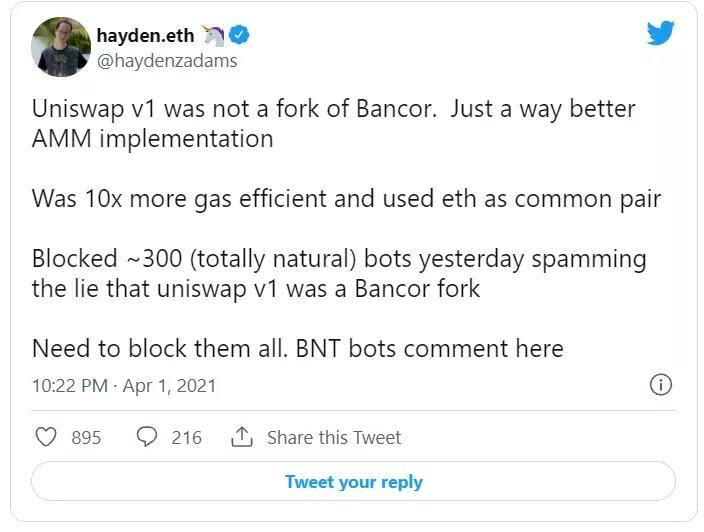 The complexities of how an "Automated Market Maker" (AMM) like Uniswap manages this process are numerous. But simply put:
Uniswap is an automated market-making protocol that maintains price ratios through a constant product formula and is deployed on Ethereum, serving as a fully decentralized trading tool. It is not subject to regulation or access by any central authority, and its code is entirely open-source on GitHub.
Market makers are agents that facilitate market liquidity. In traditional CEXs (Centralized Exchanges), market makers are primarily institutions. AMMs, on the other hand, allow for real-time pricing between two assets based on a simple pricing algorithm, effectively decentralizing the market-making process.
The so-called automated market-making protocol is like a shop with only basic functions. In Uniswap, liquidity providers simultaneously act as both buyers and sellers. Uniswap can provide exchange services for any two ERC20 tokens.
Undeniably, Adams successfully incentivized external parties to provide trading depth. "Liquidity Providers" (LPs) deposit tokens into a pool and earn rewards for doing so. For example, if I add ETH and USDT to the ETH-USDT pool, I can earn "liquidity tokens" proportional to my contribution. (This is not the same as governance tokens, which we will discuss later).
Note: USDT is a token launched by Tether based on the stable value currency US Dollar (USD), with 1 USDT = 1 USD, allowing users to exchange USDT for USD at a 1:1 ratio at any time. Tether strictly adheres to a 1:1 reserve guarantee, meaning that for every USDT token issued, there is $1 in its bank account backing it up.
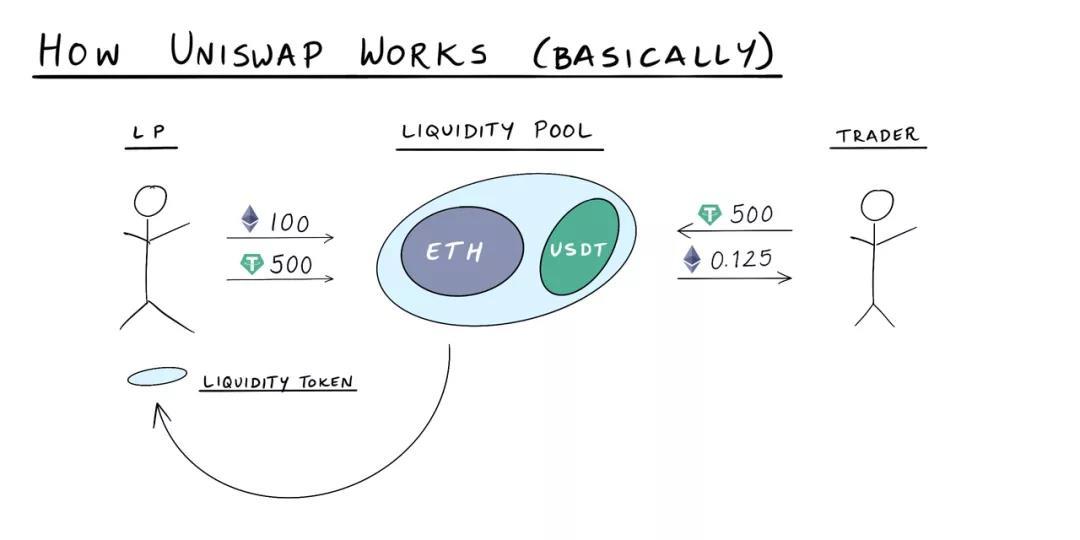 The complexities of how an "Automated Market Maker" (AMM) like Uniswap manages this process are numerous.
Uniswap's novelty and early success did not go unnoticed by capital. Paradigm led a $1.8 million seed round for the project in 2019. By the following summer, Adams announced further capitalization, led by a16z with $11 million. At that time, the project had approximately $130 million in Total Value Locked (TVL), reflecting the amount secured by smart contracts. (Though not a direct analogy, TVL can be understood as "assets under management.")
(Now, Uniswap's cumulative trading volume has exceeded $500 billion, with a market cap of over $10 billion.)
While venture capital interest validated Uniswap's initial growth potential and long-term vision, it also introduced vulnerabilities.
2. The Opportunity for Rebels
Before discussing Uniswap's vulnerabilities, we need to address the unique disruptive patterns in the blockchain world. Specifically, it seems that two core rules govern this industry and provide opportunities for rebels.
The Law of Fluid Power. Crypto operates in opposition to existing power structures, viewing traditional hierarchies as unreasonable. This may relate to some long-established institutions, such as the traditional financial system or newer companies like Coinbase. In both cases, power is perceived to be held by a central entity seeking to reinforce control. Crypto hopes that power is entirely fluid, accumulating based on contributors' value to the community. From this perspective, it is not just about decentralization; it is about distributing power according to relative contributions within a decentralized structure.
The Law of Fluid Wealth. Similarly, the crypto world is skeptical of rent-seeking entities. Organizations that do not provide ongoing value and effort but earn money under the same rules as every other participant are often seen as compromised. The crypto world desires wealth to be fluid, rewarding ongoing value creation. Fundamentally, the crypto world views users as essential contributors to value creation rather than mere consumers of value.
a16z partner Chris Dixon articulated this last point best in a tweet.
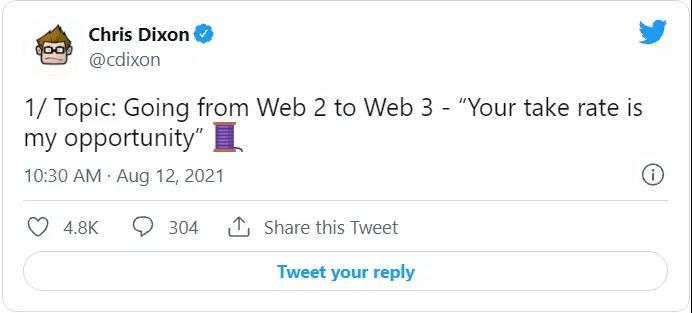 Dixon explained how web3—the term used to describe the crypto-native network—wins by redistributing profits. Decentralizers typically do not retain this fee like centralized entities; instead, they return it to users to acknowledge their value.
Uniswap leveraged the second law during its rise. Coinbase, Binance, and other centralized exchanges not only dominate most of the crypto market but also extract fees. While Uniswap also charges fees, it passes those fees on to LPs (Liquidity Providers), rewarding their contributions.
This was already a significant upgrade, but Uniswap's relative disregard for the law of fluid power created a problem.
By accepting venture capital, Uniswap effectively allowed some power on its platform to be captured by invaders. This may largely be a matter of perception—funds like Paradigm are known for adding actual value to projects. Research director Dan Robinson was an early collaborator with Uniswap.
But for some outsiders, Uniswap suddenly appeared to be allied with institutions. While some anger may have been excessive, the funding decisions did have tangible effects. Those LPs who helped the exchange get off the ground by seeding liquidity across different markets risked having their share of returns diluted by these much larger companies pouring funds into AMMs.
Perhaps Uniswap's governance structure violated the first law even more. While the project did provide LPs with a way to earn money, it did not give them a way to vote. There were no "UNI" tokens providing the community with a mechanism to express opinions and chart a path forward. Power was obscured and held by a few.
This provided a pathway for attack, noted by more than one commentator. On August 23, 2020, Larry Cermak, research director at The Block, tweeted.
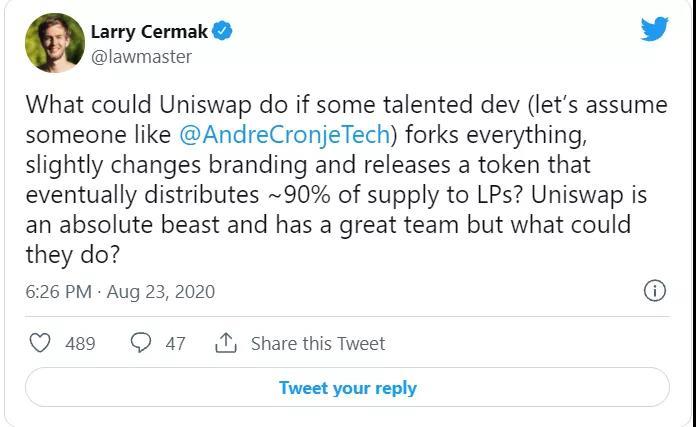 Cermak posed an intriguing question: What would happen if someone leveraged Uniswap's AMM power and added a token? What if the community owned 90% of the project and could decide its future?
Perhaps without realizing it, Cermak had outlined a foreshadowing. A rebel was listening carefully.
3. Sushi's Token Incentives and Liquidity
Little is known about the person who called himself Chef Nomi.
Nomi borrowed his pseudonym from the game "Hearthstone" from Warcraft, appearing on Twitter a day after Cermak's tweet.
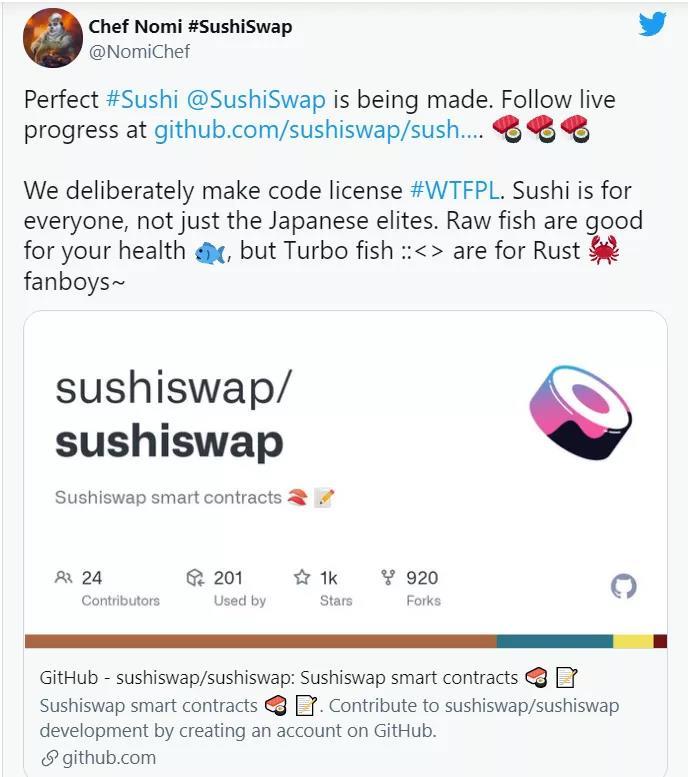 Even this initial iteration showed an appreciation for modern branding. Nomi chose a playful, cute name that successfully stood out, was highly imitative, and scalable. The name Sushi has persisted and provided a basis for naming all subsequent products.
 Although few noticed the first tweet, it wasn't long before Nomi attracted attention. Two days later, on August 26, Nomi officially announced the creation of Sushiswap. In a tweet and Medium post, he outlined how Sushi differed from the project it forked from. This triggered a series of events that unfolded so rapidly that it is worth previewing.
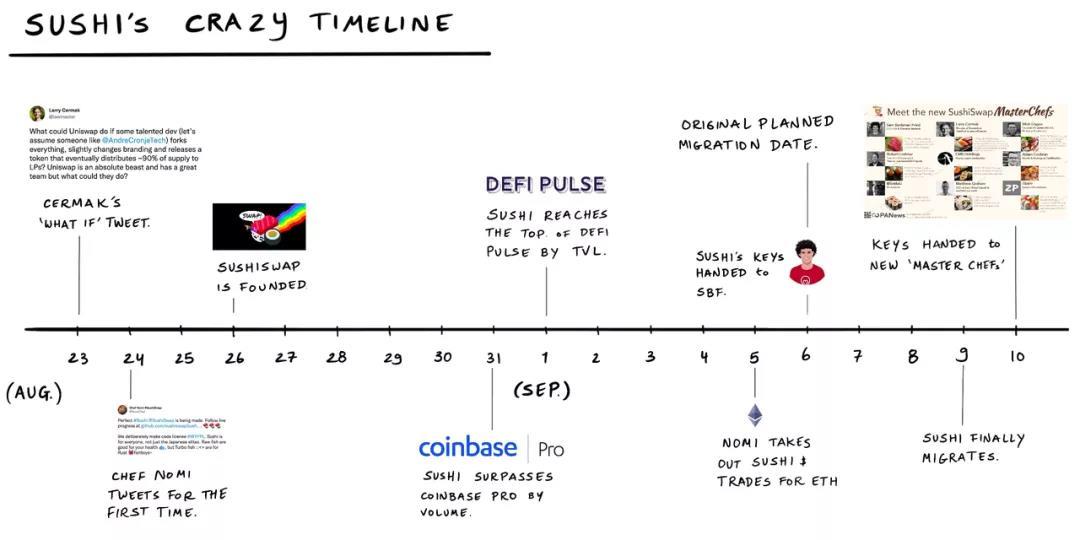 The timeline of Sushi's meteoric rise------
2021.08.23, Cermak's "hypothetical" tweet;
2020.08.24, Chef Nomi's first tweet;
2020.08.26, SushiSwap established;
2020.08.31, Sushi's trading volume surpassed Coinbase Pro (Coinbase's professional version for seasoned traders).
2020.09.01, Sushi's TVL ranked first on DeFi Pulse;
2020.09.05, Nomi withdrew Ethereum from Sushi;
2020.09.06, Sushi's private key was handed over to SBF;
2020.09.09, Sushi finally migrated;
2020.09.10, the private key was handed over to the new chefs. In the initial post, Sushi pointed out that while Uniswap allocated its 0.3% trading fee to LPs, this only applied to active providers. This meant that if you stopped providing ETH and USDT, you would no longer earn rewards.
Sushi deemed this arrangement unfair, as Uniswap did not recognize that it was the LPs who brought the project to life. To remedy this, Sushi only charged a 0.25% fee and passed it on to the LPs, with an additional 0.05% fee going to holders of its token SUSHI. Importantly, SUSHI not only provided early participants with ongoing rewards but also offered governance rights, which Uniswap lacked.
On Uniswap, LPs earn fees proportional to their share of liquidity provided, which feels more like a one-off transaction, lacking the long-term value of the protocol. In contrast, the SUSHI token represents the potential earnings of the entire Sushiswap protocol, allowing for long-term capture of a portion of the protocol's fees.
This token incentive model binds liquidity providers to the long-term benefits of the protocol. LPs serving the protocol can continuously earn more tokens, so if early LPs stop providing services, their held tokens will be diluted by newcomers, balancing the interests of both early and later participants.
To so boldly replicate an existing product requires a combination of "audacity and shamelessness." Token incentives were just the first step for Sushi; another move was to ruthlessly acquire liquidity from Uniswap.
Sushi's method of acquiring liquidity is known as a "vampire attack" or "zombie mining," relying on siphoning liquidity from Uniswap; it is a slow-motion heist. Sushi achieved this by offering rewards to Uniswap's LPs.
It's akin to opening a small gambling table in a large casino, waiting for participants to grow before opening your own casino—LPs who provide liquidity in 12 Sushi pools on Uniswap can earn SUSHI tokens, with rewards for providing liquidity to the ETH-SUSHI market being doubled. Nomi introduced that after 15 days, this liquidity would be transferred from Uniswap's platform to Sushi's own exchange.
Just three days after its launch, Sushi caused Uniswap to lose 53% of its liquidity; two days later, it reached 68%. Cermak tweeted, "If I were Uniswap, I would be very uneasy."
At least in public, Hayden Adams remained unfazed. On September 1, he posted a message, initially passionately denouncing Sushi.
It's hard to tell who is pretending and who is blatantly playing dumb; the TVL has astonishingly deposited $1 billion in high-risk investments within just a few days, mainly from a large number of whales.
Anyone talking about community versus VC here is either delusional or deliberately misleading.
Although many of Sushi's LPs indeed held significant stakes, Adams's criticism did not align with what was happening behind the scenes. Since opening on August 26, Sushi's Discord channel had attracted a steady stream of loyal supporters, many of whom came from the Asian market. One of the joiners was "0xMaki," who transformed himself into the "General Manager" within minutes of joining the chat.
On the same day that Adams expressed skepticism about the "Sushi" project, it rose to the top of the DeFi Pulse rankings. Within less than a week, it had become the project with the largest TVL in the ecosystem.
Nomi's heist seemed to be working, attracting liquidity and igniting a movement that was gathering momentum at an astonishing pace. Sushi was the talk of the crypto world; all that remained was to complete the prelude and migrate liquidity away from Uniswap. Everything was under control. Then it collapsed.
4. The Founder's Flight
We owe thanks to Freud for the concept of "founder murder." In "Totem and Taboo," this Austrian theorist posited that culture is solidified after a symbolic patricidal event, where the father is killed by his sons. This helps alleviate the Oedipus complex and produce offspring.
René Girard supplemented Freud's concept. Girard argued that such killings could occur, but not within the framework of the Oedipus complex. Regardless of the relationships involved, it can happen, stemming from the group's desire to punish a "scapegoat." In an excellent piece on this topic, Alex Danco described this phenomenon.
In short, the idea is that any long-stable group or society may trace its origin story back to a shocking moment of violence. The memory of that violence, on some subconscious level, helps to unite the community. No one wants it to happen again.
The effect of the scapegoat bearing the social sins is to regain unity and camaraderie; death gives birth to life; violence precedes peace; to build Rome, one must first kill Remus.
Note: In Roman mythology, the brothers Romulus and Remus founded the city of Rome. In a dispute over what to name the new city, the brothers quarreled, resulting in Remus being killed, hence the city was named after Romulus.
It would be an exaggeration to say that these ideas visited the designers of Sushi on the evening of September 4. Looking at Discord, Chef Nomi seemed completely immersed in the migration task, hastily answering a few questions.
From the outset, Sushi delineated a "development fund." This sub-entity was allocated 10% of the project's tokens as compensation for the developers' efforts. He believed that those who gave Sushi life and improved it would be rewarded, including Chef Nomi. However, while many of the platform's believers knew about the fund, few seemed to foresee any issues. Nomi himself actively dispelled concerns about fleeing with the funds, stating on Discord that he was a "good guy."
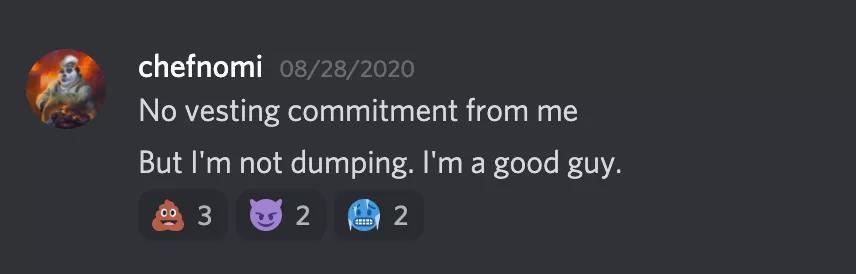 Sushi Discord
The events of September 5 proved the hollowness of those words. On the eve of the planned migration, Nomi withdrew half of the development fund's SUSHI and sold it for 380,000 ETH. About $14 million.
Nomi's actions were quickly branded as an "exit scam," as he vanished with investors' funds. However, Chef did not disappear. Instead, he attempted to defend himself, stating that withdrawing would allow him to focus more.
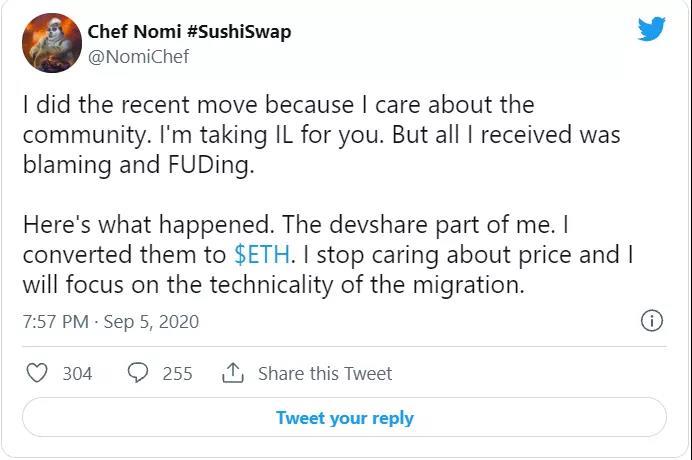 This made no difference. Influential figures in the crypto space condemned the move, with Sam Bankman-Fried (SBF) tweeting, "Chef Nomi is terrible." The community surrounding the project began to protest, feeling betrayed.
Like other things related to Sushi, the consequences unfolded at an astonishing pace. The day after his departure, under community pressure, Chef Nomi handed over the project's private key to SBF. As the CEO of FTX pointed out in the first part of our trilogy, this was a "time-sensitive matter." This was a critical decision. When Sushi was in distress, facing the threat of total collapse, SBF proved with his authority and credibility that it was safe; he would protect the project and advance its development.
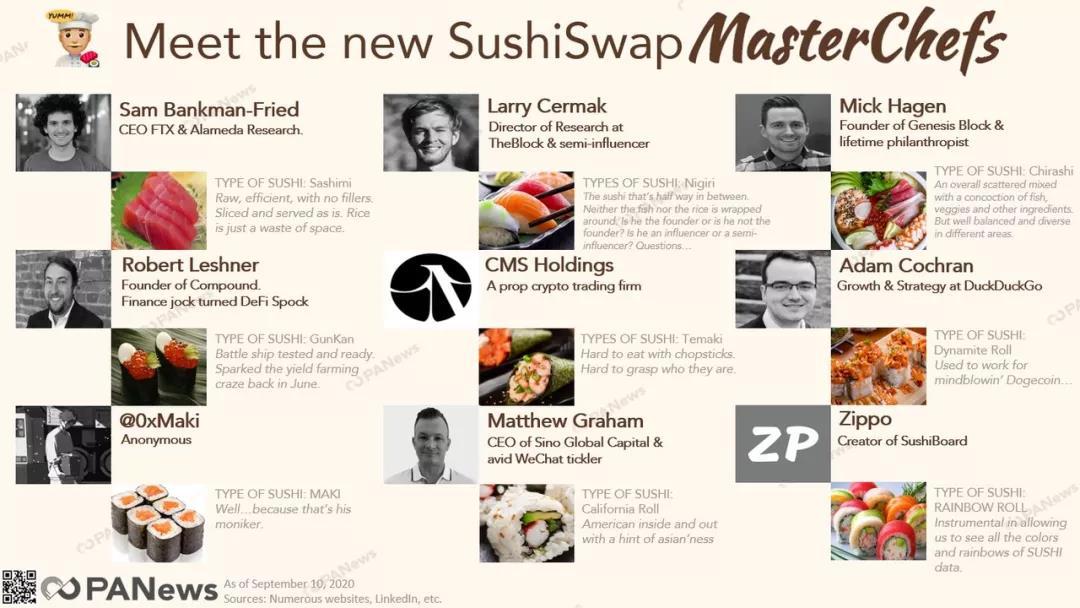
Less than a week later, this management was officially concluded. On September 9, Sushi finally migrated from Uniswap, becoming an independent exchange. The next day, SBF announced that he had handed over the AMM's private key to some new "chefs," responsible for guiding the community's development. This included Cermak, Robert Leshner from Compound, Matthew Graham from Sino Global, and still-anonymous 0xMaki.
 PANews
Then, on September 11, the story took one last astonishing twist. Chef Nomi repented.
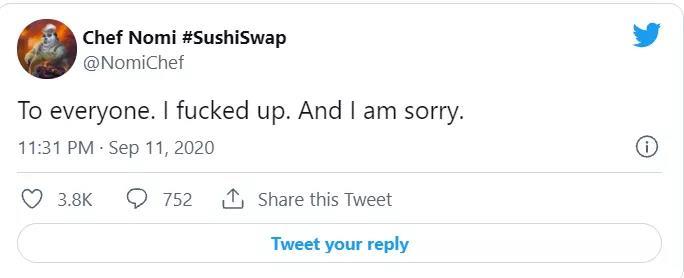 He also offered more than just his repentance, returning all 380,000 ETH to the project.
This move was appreciated by the Sushi community, somewhat restoring respect for its founder. But it didn't matter—Chef Nomi had already been "murdered." Metaphorically speaking, functionally, he no longer existed in the background of Sushi.
On September 12, he sent his last message on Discord.
In mentioning Nomi, one commenter wrote, "He’s gone xD."
Another responded, "He’s still here. He’s been posting in the engineering channel. See #backend-dev."
After a while, that person appeared himself.
"I'm in the backend channel."
That was his last voice.
5. A True Leaderless Organization
A year has passed since Nomi's disappearance. Sushi is still here, which is remarkable; this "destructive founding" power has invigorated a community and a budding culture.
(Of course, it is unlikely that Nomi truly disappeared. Instead, he "lives among us, lurking in our Discord… just in an anonymous and decentralized protocol where no one knows who he is.")
In its first year of operation, Sushi has achieved success in many ways, particularly in the following areas:
A large community. Sushi has about 200,000 users.
Loyal leadership. 0xMaki and Joseph Delong entered the project together.
A wide range of product components. Sushi spans lending, decentralized applications, and more.
Significant potential. Trading volume is growing, recently reaching $12 billion weekly.
Despite such success, Sushi seems to be undervalued. Let’s assess the project's current status. Community
In my conversations with crypto experts—who all requested to remain anonymous or use pseudonyms—the strength of the Sushi community was the most frequently mentioned point. Reports indicate:
Sushi is by far the largest and most interesting DAO. The only possible reason is its founding story.
As mentioned earlier, Sushi reportedly has about 200,000 users, with 10,000 to 20,000 traders using the DEX weekly. Its Discord has 45,000 members, with 15% online during my observation of the community.
This is quite an interesting place. One morning, I spent an hour listening to Lofi music with other members. In other channels, friendly conversations were abundant.
Given Sushi's origins, comparisons with Uniswap, particularly in terms of community, are inevitable. Undoubtedly, Uniswap is larger, with about 2.5 million users, 12.5 times that of Sushi, and the number of traders trading on this DEX daily matches the number of Sushi's weekly traders.
Its Discord also has similar engagement, with about 86,000 members, 11% online during my exploration (the figures I saw when casually logging into Discord should be the roughest approximation; better data is welcome).
If these numbers reveal the differences between the two communities, perhaps it is that 22.5% of Sushi's users can be found in its Discord, while only 3.5% of Uniswap's users linger in the chat rooms. Of course, this is not a perfect analysis, as joining Discord groups does not require proof of token ownership, but it reflects a high level of engagement.
This is also reflected in voting patterns. Looking at the last five proposals considered by the Sushi and Uniswap communities, there is a significant difference in participation rates. Uniswap's five proposals received a total of 1,641 votes, averaging 328 votes per proposal. Despite being only 8% the size of Uniswap, Sushi received 5,283 votes, averaging 1,057 votes per proposal.
A final note on community issues: one crypto expert pointed out that the communities of Uniswap and Sushi differ in geographic composition and tone. Due to its founding team and early community, Uniswap primarily attracts North American users. This lineage creates an exclusivity and elitism. Sushi effectively countered this feeling, positioning itself as a more inclusive global AMM. This seems to have proven particularly appealing to the Asian market.
I don't think the Uniswap team realizes how high they have placed themselves and how low their community engagement is, especially in Asia. They have unwittingly ceded the market to Sushi. Team
Sushi's leadership has contributed significantly to its more open atmosphere. Since Nomi's departure, the project has relied on the efforts of its members, particularly 0xMaki and Joseph Delong.
To some extent, Nomi's departure may have been a loss. Most of what I've heard about him is second-hand. He is described as an outstanding technical talent—far from the poor imitator some believe him to be.
Nomi was not the only high-profile departure in Sushi's first 12 months. An early community member pointed out that the project seemed to have two founders at its inception. They noted a now-deleted user appearing in early conversations.
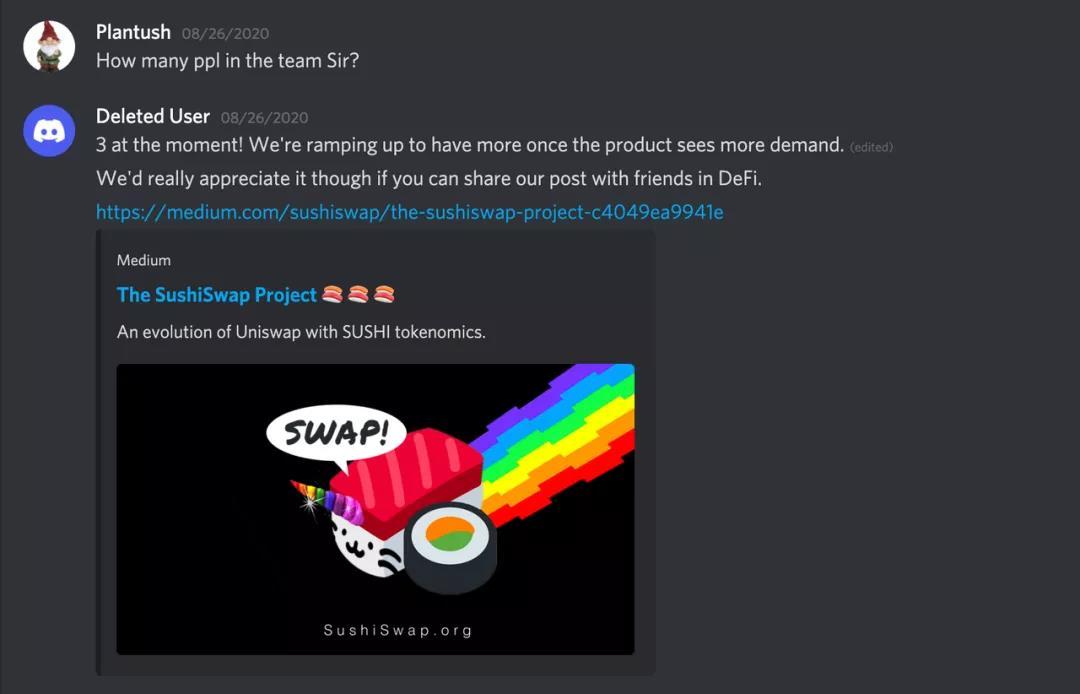 Besides the aforementioned "deleted user," another evangelist "CTRL" also left Sushi in its first year. CTRL initially served as the community manager but left under suspicious circumstances. In Discord, a user described the situation at the time.
If I remember correctly, he tried to blackmail the team, doing almost nothing while taking a high salary.
Perhaps this is why 0xMaki's most valuable contribution may be his genuine commitment to the project. While others may have sought to make a quick buck, Maki's true passion for Sushi makes him a fitting embodiment of the community.
It remains unclear whether this is related to having the same technical talent as Nomi. In an interview with the Unchained podcast, Maki described himself as an inexperienced crypto outsider. A source who has been following the DEX landscape confirmed this view. After hearing Maki's early interviews, they thought he "had no clue."
Of course, this is not a universal view. A different critic believes Maki is a professional BD contributor and a talented recruiter. While the community ultimately signed agreements to bring in new partners, Maki unearthed key participants like Keno and Joseph Delong.
(He also took responsibility for the fat-fingered Discord message "tfars iuyt balitd," which became a rallying cry for Sushi).
Ultimately, the opinions I heard about Maki were quite contradictory; despite digging through community chats and interviews, it was difficult to discern how he integrated into the Sushi project.
Joseph Delong's image is more straightforward. Before joining Sushi full-time, Delong worked as an engineer at the crypto company Consensys and served as a researcher in the blockchain lab of USAA (United Services Automobile Association).
In addition to bringing experience, Delong is also a more vocal leader for Sushi. Maki seems to spend little time on Discord, while Delong is very active, joking about new emojis in one channel and connecting with a new interested engineer in another.
Both Maki and Delong deserve credit for keeping the project running. However, despite their best efforts, Sushi seems to operate in a chaotic state. This is particularly evident when looking at Sushi's products.
Products
In a short time, Sushi has launched a suite of products, including lending ("BentoBox"), liquidity mining, collateralization, and token issuance tools ("Miso"). An NFT platform ("Shoyu") is expected to debut soon, becoming the first decentralized player in the NFT space. This could be a big business.
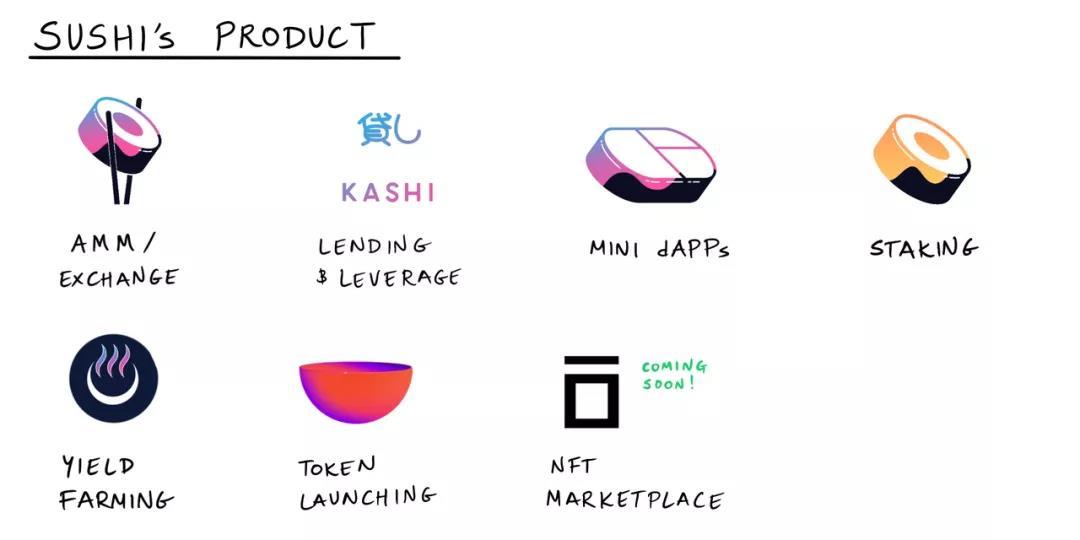 More impressively, many of these initiatives emerged organically without external incentives. BentoBox and Miso were both created by members before being "hired" by the project to contribute more formally. This is what a truly leaderless organization looks like at its best—talented individuals discovering an opportunity and leveraging their skills to bring real value to life.
This also means that Sushi lacks focus. What does Sushi want to become? Comparing Sushi's product range to Uniswap may provide some insights:
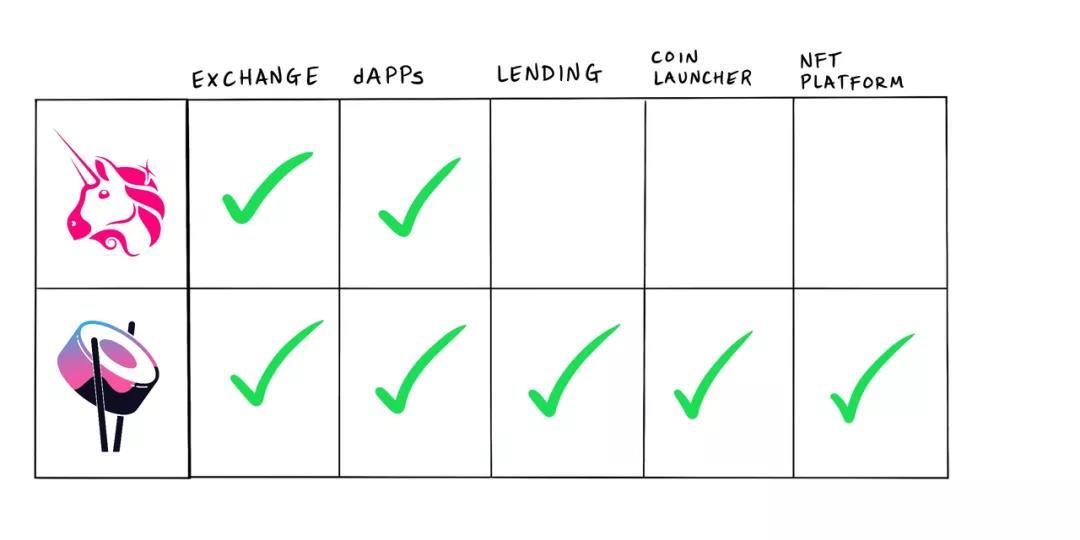 While such matrices are typically used to show how one company lags behind another in functionality, it is hard not to view the issue from different perspectives. Certainly, Uniswap may not have the breadth of Sushi, but it has something arguably more important: direction. Ironically, a project named Sushi feels spiritually closer to a rice ball.
Someone succinctly distinguished the strategies of the two projects—"Sushi innovates in products and community engagement, while Uniswap innovates in protocol."
Time will tell which approach is wiser. Undervalued Potential So far, Sushi's chaotic products do not seem to hinder its growth. From its potential—given the booming crypto space over the past year—the project is thriving.
While the days of threatening Uniswap's dominance are over, Sushi has established itself as the second-largest DEX. At the time of writing, its 14.8% market share lags behind Uniswap's 65.6%, but it has remained relatively stable over the past seven months.
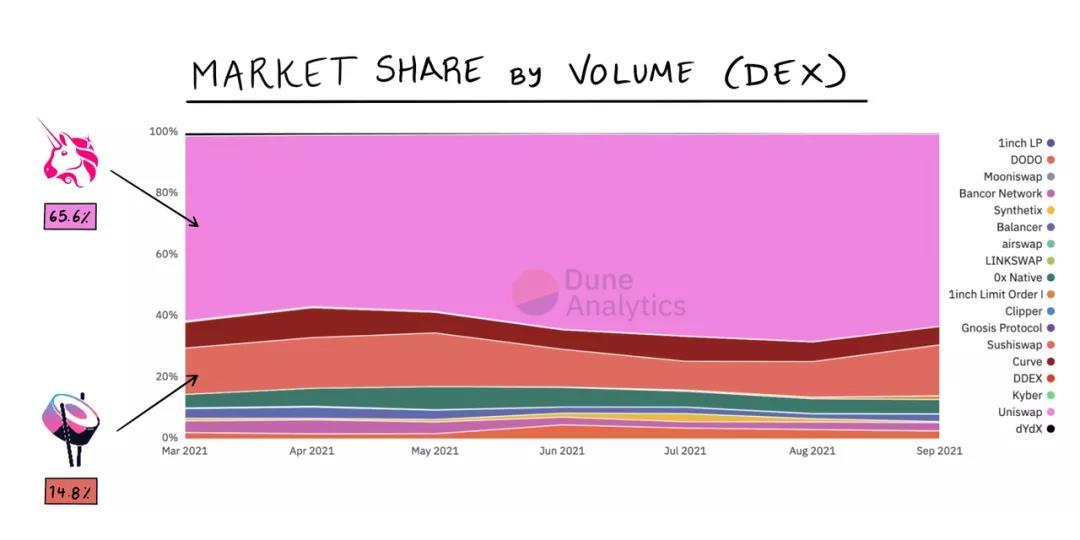 This share adds up to meaningful numbers. Sushi currently has a market cap of $2.8 billion, up from $1.2 billion three months ago. Weekly trading volume hovers around $2 billion, and at the time of writing, it has $4.3 billion in TVL, enough to make Sushi the ninth-largest DeFi project. Uniswap ranks sixth, with $6.4 billion.
What once seemed almost a joke of an initiative has become a serious player.
It can be argued that relative to this potential, Sushi's value is undervalued. Compared to other DEXs, Sushi's market cap appears discounted by multiples of TVL, trading volume, and revenue.
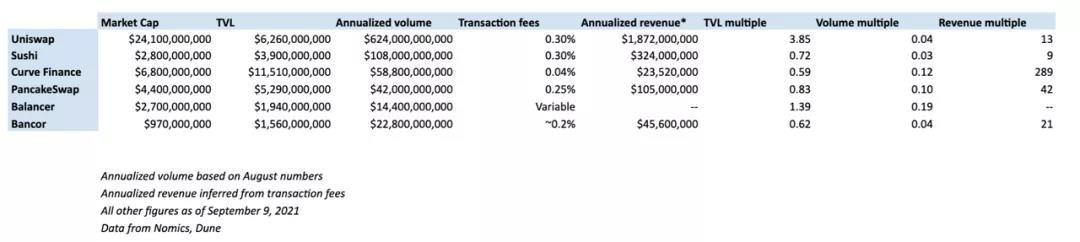 For example, Uniswap's valuation is 13 times its annual revenue, while Sushi is only 9 times. This is a significant gap from the market leader and far from the multiples of Curve, Pancake, and Bancor. (Perfectly comparing the different products of these platforms is tricky, but it illustrates the point).
If Sushi's projected revenue were valued at the same rate as Uniswap, the project's market cap would exceed $4.2 billion. It seems that Sushi indeed has room to run, but the crypto market remains skeptical of it.
If Sushi wants to win over skeptics and become more than just the most compelling case study in the crypto space, it will need to formulate a clearer path forward.
6. Where to Go from Here
In a recent tweet, Kyle Samani, founder of Multicoin Capital, wrote.
I think Sushi is a bit lost, not knowing what it wants to be when it grows up.
After its historic birth last year, Sushi seems to have quickly passed through childhood and entered adolescence (along with the accompanying identity crisis).
What should Sushi become? How can it leverage the most engaged community in the crypto space to realize its potential?
In conversations with experts and during my research, I believe Sushi should consider three key steps:
Prioritize Shoyu
Improve Core Products
Go Beyond the Consumer Perspective
While steps 1 and 2 can occur simultaneously, tackling step 3 may require more information. Prioritize Shoyu
One of Sushi's latest initiatives may prove to be the key to unlocking the second act.

The decentralized NFT marketplace Shoyu, proposed six months ago, is expected to launch a V1 version in November. This represents a significant addition to the platform.
We have reason to believe that while Sushi's product line is already extensive, Shoyu could be beneficial. First, NFTs are experiencing a favorable market moment. In August, market leader OpenSea achieved $3.4 billion in trading volume, a 1000% increase from the previous month. The market situation is quite crazy.
The competitive landscape appears favorable for Sushi. OpenSea is largely the dominant player, while the second-largest exchange, Nifty Gateway, lags significantly, with trading volume in August of less than $30 million. Shoyu could surpass smaller competitors in a relatively short time.
Given that the incumbents (a descriptor that hardly fits in such a dynamic field) are centralized, this may be particularly true. If we believe that the "laws of disruption in the crypto world" extend to the NFT space, Sushi has a clear avenue for attack. OpenSea, Nifty, SuperRare, and other companies simultaneously hold both power and wealth—Shoyu could liberate them.
Finally, NFTs benefit from heightened community enthusiasm, which is unique to Sushi. With an already dedicated tribe, Shoyu could prove to be a natural outlet for the project's creative energy and a significant revenue source.
Though still in its early stages, Shoyu seems to be a worthy bet to prioritize. Improve Core Products While supporting Shoyu, Sushi should upgrade its core products. This is crucial for keeping pace with Uniswap and preparing for the future.
Those I spoke with clearly indicated that as an AMM, Sushi lags behind Uniswap. While Maki and Delong have overseen the platform's expansion, Adams focused on improving infrastructure. As Sushi maintains its multiple business units (and adds more), it must ensure that deficits do not increase. If they do, Sushi's share is likely to flow to Uniswap, jeopardizing its core business.
Upgrading can also help avoid costly liabilities. In mid-August, Sam Sun from Paradigm discovered a vulnerability in Sushi's product components, exposing 109,000 ETH ($381 million) to attack. Sun did not exploit the vulnerability but helped patch it. While his professionalism and altruism are impressive (especially considering Paradigm's investment in Uniswap), it illustrates that Sushi has much foundational work to do.
A final reason for improving the core is that it enables Sushi to serve different investors. Some believe Sushi should focus on building a stronger margin engine, drawing lessons from centralized exchanges like FTX. As part of this, the DEX could leverage other protocols, including Perpetual, which offers "10x leverage for market makers and takers."
This could set the stage for derivatives trading and institutional clients. Go Beyond the Consumer Perspective If there has been a unifying strategy for the product thus far, it has been a focus on serving retail investors. In this mission, Sushi has become a "super app," despite its weaknesses.
Now seems too early to abandon this focus, so prioritizing Shoyu makes sense. If Sushi can have a decentralized NFT, there may be no need to shift attention. But if Shoyu does not gain momentum, Maki and Delong should quickly seek other directions.
Assuming the team has upgraded the core infrastructure, Sushi should be well-positioned to embrace professional investors. This is also what Samani emphasized in the earlier quoted tweet.
I think the Sushi community has not seriously discussed how the world will evolve in the coming years and where/how Sushi should position itself in that world. Ignoring the derivatives market is a mistake. It is simply too large to overlook. Unlike spot trading, derivatives have real locking (you cannot un-mortgage collateral without closing the position)… It is very likely that to do this, Sushi will need to split the front end into two parts: a professional version and a retail version.
Could this be Sushi's next move? Can the platform become the decentralized go-to for serious derivatives traders? As Uniswap successfully captured a large portion of the retail market, it may make sense for Sushi to pursue institutional clients.
While each of these opportunities is compelling, the most important thing is that Sushi must stay true to its character. The wisdom and potential of the community cannot be underestimated.
Wherever they are, I believe Satoshi dreams of Sushi.
In its structure, the Uniswap fork represents the clearest embodiment of decentralization, showcasing the extraordinary power of the crypto world to forge connections and inspire action. While dramatic at the time, the founder murder of Chef Nomi ultimately strengthened those early ties.
As Sushi begins its second year, holders will hope it maintains this spirit while demonstrating greater clarity. If it can balance chaos and clarity, it may prove to be the ace in the DeFi space.
Summary:
A strong community can compensate for shortcomings in other areas. While Sushi may not have the world's strongest exchange, it does possess the most active community in cryptocurrency. This drives its success, despite many vulnerabilities.
The crypto market follows different paths of disruption. To overthrow the entrenched interests of the cryptocurrency world, find ways to liberate power or wealth. Tight control over power can create opportunities for rebels to attack.
Modern brand building must consider mimetic qualities. While it may seem like no idea, Sushi successfully employed "memes," focusing on friendly brand symbols. More consumer-facing companies should consider how their products are expressed in appropriate ways.
The crypto market is a multipolar market. While the crypto market is globally scaled, there are still centers of power. In particular, North America and Asia represent the two poles of the field; companies with broad ambitions must take these two user groups into account.
 Risk warning
 Risk warning

Popular articles





