








Blockchain Games: Misunderstandings and Reality

 Jon Radoff writes this article to clarify the misunderstandings and realities of blockchain games in the industry, and to correctly recognize the innovations and boundaries that blockchain brings to the gaming industry.
Blockchain Games: Myths and Realities
Author: Jon Radoff
Compiled by: Metaverse Task Force
Jon Radoff, CEO of Beamable, a creator platform for developing real-time games, is a veteran in the gaming industry. His blog "Building the Metaverse" is one of the few original platforms in the industry that provides positive insights on the metaverse. Jon Radoff writes this article to clarify the misunderstandings and realities surrounding blockchain games in the industry, and to correctly recognize the innovations and boundaries that blockchain brings to the gaming industry.

We have seen an explosive growth in societal interest in blockchain games ------ while also witnessing a similarly explosive increase in misinformation, confusion, and ridicule.
My goal is to help all game creators, regardless of the business models they envision. If someone is seriously building a game with blockchain, I will certainly support their success.
What I hope to share here is primarily a "behind-the-scenes" perspective for those who may be considering developing blockchain games, as well as for anyone curious about the dangers and opportunities in this field.
Some skepticism and ridicule are to be expected. I hope to be fair in this article and cover some of those aspects. But let's start with some core beliefs that some people seem to hold.
1. Misunderstanding: Games with open economies are "evil"
At its core, blockchain games are simply games with an "open economy." Before digital games existed, you could buy a board game and later resell it. In fact, for most of video game history, you could buy a console, box, or machine and resell it to anyone you wanted ------ just like any other personal property. Games like "Magic: The Gathering" (MtG) and "Pokemon" are specifically designed around the open economy of our real world, where players ultimately trade (yes, speculate) individual game cards.
It is only with the recent emergence of virtual world-based online games that we have begun to see gameplay built around closed economies. For example, most "Massively Multiplayer Online Role-Playing Games" (MMORPGs) do not allow you to trade important items with other players ------ most mobile games do not even allow you to trade currency. This is because the experience (and business model) of these games is entirely based on a finely tuned achievement progression system.
Blockchain is a public, replicable ledger that can enable an open economy around games. It allows games to exchange virtual property through decentralized markets and exchanges by providing transparent, provable, and consensus-based mechanisms, and can even provide an ecosystem for interoperable items among a set of games that choose to cooperate.
These games will be different from most current digital games.
Open economies are ethically and morally neutral. Now, if you want to argue whether capitalism and the right to trade private property in the market is wrong ------ then you can engage in that philosophical battle if you wish. But this is not a debate specifically about game development, nor is it a debate I find interesting in the commercial gaming industry.
But people actually don't like the economy of "Magic: The Gathering"
Now, some people claim that they actually don't like open economies like that of "Magic: The Gathering" ------ they would prefer not to have cards constantly evolving, rendering previous decks obsolete. Or they might say that cards like Black Lotus shouldn't be so scarce. Debating the merits of any game design is perfectly reasonable, although I urge you to consider what it takes for a game to sustain itself over the long term; aside from MtG, many collectible card games have faded away, often because they could not sustain their ecosystems over time. However, the existence of some designs that some people dislike is not a reason to deem an open economy as evil.
While open economies are morally neutral ------ you cannot say the same for some market participants, which brings us to…
2. Reality: Scammers abound
This is really unfortunate, but there are indeed many scammers in this industry. They deceive people out of their money and ruin the honest, hard-working efforts of many.
It is similar to some early crowdfunding games; undoubtedly, if you have been following game development for a while, you can think of a crowdfunding game that got some money and then disappeared. The difference with crypto projects is that they often achieve more anonymity under the temptation of liquidity (i.e., supporters believe they can exit or speculate in addition to supporting the game they are excited about), which exacerbates the problem.
Ultimately, crowdfunding for games has become less popular because many games did not receive successful backing. In some ways, this is something you should expect ------ game development projects fail at an astonishing rate because delivering a game (let alone developing a good one) is so damn hard to do.
Selling NFTs or tokens to support a game is essentially a form of crowdfunding on the blockchain, so it increases the risk of dealing with bad actors who may not have good intentions.
That said, I believe you should not rule out supporting your favorite games through NFT or token sales. But learn what we all learned in the crypto space long ago: do some due diligence and understand whether their experience matches their ambitions. Good game development teams are not afraid to put their reputations on the line.
In fact, it is possible for pseudonymous teams to emerge that are worth supporting ------ typically, they have built a reputation as creators over a long period (and can verify their identity through public posting platforms like Twitter). Their reputation is also very valuable to them.
And if your reason for supporting a project is speculation ------ rather than the fun you might have in the game experience ------ then be aware that this is very risky.
Buyers beware: you are investing in a team and their execution capabilities, and coming together in a creative enterprise. When it is a game, it is likely to fail… so your expectations should include that possibility. But do not let yourself be scammed or exploited, believing that fraud is just a failed project. If this team wants your money to realize their dreams, then let them put their reputation on the line.
3. Misunderstanding: Environmental impact
It is surprising that this claim continues to circulate in gaming, but it means that people do not really understand the difference between the gaming and digital art markets ------ or how blockchain technology has changed in just the past year.
First, there are two main blockchain algorithms: Proof of Work (PoW) and Proof of Stake (PoS). PoW requires solving massive cryptographic puzzles to achieve consensus, and Bitcoin and Ethereum mainnet use this algorithm. It consumes a lot of energy to complete these operations.
Blockchain games are not built on the Bitcoin or Ethereum mainnet. Most games are built on PoS blockchains like Solana, Avalanche, Hedera, Polygon, and Immutable X. PoS does not require more energy consumption than any other cloud-based service, like the backend technology of anything you are reading online right now. Games are built on these chains for practical reasons, including reduced energy consumption and high throughput for microtransactions.
In fact, if you look at the total energy utilization of a popular game: the total energy consumed by your players' GPUs on the front end will ultimately be millions of times greater than the negligible energy consumption of the PoS backend.
If you want to criticize PoW algorithms like Bitcoin, or other non-gaming applications of NFTs (like digital art collectibles, which indeed mostly run on the Ethereum mainnet), then that is fine ------ just be aware that it has nothing to do with the games being built today.
One question to consider is: if this is an aspect that concerns you, and all this news about games using PoS is new to you… is it possible that other aspects of blockchain games have been prematurely dismissed or misrepresented by you?
4. Reality: Early projects often look bad
Let’s be clear: game development is a craft. This means it relies on constant refinement, learning, and iteration.
In the earliest stages of a new market, new business model, or new genre, almost nothing looks perfect.
Even games that are very popular today looked terrible in some of their earliest prototypes.
Now, we have seen a lot of junk. Just like there is a lot of junk in PC and mobile games. There is nothing wrong with junk. Everyone needs to learn. Over time, we will see improvements. The junk that currently exists is not an indictment of blockchain; in fact, I know of several games in development that have AAA quality… of course, these games will take the longest to bring to market.
5. Misunderstanding: "NFTs are just links"
"With NFTs, you don't really own anything; you just own a token in a ledger that points to a JPG file somewhere on some random server." First, "JPG on a random server" applies to digital art collectibles. It is not particularly relevant to what happens in games. This is also a bit unfair to its significance in the art market, but that is a discussion for another article.
Here is the role of blockchain in games: it retains the state of the game economy and transaction history (typically done with JSON fragments, which is a good way to serialize this data).
Individual games will decide how to interpret the data on the blockchain. This includes deciding to block the use of items they do not like. This means, yes, many game companies may be involved in blocking the use of items through bad actors' wallets, among other things.
Do you "own" it? We enter a somewhat philosophical debate here: but if "owning" means you have an agent who can decide whether to trade or dispose of another asset or token with a third party ------ then yes, you "own" it. You own it just like you own a "Magic: The Gathering" card that you choose to sell to someone else, even if you do not own the copyright to the card artwork itself. The physical card it is printed on is not much different from the token on the blockchain.
If you show up with a Black Lotus in a "Magic: The Gathering" tournament, will you be allowed to use it in every round? No, because they will set rules about what you can and cannot use. If you stole a Black Lotus and were caught, would you be banned for life? Very likely (in addition to other legal charges). Games built on the blockchain can do the same things. What blockchain facilitates is games with open economies.
6. Half-truth: If the server an NFT points to goes offline, you lose the NFT
An NFT can point to a URL on a server, and if that server disappears, then the content of the NFT disappears. However, the ownership of the content represented by that NFT remains unchanged.
There are alternative methods that do not rely on centralized servers. For example, blockchain-based storage systems like Arweave provide permanent decentralized storage that does not depend on whether servers remain operational.
The deeper issue with games is that server issues are more complex: after all, this is a game server ------ not simple file storage. And this does introduce more complexity. Since we have not yet seen blockchain games go through their entire lifecycle of becoming popular and then shutting down, we cannot be certain how this will play out in all cases. But there are several possible outcomes, not all of which are negative:
Even if a game disappears, there can be some continuity of game content in the form of skins or trophy cabinets that will live on outside the game (I have more discussion on this topic below, as it is controversial in itself). There have already been some NFT-based showcases and galleries emerging that are designed to do just that ------ interoperable, cooperative game networks can also provide more than just pure skins.
Game servers can be open-sourced, providing a means of continuity by simply continuing to operate within the same economy on the blockchain.
Communities can build their own game clients and/or game servers, allowing the game to continue (assuming the licensing of NFTs does not prevent it, and the owners intend to enforce it even after the game goes offline).
In fact, the latter scenario points to an innovative area: digital collectible-focused game companies that prioritize creating game economies and open-sourcing their games to the community.
7. Reality: Open economy games are different from closed economy games
People often point out how previous games attempted semi-open economies (like the unsuccessful auction house in "Diablo 3") and failed. They often seem to forget that games with open economies like "Magic: The Gathering" exist.
The issue is: games with open economies require different game designs. Most of them will not succeed by installing an open economy (blockchain) onto a closed economy MMORPG. While there are a few exceptions, most MMORPGs that tried to transition from subscription to free-to-play have failed for similar reasons ------ the game design relied too heavily on the business model.
What will these new games look like? We do not fully know yet. Some of the earliest successes seem to draw a lot of experience from collectible card games like "Magic: The Gathering," or from open-world games with land economies (like Second Life). I look forward to people experimenting, and there will be many surprises. Game development is a craft.
8. Misunderstanding: Existing technology can solve this problem better
The common saying is that we have database technology that is faster, more scalable, and more performant than blockchain. While this is absolutely true, it is not the problem that blockchain is solving.
What it solves is the ability to provide a means for people and applications to exchange value with each other without needing a centralized gatekeeper.
Before blockchain, the main solutions for creating open economies required a centralized service to provide APIs for all participants to use. Even if you believe these services will run reliably forever, you end up with a pivotally centralized model where everyone builds on the same economy. This exists in Second Life and their Tilia payment platform, and to a limited extent on Steam today.
"But didn't various scripture systems, like the one created by George Pullman, do this in the past and blow everyone up?"
No, that was a centralized value exchange system, not a decentralized one. It relied on the credibility and control of a central authority. In fact, this is one of the main reasons many people prefer decentralization.
Centralized systems are structurally hub-and-spoke. This means every game is built around a single service hook, where you constantly send and receive all transactions through them. These networks are inherently more restrictive.
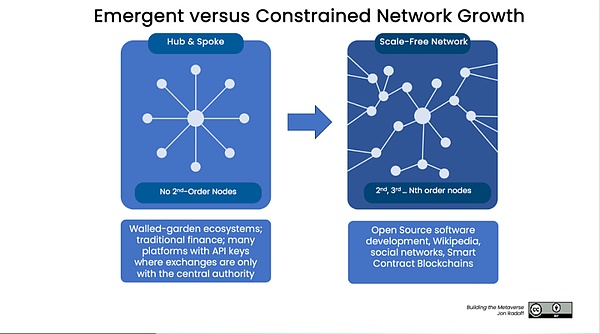
In terms of gaming, blockchain allows creators to leverage decentralized markets, exchanges, and other application code that they do not need to develop themselves ------ and without needing to ask publishers for permission to participate. Whenever you need to rely on some centralized service (like publishing and selling your game or its in-game items), you give them the ability to extract high rents for their services. You are also subject to their whims about what is right and what is not allowed. The goal of blockchain is to enable permissionless development, allowing small teams to have big dreams ------ relying on a growing ecosystem they do not need to build themselves.
In fact, there are entirely new ways that games will be able to expand their ecosystems by modifying or even open-sourcing their client software. We already know that people love to modify user interfaces, levels, or add features. (If you don’t know, take a look at "Minecraft" and Terraria and the other dozen or so games you can find on CurseForge). Blockchain will extend modifications to include modifications that interact with the economy (custom auction houses, charts, etc.), and even outsource gameplay to the community itself (as LootProject is attempting).
Gatekeeping results in cumbersome rent-seeking that stifles innovation and creativity.
Blockchain is not as performant as centralized databases because they need to reach consensus with all validators. And that is where the power of blockchain lies. Fortunately, some newer PoS blockchains have high performance, so this inherent inefficiency of consensus does not hinder making a good game.
"But doesn't a decentralized economy mean a wild west where anything goes?"
No, each game can still choose how it wants to interpret digital assets from the blockchain; it can verify authenticity by checking the provenance of items and ensuring they come from certain wallets. Items that are fraudulent can be frozen. Items can be instantiated with their own game properties and modified to fit evolving game systems (just like the rules affecting Black Lotus in "Magic: The Gathering" change over time).
In a more open ecosystem, interoperability between game worlds means nothing can force one world to display or use an item in a way that conflicts with the intentions of a new world.
9. Half-truth: New platforms are just re-centralizing NFTs
This is a reasonable concern. This criticism is often directed at OpenSea: essentially "new wine in old bottles" ------ they are creating a new centralized ecosystem that people rely on to buy/sell their digital assets. And they are also starting to introduce rules that allow them to control the sales process and even freeze assets.
If we take eBay as an example, online auction platforms have indeed become (mostly) winner-takes-all markets.
Platforms like OpenSea attract a lot of attention. Their value lies not only in the utility they provide but also in the audience scale they leverage. Since sellers aim to get the highest bids, it naturally tends to favor the largest platforms. In this sense, it is not much different from Web2.
It should also be noted that curators and critics will continue to play a role. Essentially, OpenSea is currently the largest curator. But there are also curators like SuperRare that focus on specific types of content, and we may see the same situation happen in gaming.
However, the fundamental structure of NFTs is such that the friction of transferring assets from one sales platform to another is much lower. We have already seen new platforms like LooksRare quickly replace platforms like OpenSea. I believe we will also see the emergence of fully on-chain auction systems that could aggregate auctions across the entire ecosystem ------ achieving the highest auction bids without requiring everyone to enter the same auction house.
It is still too early to declare any comprehensive victory in the market ecosystem. I suspect it will be more vibrant and competitive than early successes suggest, but only time will tell how it unfolds.
10. Half-truth: Gamers don’t like NFTs
They will certainly push back against NFTs.
This is the typical innovator's dilemma: adding a new business model on top of an existing business carries a high risk of alienating existing customers. This is the problem Ubisoft recently encountered, as well as the one "Star Wars Battlefront" faced when trying to add free-to-play elements on top of a premium game.
Part of the issue is brand perception ------ unfortunately, due to misunderstandings related to the environmental impact of gaming, and the existence of bad actors (criminals) in reality exploiting the technology, NFTs have gained a negative reputation.
While there is a vocal group of players who do not want to see NFTs added to their games, there also seems to be many players who are open to the idea.
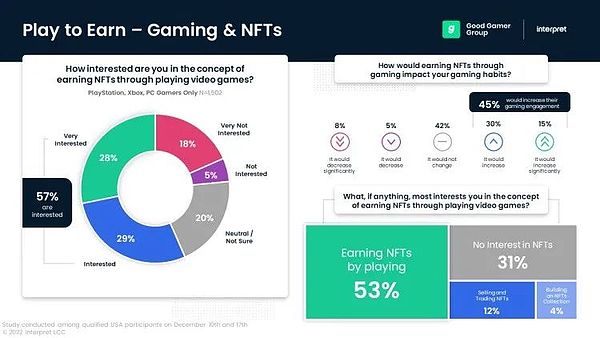
Now, there are some criticisms of the above research: the selection criteria for the survey skewed towards a large number of "interested" players. This is because the selection criteria required people to either own or have owned NFTs or to have heard of them. We can assume that there are still a large number of people who do not know what NFTs are (or are uncertain enough to say they do not know). Therefore, perhaps the proportion of people interested in the idea among the gaming population is much less than 53%. However, this does not exclude evidence supporting that a significant portion of players can accept it. Even if it is only 1%, people can build a whole industry around it.
What I hope we see is ------ just as games using NFTs will be a new type of game design ------ they will also attract an audience different from the typical AAA game players (just as past free mobile games opened up entirely new market segments).
11. Misunderstanding: All NFTs will be interoperable
The core idea here is that we will have the ability to purchase NFTs representing items in one game that have some utility in another game.
Sometimes the confusion arises when people claim this means all NFTs will provide interoperability.
Some will, some won't. In cases where they do, they may be limited to certain game worlds and avatar systems. Some of these will be single worlds, some will be galaxies of cooperative worlds, and sometimes it will be a large network united by a common avatar system.
Interoperability indeed has many challenges. When we talk about interoperability, there are actually several issues.
Behavior: Things may work differently in different worlds
Meaning: Things may even mean the same thing in different worlds
Presentation: Things need to look different between different worlds
Persistence: Maintaining economic accounting across worlds
Connectivity: Communication and networking between worlds
Blockchain actually only solves the "persistence" issue. It is quite good at envisioning multi-party interactions without needing centralized rent-seeking entities (cooperative worlds, interoperable markets, galleries, economic applications, etc.).
Other layers either require people to cooperate (to agree on how things are presented, their meanings, or behaviors), or there may be default/undefined behaviors, meanings, and presentations.
12. Misunderstanding: Players don’t care about interoperability
Sometimes, this is pointed out more as a commercial criticism: that interoperability with NFTs is a solution in search of a problem. Players won’t care. Or that it will be a poorly implemented feature that people won’t like.
We have already achieved interoperability in walled garden ecosystems. For example, "Second Life" ------ despite exaggerated reports of its demise ------ still has a thriving economy where creators build content for each other and move it from one place to another. This is happening on a large scale in "Minecraft," and it is also happening in Roblox (which had over 250 million monthly active users by the end of 2021), and it is now happening in VRChat. For a long time, we have achieved interoperability at the modification level in games like "World of Warcraft," "Fantasy Westward Journey," and many other examples.
So we already know that players are interested in interoperability within walled gardens.
Will we see interoperability happen between wildly different worlds with different aesthetics, or between worlds with different game rules? Perhaps not, but that simply overlooks the interest in taking your avatar from one world to another, as has already happened in more social environments ------ as well as between cooperative game worlds.
Everything blockchain does is to enable an open economy. I can think of no reason why, if people want interoperability in a closed economy, they would not want interoperability in an open economy.
Unknown: NFTs have a life beyond gaming
Sometimes, blockchain advocates say that the value of NFTs will extend beyond the lifespan of the game.
Typically, this lifespan manifests on two levels:
Resale value to another player while the game is thriving
Retention value (i.e., "collectible" value) once the game is no longer operational.
We know that players already have a desire to resell game assets ------ whether allowed (like in open market games such as "Magic: The Gathering") or illicit (using third-party markets for "World of Warcraft"). Whether games like Axie Infinity can keep this flywheel spinning will depend on whether they maintain a sufficiently high level of long-term enjoyment to continue attracting players. There may be space for games like this, just as there is space for some timeless collectible card games (as digital products, you would think the space would be larger due to higher availability, accessibility, and variety).
Once a game no longer exists, the practical value of items will disappear, leaving only the affinity value.

This means that once an item is no longer used as a playable item, you will see its value decline… but that does not mean it loses all its value.
For my part, in some games I have played in the past, I wish I could retain some digital collectibles from the game experience. I do not know if there are enough people who care about this.
I do not know what the long-term value of these collectibles will be. No one knows. But I do know that collecting things is not new, and many people want to do so.
There may be some cases of interoperability where games collaborate and have more utility than simple collectible value. Again, this is also an unknown ------ time will tell how important this is to the ecosystem.
 Risk warning
 Risk warning


Popular articles





