








Messari Interpretation of Threshold: Advantages and Roadmap After the Merger of Keep Network and NuCypher

 The total amount of BTC on Ethereum is less than 2% of the total circulating supply of BTC. This raises a question: do BTC holders distrust centralized systems, or do they simply not want to have any relationship with other cryptocurrencies?
Original Author: Ryan Swanson, Messari
Original Title: 《Crossing the Threshold of Decentralized M\&A》
Compiled by: Hu Tao, Chain Catcher
As the first product of decentralized application mergers, Threshold (Keep Network / NuCypher) aims to create a de facto crypto network for blockchain and cryptocurrency, bringing BTC into the Ethereum network with a highly scalable decentralized solution (tBTC v2). Thanks in part to Keep's previous tBTC iterations and NuCypher's expanded node network, Threshold aims to provide the first fully decentralized Bitcoin-to-Ethereum asset bridge, a space controlled by centralized custodians like BitGo with the help of some notable partners.
Background
Keep Network
Keep Network was founded in 2017 by Matt Luongo and Corbin Pon as a privacy layer for public blockchains. KEEP utilizes off-chain data containers that can interact with smart contracts. These off-chain data containers, known as "Keeps," are managed by a distributed network of Keep operators called "Signers," who are randomly assigned portions of user data to further protect information from unnecessary access.
By segmenting and encrypting data across multiple signers, accessing complete information would require collusion among multiple parties, which seems to run counter to their own interests. The system relies on Keep Network's primary application, secure multi-party computation (sMPC), which ensures that no single signer can decode the information stored on the network.
NuCypher
NuCypher was founded in 2015 by Michael Egorov and MacLane Wilkison with the goal of providing data protection and encryption while still allowing users to securely move information and computations to the cloud. The core technology of NuCypher is called Proxy Re-Encryption (PRE), which allows for end-to-end data encryption where a proxy entity transforms encrypted data from one key to another ("re-encrypting") without decrypting the source data. PRE ensures that data owners can grant and revoke access to private data.
In 2017, NuCypher evolved into a blockchain-based operator, integrating smart contract technology, threshold cryptography, and a token-based decentralized infrastructure model to establish PRE as a decentralized protocol. Today, NuCypher's PRE technology focuses on providing encrypted access control for distributed applications and protocols rather than traditional data-sensitive industries like healthcare and traditional finance.
Mergers
M&A Landscape:
In traditional finance, mergers and acquisitions constitute the competitiveness of some of the largest banks and financial institutions and have become a catalyst for lucrative bonus plans pursued by Wall Street investment bankers. According to Reuters, 2021 was a record year for M&A, with a cumulative transaction value of over $5.8 trillion from 62,193 deals, a 64% increase from 2020, surpassing the previous record of $4.55 trillion set in 2007.
The profitability of M&A deals, combined with the increasing number of blockchain-based projects today, is expected to play a significant role in crypto, as winners gain market share and find resources more effectively together than against competitors. However, what does the M&A landscape look like in the crypto space under a non-traditional ownership model driven by the community rather than a board?
Like most cryptocurrencies, the definition of M&A varies by announcement and often looks different from Google's acquisition of a private startup for technology or the merger of Sprint and T-Mobile, which seeks to gain market share from AT&T and Verizon.
Crypto M&A can take many different forms, and in 2021, the sector took its first steps into the world of mergers and acquisitions. Alameda Research's acquisition of the RenVM tech team was essentially a team-wide hiring spree, bringing the Ren team into the Alameda team with a focus on the team's concern for interoperability within the Solana ecosystem. Yearn.finance announced several "mergers," which are better described as platform integrations rather than direct mergers or mutual acquisitions. In terms of acquisitions, Polygon has been actively acquiring, with purchases of Hermez Network and Mir for $250 million and $400 million, respectively.
When it comes to true decentralized mergers, the scope becomes narrower. Recently, Fei Protocol and Rari Capital agreed to integrate their platforms in an effort to capture the liquidity supply space. Rari's RGT token will be exchanged for TRIBE at a ratio of 10:267, with Fei Protocol taking on all responsibilities related to Rari's $10 million theft incident in May 2021.
From a governance perspective, TRIBE and RGT holders seem to be largely aligned, as the proposal received 90% approval from the Fei Protocol community and 93% from Rari members. Now, as the Rari and Fei communities advance their merger from a product and governance perspective, let’s delve into one of the earliest mergers in this space, composed of NuCypher and KEEP—entering Threshold.

Threshold:
Initially announced in March 2021 under the codename KEANU (Ke ep A nd Nu Cypher), the merger of these two crypto platforms marked the first merger of two decentralized protocols. The Threshold merger occurred at the code level of their respective protocols, referred to as a "hard merge," where Keep and NuCypher ceased to exist as independent protocols, and the subsequent protocol, Threshold, continued to provide all the services previously offered by Keep/NuCypher, with the intention of expanding its services to become a platform for any form of threshold cryptography.
Combining code is one thing, but merging two stakeholder groups is entirely another. While the initial merger proposal was released in March 2021, it wasn't until June 11 that the Keep and NuCypher communities voted in favor of the RC0 token proposal (78% KEEP / 100% NU). Although the approved protocol was neatly named RC0, the proposal actually went through six different iterations, with members from both communities discussing various aspects such as the name, the exchange rates of the predecessor tokens, and governance structure back and forth.
Ultimately, the two communities reached an agreement on the T6 token proposal, with both sides receiving an equal share of the new Threshold network and establishing an independent Threshold DAO treasury. The biggest challenges to completing the T6 token proposal were (1) leaving no tokens behind, (2) minimizing the risk of "zombie" KEEP/NU tokens, and (3) establishing a robust risk management system for the subsequent DAO.
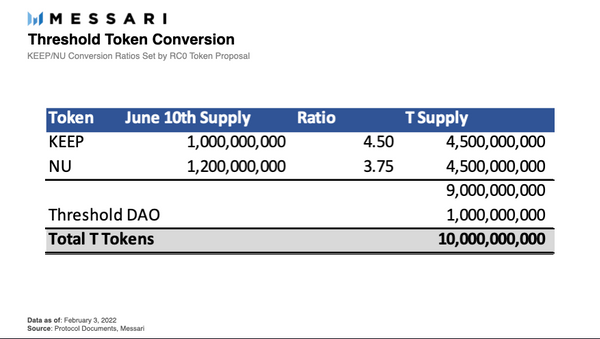
As part of RC0, the exchange rates for KEEP and NU tokens were set at 1:4.78 and 1:3.26, respectively. The rates were based on the total supply of each token after both protocols ceased inflation, resulting in each protocol representing 45% of the Threshold network. The initial supply of T was set at 10 billion, with 10% reserved for the Threshold DAO. Now, with the conversion rates and token names finalized, the real work can begin—determining DAO governance.
Governance:
Inspired by the success of Compound Finance, the Threshold team decided to establish a three-pronged system, which includes a bicameral DAO representing token holders (Token Holder DAO) and network stakers (Staker DAO), along with an elected multisig committee.
Most governance control is given to the Staker DAO; however, each branch operates within a range of checks and balances. Both the Token Holder DAO and Staker DAO have the ability to propose on-chain votes, delegate votes, and execute proposals. The Token Holder DAO consists of T token holders, stakers, and those who deposit their tokens into the coverage pool (a component of tBTC).
On the other hand, the Staker DAO is composed of stakers whose voting power is determined by their relative share in staking T tokens. As mentioned earlier, most protocol governance is handled by the Staker DAO, which makes sense as this team focuses on supporting the protocol network and its various services. Conversely, the Token Holder DAO is responsible for organizing more "capital market" demands.
Finally, the Multisig council consists of 9 elected representatives, with 4 seats elected by NU token holders and 4 seats elected by KEEP token holders. The remaining seats are determined by a vote from the merged community. Each member will serve a one-year term and actively contribute to the development of Threshold. Council members currently have no term limits but can be removed through symbolic voting. The council's governance powers are concentrated on proposals with protocol-wide implications, including staking reward management and veto power, which will serve as a fail-safe against any harmful proposals that pass.
Benefits of the Merger:
Threshold combines the strengths of Keep and NuCypher while avoiding their two biggest obstacles. For Keep, the merger increased the scale of the off-chain data storage network by raising the number of network nodes from about 200 to over 2,000. The increase in validators created a more decentralized set of signers, thereby reducing the risk of collusion.
On the other hand, NuCypher's PRE inherits existing Keep-built applications that require scalable security. Keep's primary use case is the Bitcoin-to-Ethereum asset bridge (tBTC), which utilizes their off-chain storage network to keep Bitcoin in a decentralized cryptographic state, while the synthetic tBTC can be deployed on the Ethereum network.
As part of the merger roadmap, Threshold plans to upgrade to tBTC v2, which will bring all the original benefits of tBTC at a lower cost and higher security on a scalable network.
Demand for tBTC and Ethereum from Bitcoin:
Bitcoin is the original distributed ledger and the explosion of cryptocurrency as we know it today. The issue with Bitcoin (positive for some) is that it is not particularly "smart" for the next generation of currency, but it is extremely secure. While the reception of PoW varies, depending on whom you ask, the amount of "work" and cost involved in Bitcoin's consensus mechanism creates an extremely secure digital currency with minimal risk of corruption.
Bitcoin mining is a publicly traded industry worth billions of dollars, with BTC itself accounting for about 40% of the entire crypto market. While BTC is many people's first investment in cryptocurrency, most eventually delve deeper into the rabbit hole and transition to DeFi, NFTs, P2E, and all the other smart contracts that make up Web 3.0. Security is traded for innovation, but despite the fact that the crypto ecosystem has built decentralized bridges and sidechains for every layer, there is still no real decentralized connection between Bitcoin and the rest of the crypto world.
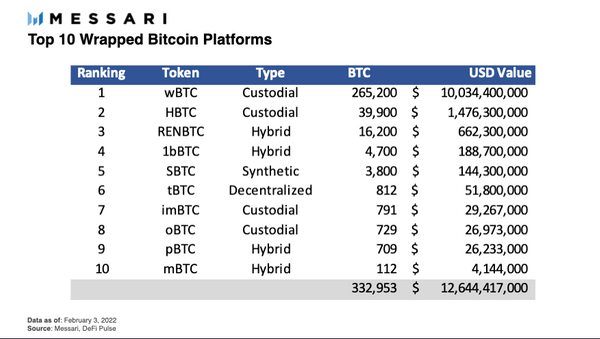
ERC-20 Bitcoin does exist, with Wrapped BTC being one of the more popular implementations in DeFi, but wBTC and 9 of the other top 10 solutions are either decentralized or operate through hybrid models, which are essentially decentralized with a termination switch.
The table below highlights the degree of centralization of Bitcoin on Ethereum, with wBTC being nearly 4 times the total of the next nine platforms combined. The total amount of BTC held by the top ten solutions is less than 2% of the circulating total of BTC. This raises the question: do BTC holders distrust centralized systems, or do they simply not want to have anything to do with other cryptocurrencies? Threshold bets on the former.
The merger of Keep and NuCypher makes tBTC v2 a viable competitor in the Bitcoin-to-Ethereum solution space, providing a low-cost, permissionless, and decentralized alternative to wBTC and other top ERC-20 implementations. The question remains whether there is a demand for a more decentralized BTC-to-Ethereum asset bridge.
Conclusion/Roadmap:
Looking ahead, the Threshold team remains focused on launching tBTC v2 and capturing a larger share of the bridging cake between Bitcoin and Ethereum assets, with a current goal of reaching $7 billion in TVL by the end of 2022. While DeFi is built on the concept of active assets, most Bitcoin holders seem satisfied with their current positions. Institutional investors increasingly interested in crypto often start with Bitcoin, so perhaps this new group of investors is more inclined to deploy their Bitcoin on Ethereum or other blockchains, but would they want to use a decentralized medium?
Threshold believes that demand is urgent in the next crypto cycle, and the team envisions its bridging architecture as the preferred method for bringing BTC into Ethereum. Additionally, the Threshold DAO is developing a stablecoin (thUSD) to complement tBTC with risk-averse assets compatible with tBTC collateral.
The team believes that thUSD could ultimately support decentralized lending against physical assets, such as mortgages or auto loans. Overall, the two communities seem to have smoothly come together and are now focused on ensuring that all the work of the decentralized merger truly pays off. While many in the crypto space may not have directly used these two platforms in the past, this situation may change as Threshold looks to carve out a place in the new year.
 Risk warning
 Risk warning

Popular articles





