








Understanding Ecological Grants in One Article: The "Angel Investment" of Web3

 A total of $12 billion has been disbursed for various ecological grants.
This article is from Decentralised
Original author: Joel John
Compiled by: Katie, Odaily Planet Daily Katie
Today, we will delve into how entrepreneurs can leverage Web3 "ecosystem Grants" (funding incentives for ecosystem projects) to build an MVP (Minimum Viable Product) before talking to venture capital funds. Using data from multiple Grant projects, I analyzed how Grant projects are designed and how founders derive value from them.
I have been pondering how technology evolves from a niche user base to a broader user base. The focus is particularly on how Grant-based capital facilitates the growth of applications in Web3. Next, we will look at the importance of Grant capital, how to utilize it, and how to leverage it to create cool products.
For the past 30 years, government-funded research has driven the development of the internet. The internet was initially a defense research project. The government created an environment that attracted enough researchers to participate in building the internet.
In the 1980s, Tim Berners-Lee wrote the first proposal that ultimately became the "World Wide Web" for a government-funded organization (CERN). Giants like Google and Facebook also emerged from prestigious academic backgrounds. It is clear that many things that eventually evolved into the internet were products of capital deployed without explicit Grants, which were used to create quick profits.
The Wheel of Web3 Adoption Rolls Forward
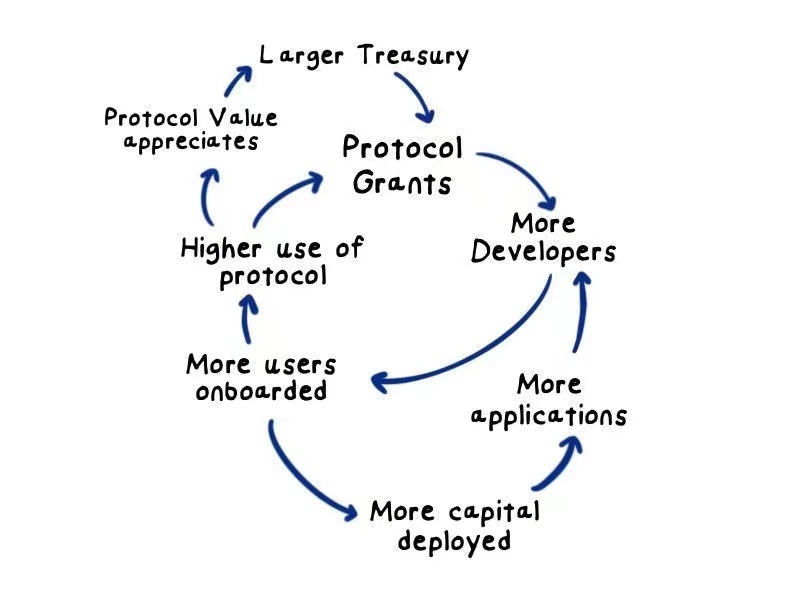
Web3 has not yet directly benefited from government investment on a large scale; rather, protocols that issue Grant funding are injecting capital into Web3. If you view these networks or protocols as the future of nation-states, it is significant. The premise of protocols providing Grant funding is very simple.
The more applications deployed on-chain, the more users there are, and thus the higher the utilization rate of the underlying protocol itself. Users can log into an application on-chain, but once they connect their assets, they can penetrate different Dapps within that ecosystem. What’s the connection here? It can be related to Joel Mongro's description of the Fat Protocol theory from six years ago:
"The market value of a protocol always grows faster than the total value of the applications built on it, as the success of the application layer drives further speculative trading at the protocol layer."
Therefore, if you can get more developers to build applications on top of the protocol, it will ultimately drive the value of the underlying protocol to rise proportionally. This script has been repeatedly played out in past ecosystems.
Consensys actively helps developers find ways to build on Ethereum, which has benefited Ethereum immensely. Solana, Polygon, Harmony, and FTM have had similar experiences. The metrics of developer participation are very accurate predictors of price appreciation, to the extent that some investors actually track the number of developers building in the ecosystem and base their investments on that.
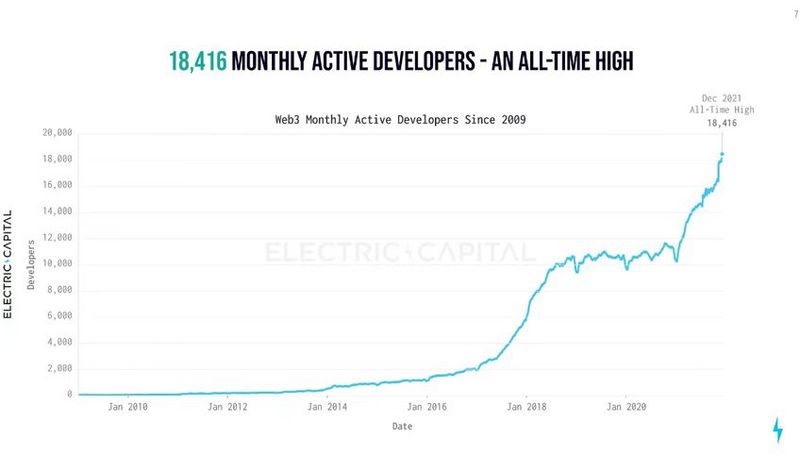
Source: Electric Capital Developer Report
There are only about 18,000 monthly active developers in the Web3 ecosystem, with approximately 340,000 developers entering the system in 2021, the highest level on record. But we are only scratching the surface. If Web3 is to gain global adoption, it needs more developers.
The reasons developers do not join Web3 vary. The Sustainable Ecosystem Expansion Core Team of MakerDAO recently released a report summarizing three reasons:
Shared values ------ Like-minded individuals will ultimately converge, and recognition of technology and values will eliminate many people.
Technical depth ------ A lot of skepticism surrounding NFTs and trading will hinder technological innovation in Web3 as an ecosystem. These discussions involve a lot of "naming names," as those discussing these matters have clear economic motives and interests.
Reputation risk ------ Developers find that fully transitioning to Web3 is risky due to the prevalence of scams, hacks, and Ponzi schemes in the space. This leads to talent that solves Web3 issues in traditional markets being unable to fully transition into the industry.
Many Web3 companies I supported early on intentionally sought funding from venture capital firms like Accel and Sequoia during their growth phase, so they could convince talent from traditional markets that they were legitimate businesses.
In fact, protocols like Polygon have crossed the chasm into the realm of public recognition. Abroad, I have friends who list their jobs at Polygon on dating apps like Bumble or Tinder. Indeed, the number of "right swipes" increased.
Large foundations focus on legitimacy and hire compliance experts internally to help startups in their portfolios recruit talent from traditional roles. The signaling value of traditional venture funds begins to take effect as companies scale and scramble to hire talent in a short time. One way to avoid this is to enable talent in the system to build without worrying about funding.
Grant funding programs can operate in two ways:
They incentivize talent who wish to enter the field with capital. This money is, in a sense, a reward for developers, creators, and marketers collaborating with Web3 projects.
For those looking to build Web3 projects, they lower the cost of experimentation. In the past, if you wanted to transition to starting a company, you had to convince a group of seed investors of your capabilities.
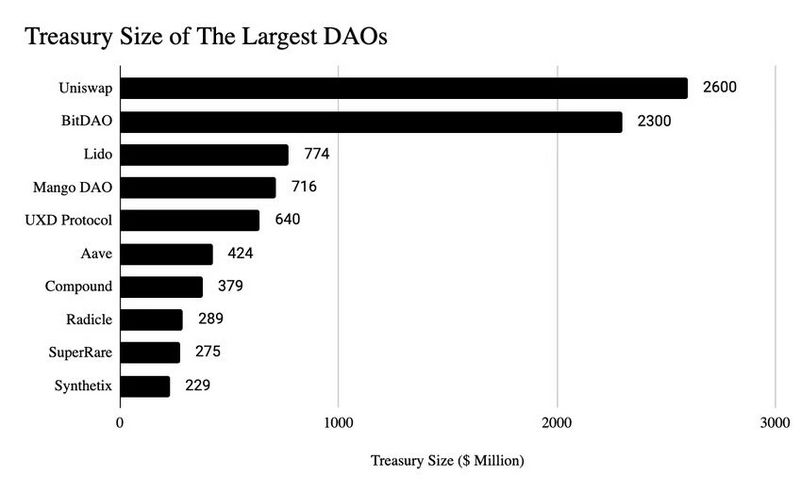
Source: DeepDAO.io
Why do protocols do this? In most cases, the protocols themselves do not have explicit profit mandates. Unlike venture funds, ecosystem funds typically do not have external capital. Funding usually comes from protocol revenues or a portion of the protocol's native tokens, which are retained as grants for new talent.
The chart from DeepDAO above shows the top ten DAO treasuries they track. We are curious about where most of the capital is deployed and how it varies across different ecosystems. The Questbook team compiled this data and shared it with us. Here are my analytical results.
Grants in Different Stages of the Ecosystem
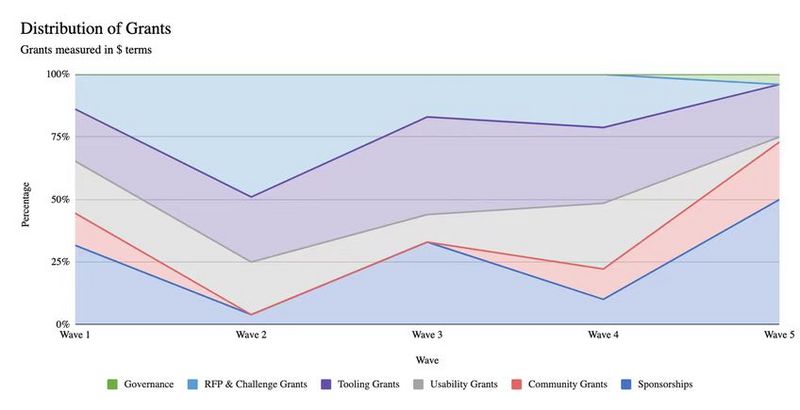
The above chart breaks down how Uniswap has allocated funding over the past year and a half. Uniswap was also launched with the help of the Ethereum Foundation Grant program. So far, Uniswap has deployed nearly $5 million, with about half going to the 6th wave of Grant funding.
Funding external projects did not make much sense until the Uniswap protocol reached a scale that could be adopted by a large number of users. Until the last two waves of Grants, the government did not allocate funds for governance. Instead, most Grants were divided among usability, tools, and RFPs (Requests for Proposals/Challenges).
Grants create a ripple effect for developers. In most cases, these developers may not be developing a product worth starting a business. On the other hand, they have specific skills to build tools that the protocol can use. Therefore, rather than having them raise funds from venture capital and worry about making money, it is better to incentivize them to build those products that cannot scale through dollars with Grant funding programs.
These types of tools often solve very application-specific problems. For example, they can be used to display the historical APY (Annual Percentage Yield) of a pool on Uniswap or track the loan rates of assets on Aave. These tools are often very useful for niche communities but may not necessarily be profitable.
The Fit Between Protocols and Ecosystems
Which direction will founders of products supported by venture capital choose? In my understanding, the solution is to look at protocols at an inflection point. The ideal protocol should have enough technical advantages to support a large number of users while also facing a lack of skilled developers who can build applications.
Most protocols face this issue at their development stage. Solana, Polygon, Avalanche, Near, and Harmony all had to launch large-scale developer-centric Grant projects aimed at finding developers who could build large-scale applications on these projects. When increasing initial Grant funding, developers must consider which protocol is best for them, as each protocol has an active investor community.
At LedgerPrime, we have seen a large number of DeFi applications from Solana. Avalanche has caught up due to its EVM compatibility. On the other hand, Polygon is undoubtedly the preferred choice for developers building B2C applications due to its relatively low transaction costs.
We assessed the number of Grants in each ecosystem to understand the current flow of developers. Solana and Polygon cannot be calculated because their Grants are provided through multiple smaller entities, making it impossible to derive exact numbers. Polkadot's Grants amount to ±300, making it the most Grants issued to date. The Ethereum Foundation itself has completed nearly ±230 Grants. (The official number is close to 300, but we excluded grants related to academic/research.)
Despite Uniswap, Aave, and Compound holding billions in capital, the number of Grants they issue has decreased. For founders looking to build applications and then scale them to venture capital-supported projects, raising Grant funding from L1 or L2 may still be the best option.
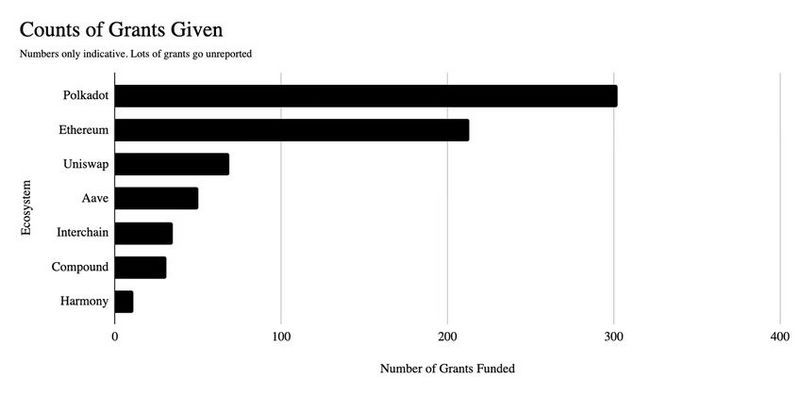
As protocols develop, organizations running Grant projects need to adopt a holistic stack-based approach to operate Grant projects. Developers may rely on Grants to enhance their skills, deploy their first applications, and ultimately scale those applications. Capital is typically deployed in:
User onboarding;
Developer education;
Application scaling to the later stages of protocol development.
Structurally, most ecosystem Grant programs are optimized for transaction flow. For example, Harmony does this by deploying funds.
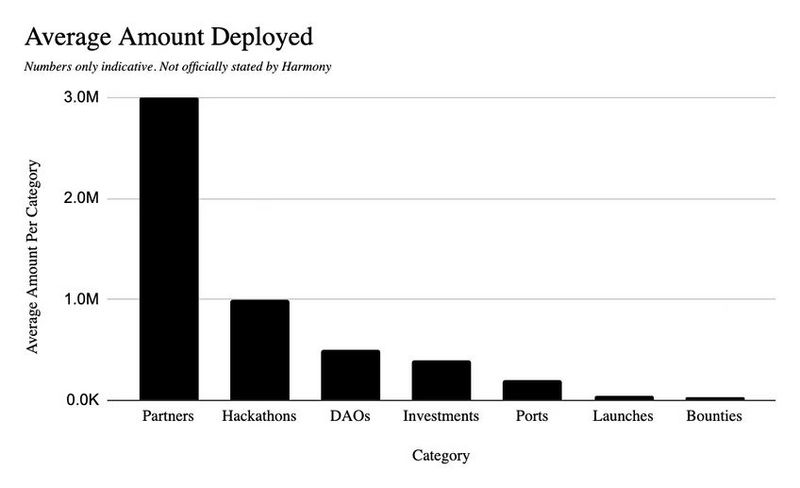
Harmony recently announced a $200 million Grant program that will deploy funds over three years. It is also one of the fastest-growing L2s on Ethereum today. In terms of maturity, Harmony is like a "middle-aged protocol," as it has existed long enough to start attracting users to use its protocol but has not yet developed into a mainstream protocol like Solana.
About one-third of Harmony's Grant declarations will be awarded to DAOs, averaging $750,000 per DAO. In contrast, companies identified as "partners" will each receive nearly $3 million in funding.
However, only about ±16% of the funds will actually be deployed to these companies. In this case, partners are either acquiring or accelerating development and then reallocating funds to smaller businesses. For example, Filecoin collaborated with Tachyon, Techstars, Faber, and Longhash during its growth cycle.
Because the Harmony protocol can outsource the work of managing transaction processes, it helps companies scale or handle investor relations through third-party companies that specialize in this work. In the same way, they allocate about 16% of funds to hackathons, with each hackathon receiving $1 million.
The benefits of hosting hackathons for protocols are twofold. On one hand, they find it easier to raise developer awareness through global events lasting several weeks. They are building a spiritual commitment from stakeholders through substantial rewards.
On the other hand, they can curate a list of hundreds of potential applications to be built. Each hackathon produces "winners," and correspondingly, there are multiple participants. If they can retain developers, they can create some really great products. Although Harmony itself may only directly invest in a few transactions, the Grant program they build is optimized to attract hundreds of developers.
Aggregation Theory and Grant Programs
In my previous articles, I analyzed how blockchain enables entirely new markets while lowering trust and verification costs. Grants are a product of this market. Things like venture capital and syndicate investing have existed for a long time, so when the entrepreneurial financing social platform Angel.co emerged in the early 2010s, it provided us with a reference model.
On one hand, Grants in Web3 are scattered across various projects, making it difficult to provide a single, unified interface for incentives. On the other hand, data related to Grants can be queried and verified more easily than most traditional Grants or crowdfunding projects. This is why Gitcoin's token is now valued at around $700 million.
Questbook has taken a different approach to address this issue. They first provided developers with some experiences in Q2 2021. About 100 tutorials were created for developers looking to transition from Web2 to Web3.
For protocols, the challenge is finding distribution channels based on a vetted talent pool that has been trained to know how to participate in building with their skills. For developers, the issue is finding relevant pre-funding opportunities. Questbook serves as an intermediary connecting developers and funding. They claim to have distributed nearly $500,000 through their Grant funding allocation tool so far.
There are many challenges to this.
First, protocols often lack visibility into how and where funds are deployed. Even when capital deployment is complete, it is difficult to track a company's trajectory throughout its growth cycle. There may often be multiple protocols providing Grants to a single company. The total of these Grant amounts may resemble their own venture capital funding.
Today, network participants cannot clearly see who received how much money. Questbook addresses this challenge through its easily filterable interface. Over a sufficiently long time frame, it will make it easier to track the net worth generated through these Grant projects. For example, Uniswap may have already returned all funds deployed through Ethereum-related Grants to date.
I believe that in the coming years, processing Grant applications will become a form of "credentialing." The number of Grants received by individuals and the DAOs they collaborate with will become a better "certificate" than academic degrees. As the work of these developers can be easily verified on-chain, trust issues will diminish.
The Future Direction of Ecosystem Grant Programs
Ecosystem treasuries are likely evolving from on-chain to become a significant force in the financial system. Polygon has conducted mergers and acquisitions worth over $700 million, reminding us that the scale of enterprises in the industry is no longer controlled by hedge funds and venture capital. The partner companies involved in the protocols are likely to step in and play the role that ICOs could not play in 2017.
At that time, the view was that users would directly invest in applications and witness their scaling. Today, users (through capital investment) vote on protocols, while the protocols deploy funds through ecosystem Grants as transactions.
This is a shift that most developers I recently interacted with are not aware of. Venture capital funds themselves may not be the ideal way to build and scale businesses. Depending on the stage and nature of the application, about $12 billion can be injected through different Grants. Most of this capital is non-dilutive and targeted. So you can create something valuable while still retaining a significant amount of ownership.
The ultimate goal of ecosystem Grants is to solve problems that traditional financing methods cannot address. These are typically products that require time and years of commitment. To achieve this, the value of individual protocols must reach trillions of dollars. At the time of writing, Bitcoin's market capitalization is approximately $800 billion.
Will we see results from ecosystem Grants as significant as those from the internet? It will be interesting to see if we can leverage ecosystem Grants to solve real big problems in the future, such as internet access, healthcare, and education.
 Risk warning
 Risk warning


Popular articles





