








Babylon Finance Founder: Why We Chose to Shut Down and the Lessons I Learned

 The asset management agreement, as the top of the high-rise, not only has to bear the risks of the underlying agreements but also faces the risks of the entire money market.
Original: Babylon Finance is shutting down
Author: Ramon Recuero
Compiled by: Chasey, WhoKnows DAO
Babylon Finance is a community-driven asset management protocol. Users can create investment groups (Garden) using Babylon and participate together in investments in DeFi projects. It is built on the Ethereum blockchain, governed by the community, and features characteristics such as being unregulated, transparent, and permissionless. Its token is BABL.

TL;DR
On August 31, Babylon founder Ramon Recuero announced that the protocol will officially cease operations in mid-November this year, mainly due to the irreparable losses the team suffered from the hacker attack on the Rari/FEI lending pool in April. This article is an announcement from Ramon Recuero, outlining the follow-up actions the Babylon team will undertake:
- Starting September 6, the remaining assets in the treasury will be liquidated and distributed to BABL and hBABL holders. Specific details will be announced this week;
- After obtaining approval from the governance team, all liquidity will be withdrawn from Uniswap to prevent liquidity loss during the liquidation process;
- The team will return all tokens, including those already allocated; the team has never sold any tokens and will not profit from them;
- From August 31, users will no longer be able to create new investment strategies or investment groups, and existing investment strategies will be completely shut down along with Babylon's official website and Discord server on November 15;
- The team will cooperate with FEI to continue the subsequent compensation process, aiming to mitigate the financial losses caused to users by the hacker attack;
- The community is welcome to clone/fork Babylon, as all code is open-sourced.
A Road to Nowhere
In this announcement, Ramon Recuero reflects on and explains how Babylon has come to this point, sincerely hoping that the lessons learned from Babylon can help other entrepreneurial teams in the cryptocurrency space.
Let's outline the journey of Babylon from rise to fall:
- February 2021 - Seed round financing of $1.9 million; Summer 2021 - Establishment of Babylon DAO, initiation of on-chain governance, and launch of Beta testing
- November 2021 - Issuance of Prophets NFT, raising a total of $3 million
- December 2021 - BABL listed on Uniswap
- February 2022 - Release of "The Heart of Babylon," creating a BABL lending market on Fuse
- March 2022 - Official launch; April 2022 - Rari suffers a hacker attack, compensation proposal approved
- June 2022 - FEI decides to cancel compensation, Babylon team takes emergency action
Until the hacker attack on Rari, Babylon had maintained a relatively strong position in the market: even during the major bear market in February this year, it achieved a TVL of $30 million. At the same time, it created a $10 million pool on Rari, attracting 1,500 depositors and successfully entering the top ten pool rankings. According to calculations, the funds could support the team for 9 months, and additionally, the team secured an extra 20 months of funding through BABL collateralized loans.
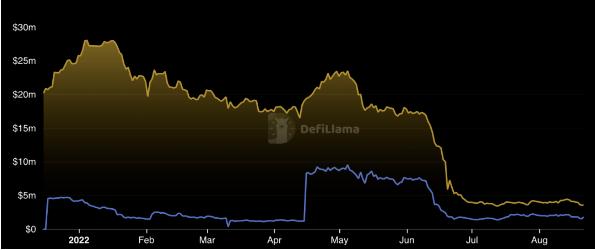
During the period from April to May, despite multiple debuffs such as the bear market, hacker attacks, the 3AC incident, and the Luna incident, Babylon maintained positive growth and gained more market share compared to competing products. It was not until the end of June when FEI/Rari announced the cancellation of compensation that Babylon had to redefine the asset value of Rari to zero.
In the face of this crisis, although the Babylon team acted quickly and tried their best to salvage the situation, the butterfly effect triggered by the Rari incident ultimately proved too difficult to bear:
- Affected investment groups lost $3.4 million, and related user withdrawals caused Babylon's TVL to drop by 75% within a few days, from $18 million to $3.4 million. Since the protocol charges a 0.5% management fee and a 5% performance fee, achieving sustainable automatic operation requires a TVL of $50 million;
- Bad debts on Fuse went unpaid, and users could no longer borrow funds using BABL as collateral; the Babylon team spent a lot of time and effort trying to recover its $10 million lending market on Fuse;
- The team lost the funds invested in Rari, which could have supported operations for 3 months, and the possibility of borrowing using BABL also disappeared;
- The price of BABL dropped from $20 to $5; due to the token's supply cap and only 10% remaining in the treasury, the possibility of raising funds through token sales was virtually zero;
- The team was truly exhausted. From initially coping with the bear market to facing one crisis after another, culminating in the hacker incident that became the last straw, users were very angry with the team, even though the fault did not lie with them.
The cancellation of FEI compensation became the last straw that broke the camel's back. A series of events and incidents engulfed the Babylon team's cash situation, funding channels, and most importantly—user confidence in the team.
Since the hacker incident, the Babylon team has been working without pay, searching every day for ways to help the team through the crisis and achieve a TVL of $50 million. However, the token's price in the public market has been suppressed, and the team does not have enough tokens for financing; even after November, the funds to maintain the website and protocol operations will also be insufficient.
There is no way out.
Play Dead or… Face It?
At this point, for a moral and responsible team, the only thing left to do is to shut down the DAO and return the remaining assets to BABL and hBABL holders.
While most protocols do not liquidate but choose to remain as half-dead zombies because it is easier, cheaper, and involves fewer legal issues, the Babylon team believes that only shutting down is the responsible course of action:
"We failed, and we need to accept failure. When a project/startup fails, the founders should not gain any benefit from it, so we will return all team tokens, whether already allocated or not. To be honest, seeing teams like FEI profiting immensely after project failures is incredibly disappointing."
To prevent insiders from trading tokens at expected liquidation prices and draining BABL's liquidity, the team has removed most of the liquidity from the Uniswap v3 pool. All assets will be distributed to token holders through the liquidation process.
The team believes that shutting down Babylon can help the community, investors, and the team itself to restart their journeys and focus their energy on other matters, creating value for the world from different perspectives.
Lessons Learned
Ramon Recuero reflected on the issues encountered while operating Babylon, and in the following sections, we will narrate from a first-person perspective.
1. Raise More Funds
My experience working at YC taught me that small teams can be much more effective than a large crowd, so we have always maintained a small scale (6 full-time, 2 part-time) to enhance efficiency and reduce costs.
Running a DeFi protocol relies more on funding than other types of startups. Below is a rough categorization of the expenses incurred by the core team and DAO over the past 20 months.
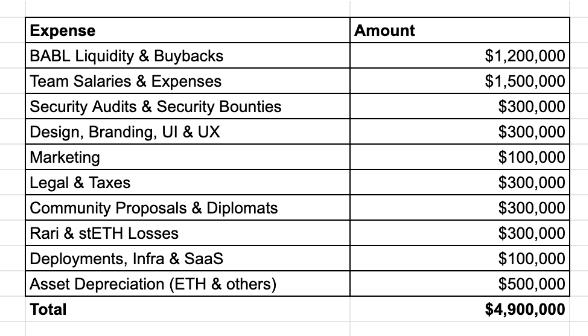
There are three types of costs that ordinary internet companies do not need to consider, but crypto companies must:
- Legal costs, which are 20 times that of ordinary startups. From registering a company to authorizing token issuance and signing agreements, everything is quite complex and expensive;
- Security is extremely important; during the last bull market, the supply-demand situation allowed security audit companies to quote extremely high prices for their services. We take security issues very seriously, conducting 7 security audits and launching a bug bounty program on Immunefi;
- Token issuance requires a large amount of liquidity. We deployed $1 million when issuing tokens and later deployed an additional $500,000 to integrate with Rari and prevent oracle manipulation.
In this regard, our biggest mistake was raising too little. In October last year, as the market began to cool down, it became increasingly difficult to raise funds through Balancer LBP. However, at the same time, discussions around NFTs were heating up, and we believed in both DeFi and NFTs, so we decided to create the first DeFi NFT series—The Prophets.
This was a major undertaking, and we spent two months on it.
- Some understood DeFi
- Some understood NFTs
- Very few understood both DeFi and NFTs
We tried hard to find users who understood both DeFi and NFTs, but DeFi users did not understand why we didn't just raise funds through token sales, while NFT users did not understand DeFi or the utility of tokens.
Through this attempt, we raised $3 million, while our initial goal was $20 million. This was the most expensive mistake we made, and it can be said that all other problems stemmed from this.
We had planned to hire three more people, but because we did not meet our goals, we had to sprint and find ways to reach a TVL of $50 million to make the protocol truly profitable.
2. Consider Risks and Weigh Timing
The market is still in its early stages. Asset management is one of the smallest niche markets in DeFi; even when considering all protocols, it is only about $70 million. However, I firmly believe that active asset management will be one of the largest sub-markets in a few years.
I genuinely believe that a cryptocurrency-native hero project will emerge, providing trustworthy and secure investment support for retail investors. This was also the original intention behind founding Babylon; I hoped to help ordinary people achieve compound wealth growth through cryptocurrency investments and provide a platform that aggregates all the advantages of cryptocurrency while protecting users from risks such as hackers, scams, and high leverage. However, the services provided by Babylon did not match the current cryptocurrency users.
From the perspective of the product lifecycle curve, current cryptocurrency users still belong to early adopters, who have shorter time preferences and higher risk tolerances. The Babylon protocol could provide investment opportunities for investors with different risk preferences, but it has always focused on medium to long-term investments.
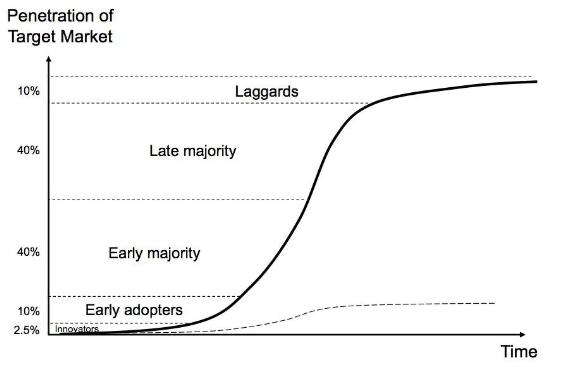
In this mismatch, the Babylon team strayed further along the risk curve to provide the services users needed: the sustainable growth of Babylon's largest investment group, The Fountain of ETH, was only achieved after the Babylon team added the option to create a 3x leverage stETH strategy. At the same time, users' risk preferences forced the team to integrate with more and more protocols, including Rari. Additionally, Babylon was forced to introduce leverage mechanisms to keep APY competitive.
Moreover, our unique idea was to use blockchain technology to create non-custodial, community-driven funds, which was impossible before the advent of cryptocurrency. Operated by the community, collaboratively built, and compounding wealth—yet most users did not want to participate. What investors wanted was to deposit money, forget about it, and withdraw it along with the earnings when they remembered. Therefore, most investment groups on Babylon were managed by 2-3 core members, while other members merely appeared as witnesses in the entire storyline.
Although we identified market opportunities, such issues prevented us from acquiring enough users to achieve Babylon's complex and ambitious goals.
3. Deep Bear and Under Currents
No matter what the media says, just look at your bank balance to understand that we are currently in a recession. From the outbreak of the pandemic in 2020 to the complete collapse in 2022, we are witnessing history:
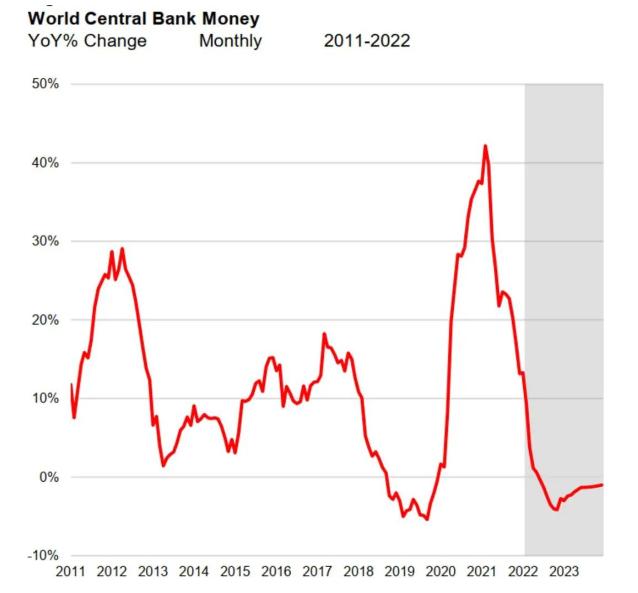
- The fastest annual liquidity reduction in history;
- The worst bond market since 1789;
- The 60/40 investment portfolio is expected to lose 49% this year, resulting in the worst returns ever;
If the bond and stock markets are like this, it is not surprising what happens in the cryptocurrency market. The Federal Reserve and central banks around the world have paused fiscal and monetary policies as a countermeasure against inflation; upon hearing the news, everyone rushed to the exits, causing tsunami-like fluctuations in global markets; chaotic deleveraging events occurred frequently, leading to a chain reaction of liquidations, with over $1 trillion disappearing into thin air; 3AC, Luna, Celsius, Voyager…
As the pinnacle of high-rise buildings, asset management protocols must not only bear the risks of underlying protocols but also face the risks of the entire monetary market. Therefore, the Babylon team had to race against time, trying to support the unwinding of several strategies and deleveraging. Here, it is necessary to mention the deleveraging of stETH, which was once traded at an 8% discount to ETH.
Liquidation depressed token prices, with the most obvious examples being ETH and BABL, both losing 60% of their value within a few weeks, which dealt a significant blow to our treasury.
- A Crazy World
Finally, it must be mentioned that current regulations are still fraught with uncertainty. Many projects choose to register legal entities to reduce risks, spending hundreds of thousands of dollars on legal fees.
However, the challenges at the regulatory level go far beyond money: the U.S. Treasury has banned the use of Tornado, even though the wrongdoers are the users; the code and technology itself are neutral and do not possess good or evil.
Although these regulatory changes did not have a substantial impact on us, the added risks in our already precarious situation became a small driving force that led Babylon to the conclusion of shutting down.
In Conclusion, Thank You
Despite various reasons, in terms of results, Babylon has failed.
However, I am proud of the work we accomplished during this time:
We created a complex DeFi asset management protocol, serving thousands of users and achieving a TVL of $30 million;
We designed and launched a token with a viable business model; created a fully decentralized DAO with an on-chain governance system;
We designed, implemented, and released the first set of NFTs with real utility in DeFi protocols;
We established a strong staking mechanism and token economy; launched a $10 million lending market on Fuse;
We made improvements in UI/UX, such as gas-free deposits on the mainnet and free on-chain governance voting;
We created a composable API that allows fund managers to create DeFi strategies associated with custom contracts.
We hope that the work we have done can help other teams in this field, so all our code and libraries are open-sourced: https://github.com/babylon-finance?view_as=public
There are four repositories: Protocol Code:
- Smart contracts, tests, and deployment scripts;
- Dapp: Frontend code;
- API: Smart contract integration development tools;
- Docs: All documentation.
Thanks to the team for all their hard work, and thanks to all the investors and community members for their help and support over the past year. Despite the challenges mentioned above, I remain incredibly optimistic about DeFi and asset management. Wishing good luck to other teams in this field!
 Risk warning
 Risk warning



Popular articles





