








LD Research: Exploring new paths, another option for public chains serving niche markets
 I believe that the combination of public chains serving niche markets and major public chains like Ethereum will ultimately bring a more secure, private, fast, and life-oriented blockchain to WEB3 users, developers, and mainstream users who will use blockchain in the future.
Author: Noise Zhou, LD Capital Research
Preface
Back to 2020, with the arrival of a bull market, the increase of on-chain Web3 users and the emergence of Uniswap, Opensea, and more DeFi and NFT-related Dapps, public chains like Ethereum began to be overwhelmed. The skyrocketing gas fees, congested networks, and the rampant trading bot MEV led to a poor user experience for Web3 users.
At this time, some unconventional public chains or infrastructures began to explore new paths, attempting to break through the dilemmas faced by public chains like Ethereum and carve out their own styles.
For instance, Terra focuses on algorithmic stablecoins, FLOW emphasizes NFTs, Cosmos and Polkadot center around multi-chain and cross-chain capabilities, Avalanche innovates through its X, P, C three-layer network architecture, and NEAR achieves higher speeds through sharding. These public chains are challenging the blockchain trilemma, striving for better scalability and security, more decentralization, and enhanced user experiences by focusing on specific challenges.
By 2022, with technological advancements such as Layer 2, ZKEVM, MOVE language, sidechains, and dedicated chains, public chains in niche segments began new research and directions.
Focus Brings Change
Blockchain can be broadly categorized into public blockchains, consortium blockchains, and private blockchains, with Ethereum being the public chain with the highest TVL and user count. Besides Ethereum, other public chains have different focal points in their positioning or segmentation, competing with Ethereum through differentiation.
The previous article mainly discussed innovative architectures, such as modular technology in specialized public chains, while this article will delve into service-focused niche public chains and introduce some recently progressing public chains in this area, including Layer 1, Layer 2, and application chains.
Canto | DeFi Public Chain Based on Cosmos
Canto is a Layer 1 public chain with the vision of making the financial system open, transparent, free, permissionless, and decentralized through DeFi/smart contracts. Canto is a community project initiated by @scottlewis (Twitter), and the GitBook mentions that any community member can freely create resources, channels, images, etc. The project's official website does not provide specific information about the Canto team or funding details.
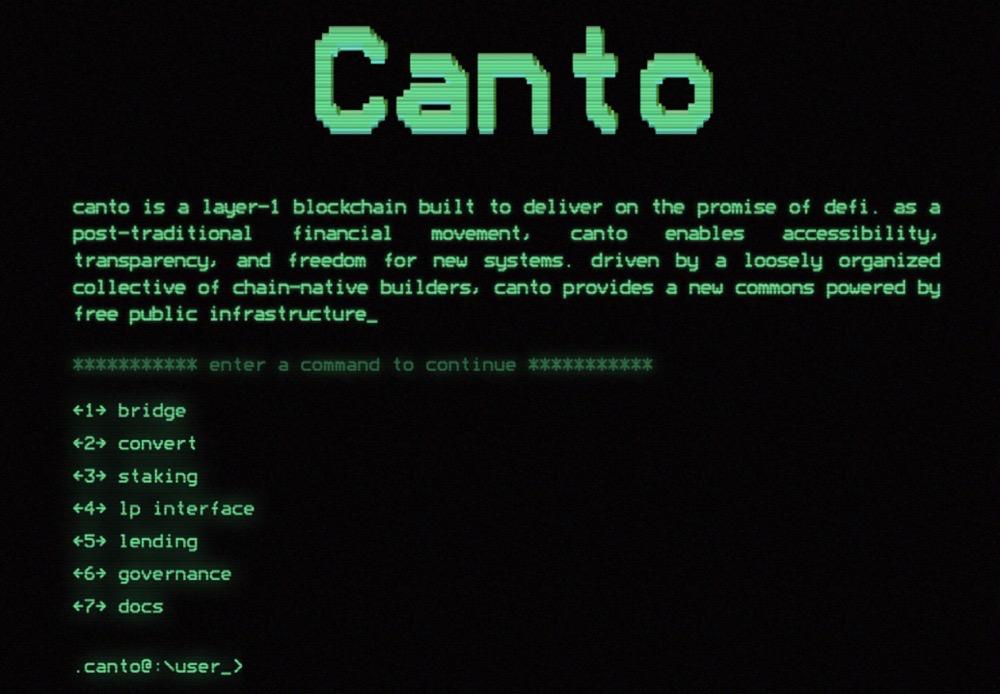
Data Source: Canto.io
After observing the development of DeFi, the team concluded that from the launch of DAI at the end of 2017 to the emergence of numerous DeFi projects in 2020/2021, the DeFi ecosystem has three core elements: DEX, lending, and decentralized stablecoins. As the ecosystem develops, these projects tend to make similar decisions, such as launching governance tokens. Therefore, Canto proposed a radical concept: the core elements of DeFi should exist as free public infrastructure to promote ecosystem development.
As a DeFi public chain, the official launched three Dapps: Canto DEX, Canto Lending Market (CLM), and $NOTE token.
- Canto DEX
The official DEX, like most DEXs, Canto uses an automated market maker (AMM) for asset pricing. To prevent predatory rent-seeking behavior, the DEX will always operate without charging any fees, cannot be upgraded, and remains ungoverned, with no tokens or additional fees introduced over time.
- Canto Lending Market (CLM)
The code is derived from a fork of Compound v2's lending platform. CLM will allow Canto DEX's LP tokens to be used as collateral, which can be deposited into the lending market, but users will not be allowed to borrow LP tokens. CLM is governed by Canto token stakers. For better ecosystem development and user cultivation, Canto token stakers share common interests, so CLM's governors will not extract rent at the application layer.
- $NOTE Token
$NOTE is an over-collateralized token, the core of the Canto public chain. Its value is algorithmically stabilized at 1 USD. Features include: over-collateralization, high capital efficiency, decentralization, and full automation.
The only way to acquire $NOTE is through borrowing from CLM, with the interest from borrowing used for the ecosystem, managed by Canto DAO.
The method for controlling the price stability of the NOTE token lies in adjusting interest rates through contracts to influence circulating supply. The contract adjusts every six hours; when the NOTE token value falls below 1 USD, the contract raises the interest rate for NOTE deposits, and conversely, when the value exceeds 1 USD, the interest rate is lowered.
Canto attracts users by deeply engaging in DeFi, providing free and open infrastructure, and a systematic algorithmic stablecoin, thus gaining attention and support in the DeFi niche market.
Aztec Network | Privacy Layer 2 Using zk Rollup
Aztec is the first privacy zk-rollup on Ethereum, enabling anonymous transactions between accounts through the underlying Plonk proof mechanism and achieving private interactions with DeFi projects via Aztec Connect.
Plonk was created by Aztec members Ariel Gabizon and Zac Williamson and is an innovative zk-SNARK zero-knowledge proof scheme.
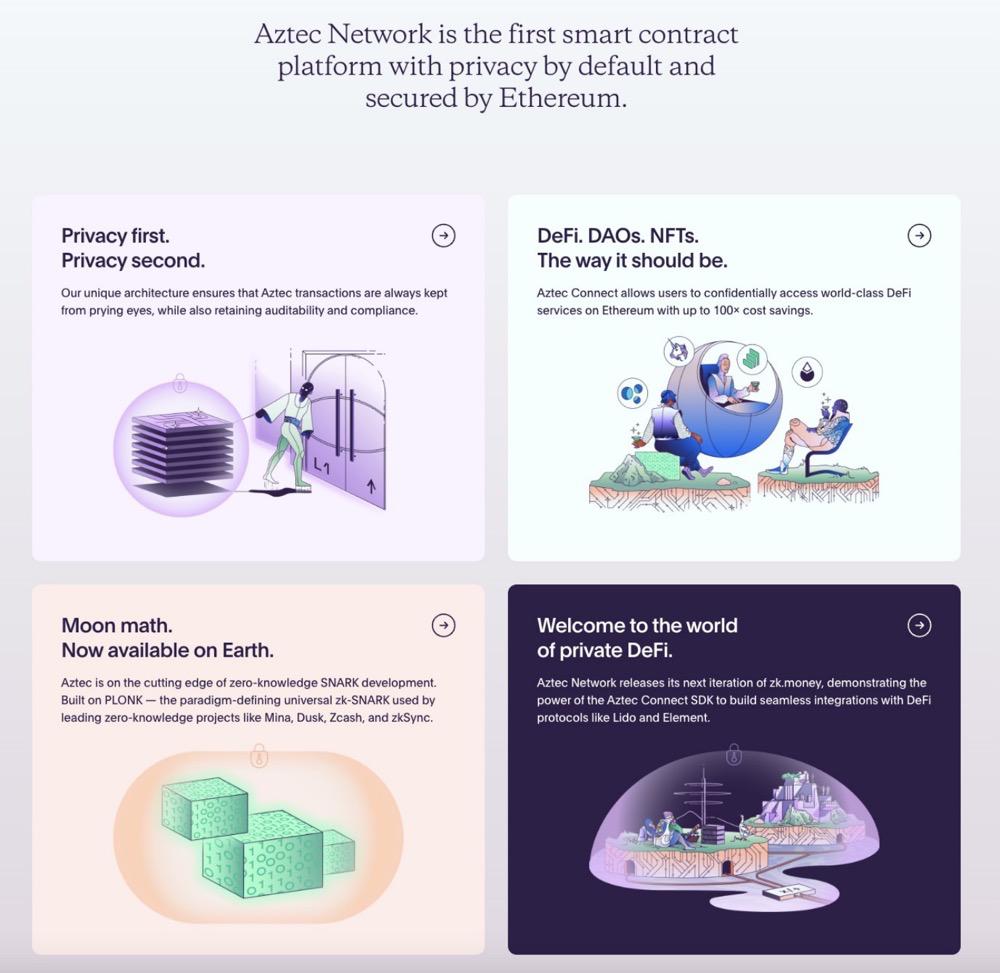
Data Source: aztec.network
The team believes that decentralization is premised on individual rights, and without privacy, our ability to choose how to live and make a living is compromised. Therefore, the team focuses on privacy, aiming for: privacy (using privacy-first zk-rollup and allowing private access to Ethereum Dapps), usability (reducing Dapp interaction costs while maintaining privacy through Aztec), and compliance (supporting auditability and compliance through a privacy programming language).
Currently, zk.money and Aztec Connect have been launched. Soon, noir will be introduced, a Rust-based privacy programming language created by Aztec Network, allowing developers to securely and perfectly build privacy-protecting smart contracts on Aztec.
- zk.money
zk.money is a Layer 2 privacy application built on the Aztec network, using Plonk (zk-SNARK) to ensure the anonymity of sending and receiving tokens without publicly releasing any transaction data. Ethereum users can use it to protect their transaction data from being disclosed. Currently, through the Aztec Connect feature, zk.money can interact with Dapps such as Lido, AAVE, Curve, UNISWAP, and Liquity.
- Aztec Connect
Aztec Connect is a set of privacy tools that connect Ethereum DeFi protocols to Aztec, allowing composable private DeFi operations on Ethereum. The privacy tools include bridge contracts (connecting Ethereum smart contracts to Aztec's interface) and SDK (frontend toolkit supporting web interfaces to access Aztec Connect integration).
In simple terms, Aztec Connect acts like a ladder, using rollup contracts as a proxy to interact between the Aztec network and Ethereum Dapps, saving users' gas fees.
Aztec integrates operations with the Ethereum mainnet, allowing users to gain privacy without the cumbersome process of using a privacy chain. This provides users with Layer 1 DeFi liquidity and Aztec's privacy operations, addressing some users' privacy needs.
Shimmer | The Pioneer Modular Network of IOTA 2.0
Shimmer is a Layer 1 network based on IOTA's parallelized DAG (Directed Acyclic Graph, IOTA's "Tangle") and undergoes a series of version upgrades and new feature additions (such as native tokens, output types, Layer 2, decentralization, etc.). It is building a new distributed architecture with IOTA, which will become a new scalable, modular decentralized blockchain, validating innovative technologies before launching on the IOTA mainnet.
Shimmer will use the Stardust protocol, an upgrade of IOTA 1.5 (also known as Chrysalis), enabling IOTA to upgrade into a distributed public chain supporting multi-assets and smart contract execution.
Stardust serves as the infrastructure layer for smart contract chains, adding functionalities compared to IOTA: introducing custom tokens, enabling conditional transfers, allowing NFTs to store tokens acting as wallets, and improving the protocol to protect node resources, eliminate client trust assumptions, and enhance network load balancing capabilities.
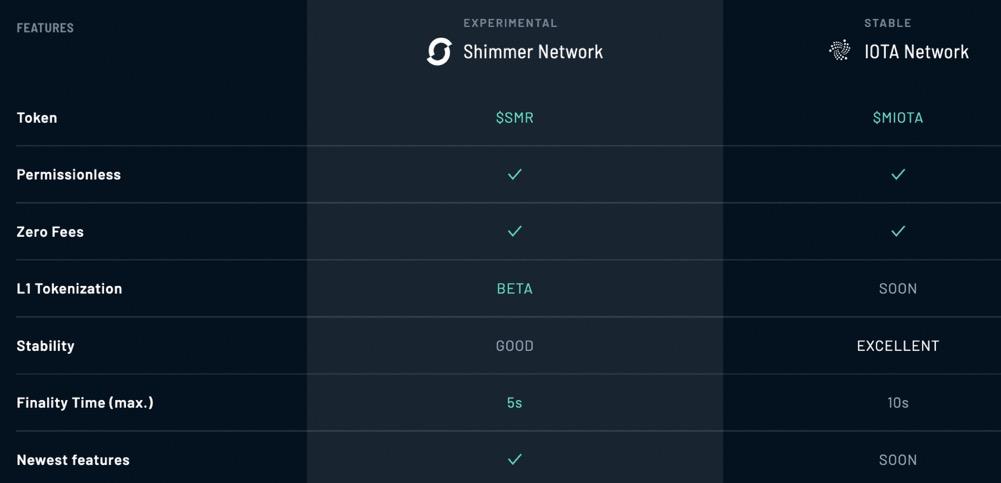
Data Source: shimmer.network
Data Cap/Byte Cost: Since storage space is a limited resource for any blockchain, Stardust will set a cap on the data included in transactions, which can expand as the number of tokens in the transaction increases. This allows for fair allocation of used space while keeping Shimmer unaffected and ensuring that block sizes do not grow uncontrollably like most blockchains. The maximum block size is limited by the number of existing tokens, restricting the ability to store data indefinitely in blocks, binding the token value of transactions, referred to as "byte cost."
Preventing Dust Attacks: The functionality brought by byte cost means that if data needs to be retained in Shimmer blocks, permanent data storage will require locking tokens. Only if dust attackers are willing to pay for it will there be a possibility of sending junk information in blocks to inflate them.
Output Unlock Conditions: When users transfer custom tokens, they must send a certain amount of native tokens to support their data storage in the block.
To this end, Stardust introduces an output unlock condition: if the sender provides the required token deposit, the recipient must replace the sender's deposit with their own when receiving the custom token. Once completed, the sender's token deposit will be automatically refunded. The sender can also set a time limit for the recipient to complete the deposit replacement; if the recipient fails to replace it within the specified time, the tokens or NFTs will be automatically returned to the sender.
Modularity: As the smart contract architecture layer Assembly develops, various application chains built on top can connect to IOTA 2.0 and Shimmer as a settlement layer, creating various possibilities.
Shimmer is to IOTA what Kusama is to Polkadot; it will be the pioneer network for IOTA, where more innovations and technologies will be deployed first, allowing users to experience more innovations ahead of IOTA 2.0. Subsequent Layer 2 application chains created by Assembly and other modular features will also be used on Shimmer first.
Fuel | High-Speed Modular Execution Layer
Initially, Fuel V1 was a Layer 2 for Ethereum, using Optimistic Rollup deployed at the end of 2020, while the current Fuel has started the V2 high-speed modular execution layer plan.
The team believes that the Layer 1 architecture is transforming from a tightly coupled overall design of consensus, data availability, and execution (like Ethereum) to a modular development where execution is separated from data availability and consensus (such as the future Ethereum execution layer and consensus layer or Celestia). This separation allows for specialization at the base layer, increasing bandwidth capacity, and Fuel's design can leverage this additional bandwidth. Fuel serves as the execution layer of a modular blockchain, providing high security and flexible throughput while supporting interoperable Turing-complete smart contracts.
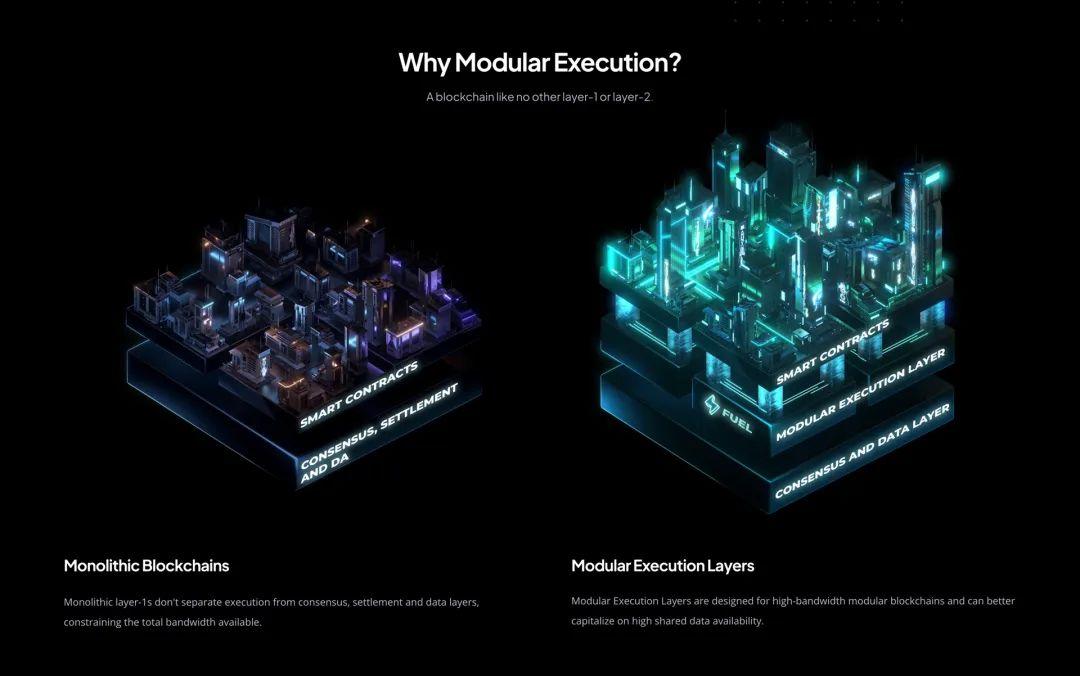
Data Source: fuel.network
Parallel Transactions: Using the UTXO model, it provides unparalleled processing power through strict state access lists and parallel transaction execution.
FuelVM: Using FuelVM aims to reduce the waste processing of traditional blockchain virtual machine architectures while significantly increasing the potential design space for developers.
Excellent Developer Experience: Using the self-developed Sway and Forc (Fuel Orchestrator) provides developers with a better development environment. Sway is a domain-specific language for FuelVM, developed based on Rust, specifically designed for the Fuel blockchain's optimized VM.
Fuel has developed steadily since its establishment, with nearly 50 contributors shown on the official website, and has received investment from well-known institutions. As a team founded in 2019, the deployment of Fuel V2 is expected to be relatively smooth, but the subsequent ecological development will also require an excellent consensus layer as a modular foundation.
Conclusion
With the approach of Ethereum's Merge and the development of Layer 2, some developers have realized that merely copying Ethereum's overall design cannot make them stand out among numerous public chains. Therefore, some teams have turned to more niche public chain markets to attract mainstream users, developers, and blockchain-native users. Currently, there are projects like FLOW that continue to develop the NFT ecosystem, targeting users through youth-related IP and mainstream IP, as well as Canto, Aztec, Shimmer, Fuel, and more mentioned in this article, which are specifically developed public chains focusing on modularization, privacy, developer & user friendliness, NFTs, Layer 2, and other directions.
It is believed that the combination of service-focused niche public chains and major public chains like Ethereum will ultimately bring a safer, more private, faster, and more life-oriented blockchain experience to WEB3 users, developers, and future mainstream users of blockchain.
Compared to the new public chains that still have high valuations in the bear market, we should not overlook the unique public chains that are under construction and have relatively reasonable valuations, whether they are in development or yet to exist in the future. The ones that defeat Ethereum may not be Ethereum forks, but rather user-friendly public chains that can help Web3.0 mature.
 Risk warning
 Risk warning


Popular articles





