








Vitalik: DAOs are not companies; decentralization in autonomous organizations is very important

 We may only need a few DAOs that look more like political science rather than corporate governance structures.
Original Title: 《DAOs are not corporations: where decentralization in autonomous organizations matters》
Author: Vitalik Buterin
Translation: Guo Qianwen, Chain Catcher
Recently, there has been much discussion focusing on the viewpoint that highly decentralized DAOs cannot operate, suggesting that DAO governance should gradually trend towards traditional corporate governance to maintain competitiveness. These viewpoints are generally consistent: highly decentralized governance is inefficient, while traditional corporate governance structures with boards of directors and CEOs, or similar structures, have evolved over hundreds of years to make good decisions in a changing world and create value for shareholders. Idealists of DAOs naively believe that the egalitarian ideal of decentralization can perform better; however, such attempts in the traditional corporate sector have at most achieved limited success.
This article will argue why this position is often incorrect and will discuss in detail the importance of different types of decentralization in different situations. I will particularly focus on three situations of decentralization:
- Decentralization is for making better decisions in concave environments: In such environments, pluralism or even naive compromise can outperform the consistency brought by centralization.
- Anti-censorship decentralization: Applications need to resist attacks from powerful external actors while operating.
- Decentralization is credible fairness: DAOs perform functions similar to those of nation-states, such as providing basic infrastructure, so characteristics like predictability, robustness, and neutrality are more important than efficiency.
Centralization is convex, decentralization is concave
Original post reference: https://vitalik.ca/general/2020/11/08/concave.html
One way to categorize decisions that need to be made is to see whether they are convex or concave. When choosing between A and B, what we first look at is not the A vs. B issue itself, but a higher-order question: Are you willing to take a compromise between A and B, or would you prefer to flip a coin to decide? In terms of expected utility, we can express this distinction with a diagram:
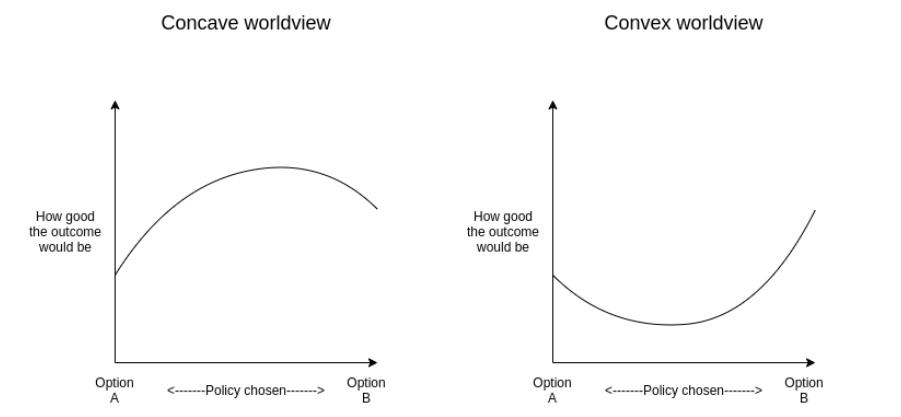
If a decision is concave, we will choose to compromise; if it is convex, we will choose to flip a coin to decide. Generally, we can more easily answer the higher-order question: "compromise" or "flip a coin," rather than answering the first-order question focused on A vs. B itself.
Examples of convex decisions include:
- Responding to pandemics: A 100% travel ban may effectively block the virus, while a 0% travel ban cannot block the virus but at least does not inconvenience people; however, a 50% or 90% travel ban results in poor outcomes on both fronts.
- Military strategy: Attacking along line A may make sense, and attacking along line B may make sense. But splitting the army in half to attack on both sides means the enemy can easily deal with each army one by one.
- Technical choices in cryptographic protocols: Using technology A may make sense, and using technology B may make sense, but some mix between the two often leads to unnecessary complexity and even increases the risk of interference between the two.
Examples of concave decisions include:
- Judicial decisions: The midpoint of two independent judgments may be fairer and more rational than randomly selecting one judgment.
- Public goods investment: Generally, providing X dollars to each of two promising projects is more effective than providing 2X dollars to one while giving nothing to the other.
- Tax rates: Due to quadratic deadweight loss mechanics, the harm caused by an X% tax rate is often only a quarter of that caused by a 2X% tax rate, but it generates half more revenue than the latter. Therefore, moderate taxation is better than randomly choosing between low/no tax and high tax.
When decisions are convex, the process of decentralized decision-making can easily lead to chaos and ineffective compromises. When decisions are concave, relying on the wisdom of the crowd can yield better answers. In these cases, structures similar to DAOs, which can input a large number of different decisions, are significant. In fact, those who believe the world is overall more concave are more likely to see the need for decentralization in a broader context.
Should VitaDAO and Ukraine DAO be DAOs?
Many relatively emerging DAOs differ from early DAOs (like MakerDAO), which focused on providing infrastructure organizations, while relatively emerging DAOs perform various tasks around specific themes. VitaDAO is a DAO that funds early longevity research, while UkraineDAO funds and organizes activities to help victims of the war in Ukraine while supporting Ukraine's defense efforts. Do they need to be DAOs?
This is a subtle question, and we can gain a possible answer by understanding the internal workings of UkraineDAO itself. A typical DAO tends to be "decentralized," pooling a large amount of capital into a pool where token holders vote to fund each allocation. In contrast, UkraineDAO divides its functions into many units (pods), with each unit working as independently as possible. The highest-level management can create new units (in principle, the management can also fund the units, although so far, funding has only been provided to external organizations related to Ukraine), but once a unit is created and endowed with resources, it operates largely independently. Internally, individual units do have leadership that operates in a more centralized manner, although they still strive to follow the spirit of individual autonomy.
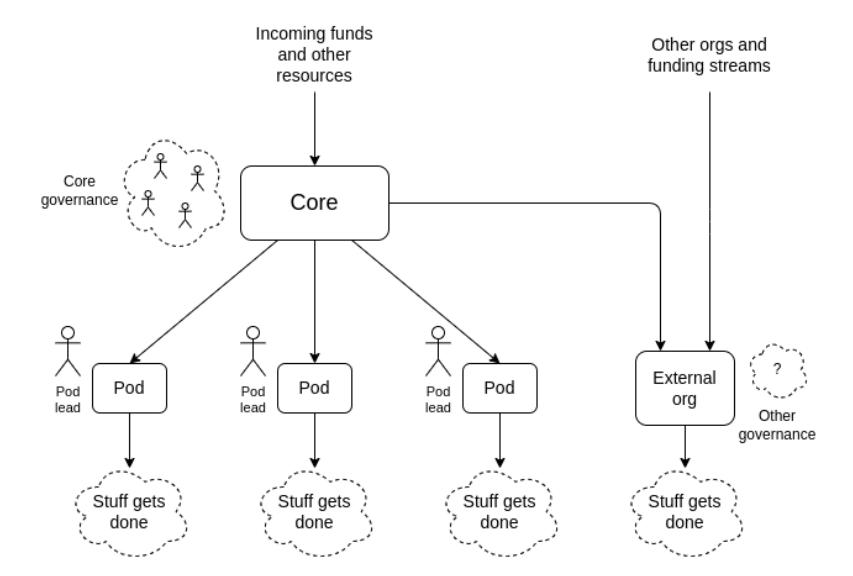
A natural question people might ask is: Isn't this "DAO" actually just a traditional multi-layer hierarchy? Just packaged differently. I would argue that it depends on the implementation: adopting this model can certainly evolve into the stereotype of a large corporate autocracy, but it can also be adopted in very different ways.
Two things can help ensure that organizations built in this way can form meaningful decentralization:
- True high autonomy of units. Units receive resources from the core, and if a unit wants to continue receiving these resources, it occasionally needs to undergo checks to see if its requests and capabilities meet the requirements. But apart from that, units act completely independently and do not "take orders from" the core.
- Highly decentralized and diverse core governance. This does not require a "governance token," but it does require broader and more diverse core participation. Generally, broad and diverse participation leads to decreased efficiency. However, if (1) is satisfied, with units being highly autonomous, the core only needs to make fewer decisions, then the impact of reduced efficiency in higher-level governance will be minimized.
Now, how does this fit into the "convex and concave" framework? The answer is roughly as follows: (more decentralized) top-level is concave, (more centralized in units) bottom-level is convex. Giving a unit X dollars is generally better than randomly choosing between giving it 0 dollars and giving it 2X dollars. Taking compromises or guiding different decisions with "inconsistency" principles will not cause too much loss. But within each individual unit, having clear viewpoints guiding decisions and being able to adhere to many choices that coordinate with each other is more important.
Decentralization and anti-censorship
In cryptocurrency, decentralization is often seen as a means of resisting censorship: a DAO or protocol needs to be able to continue operating and protect itself in the face of external attacks, including those from large corporations or even governments. This has been publicly discussed for a long time, so I will not elaborate further, but there are still some important nuances.
The two most widely used and successful anti-censorship services currently are The Pirate Bay and Sci-Hub. The Pirate Bay is a hybrid system: it is a search engine for BitTorrent, which is a highly decentralized network. However, the search engine itself is centralized, with a small core team responsible for maintaining its operation. It uses a whack-a-mole strategy to protect itself: when the hammer falls, it makes way and then reappears elsewhere. Both The Pirate Bay and Sci-Hub frequently change domain names, leverage different jurisdictions, and use various other technologies. This strategy is centralized, but it has allowed them to succeed in agility in defense and product improvement.
DAOs are different from The Pirate Bay and Sci-Hub; DAOs are more like BitTorrent. And BitTorrent needs to be decentralized: it not only needs to resist censorship but also requires long-term investment and reliability. If BitTorrent were shut down once a year and required all its seeders and users to switch to a new provider, the network would quickly degrade. Anti-censorship DAOs should also belong to the same category: they should not only provide services to evade permanent censorship but also avoid mere instability and disruption. MakerDAO (and Reflexer DAO managing RAI) is an excellent case in this regard. You can build a regular search engine and use Sci-Hub-like techniques to ensure its survival.
Decentralization is credible fairness
Sometimes, DAOs also need to take on some functions of nation-states. This often involves tasks that can be described as "maintaining basic infrastructure." Because the government's ability to oversee DAOs is weak, DAOs need to engage in more self-supervision structurally, which requires decentralization.

Consider three incentive examples: algorithmic stablecoins, Kleros courts, and Optimism's retroactive funding mechanism.
- Algorithmic stablecoin DAOs are systems that create crypto assets using on-chain financial contracts, with their prices tracking some stable index, usually (but not necessarily) the US dollar.
- Kleros is a "decentralized court": as a DAO, its function is to make rulings on arbitration issues, such as "Is the content of this GitHub submission acceptable for this on-chain bounty?"
- Optimism's retroactive funding mechanism is part of the Optimism DAO, which retroactively rewards projects that have provided value to the Ethereum and Optimism ecosystems.
In all three cases, subjective judgment is inevitably required, which cannot be automatically completed by a piece of on-chain code. In the first case, the goal is to obtain a reasonable estimate of the price index. If the stablecoin tracks the US dollar, then you only need the ETH/USD price. If hyperinflation or some other reason to abandon the dollar occurs, the stablecoin DAO may need to manage a trustworthy on-chain CPI calculation.
Kleros will inevitably make subjective judgments on any submitted issue, including whether a submitted issue should be rejected for being "unethical." The retroactive funding task of Optimism is one of the most open subjective questions: which projects have made the greatest contributions to the Ethereum and Optimism ecosystems?
All three situations inevitably require "governance," and it needs to be quite robust. In all cases, governance will be subject to internal and external attacks, which can easily lead to significant problems. Therefore, governance not only needs to be strong but also needs to convince the many members of the public who distrust it that it is strong.
The Achilles' heel of algorithmic stablecoins: Oracles
Algorithmic stablecoins rely on oracles. To allow on-chain smart contracts to know whether to lock the value of DAI at 0.005 ETH or 0.0005 ETH, it needs some mechanism to understand the (off-chain) information about the ETH/USD price. In fact, this "oracle" is the main place where algorithmic stablecoins can be attacked.
This leads to a security dilemma: algorithmic stablecoins cannot safely hold collateral worth more than their speculative tokens (like MKR, FLX…) market cap, and therefore cannot issue more units. Because if it were allowed to do so, it could buy half of the speculative tokens, use those tokens to control the oracle, and through providing bad/incorrect oracle values, liquidate it to steal user funds.
One possible alternative design for a stablecoin oracle is to add a layer of indirectness. Quoting a post from ethresear.ch:
"We set up a contract with 13 'providers'; the answer to the query is the median of the answers returned by these providers. There will be a vote every week, where oracle token holders can replace one of the providers…
The security model is simple: if you trust the voting mechanism, you can trust the oracle's output unless 7 providers become corrupt at the same time. If you trust the current oracle providers, you can at least trust their output for the next six weeks, even if you completely distrust the voting mechanism. Therefore, if the voting mechanism is compromised, any participants in applications relying on the oracle have enough time for an orderly exit."
Note that this suggestion somewhat deprives the governors of the ability to act quickly, intentionally dispersing the responsibility of the oracle across a large number of participants. This is valuable for two reasons. First, it makes it harder for outsiders to attack the oracle and makes it harder for new token holders to quickly control the oracle. Second, it makes it harder for oracle participants themselves to collude to attack the system. It also weakens the extractable value of the oracle; in this case, if one provider delays the release, others will quickly release.
Fairness of Kleros
The "decentralized court" system Kleros is a very valuable piece of infrastructure in the Ethereum ecosystem.
Recently, there have been some public concerns about whether the platform's decisions are fair. Some participants have initiated cases trying to claim compensation from the decentralized smart contract insurance platform that they believe they are entitled to. The most notable of these cases should be the report of Case No. 1170 by Mizu. This case evolved from a minor language dispute into a widespread scandal, as some accused Kleros' internal personnel of collaborating, using a large number of tokens to steer decisions in their desired direction. One participant in the debate wrote:
"The court's incentive-based decision-making process… is currently being devoured by a devil with a strong (25%) interest in the court."
Of course, this is just one side of a broader debate that the Kleros community needs to clarify who is right and how to respond. However, from a broader perspective, it is important how much value propositions like Kleros can persuade the public—that they are protected from such centralized manipulation. To make the existence of something like Kleros trustworthy, it seems necessary to prohibit individuals from holding 25% of the shares in the higher courts. Whether through broader distribution of tokens or using other non-token-driven governance, a more credible form of decentralized governance could help Kleros completely avoid such concerns.
Optimism's retroactive funding
The results of the first round of Optimism's retroactive funding were selected by four votes from 24 "badge holders." The second round may have more badge holders, with the ultimate goal of transforming it into a retroactive funding allocation system controlled by broader civic institutions, perhaps involving some multi-layered mechanisms of categorization, small committees, and/or delegation.
There has been some internal debate about whether there should be more or fewer citizens: does "citizen" really mean closer to "senator," where the citizen should be a deeply knowledgeable expert contributor to the Optimism ecosystem, or anyone who has evidently participated in the Optimism ecosystem? Or somewhere in between? On this issue, my personal stance has always leaned towards more citizens, using second-layer delegation to address governance inefficiencies rather than adding centralization to the governance protocol. The key reason I maintain this stance is the belief that there are potential insider trading and self-dealing issues.
Optimism's retroactive funding mechanism has always been intended to integrate with the future speculative ecosystem: public projects currently needing funding can sell "project tokens," and anyone purchasing project tokens is eligible for significant retroactive funding later. However, for this mechanism to work well, it critically depends on the retroactive funding functioning normally, but this retroactive funding mechanism is highly susceptible to disruption, such as:
- If some people have already decided how they will vote on a particular project, they can buy in (or short if the price is too high) their project tokens before the decision is published.
- If certain people know they will later adjudicate a specific project, they can buy project tokens in advance and then intentionally vote in favor of it, even if the project is not actually worthy of funding.
- Funding decision-makers can accept bribes from projects.
There are typically three ways to address these types of corruption and insider trading issues:
- Retroactively punish malicious decision-makers.
- Actively filter and seek high-quality decision-makers.
- Increase the number of decision-makers.
The business world often focuses on the first two approaches, applying financial regulation and explicit penalties for the first, and personal interviews and background checks for the second. The decentralized world appeals less to these tools: project tokens may be traded anonymously, and DAOs have extremely limited recourse to external judicial systems. Moreover, the remote and online nature of projects, along with the appeal for global inclusivity, makes background checks and informal face-to-face "tests" more difficult. Therefore, the decentralized world needs to place greater emphasis on the third technique: distributing decision-making power to more decision-makers, so that the power of each individual decision-maker is reduced, making collusion more likely to be reported and exposed.
Should DAOs learn more from corporate governance or political science?
Curtis Yarvin is an American philosopher who believes that corporations are more effective and superior to governments, and thus we should make governments look more like corporations to improve them (for example, moving away from democracy towards monarchy). He recently wrote an article expressing how he believes DAO governance should be designed:
"Conversely, since the Industrial Revolution, the basic design of Anglo-American limited liability corporations has remained roughly unchanged—a dissenting historian might say this is actually a corporate revolution. If the design of the corporation is not perfect, we can expect it to trend towards perfection.
While there are categorical differences between these two types of organizations—what we might call first-order (sovereign) and second-order (contractual) organizations—it seems that current society has very effective second-order organizations but no very effective first-order organizations.
Therefore, we may know more about second-order organizations. Thus, when designing DAOs, we should start from corporate governance rather than political science."
Yarvin's post correctly points out the key distinction between "first-order" (sovereign) and "second-order" (contractual) organizations. However, Yarvin's post then makes a surprising mistake by saying that corporate governance is a better starting point for DAOs to operate. This mistake is surprising because the logic of this situation almost directly implies the completely opposite conclusion. Because there is no sovereignty above DAOs, and they are typically explicitly engaged in providing services (like currency and arbitration), these services are usually owned by sovereign entities. Therefore, what DAOs are more worthy of learning from is the design of sovereignty (political science), rather than the design of corporate governance.
It is commendable that the second part of Yarvin's post indeed advocates for adopting a "hourglass" model that combines a decentralized layer of consistency and accountability with a centralized management and execution layer, but there is already a consensus that DAO design needs to learn from both first-order and second-order institutions.
Sovereign states are inefficient, while corporations are efficient, which can be proven by number theory, but abstract group theory can only prove a limited number of things: corporations face fewer failures and achieve more successes because they can set more parameters and have stronger tools to operate. Corporations can rely on local sovereignty for protection when needed and depend on external legal systems to stabilize their incentive structures. However, in sovereign states, the biggest challenge often is that when the incentive structure is under attack and/or at risk of complete collapse, there is no external Leviathan ready to support it.
When designing successful governance systems for sovereign states, the biggest issue is what Samo Burja calls the "succession problem": how to ensure continuity when the first group of people retires and the system is taken over by a new group. Burja writes that corporations often do not address this issue at all:
"Silicon Valley is keen on 'disruption' because we have become accustomed to this succession problem, which has never been solved in independent institutions like corporations."
DAOs will ultimately need to address the succession problem (in fact, given that many early adopters of cryptocurrencies are "cash out after making enough money," some DAOs have already needed to deal with succession issues). Monarchical and corporate-like forms often struggle to solve the succession problem because the structural system is closely tied to the habits of a specific individual, making either the handover difficult or creating significant risks regarding who to hand over to. More decentralized political forms like democracy at least provide theories on how to achieve smooth transitions. Therefore, I believe that compared to corporate governance, DAOs can draw more from freer and more democratic political science schools.
Of course, DAOs must sometimes complete specific complex tasks, and using some corporate-like forms to accomplish these tasks is wise. Additionally, DAOs need to deal with unexpected uncertainties. If a system is designed to operate around a set of assumptions in a stable and unchanging manner, when faced with extreme and unexpected changes, it indeed requires bold leaders to coordinate responses. A typical example of the latter is how stablecoins handle the collapse of the dollar: what should a stablecoin DAO do when it has been firmly committed to tracking the dollar and suddenly finds that the dollar is no longer a viable tracking target and needs to quickly switch to some CPI?
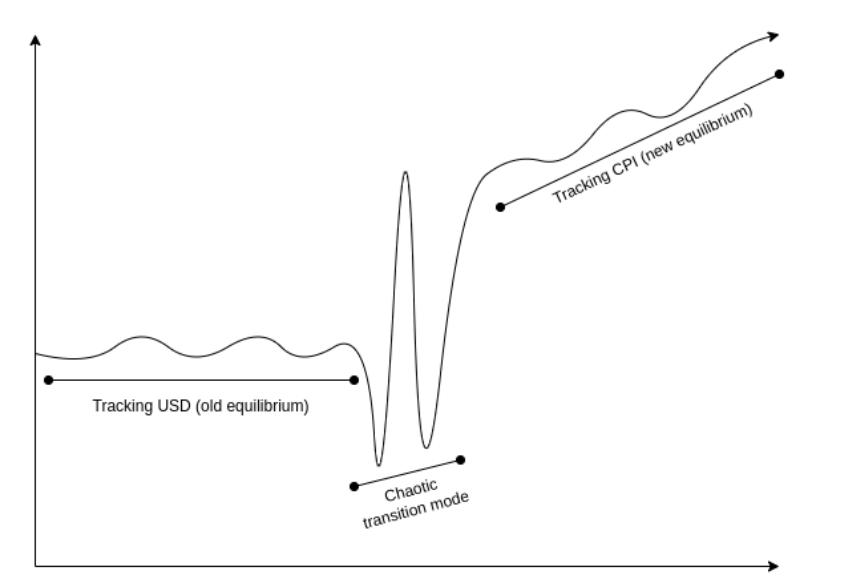
In this case, corporate governance may provide some inspiration. Because they offer a ready-made model to address the issue: the founder is the pivot. But it turns out that political systems have also historically provided a model for addressing this situation, and this model covers how to return to a decentralized model after the crisis ends: the Roman Republic had a practice of electing a dictator to serve in a temporary term to address crises.
In fact, we may only need a small number of such DAOs—those that look more like constructs of political science rather than corporate governance. But they are the truly important ones. A stablecoin does not need to be efficient; it must first be stable and decentralized. The same goes for a decentralized court. Systems that fund specific causes—whether it is Optimism's retroactive funding, VitaDAO, UkraineDAO, or other systems—are far from maximizing profits. Therefore, a consistent plan that ensures the system continuously allocates funds for its intended purposes is needed, aside from shareholder profit incentives.
So far, most organizations, even in the crypto world, will be "contractual" second-order organizations, ultimately relying on first-order giants for support. For these organizations, a more streamlined, leader-driven, and agile governance form makes sense. But we should not lose sight of the fact that without some non-corporate decentralized form to maintain overall stability, the ecosystem cannot exist.
 Risk warning
 Risk warning



Popular articles





