








Aptos Launch Day: Sorting Out Core Information Points and the Pessimistic Sentiment Behind It

 "Skyfall level" project? Not at all, not at all.
Author: Nianqing, ChainCatcher
At 3:04 AM Beijing time today, Aptos announced the official launch of its mainnet, Aptos Autumn, on Twitter. The market has been waiting for this moment for a long time. After all, this is a star public chain founded by former core developers of Mate (Facebook), developed based on the Move language, and backed by top venture capital firms such as a16z, FTX Ventures, Coinbase Ventures, and Binance Labs, carrying narratives like "Ethereum killer" and "Diem successor."
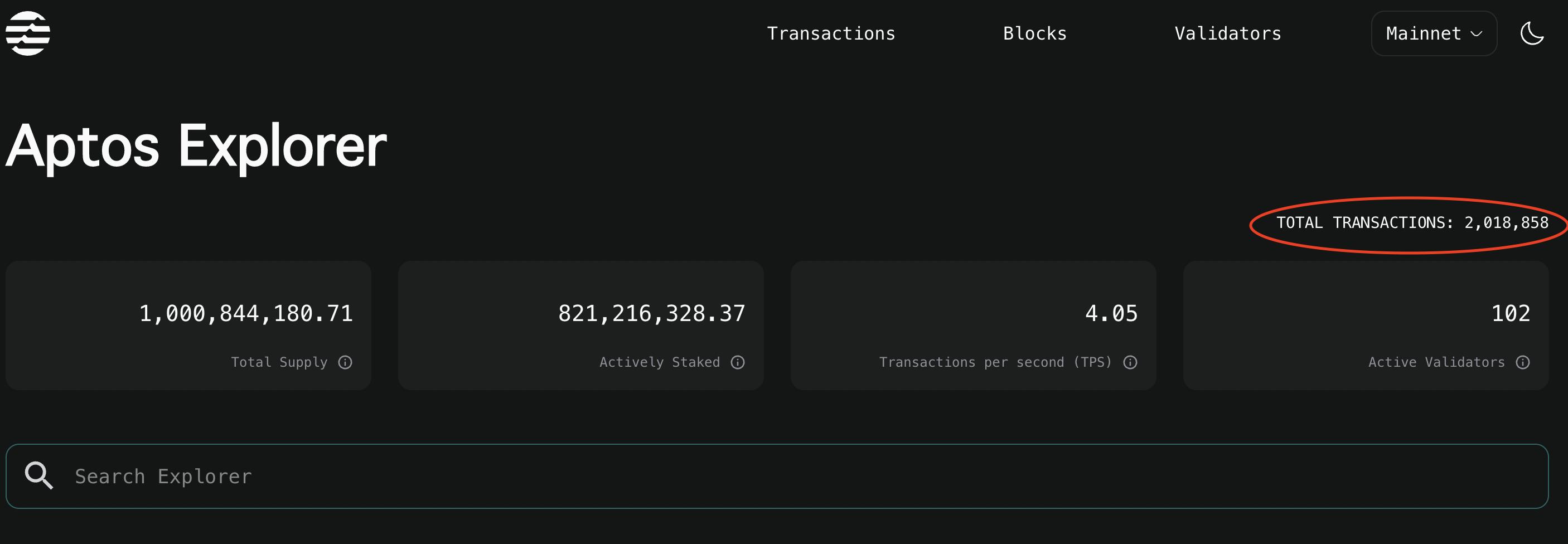
However, when users eagerly wanted to experience this "revolutionary" blockchain network, they found that the TPS data on Aptos Explorer was only "4." Subsequently, major exchanges such as Binance, Coinbase, FTX, OKX, Huobi, and Upbit quickly followed suit without any official announcement of APT token economics. Additionally, users began to raise questions about TPS, token economics, and other issues in communities like Discord, leading the community to close comment functions and some language discussion groups to "protect the community from scams."
As is well known, according to the law of public opinion fermentation, delayed information disclosure during major hot events can lead to escalating event heat. Although it is uncertain whether the above situation was intentional by the Aptos team, the effect has indeed been achieved. Today, discussions around Aptos TPS, token economics, APT clones, and community bans have sparked conversations in various communities.
In these discussions, rumors and expressions of "watching it collapse" are prevalent. ChainCatcher has sorted out some key points you should know about the first day of Aptos launch amid the plethora of redundant information and voices:
The Aptos mainnet actually launched on October 12, and it has been running for nearly a week since the official announcement this morning. However, currently, there are no Dapps launched on the mainnet, except for wallet applications like Petra wallet and MARTIAN.
The current TPS of the Aptos mainnet is about 4 transactions per second, mainly because its ecological projects have not yet launched, resulting in very few actual interactions. Although the data shows that the total number of transactions has exceeded 2 million, most transactions in the block explorer are maintenance messages from block validators, and user transaction volume is expected to significantly increase starting tomorrow.
The initial supply of the Aptos token APT is 1 billion, and it adopts an inflation mechanism. Among them, 51.02% of the tokens are allocated to the community, but the official has not yet announced an airdrop plan. The community token distribution shows that 410 million APT is held by the Aptos Foundation, and 100 million is held by Aptos Labs. Currently, about 82.1% is staked in contracts, meaning the initial circulating supply of APT tokens is approximately 180 million.
Binance, Huobi, FTX, and OKX will open APT trading at 9:00 AM Beijing time on October 19, and Coinbase will open trading after the deposit reaches the standard. As of the time of publication, no exchanges are trading APT, so please be cautious.
The Aptos mainnet has undergone three rounds of testing before its launch. Previously, Aptos planned to launch the mainnet in the fall after the incentivized testnet 3, and the timeline has indeed not been delayed. After the mainnet launch, testnet 4 will be launched in the winter.
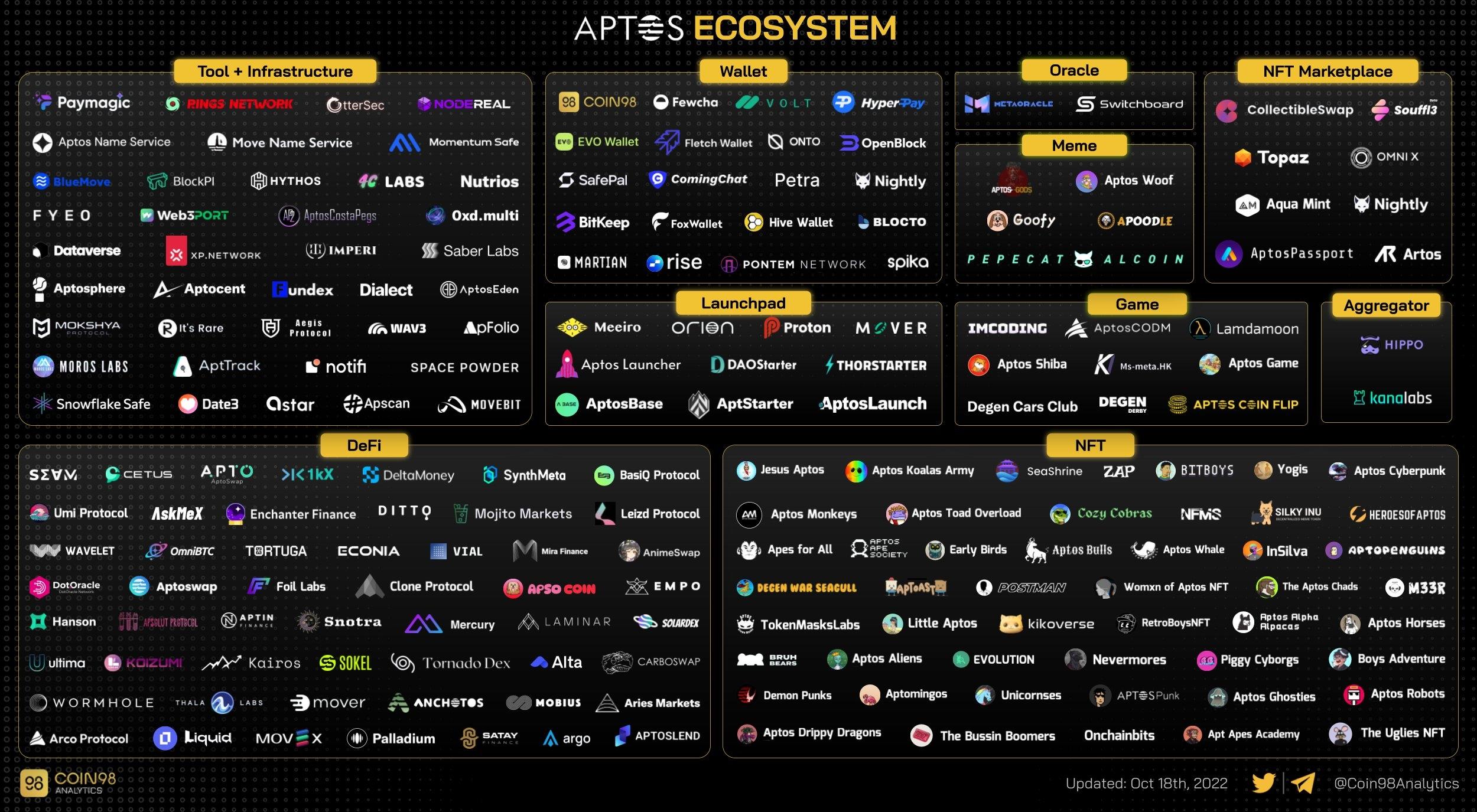
Aptos ecosystem overview, source: Coin98
In addition to this basic information, there is another question worth discussing: why did the launch day of Aptos trigger such a "bearish" sentiment?
The direct reason is that the token economics of Aptos has not been disclosed for a long time today, leading to doubts about "over 80% of the token supply being controlled by the team and investors" and "insufficient decentralization." This afternoon, under repeated urging from the community, the team finally released a brief version of the token economics. Although more than half of the tokens are allocated to the community, 410 million APT is held by the Aptos Foundation, and 100 million is held by Aptos Labs. Some sarcastically remarked that the term "community" has been redefined.
Crypto KOL Cobie commented on this on Twitter: "FTX, Binance, etc. are listing Aptos without any transparency in token economics, which is not great." @apolynya also commented under the relevant tweet: "I bet that in the current state, Aptos is a centralized blockchain controlled by VCs, dumping tokens through FTX and Binance."
The deeper underlying reason may be that although the Aptos ecosystem seems prosperous, users have long been fatigued by the hype and narrative of "high TPS" and "bringing a billion users to blockchain," and there seems to be no sign of disruptive innovation in Aptos.
(There have been several analysis articles on the advantages and innovations of Aptos previously, which will not be repeated here.)
Related reading: 《 7 O'Clock Capital: Understanding the Modular Capital Public Chain Aptos in One Article》
Specifically, Aptos has taken on some projects that have flowed from Solana. These projects often give a sense of "déjà vu," especially NFT projects, with obvious "imitation" traces of Bored Apes and CryptoPunks, and the gameplay mechanics are rather clichéd. Additionally, due to similar launch times and both using the Move language, many projects choose to develop and deploy simultaneously on both Aptos and Sui, which also results in a lack of innovation in Aptos ecosystem projects.
As Solana's founder Anatoly Yakovenko recently said in a podcast, "Only crypto-native users care about the 'multi-chain future.' When blockchain is widely adopted and new users increase, everything will be defined by killer applications."
The mainstream market probably does not care whether a network uses the Move language or is a Diem successor; they are more concerned about which applications are good or whether the network truly changes the way accounts interact. Perhaps Aptos should learn from Flow (the development language Cadence of Flow has many similarities with the Move language), and since it is positioned for the mainstream market, it should focus on attracting mainstream users through more powerful applications.
Moreover, high valuations and low ecosystems can lead to more unexpected risks after the mainnet launch. The launch of Aptos today has also awakened many people's memories of the "Internet Computer" ICP, which was once highly anticipated. At that time, this project was highly anticipated, just like Aptos now. Like Aptos, ICP also underwent a long development and testing process, even two years longer than Aptos. And like Aptos, ICP was also backed by well-known venture capital firms such as a16z and Polychain Capital, with a total fundraising amount of $195 million.
Additionally, once ICP was launched, it was also quickly listed by major exchanges such as Huobi, Binance, Coinbase, and OKX. Within less than a week of its launch, it successfully entered the top ten cryptocurrencies with a market cap of nearly $38 billion. Its token price peaked at $750, while the current token price is $5, less than one percent of its highest price.
Will Aptos repeat the fate of ICP? Or will it exceed expectations and surpass Ethereum? The specific performance remains to be observed. ChainCatcher reminds everyone to be cautious of FOMO in a bear market.
 Risk warning
 Risk warning




Popular articles





