








After the number of nodes decreased by 70%, Solana is anxious this time
 Core Viewpoint
 The internal and external challenges on the road to "on-chain Nasdaq"
Author: momo, chaincatcher
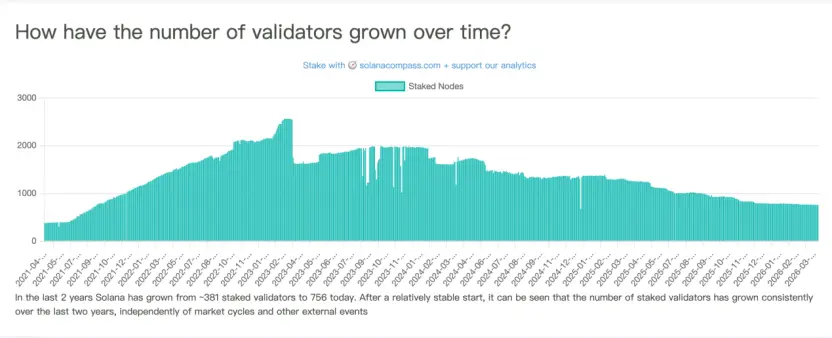
The number of Solana nodes has decreased by 70% from its historical peak. At the beginning of April, according to data from Solana Compass, the number of validators plummeted from 2,560 in March 2023 to about 756; during the same period, the Nakamoto coefficient dropped from 31 to 20, a decline of 35%, indicating a weakening degree of decentralization.
This change coincides with Solana's attempt to tell a grander narrative—becoming the "on-chain Nasdaq" to support the global capital market. The sharp reduction in nodes and the expansion of ambition create an unavoidable tension.
Solana has not been without responses to the issues of nodes and centralization in the past, but the results have been unsatisfactory. Recently, according to SolanaFloor, the Solana Foundation will implement a new validator policy, which will officially take effect on May 1. What is the focus of this new policy? Can it change the current situation?
1. Why has the number of nodes decreased significantly?
From the trend of Solana's node numbers, the sharp decline in validators is not a sudden drop. Since the beginning of 2024, the number of nodes has been continuously decreasing, gradually falling below 1,000.
The significant drop in the number of nodes caused panic in the community earlier this year, to which Solana founder Toly responded that the main reason was the end of subsidies.
For a long time, Solana has been criticized for having insufficient nodes and excessive centralization. To quickly expand the validator base, Solana launched the Foundation Delegation Program (SFDP) in its early days, providing support to small and medium nodes through staking matching, residual delegation, and voting cost assistance.
In simple terms, the foundation matches external staking at a 1:1 ratio, with a maximum match of 100,000 SOL; the remaining SOL after matching is then evenly distributed among all qualified validators; at the same time, it subsidizes daily voting transaction fees. This mechanism was indeed effective in the short term. A report released by Helius in August 2024 showed that over 70% of validators relied on this system to varying degrees at its peak.
However, problems soon became apparent. Although these subsidy-dependent nodes accounted for the majority in number, they controlled only about 19% of the total staking; in contrast, about 420 nodes that did not rely on subsidies held over 80% of the staking share, with the top 20 nodes accounting for more than one-third of the staking.
It is clear that a large number of nodes does not equate to "decentralization." Subsidies attract a large number of low-staking, low-performance "nominal nodes," which, while dispersed, lack the capability to participate in real staking competition; institutions and large holders that truly control a significant amount of SOL prefer to allocate resources to large nodes that are technically reliable and operationally stable.
This also explains why, despite the previous inflated growth in the number of nodes, the Nakamoto coefficient did not increase correspondingly.
For Solana, rather than maintaining a large number of underperforming, low-contributing "nominal nodes," it is better to establish a smaller but more professional group of validators to ensure the long-term stability and security of the network. Thus, Solana began to actively reduce subsidies.
Starting in 2025, the foundation gradually adjusted its delegation strategy, phasing out nodes that relied heavily on subsidies. The core mechanism was summarized as "one in, three out": for every new subsidized node, three old nodes must be eliminated based on two criteria—having received foundation delegation for at least 18 months and having external staking below 1,000 SOL. At that time, it was estimated that about 51% of nodes met the criteria for elimination, potentially around 686 nodes.
After the withdrawal of subsidies, the survival of small and medium nodes became even more challenging. Analysis pointed out that nodes need to have about 3,500 SOL for staking and an annual maintenance cost of about $45,000 (with voting fees accounting for a large portion, approximately 400 SOL) to survive.
Meanwhile, competition within the network has intensified, with leading validators competing for delegation with almost zero fees, further compressing the profit margins for small and medium nodes.
As network upgrades like Alpenglow increase hardware performance requirements, some older equipment has gradually been phased out, raising the entry barriers for validators.
However, the clearing out of small and medium nodes and the significant decrease in the number of nodes still leave the community worried about excessive concentration of power. A Twitter user commented, "Users use PoS chains for security, but the chain becomes centralized in pursuit of security. So what exactly are we supporting?"
2. What is the intention behind Solana's new validator policy?
In this context, let's take a look at Solana's latest validator delegation plan.
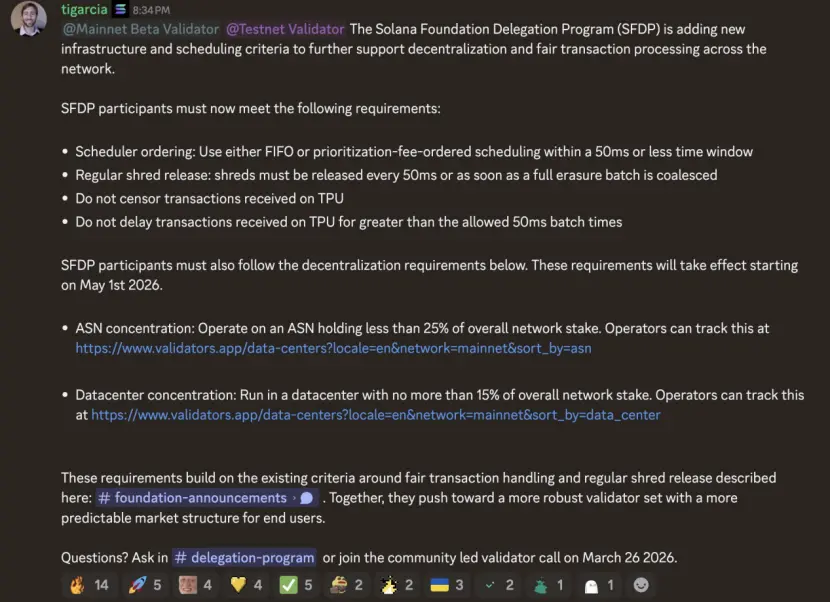
The core change focuses on strict constraints on the infrastructure layer.
The staking ratio carried by any single ASN (which can be understood as a cloud vendor or network service provider) cannot exceed 25%, and the proportion of a single data center cannot exceed 15%.
In other words, even if you run a compliant and stable node, as long as "too many people are in the same place," you may lose the foundation's delegation support.
The logic behind this is not complex. Currently, Solana's validators, although seemingly dispersed in number, are physically highly concentrated among a few cloud vendors and data centers. A report by Helius mentioned that two custodial service providers controlled over 40% of the total staking, with most concentrated in Europe. According to sources, the Solana Foundation is also beginning to support nodes in Asia.
Thus, this new regulation resembles a form of "forced separation," aimed not at increasing the number of nodes but at requiring nodes to migrate away from overly concentrated infrastructure, redistributing the risks that were originally stacked behind a few nodes.
At the same time, the rules further tighten the validators' freedom at the execution layer. This includes requirements to complete transaction sorting within 50 milliseconds, process transaction priority according to established rules, release data shards in a forced rhythm, and explicitly prohibit reviewing or delaying transactions received by the TPU. This series of constraints directly addresses the long-standing issues of MEV competition and execution transparency, essentially compressing the "operational space" of validators, exchanging more standardized rules for network consistency.
Directionally, this is an upgrade based on last year's "one in, three out," filtering out more qualified nodes through rules.
However, controversy has followed. Node operator Chainflow raised concerns in public discussions.
On one hand, according to the current rules, whether a node can continue to receive delegation does not entirely depend on the quality of its operation, but rather on its "location." If a certain cloud vendor or data center has already reached its limit, then regardless of how well the node itself performs, as long as it is still deployed there, it may be excluded from the subsidy system. This means that some long-stable small validators may lose their survival space simply because they are "in an overly crowded environment."
On the other hand, a more practical issue lies in the migration itself. Quality infrastructure resources are already concentrated in a few large service providers, and once small and medium nodes are forced to migrate, the options available often involve data centers with poorer performance and stability. In this scenario, node performance declines, block production rates drop, and consequently affect earnings, potentially accelerating their elimination from the market.
In summary, Chainflow believes that for small and medium validators, the greatest uncertainty brought by the new rules does not lie in the technical threshold but in a "mechanism of elimination unrelated to their own capabilities." Therefore, Chainflow suggests that rather than setting rigid upper limits on "network share," it would be better to refine restrictions to the subsidy distribution ratio within individual data centers, achieving more precise decentralization while retaining quality infrastructure.
The new policy has less than a month to be implemented, and it is likely to further squeeze some small and medium validators, causing a decrease in the number of nodes. However, the ultimate effect will depend on the data from the Ghost platform and the foundation's execution details after May 1.
3. The "On-Chain Nasdaq" Competition
Currently, public chains have entered the competition to support the global capital market as the "on-chain Nasdaq."
For traditional financial capital, "speed" and "cost" are indeed important, but the prerequisites are "security" and "compliance." This means that Solana's long-standing issue of node centralization will be significantly magnified when addressing institutional narratives.
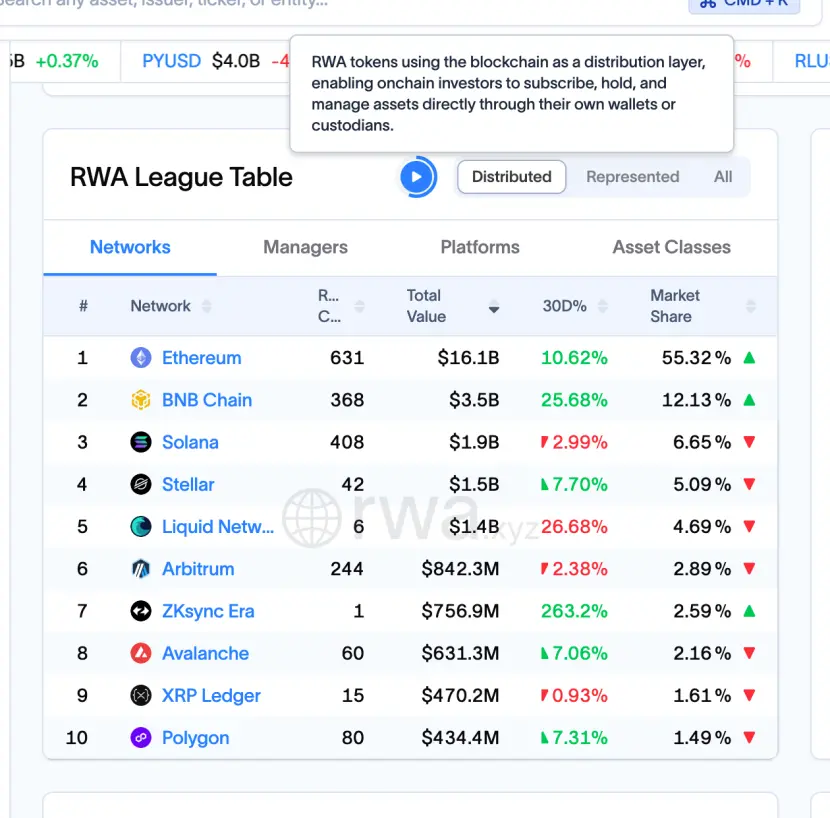
According to data from RWA.xyz, Ethereum still dominates in the value of RWA assets, with on-chain deployed assets exceeding $16 billion and a market share of over 55%; BNB Chain ranks second with $3.5 billion and a 12.13% share; Solana ranks third with about $1.9 billion and a 6.65% share. Most large tokenized government bonds and private credit platforms on the institutional side are still deployed within the Ethereum ecosystem.
In terms of RWA assets, the number of wallets and active addresses on Solana has now surpassed Ethereum. The growth of on-chain RWA users primarily stems from the launch of tokenized xStock stocks in mid-2025. Solana has opened a gap on the retail user side with its speed and low cost.
In this competitive landscape, both Ethereum and Solana are undergoing critical upgrades in 2026, each addressing their shortcomings. Ethereum's main line involves two major upgrades, Glamsterdam and Hegotá, focusing on making the mainnet run faster and more efficiently—through parallel execution, increasing gas limits, optimizing transaction sorting, and lowering node entry barriers to allow more people to participate in validation.
On Solana's side, the focus is on improving stability and risk resistance. In addition to the aforementioned new node policy, it has also upgraded its consensus mechanism to reduce final confirmation time from seconds to milliseconds, while introducing a second independent client to avoid "the entire network crashing if one software fails."
These two routes are converging in the same direction. At this stage, when real institutional funds and RWA assets begin to go on-chain at scale, the market's priority choice will still be more mature, stable, and predictable infrastructure. For Solana, the key lies in whether it can resolve structural issues such as centralization and transform "speed" into "trustworthy speed."
 Risk warning



Popular articles





