








Arthur Hayes Blog: What Goes Down Must Come Up

 Things that fall will surely rise again.
Written by: Arthur Hayes
Compiled by: Mary Ma Wu Says Blockchain
The current question is whether Bitcoin's price is at a "bottom." Bitcoin is the purest and most time-tested form of cryptocurrency. While it may not be the worst-performing cryptocurrency, its role as a reserve asset in the crypto world will ensure that Bitcoin leads us out of the dark shadows. Therefore, we must pay attention to Bitcoin's price movements to determine if this market has hit its bottom.
Three groups have been forced to sell their Bitcoin into the hands of true believers: centralized lending companies, Bitcoin mining companies, and ordinary speculators. In each case, whether in their business operating models or in how they leverage their trades, the abuse of leverage has been the cause of liquidations. As U.S. short-term Treasury yields have risen from 0% in Q3 2021 to the current 5%, everyone has suffered massive losses due to their super bullish beliefs.
After reviewing how rising interest rates have destroyed the positions of each group, I will explain why I believe they have no more Bitcoin to sell and why, in the long run, we may have already hit the cycle's low during the recent FTX/Alameda disaster.
In the final part of this article, I will outline how I plan to trade at this potential bottom. To this end, I recently attended a webinar by my macro idol, Felix Zulauf. At the end of the broadcast, he said something that impressed me. He stated that investors and traders need to pay attention to identifying tops and bottoms, but most people focus on the noise in between, and determining the bottom is often futile. Since I am doing this foolish task, I intend to try to call it in a way that protects my portfolio, maximizing the buffer against mistakes in price levels and/or timing.
With that in mind, let's dive deeper.
Most of us may not be as talented as Alameda's CEO (note: a jab at the chaotic accounting), so we have to learn math the hard way. Do you remember PEMDAS? It is an acronym that describes the order of operations when solving equations.
- P --- Parentheses
- E --- Exponents
- M --- Multiplication
- D --- Division
- A --- Addition
- S --- Subtraction
In fact, decades after first learning this acronym, I still remember it, which speaks to its stickiness.
But equations are not the only things that have a static order of operations: bankruptcies (and the ensuing contagion) also occur in a very specific sequence. Let me first explain what this sequence looks like and why it occurs.
But before that, I must acknowledge that no one wants or intends to go bankrupt. Therefore, if I offend those who have suffered losses due to SBF's misdeeds, I apologize in advance. However, this fraudster has just been running his mouth, saying stupid things that need others to prompt him to say. So the rest of this article will be interspersed with the sad drama of SBF and what he is responsible for. Now, let's get back to the point.
Centralized lending companies (CELs) typically go bankrupt because they either lend money to entities that cannot repay or experience maturity mismatches on their loan books. The reason for the maturity mismatch is that banks receive deposits that can be withdrawn by depositors in a short time, but they lend out those deposits over a longer term. If depositors want their money back or demand higher interest rates due to changing market conditions, then without an injection from some white knight company, CELs will become insolvent and quickly go bankrupt.
Before CELs are unable to repay or go bankrupt, they will try to raise funds to improve the situation. The first thing they will do is to recover as many loans as possible. This primarily affects those who have borrowed money from them in the short term.
Imagine you are a trading company that borrowed money from Celsius, but within a week, Celsius demands the return of those funds, and you have to comply. As a trading company, being called back during a bull market is not a big deal. There are many other CELs that will lend you money, so you don’t have to liquidate your existing positions. However, when the bull market fades and a credit crunch occurs across the market, all CELs typically call back their loans at the same time. With no one able to turn to additional credit, trading companies are forced to liquidate their positions to meet capital requirements. They will first liquidate their most liquid assets (i.e., BTC and ETH), hoping their portfolio does not contain too many illiquid junk coins like Serum, MAPS, and Oxygen (like Alameda and 3AC did).
After CELs recover all the short-term loans they can, they will begin to liquidate the collateral backing their loans (assuming they actually required collateral, note: a jab at Voyager's unsecured credit). In the cryptocurrency market, before the recent implosion events, the largest category of collateralized loans was backed by Bitcoin and Bitcoin mining machines. Therefore, once things start to deteriorate, CELs begin to sell Bitcoin, as it is the most commonly used asset for collateralized loans and the most liquid cryptocurrency. They also turn to the mining companies they lent to, demanding Bitcoin or their mining machines, but if these CELs do not operate a data center with cheap electricity, mining machines are as useful as SBF's accounting skills (note: sarcastic).
Thus, despite the ongoing credit crisis, we see a massive amount of Bitcoin being sold on the spot market impacting both centralized and decentralized exchanges:
CELs trying to avoid bankruptcy by selling Bitcoin used as collateral.
Trading companies seeing their loans called back and forced to liquidate. This is why Bitcoin's price plummets before CELs go bankrupt. It is a big move. The second drop (if there is one) is driven by a fear that once-unshakeable companies suddenly start to appear zombie-like, about to liquidate assets. This is often a smaller move because any company facing bankruptcy risks has already been busy liquidating Bitcoin to survive the collapse.
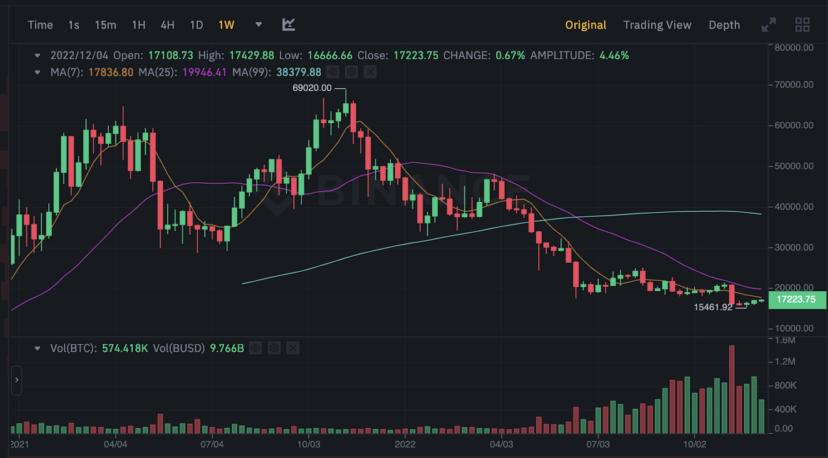
The trading volume of BTC/BUSD on Binance illustrates that there was a surge in volume during the two credit crises of 2022. It was during this time span that all these once-legendary companies were gritting their teeth.
In summary, as CELs transition from solvency to insolvency and then to bankruptcy, other participants in the ecosystem are also affected:
Trading companies that borrowed short-term funds from CELs see their loans called back.
Bitcoin mining companies that typically use Bitcoin on their balance sheets, future Bitcoin to be mined, and/or Bitcoin mining machines as collateral.
The two most ignorant cryptocurrency trading companies, Alameda and 3AC, grew to such massive sizes due to cheap borrowing. For Alameda, the polite way to say it is that they "borrowed" it from FTX customers, although others might call it theft. In the case of 3AC, they deceived gullible and desperate CELs into lending them money with little or no collateral. In both cases, banks believed these companies and other trading firms were engaging in super-smart arbitrage trades that insulated them from market changes. However, we now know that these companies were just a bunch of degenerate, long-only gamblers. The only difference between them and the masses is that they had billions of dollars to play with.
What did we see when these two companies got into trouble? We saw the most liquid cryptocurrencies, Bitcoin (WBTC in DeFi) and Ethereum (WETH in DeFi), being transferred in large amounts to centralized and decentralized exchanges and then sold. This happened during the big downturns. When the dust settled, and both companies could not raise the assets on their balance sheets above their liabilities, the remaining assets were almost entirely illiquid junk coins. By looking at the bankruptcy filings of centralized lending institutions and trading companies, we are not entirely clear on what crypto assets remain. The filings lump everything together. Therefore, I cannot prove that all the Bitcoin held by these bankrupt institutions was sold off during multiple collapses, but it appears they did their utmost to liquidate the most liquid crypto collateral before going bankrupt.
CELs and all major trading companies have sold off most of their Bitcoin. What remains are only illiquid junk coins, private equity of crypto companies, and locked pre-sale tokens. How the bankruptcy court ultimately handles these assets is unrelated to the development of the crypto bear market. What comforts me is that these entities have almost no excess Bitcoin left to sell. Next, let’s look at Bitcoin miners.
Bitcoin Mining Companies
Electricity is priced and sold in fiat currency, and it is a key input for any Bitcoin mining business. Therefore, if a mining company wants to scale, they either need to borrow fiat currency or sell Bitcoin on their balance sheet in exchange for fiat to pay for electricity. Most miners want to avoid selling Bitcoin at all costs, so they take out fiat loans using Bitcoin on their balance sheets, future Bitcoin to be mined, or Bitcoin mining machines as collateral.
As Bitcoin prices rise, lenders feel emboldened to lend more fiat to mining companies. Miners are profitable and have hard assets to borrow against. However, the ongoing quality of loans is directly related to the price level of Bitcoin. If the price of Bitcoin drops rapidly, then before the mining company can earn enough revenue to repay the loan, the loan will breach the minimum margin level. If this happens, lenders will step in and liquidate the miners' collateral (as I described in the previous section).
As far as we know, this happens due to a massive decline in asset prices, particularly in a cryptocurrency bear market, which, combined with rising energy prices, has squeezed miners across the industry. Iris Energy is facing creditor claims for defaulting on a $103 million equipment loan. In September, Compute North was the first major participant to file for bankruptcy, and other large companies, including Argo Blockchain (ARBK), also seem to be teetering on the edge of insolvency.
However, let’s look at some charts to see how these waves of cryptocurrency credit tightening have affected miners and how they have reacted.
Glassnode published a great chart showing the net change in Bitcoin held by miners over 30 days.
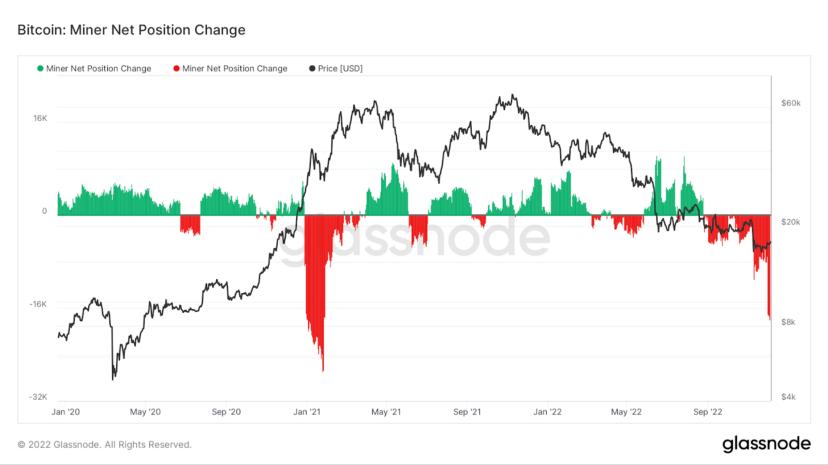
We can see that since the first credit tightening in the summer, miners have been net selling large amounts of Bitcoin. They have to do this to try to maintain their large fiat debt burdens. And if they have no debt, they still need to pay for electricity, and with Bitcoin prices so low, they must sell more Bitcoin to keep their facilities running.
While we do not know, and will never know, if we have reached the maximum amount of net selling, at least we can see that in this case, the behavior of mining companies is what we would expect.
Some miners have not succeeded, or they have had to downsize their operations. This is evident in the changes in hash rate. I first calculated a rolling 30-day average of the hash rate. Then, I looked at this rolling average and the 30-day change. I did this because the hash rate is quite volatile, and it needs some smoothing.
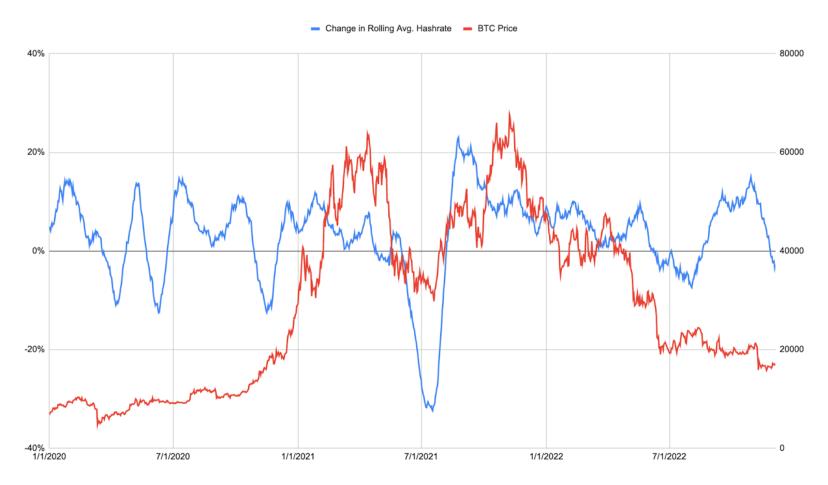
In general, the hash rate has an upward trend over time. However, there are also periods where the 30-day growth is negative. After the summer collapse, the hash rate declined, and then recently plummeted due to the impact of FTX/Alameda. This again confirms our theory that miners will scale back operations when there is no more credit available to fund their electricity costs.
We also know that some high-cost miners have had to cease operations because they are in default on loans. Any lender that has mining machines as collateral may find it difficult to utilize them since they are not in the business of operating data centers. And because they cannot use these machines, lenders must sell these machines on the secondary market, and this process takes time. This is also a reason for the decline in hash rate over a period.
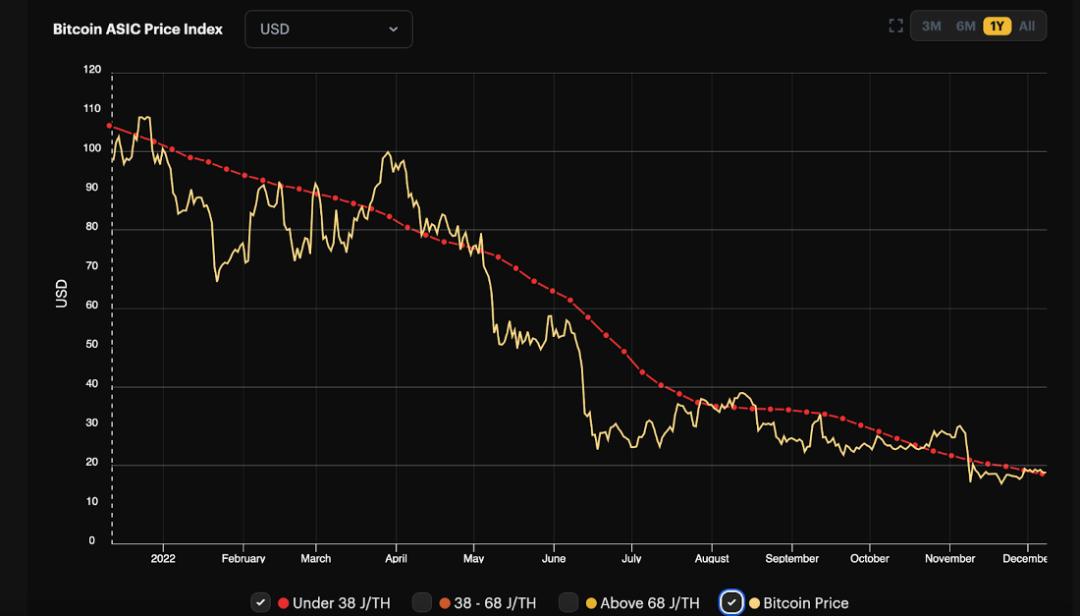
This is a price chart for Bitmain S19 or other similar mining machines with efficiency below 38 joules (J) per terahash (TH). As we can see, the collateral value of the S19 has plummeted alongside the price of Bitcoin. Imagine you used these mining machines as collateral to borrow dollars. The miners you lent to are trying to sell Bitcoin to provide more fiat to repay your loan, but ultimately cannot do so because the marginal profit margin has decreased. The miners then default on the loans and hand over their mining machines as repayment, which are now worth almost 80% less than when the loan was taken out. We can speculate that the most fervent lending points were near the market top. Ignorant lenders always buy high and sell low, every time!
Since CELs have a large amount of mining equipment that cannot be easily sold and operated, they may try to sell this equipment to recover some funds, but it will be in the single digits since the trading price of new mining machines is down 80% from a year ago. They cannot operate the mining farms because they lack a data center with cheap electricity. This is the reason for the disappearance of hash rate, as the mining machines cannot be restarted.
Looking ahead, if we believe that most mining loans have disappeared and there is no new capital to lend to miners, we can expect miners to sell off most of their block rewards.
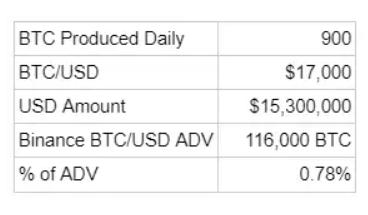
As shown in the table above, if miners sell all the Bitcoin they produce daily, it will hardly have any impact on the market. Therefore, we can ignore this ongoing selling pressure as it can be easily absorbed by the market.
I believe that the forced selling of Bitcoin by CELs and miners has come to an end. If you had to sell, you have already done so. If you have an urgent need for fiat, there is no reason to hold on to it for continued growth. Given that almost every major CEL has stopped withdrawals or gone bankrupt, there are no more mining loans or collateral left to liquidate.
Small-Scale Speculators
These gamblers are ordinary traders. While many of these individuals and companies will certainly collapse, it is expected that the failures of these entities will not have a massive negative impact across the entire ecosystem. That said, their behavior can still help us guess where the bottom might be.
The Bitcoin/USD perpetual contract (invented by BitMEX) is the most traded among all crypto instruments. The number of open long and short contracts is referred to as open interest (OI), which tells us how speculative the market is. The higher the speculation, the more leverage is used. As we know, when prices change rapidly, it leads to a large number of liquidations. In this case, the historical highs of OI coincided with the historical highs of Bitcoin. As the market declined, margin longs were liquidated or closed, which also led to a decrease in OI.
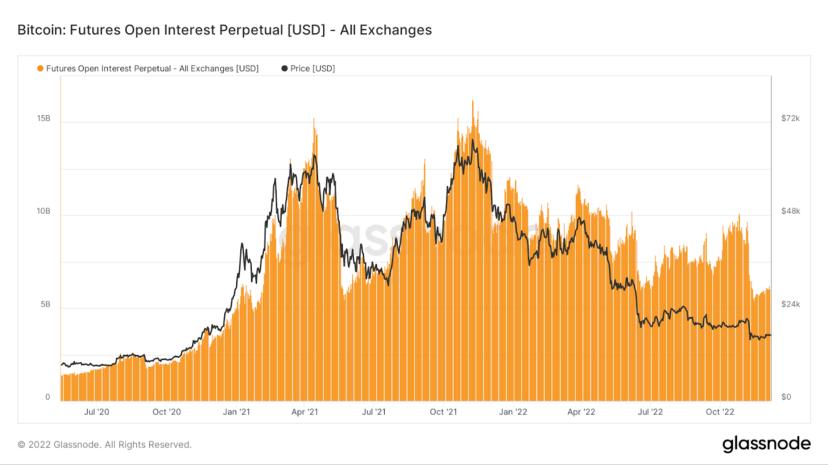
Looking at the total OI across all major centralized cryptocurrency derivatives exchanges, we can see that the local low in OI also coincided with Bitcoin's dip below $16,000 on Monday, November 14. Now, OI has returned to levels not seen since early 2021.
The timing and magnitude of the decrease in OI lead me to believe that most over-leveraged long positions have been extinguished. What remains are traders using derivatives as hedges and those using very low leverage. This gives us a foundation for a potential rise.
As we enter the sideways, non-volatile part of the bear market, can OI decrease further? Of course. However, the rate of change in OI will slow down, which means that chaotic trading periods characterized by large liquidations (especially on the long side) are unlikely to occur.
Timing to Re-enter
What I do not know
I do not know if $15,900 is the bottom of this cycle. However, I am confident that the forced selling brought on by the credit tightening has stopped.
I do not know when or if the Federal Reserve will start printing money again. However, I believe that due to the Federal Reserve tightening monetary policy, the U.S. Treasury market will experience dysfunction at some point in 2023. By then, I expect the Federal Reserve to ease again, and then bang, bang, bang, Bitcoin and all other risk assets will soar.
What I do know
Everything is cyclical. What goes down will rise again.
I like to earn close to 5% yields through U.S. Treasury bills with maturities shorter than 12 months. Therefore, while waiting for the return of the cryptocurrency bull market, I hope to earn some yield.
What to do?
My ideal crypto assets must outperform Bitcoin and, to a lesser extent, Ethereum. These are the reserve assets of cryptocurrencies. If they are rising, my assets should at least rise by the same amount, which is referred to as crypto beta. The asset must generate yield that I can claim as a token holder. This yield should certainly be much higher than the 5% I could earn by purchasing 6-month or 12-month Treasury bills.
My portfolio contains some super strong assets like GMX and LOOKS. In this article, I will not explain why I will opportunistically sell my U.S. Treasury bonds in the sideways bear market over the next few months and buy these tokens. However, if you want to start looking for the right assets that can participate in the upside while earning income while waiting for the bull market to return, open a website like Token Terminal and see which protocols can generate actual income. Then it is up to you to research which protocols have attractive token economics. Some may generate a lot of income, but it can be difficult for token holders to extract their share of the income into their wallets. Some protocols continuously pay a large portion of their income directly to token holders.
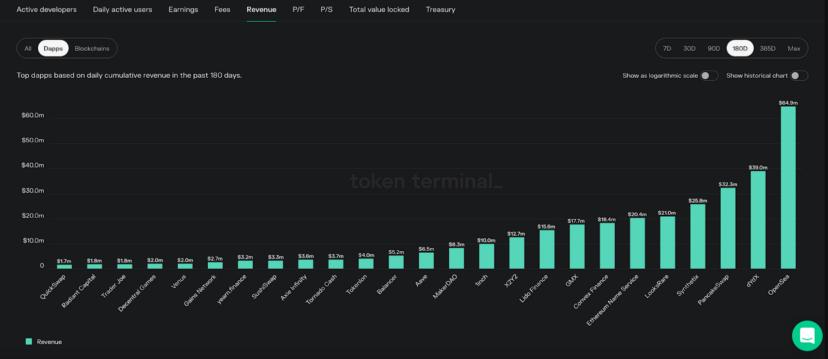
The best part of some of these projects is that DeFi was hit hard during the two downturns of the 2022 crypto credit crisis. Investors threw out good projects along with bad ones as they rushed to raise fiat to repay loans. As a result, the price-to-fee ratio (P/F) of many such projects has indeed been smashed.
If I can get a 5% yield from Treasury bills, then when I buy these tokens, I should at least aim for a 4x yield, or 20%. A 20% annual yield means I should only invest in projects with a P/F ratio of 5 times or lower. Everyone has different expected rates, but this is mine.
I could buy Bitcoin or Ethereum, but neither of these cryptocurrencies provides me with enough yield. If I do not get enough yield, I hope that when the market turns, the price in fiat terms will rise significantly. While I believe this will happen, if there are cheap protocols where I can get the returns of Bitcoin and Ethereum, plus the yield from actually using the services, that would be fantastic!
Investing at what you think is the bottom is certainly risky. Brave and noble warriors, do not be afraid, for the spoils belong to the faithful.
 Risk warning
 Risk warning




Popular articles





