








Analyzing the selling pressure issue of the Ethereum Shanghai upgrade from nine aspects

 Even if the Shanghai upgrade opens up withdrawal functions, its impact on the selling pressure of ETH is limited. However, the event of the Shanghai upgrade itself is beneficial for the long-term development of the Ethereum ecosystem, which can be considered a long-term positive event.
Author: Blue Fox Notes (Twitter: @lanhubiji)
The Ethereum Shanghai upgrade is scheduled for March this year, one of which is the unlocking of ETH staking on the Beacon Chain, known as EIP-4895. As of the time of writing, the total staked ETH is approximately 15.85 million ETH, accounting for about 13% of the total ETH supply, with a total of 495,000 active validators and an annualized interest rate of 4.2%.

Many people are concerned that after the unlocking of staking, there may be significant selling pressure. Some bears believe that the previous ETH price in USD was low, and after unlocking, there will be considerable profit in USD, leading to a high likelihood of selling.
How to view this issue?
Based on the current situation, it is highly unlikely that there will be significant selling pressure (of course, future price changes depend on more factors; here we only discuss the potential selling pressure from this single event). From nine aspects:
1. Unlocking withdrawals is a gradual release, not a sudden influx into the market
Currently, a gradual unlocking model is being used. Theoretically, the daily withdrawal limit is about 55,000 ETH. Ethereum can activate about 7.55 validators per epoch (total validators/65,536), with 225 epochs per day. This means that currently, about 55,000 ETH can be unlocked each day at most.
Additionally, the withdrawal rate will be adjusted based on the total amount of staked ETH to prevent sudden large outflows.
2. Most early stakers are long-term supporters of Ethereum
The early users who were willing to take significant risks and uncertainties to enter the ETH staking market are primarily a user group with a high-risk appetite, most of whom are long-term and steadfast supporters of Ethereum. This group is relatively less willing to sell in the current bear market.
3. Many stakers who wish to exit have already done so
Most staking participants use Lido or CEX, and some have already completed their exits. For example, users who staked through the Lido protocol can exchange their stETH for ETH through Curve without waiting for the Shanghai upgrade to unlock withdrawals. Data shows that at various times last year, stETH had significant discounts. This means that some users who wanted to exit sold their stETH for ETH. This also includes some institutions that completed their stETH exits due to previous incidents.
4. The unlocking may actually attract more institutions or large holders
With the opening of staking withdrawals, it may attract more institutions or large holders. First, this feature itself brings confidence to more users; second, it provides better exit channels for these users without worrying about liquidity or discounted exits; third, these users also have a demand for relatively stable returns in a bear market (currently, the annualized yield for ETH is about 4.2%, which, although not comparable to DeFi during a bull market, is still attractive for long-term supporters given the current market situation). A rough estimate suggests that after the opening of staking, there may be a slight decline in the short term, but the overall trend is upward, potentially breaking 20% of the total ETH supply in about a year.
5. The cost of entering ETH staking is not low
According to the bears' cost theory, the average entry cost is actually not low. The cost of the first batch of staked ETH was around $500, but the increase in staking was gradual. A rough estimate (without precise data) suggests that a large proportion of staking costs are around $1,500 or higher, which is above the current market price.
6. The nature of ETH as an asset has fundamentally changed after PoS
First, ETH is gradually moving towards deflation, which has a huge impact on ETH. Since the Ethereum merge, it has been 112 days, during which only 4,248 new ETH have been issued (as of the time of writing). Without the merge, there would have been 1,332,883 new ETH issued in these 112 days, worth about $1.66 billion, meaning the potential selling pressure has decreased by about $15 million per day. ETH holders, even if they do not participate in staking or DeFi yield activities, can still capture the value of ecosystem growth by simply holding it in their wallets.
Second, ETH can earn yields through staking. Currently, the annualized yield is about 4.2%. With staking yields, ETH not only serves as the security backbone of the entire network but also captures the returns from ecosystem growth, fundamentally changing its nature. As the ecosystem grows, it provides larger-scale security services for L2 and its networks, and ETH will ultimately benefit. In other words, ETH has become a true underlying asset of the ecosystem. It has more and more use cases to support it, and when these networks grow to a certain scale, ETH has the opportunity to generate monetary premiums, becoming not only a payment medium within the ecosystem but also gradually possessing value storage attributes. From this perspective, it competes with BTC as well.
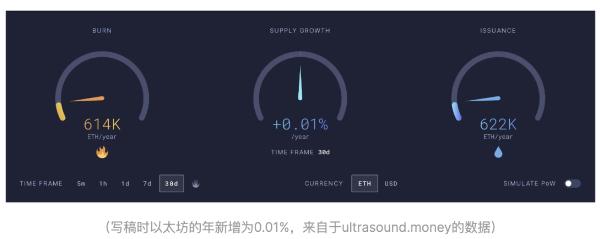
Moreover, compared to other chains or projects, such as BTC and Solana, the new issuance of ETH is very low. As of the time of writing, according to MoneyPrinter's statistics, the annual new issuance rate of BTC is 1.8%, Dogecoin is 3.58%, Solana is 6.43%, and ETH is currently only about 0.01%, which is roughly 180 times lower than BTC; over 350 times lower than Dogecoin; and over 600 times lower than Solana. The new issuance rates of BTC and Solana are not particularly high either, with many exceeding 10%, such as Osmosis at 39.2% annual new issuance; Balancer at 13%; and Curve at 10.21%.
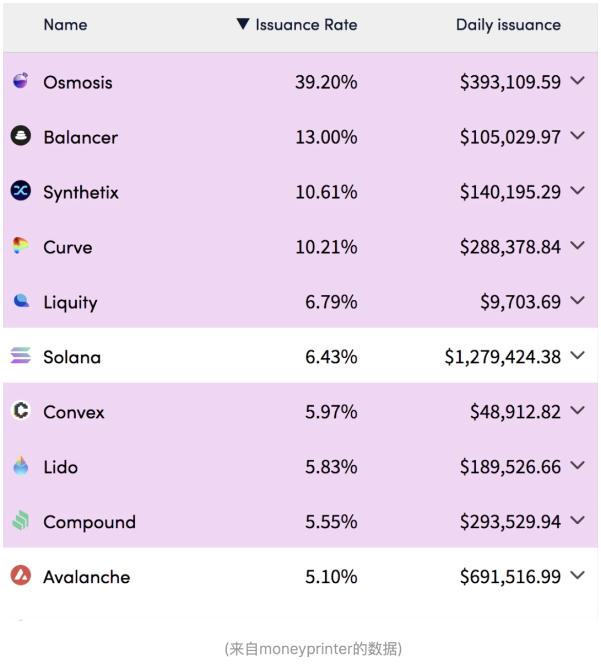
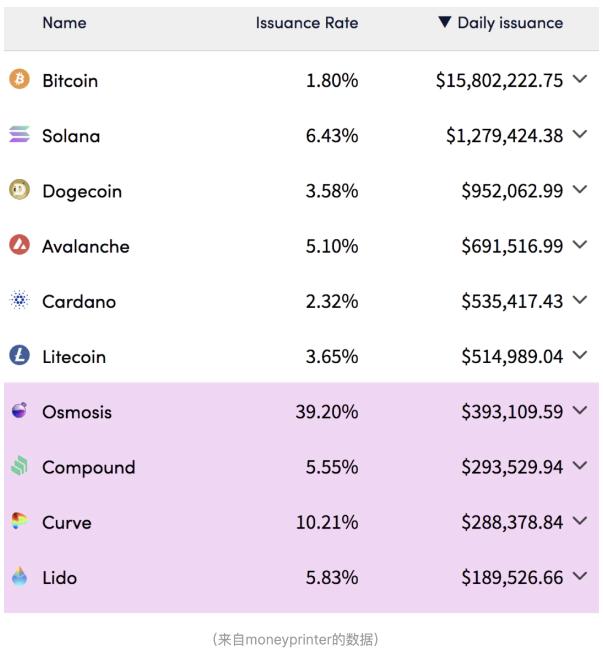
If we do not calculate based on new issuance rates but rather on daily new value, Ethereum also ranks among the lowest. Based on current conditions, BTC's daily new value reaches over $15.8 million (with monthly new issuance exceeding $47 million); Solana's daily new issuance exceeds $1.27 million (with monthly new issuance exceeding $38 million); Dogecoin's daily new issuance exceeds $950,000 (with monthly new issuance exceeding $28 million); Avalanche's daily new issuance is $690,000 (with monthly new issuance exceeding $2 million). As of the time of writing, Ethereum's average daily new issuance after the merge is about 38 ETH, which means the daily new value is less than $50,000, with a monthly new issuance of about $1.5 million. This means that ETH's daily new value is over 300 times lower than BTC; over 25 times lower than Solana; over 19 times lower than Dogecoin; and over 13 times lower than Avalanche.
Currently, it is a bear market, and gas consumption is relatively low. If the market becomes active in the future, Ethereum's daily deflation will also be quite considerable.
At present, both the new issuance rate and the daily new value of ETH are significantly lower than those of other public chains and much lower than BTC.
7. Ethereum's community consensus
Ethereum has a foundation of developers, an ecosystem, and a user base, which has formed a relatively strong community consensus. This community consensus, along with the continuous development of the Ethereum ecosystem, including L2 gradually surpassing most public chains, will only strengthen Ethereum's role as the foundational settlement layer and security provider in the crypto space. The existence of a sufficient moat will gradually be recognized by more institutions and users.
8. The yield rate of ETH staking is a dynamic game
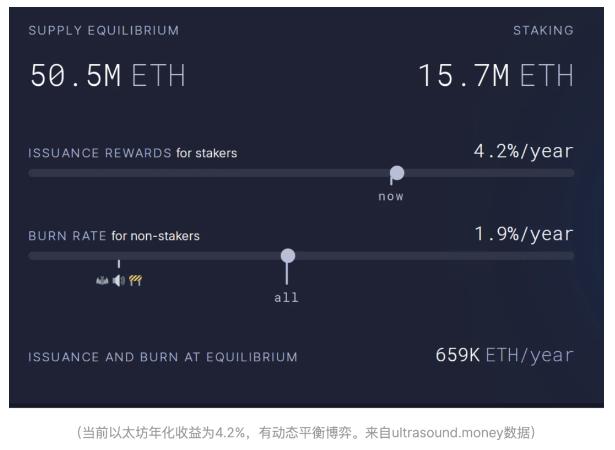
The less ETH is staked, the higher the yield rate; if the staking amount decreases to a certain extent, the yield rate will rise, attracting more participants. This relatively stable yield will appear more attractive in a bear market. Thus, there exists a dynamic equilibrium here.
When the amount of staked ETH is at 1 million, the annualized yield can reach 18.1%; when the amount of staked ETH is at 10 million, the annualized yield is about 5.72%; when the amount of staked ETH is at 12.5 million, the annualized yield is at 5%; and when it reaches 30 million, the annualized yield is about 3.3%.
9. The Shanghai upgrade includes other upgrades besides ETH staking unlock
The Shanghai upgrade not only includes the unlocking of ETH staking but also other upgrades that benefit the long-term development of its ecosystem. For example, EIP-3651 helps miners save gas fees and speeds up miner transactions; EIP-3855 can also reduce gas consumption; EIP-3860 supports larger contracts and the deployment of more feature-rich contracts, benefiting developers in launching more imaginative dApps; EIP-3540 (EVM Object Format EOF) V1 supports the separation of contract code and data, simplifying contract interactions, etc.
Conclusion
Overall, even if the Shanghai upgrade opens the withdrawal function, its impact on ETH selling pressure is limited. As for the event of the Shanghai upgrade itself, it is beneficial for the long-term development of the Ethereum ecosystem and can be considered a long-term positive event.
Finally, it is important to remind that although the Shanghai upgrade will not bring significant short-term selling pressure, it is a separate matter from the price fluctuations of ETH itself. If a black swan event occurs during this period, it will still impact the market, even without staking unlocks.
Risk Warning: All analyses above are merely partial observations of technology and the market and may not be accurate. Please maintain your own judgment and manage risk appropriately.
 Risk warning
 Risk warning




Popular articles





