








Understand Web3 Bill Interest Discount Product Flashstake in One Article

 Flashstake allows users to earn returns on their deposited assets at a fixed interest rate immediately for a set period.
Author: veDAO
If you were asked to deposit $10,000 and then receive $1 every day, would you be willing?
Many people would be unwilling, as this is not a profitable deal.
On one hand, due to inflation and discount rates, the current value of money will depreciate at a rate of about 3% per year. For example, considering interest rates, the current 100 yuan will be roughly equivalent to 103.5 yuan after one year; in other words, 100 yuan a year later is worth about 97 yuan today.
Receiving $1 every day means it would take nearly 28 years to recover the principal, which is unfair to users. Users are giving up the purchasing power of current money but are burdened with the costs of currency depreciation and inflation.
On the other hand, the reason is simpler: depositing $10,000 means a significant liquidity gap in hand, which is not conducive to the reinvestment and appreciation of wealth.
The above assumptions are a simple discussion about staking and liquidity issues. The reason for discussing this issue is that the current industry is hot on the LSD concept, which coincidentally raises questions about staking and liquidity. The veDAO Research Institute also elaborated on the LSD concept in the previous article.
Now let's ask the question differently: if you were asked to deposit $10,000 and then receive a one-time advance of your annual interest of $365, would you be willing? This is not a hypothetical scenario but one of the financial products favored in the current LSD sector, Flashstake, which has recently gained significant attention from industry Smart Money alongside Pendle Network, Gearbox, eigenLayer, and is considered an important wealth amplifier in the LSD sector.
What is Flashstake?
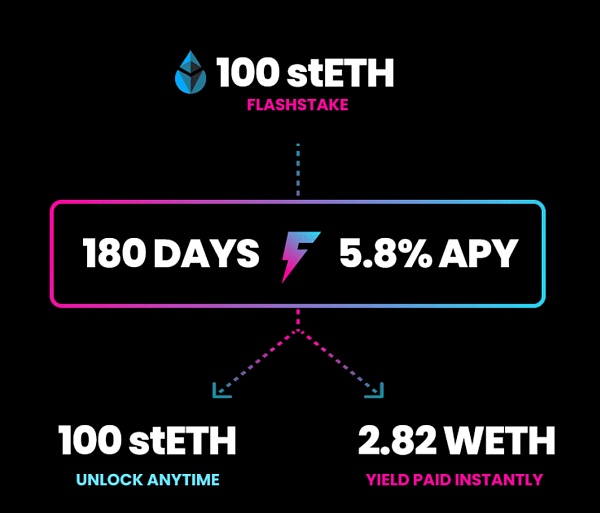
Flashstake is an innovative financial infrastructure that allows users to receive the returns on deposited assets immediately at a fixed interest rate for a set period. For example, if a user chooses to stake 100 stETH for 180 days, the Flashstake protocol will immediately give you 2.82 wstETH, with an annual yield of about 5.8%.
According to the white paper, FlashStake consists of three main components:
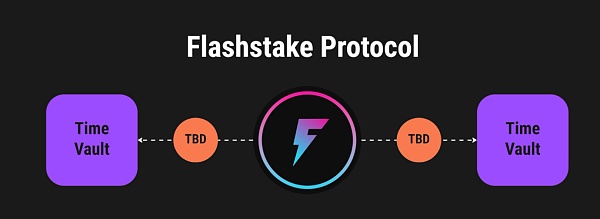
FlashStake Protocol (FSP): Facilitates the creation and activities of Time Vault strategies. FSP is the core of FlashStake and has three main responsibilities:
Store the balances of all Flashstaking activities
Deploy and register Time Vault Strategies (TVS)
Create and mint time-based derivatives (TBD)
Time Vault Strategies (TVS): Custom smart contracts for users to buy, sell, and earn TBD, helping people trade and earn TBD.
Vitalik uses Lido Time Vault to generate early returns on his stETH
Stani uses Aave v2 Time Vault to generate early returns on his USDC
Hayden uses Uniswap v3 Time Vault to generate early returns on his ETH/DAI LP tokens
With almost unlimited possibilities, Time Vaults can flexibly make important Flashstaking decisions. Ultimately, Time Vault Strategies are where the complex logic of Flashstake occurs.
Below are examples of three different individuals using three different Time Vault strategies.
Time-based Derivatives (TBD): Represent the monetary time value of any digital asset
When people invest in Time Vault strategies, time-based tokens are generated. Each individual Time Vault strategy has a uniquely assigned TBD.
Example: Staking USDC in Aave v2 Time Vault strategy generates fUSDC TBD
Example: Staking stETH in Lido Time Vault strategy generates fstETH TBD
Example: Staking ETH/DAI LP in Uniswap Time Vault generates ETH/DAI TBD
TBD is an ERC-20 token created by the Flash protocol whenever a new strategy is registered. TBD is specific to a given strategy and represents the yield pool. This means that 100% of the total supply of TBD can be redeemed for 100% of the total yield in the yield pool of a given strategy.
Token Economics
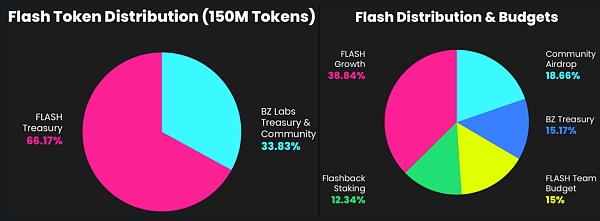
The official token of Flashstake is FLASH, with a total supply of 150 million tokens. No more tokens can be minted, and FLASH has not been distributed through financing, public offerings, or private placements. Flashstake is built on previous versions and is driven by Blockzero Labs and its community. About one-third (33.83%) is allocated back to the Blockzero ecosystem, enabling the development of Flashstake: of which, 15.17% is allocated to the DAO Treasury; 18.66% is allocated to DAO Members.
The remaining two-thirds (66.17%) are allocated to the Flashstake Treasury for various project activities: of which, 38.84% is allocated to the protocol growth budget; 12.34% is allocated to the Flash staking budget; 15% is allocated to the core contributors budget.
Flashstake Gameplay
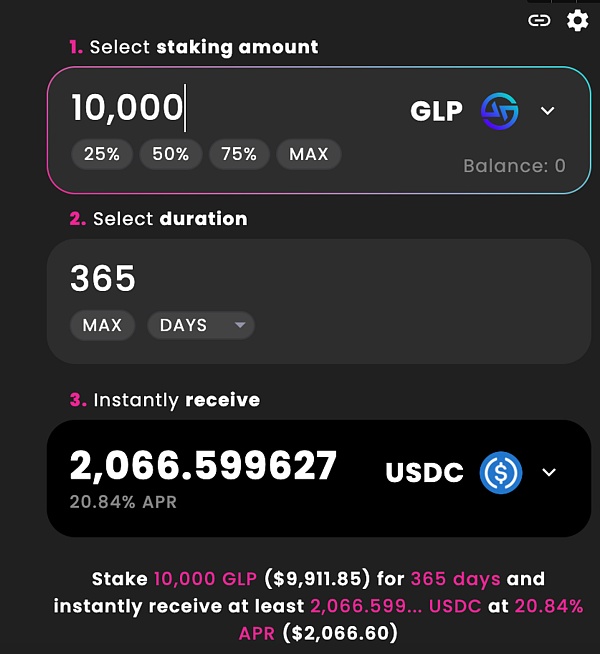
Flashstake is humorously referred to as the time-travel wormhole of interest. For users, Flashstake allows anyone to buy, sell, and earn the potential future value of staked funds today. Users only need to complete three steps: choose the amount to stake; choose the duration of the stake; then receive an advance on the interest.
In other words, Flashstake can unlock your immediate yield, which may be the reason this project is gaining attention in the LSD space: for LSD users, the liquidity of staked funds is not enough; Flashstake is needed to bring more short-term value to the funds.
There are two staking methods in Flashstake, corresponding to different user sentiment groups.
The first staking method is what we commonly understand as Stake:
In this staking model, the user experience is consistent with other staking products, where users deposit their principal into Flashstake, which then puts the user's funds into the staking pool, helping users earn more returns through protocol strategies.
The other staking model is Flash stake, which is a feature of this product: users deposit their principal into FlashStake and immediately receive a guaranteed return for a certain period.
It is worth noting that the guaranteed interest received by users is not generated out of thin air, but is based on the actual profits that users would have earned if they had used the ordinary Stake over a certain period. This portion of the profit comes from other users who are using the ordinary Stake. As compensation, stake users can earn the profits from the staked assets of Flashstake users during the staking period.
As Twitter user @nanbeiblock stated, Flash stake users are essentially shorting yields, while stake users are going long on yields.
For some DeFi users, this can bring many benefits. First, users can achieve a higher annual yield.
Some may ask, if I deposit 100 ETH, I can only immediately receive 2.82 wstETH. Although I do not lose the principal, it still represents a significant compression of liquidity, and an annual yield of less than 3% is not attractive. However, in fact, the calculation cannot be made this way. Taking 100 ETH as an example, if deposited for one year, an 8.9% APY means the user can earn $15,818 USDC. If this portion of the asset is repeatedly executed with the Flashstake strategy, it can achieve 8.9% + 8.9 * 8.9% = 9.69%, close to 10%. Relying on the income-generating logic of the collateral itself, the TVL of this protocol can grow rapidly, and the best way is to deposit LP.
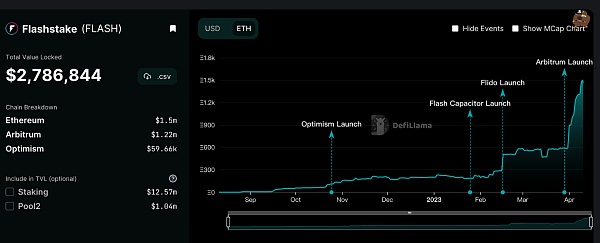
Secondly, users' Flash Stake actions will also earn rewards in the form of the protocol token FLASH. Unlike other Ethereum staking protocols like Lido Finance, the payment date and original amount of the rewards are fixed. If users do not immediately sell their FLASH tokens for profit, they can use them to withdraw their original deposits early. Users also do not need to worry about the deposited tokens being liquidated, as in Aave or Compound, because Flashstake is not a lending protocol.
However, the whole situation is not without drawbacks. Most importantly, the lack of liquidity for FLASH tokens poses an economic risk; if you want to exchange or sell them in large quantities on decentralized exchanges, you will face the threat of price drops (slippage).
Many users may decide to sell their tokens after Flash staking to realize their returns. A large sale of FLASH tokens will also reduce the returns for those who still hold the tokens or use them in other ways.
Finally, there is the financial Lego effect created by Flashstake in conjunction with other DeFi products.
For example, Pendle + Flashstake. Pendle Finance brings fixed income into DeFi yields, creating a yield market that allows users to tokenize and sell future yields, while Flashstake can unlock your immediate yields, providing users with higher annual yields.
Step 1: Lock GLP on Flashstake and receive an advance of 22.3% of the immediate interest. (Generally, the immediate interest will be lower than the corresponding interest earned from the Stake time; 100 days of Flashstake < 100 days of Stake. This can be seen as giving up the long-tail interest of 100 days to immediately obtain a lower immediate interest.)
Step 2: Go to Pendle to purchase YT-GLP (interest warrants), which will exempt your YT-GLP from zero-interest losses. (The YT-GLP notes on Pendle give users the right to rigidly obtain 1 GLP after 364 days. In other words, the current players hold 100% GLP on FlashStake + 22.3% expected GLP on Pendle.)
Regarding the principles of Pendle, the veDAO Research Institute will elaborate in the next article.
The reason for such an arbitrage window is that Flashstake's fixed APY has always been higher than Pendle's. Pendle has the deepest GLP yield trading market, so speculative new avenues for GLP yields will make this yield arbitrage possible.
Overall, the Flashstake protocol has many use cases. With the arrival of ETH upgrades and integration with more staking tokens (like GLP), FlashStake is likely to become a new star in the LSD sector.
 Risk warning
 Risk warning

Popular articles





