Messari: The mainnet launch is imminent, a comprehensive article to deeply understand Sui

 As the mainnet is about to launch, Sui's Devnet and Testnet have already supported over 200 projects covering various fields such as gaming, finance, law, and business.
Original Title: Diving Into Sui
Original Source: Micah Casella, Messari
Compiled by: BlockTurbo
Should there be another Layer 1 blockchain? Numerous platforms like Ethereum, Solana, and Avalanche are competing to become the primary base layer for smart contract development. Sui is a new smart contract platform that adopts a different blockchain data model approach, joining this competition. The original contributors of Sui, Mysten Labs, believe that Sui's data model will make it the first blockchain platform with internet-scale programmability.
The Sui tech stack addresses three core issues in the blockchain space: scalability, secure programming, and mainstream adoption. Sui's unique object-centric data model and consensus architecture enable the network to infinitely scale its capacity. Sui's programming language, Sui Move, is designed with security guarantees to prevent common hacking attacks/exploits and provide a better developer experience. Additionally, Sui plans to add a feature that allows applications to subsidize and withdraw consumer gas fees, creating a more streamlined user experience.
Background
In June 2019, Facebook (now rebranded as Meta) announced plans to build a permissioned blockchain and a digital wallet to support a global payment network. Meta spearheaded the formation of an independent consortium called the Diem Association (initially known as the Libra Association) to build the blockchain. Meta's subsidiary, Novi Finance (originally called Calibra), was responsible for developing the digital wallet.
Neither of these products fully materialized. Due to regulatory hurdles, Diem shut down in January 2022 and sold all its assets. Later that year, Meta terminated the Novi project without providing a direct reason. Before the shutdown, several project leaders believed that Meta's vision of building a global payment network would fail. Ultimately, two independent blockchains, Aptos and Sui, emerged from the initial Diem and Novi research. While Aptos inherited Diem's legacy and iterated on the technology developed for that project, Mysten Labs built a brand new Sui from the ruins of Diem.
Mysten Labs is the original contributor of Sui. It was founded in 2021 by former Novi project leaders Evan Cheng, Adeniyi Abiodun, Sam Blackshear, George Danezis, and Kostas Chalkias. The founders have extensive research and product experience in software language compilers, static analysis (programming security), distributed systems, cryptography, and cloud computing, having worked at companies like Apple, Oracle, Microsoft, R3, and Facebook. Notably, co-founder Evan Cheng received the ACM Software System Award for his involvement in designing LLVM, a technology widely used in Apple and Google devices.
The Sui blockchain has not yet officially launched, with plans to go live on May 3, 2023. In December 2021, Mysten raised $36 million in Series A funding, led by a16z, with participation from investors like Redpoint, Lightspeed, Coinbase Ventures, and Electric Capital. In the Series B funding round in September 2022, Mysten raised $300 million at a valuation of over $2 billion, led by FTX Ventures, with participation from a16z, Jump Crypto, Binance Labs, and others. Mysten Labs confirmed to Messari that these fundraisings were limited to equity sales and did not involve the provision of SUI tokens. (Regarding FTX, Mysten Labs completed a buyback of approximately $96 million for FTX's equity stake and the purchase of SUI token warrants.) Additionally, an independent foundation called the Sui Foundation was established to build the Sui community and fund/support the creation of products on Sui. The establishment of the Sui Foundation helps drive the development and expansion of the Sui ecosystem.
Sui plans to officially launch on May 3, 2023, and is expected to attract the attention of developers, project teams, and investors. With the launch of Sui, its unique technology and innovations may have a positive impact on the entire blockchain industry. Sui will continue to compete with other Layer 1 blockchain projects like Ethereum, Solana, and Avalanche for dominance in smart contract development. By addressing core issues such as scalability, secure programming, and mainstream adoption, Sui is poised to offer new possibilities and opportunities for the future development of the blockchain industry.
Technology
Object-Centric Data Model
A key distinguishing feature of Sui compared to other distributed ledgers is its object-centric data model. Most smart contract platforms, such as Ethereum, Solana, and Aptos, use accounts to track the state of the blockchain, where accounts are data structures that store user balances. Other platforms like Bitcoin and Cardano use unspent transaction outputs (UTXO) to record the state of the blockchain, meaning UTXOs represent the remaining amount of assets after a transaction is executed.
Sui combines these two approaches into a hybrid model, where its history is stored in objects with globally unique IDs. Objects also contain metadata to determine the characteristics of different objects, such as ownership and transaction history (partly derived from the object's random numerical value, also known as a version number). Sui's object-centric data model means that the global state is merely a collection of all Sui objects. Structurally, this takes the form of a directed acyclic graph (DAG), where objects correspond to vertices, transactions correspond to edges, and objects referred to as "active objects" correspond to vertices with no outgoing edges.
In Sui, all transactions take objects as inputs and generate new or modified objects as outputs. Each object contains the hash of the last transaction that produced it. Objects that can be used as inputs are referred to as "active" objects. Therefore, by observing all active objects, the global state can be determined.
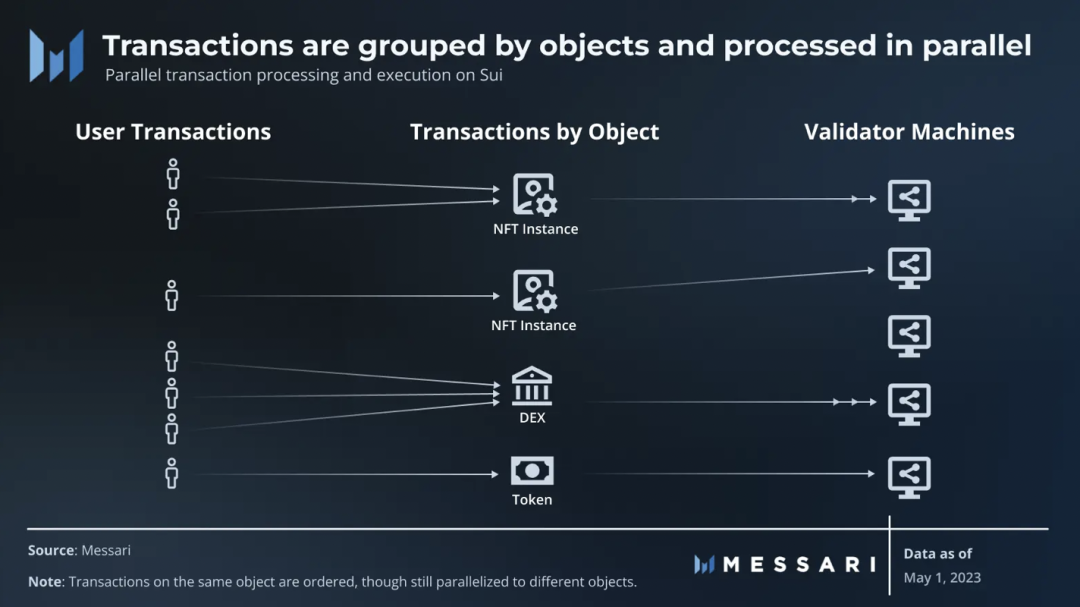
Sui's object-centric data model allows it to process object interactions in parallel at scale. Transactions on Sui are grouped based on the objects being interacted with. When multiple transactions are submitted simultaneously, as long as there are no interdependencies between the transactions, validators can process these transactions in parallel on separate machines. This system also provides a unique avenue for scalability, as the capacity increases with the addition of more machines to the network validators' nodes.
Objects on Sui can be owned objects (like fungible tokens and NFTs) or shared objects (like decentralized exchanges and auction contracts). Specifically, Sui objects can have four different types of ownership:
Objects owned by a single address (NFTs or fungible tokens)
Objects owned by other objects (for example, in a game NFT, a sword NFT can be owned by an avatar NFT)
Shared objects that anyone can read/write (decentralized exchanges or auction contracts)
Immutable objects that have no exclusive owner and are read-only (after an auction ends, the auction is frozen as immutable)
Sui Move
Solidity, the language used to write for the Ethereum Virtual Machine (EVM) and the most popular blockchain programming language, was officially released in July 2015. It wasn't until November 2015 that the concept of ERC-20 tokens was proposed. Due to the lack of built-in infrastructure in the EVM to operate on different digital assets as native resources, ERC-20 was proposed as a standard for smart contracts to create fungible assets. ERC-20 tokens played an indispensable role in subsequent crypto market peaks, such as the ICO boom of 2017 and the DeFi summer of 2020, emphasizing that the primary purpose of blockchain activity is to facilitate interactions of digital assets. Recognizing that blockchain development should focus on programming digital assets (referred to as "resources"), the Novi/Diem team built Move around this premise.
Mysten Labs modified Move (calling it Sui Move) to integrate it with its object-centric data model, as it was originally built for account-based systems. Sui Move supports two core objects: smart contracts (Move packages, which are a set of Move modules) and digital assets (resources). Sui's native support for resources is expressed through bytecode verification. After Sui Move source code is compiled into bytecode, a static analysis tool called the Move bytecode verifier ensures that the bytecode adheres to Sui's type, memory, and resource safety rules. This verification ensures that objects cannot be created, copied, or accidentally destroyed by code outside their defining module. It also includes protections against certain vulnerabilities such as double spending and reentrancy.
Requiring all code to pass through the bytecode verifier before being submitted on-chain eliminates the need for smart contract developers to write certain security rules themselves. In other blockchains, especially those that use accounts to store ledger state, these security protections are not guaranteed by the virtual machine. Instead, they must be manually coded by each smart contract developer interacting with digital assets. For example, one type of security protection guaranteed by the Move bytecode verifier includes account checks on Solana. Account checks can be difficult to implement correctly, leading to some of the largest hacks in the Solana ecosystem.
Notable vulnerabilities due to erroneous implementations that did not require additional code in Sui Move include:
Wormhole (Solana --- Account Replacement Vulnerability): $326 million
Cashio (Solana --- Account Replacement Vulnerability): $48 million
DAOHack (Ethereum --- Reentrancy Vulnerability): $50 million
Consensus
Sui validators do not package transactions into blocks like traditional blockchains; instead, they validate transactions individually and ultimately receive a finality certificate at the end of the process. According to Sui, validating transactions individually can reduce network latency. Since transactions are grouped by objects, validators can simultaneously process transactions for different objects, whether relative to each other or on their own machines (referred to as "worker nodes"). Such parallel transaction submissions enable large-scale execution.
Sui reduces latency by decreasing the communication needs between validators while shifting a significant amount of communication to users. These "users" typically run in the form of client gateway services interacting with applications (wallets for transfers, DEX entities for trading, etc.). While this may seem to add a layer of trust, it does not actually increase the trust assumptions. When using applications like MetaMask on Ethereum, users must trust that MetaMask accurately conveys the actions they want to execute on the blockchain. The same level of trust in applications exists in client communications on Sui, and additionally, the client plays a role in transaction processing.
Due to Sui's object-centric data model, any wallet or application executing a transaction can present transaction signature requests to users in a manner similar to Android-style permissions. That is, in addition to the signature request, the wallet or application will display a list of objects and how they will be modified, showcasing the downstream effects of the signed transaction.
All transactions require client communication. However, whether a transaction goes through Sui's ordering and consensus mechanism depends on whether the objects in the transaction are shared or non-shared.
Complex Transactions (Shared Objects)
Complex transactions involving shared objects are ordered and consensus through Sui's Narwhal and Bullshark protocols. The Narwhal memory pool maintains the availability of submitted transaction data and provides a structured path in the form of a directed acyclic graph to traverse (select order) this data. Bullshark consensus reaches agreement on a specific order of these structured data by achieving consensus on traversing a particular directed acyclic graph (ordering based on the DAG structure).
Complex transactions require five steps to reach finality.
Transactions are broadcast from their respective users/clients to the nodes.
Upon receiving the messages, validator nodes vote on the validity of the messages based on their stake size.
After the user/client collects a Byzantine-resistant majority of these votes, they generate a record certificate and broadcast it back to the validators.
The transaction certificate is ordered through Narwhal and Bullshark so that a Byzantine-resistant majority of validators can agree on the ordering of the transaction data.
Validators provide a final response, while the user collects an "impact" certificate, which is proof of state change and ensures the finality of the transaction.
Simple Transactions (Non-Shared Objects)
Simple transactions involving only non-shared objects do not require ordering through Narwhal and Bullshark. In other words, simple transactions can skip step 4 in the above transaction processing flow. Simple transactions are only constrained by a lightweight algorithm called Byzantine consistent broadcast, which has lower strength than Byzantine consensus and greater scalability. The broadcast ensures that all nodes receive the same message from the user/client; it does not require nodes to reach consensus on the network state, which is one of the complex parts of consensus algorithms.
Sui's data model allows validators to execute transactions in parallel through a causal ordering method (rather than total ordering (sequentially ordering transactions)). Causal ordering (how transactions affect the state of specific objects) allows Sui to group transactions based on objects. Therefore, if multiple transactions are unrelated (not involving the same object), these transactions can be processed in parallel in any order. However, transactions occurring on the same object need to be totally ordered in that specific object's transaction queue. All simple transactions bypass consensus.
Recent tests from Sui indicate that it has achieved a throughput of 297,000 simple transactions per second, with latency of less than half a second. This speed, along with the modularity of the ordering/consensus algorithms, has attracted blockchains like Celo and Sommelier to integrate Narwhal into their protocols.
DPoS
Sui uses Delegated Proof-of-Stake (DPoS) to determine the set of validators for each epoch. The total stake assigned to validators (including stakes delegated from their own and other SUI token holders) determines the voting power of validators in processing transactions. All honest validators will receive a proportion of the gas fees collected during the period based on the size of their SUI stake (details below) and temporary unlocking subsidies (Sui has not provided a specific end date).
Sui's system of paying rewards to all honest validators differs from systems that only pay rewards for transactions processed by validators. In these systems, larger validators grow at a faster rate due to their higher likelihood of being selected and receiving earlier rewards, while smaller staked validators have a lower probability. In Sui, all honest validators grow at the same rate. Delegators only receive rewards for calculating gas fees and inflation subsidies but must pay a commission to their validators.
As of May 3, 2023, Sui's testnet had 97 validators, of which only two were operated by Mysten Labs. Recommended hardware requirements for validators include a physical 24-core CPU/48 virtual CPUs, 128 GB RAM, and 2 TB SSD storage (NVMe is recommended).
Gas Fees
Sui's gas fees consist of two components: computation and storage.
Computation Gas Fees
Computation gas fees are determined by a gas pricing mechanism, where validators set the minimum gas price for each transaction in the current epoch. A "reference gas price" is then calculated based on the 2/3 percentile price of the stakes and published to users. Sui encourages validators to keep prices low but ultimately lets the validator market determine the gas price. Users can pay a "tip" above the reference price to increase the priority of their transactions. Thus, the computation gas price is the sum of the reference price and the tip.
Storage Gas Fees and Storage Fund
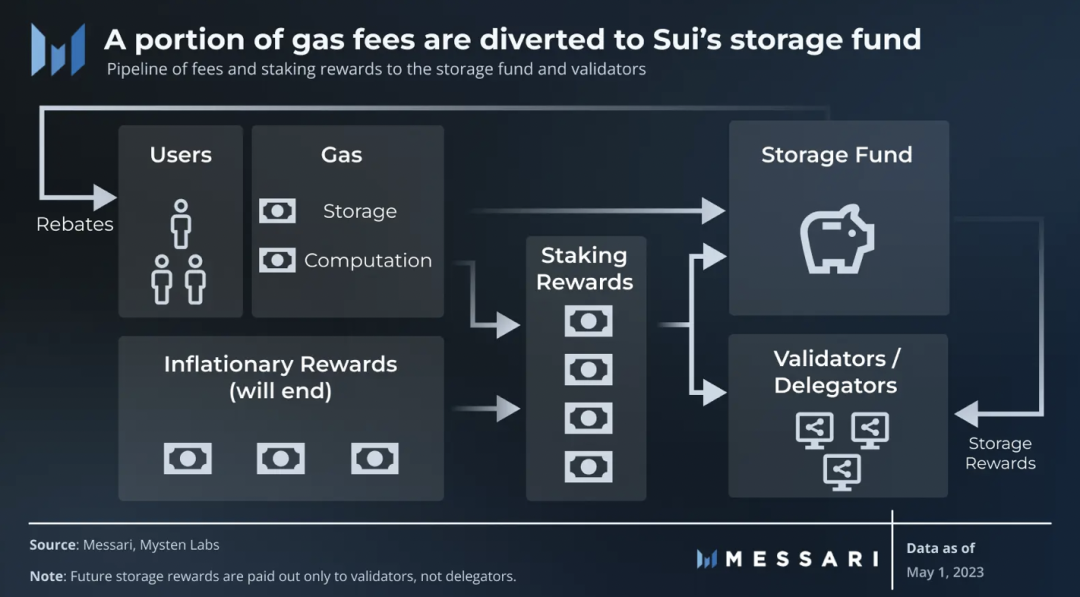
Validators (rather than delegators) receive storage fund rewards based on the size of the storage fund at the beginning of the epoch.
Sui's storage fund is a way to fund data storage on the network. By adding the capability to store arbitrary amounts of data, Sui addresses a common data storage problem: the validators storing raw data may differ from those maintaining the stored data in the future. Sui's storage fund receives a portion of the storage gas fees and network collateral rewards (computation gas fees plus inflation/unlocking of SUI). The collateral rewards accumulated by the storage fund are then immediately redistributed to validators. Users storing files on Sui can be refunded all gas storage fees they paid when they delete those files from storage. Storage fees are never paid to validators.
The storage fund creates temporary deflationary pressure on the SUI token. When demand for storage is high, fees increase, pulling more SUI out of circulation for future distribution.
Programmable Transaction Blocks (PTBs)
Sui supports a developer primitive called Programmable Transaction Blocks (PTBs). PTBs allow users to create a composable sequence of up to 1024 transactions that can atomically fail or succeed. By packaging transactions into a PTB, a single execution on Sui can perform 1024 operations. This approach increases transaction throughput and reduces the average cost per transaction.
PTBs can take many forms. They can be used for homogenous batch processing, such as minting a large number of NFTs or making multiple payments to several parties at once. They can also be used heterogeneously, taking the outputs of earlier transactions as inputs further along the sequence. For example, Sui's testnet has a DeFi-related PTB with 12 operations: 5 swaps across 3 different pools, changing 20 existing objects and creating 7 new objects in the process.
Abstracting Gas Fees
Sui also offers users the option to sponsor transactions. Sponsored transactions refer to a user (typically an application) paying gas fees for consumers interacting with the sponsoring platform. Co-founder Evan Cheng believes that "the concept of paying gas should be invisible." By allowing anyone to set up Sui Gas stations as backend support for sponsored transactions, Cheng's belief is becoming a reality on Sui.
Horizontal Scalability
Sui's architecture, data model, and transaction processing methods eliminate the need for Sui to reach global consensus on a total ordered list of transactions. Because the transaction pipeline is built for causal ordering, where transactions are grouped by objects, it can distribute workloads among validators, especially between validator machines (referred to as "worker nodes"). Thus, scalability increases as more worker nodes are added to the validator set. Scalability can be represented as an overall increase in the number of validators or a single validator adding more worker nodes/increasing its hardware resources (CPU, memory, storage, etc.).
To measure, Sui tested its capacity using a validator hardware configuration of 24-core AMD, 256GB RAM, and 25Gbps NIC, achieving between 11,000 and 297,000 transactions per second across various workloads, with final latency of half a second. Simple transactions include peer-to-peer transfers, oracle messages, social network posts, etc. Due to its scalability, Sui can support a variety of applications, such as social media, oracle networks, payments, etc., making it potentially more viable than protocols with fixed throughput limits.
Sui's scalability is not limited to transaction processing; it is also a de facto storage protocol. Users will be able to publish complex assets to Sui. For example, Sui will be able to store all parts of an NFT (videos, photos, etc.), not just metadata values that redirect to off-chain storage locations. Compared to off-chain storage on IPFS or centralized servers, Sui validators maintain on-chain storage for arbitrary assets. The method of scaling storage capacity is the same as that for transaction processing, simply by adding more worker nodes.
Competitive Analysis
Overview
Sui aims to create a smart contract platform that can scale to internet levels. So far, no blockchain has this capability. The blockchains most similar to Sui are high-throughput blockchains with some design similarities, such as Aptos and Solana. Sui distinguishes its system design from Aptos and Solana through its unique data model and storage capabilities.
Data Model
Aptos and Solana use account-based systems to record the global ledger state. They use head-of-line blocking to fully order transactions and write block order into a shared data structure. Sui's object-centric data model works differently: the global state is merely a collection of all Sui objects, with transactions recorded separately.
This design choice supports Programmable Transaction Blocks (PTBs), Android-style transaction signature permissions, and sparse replay. PTBs allow users to batch process up to 1,024 consecutive transactions that can atomically fail or succeed, increasing transaction throughput and reducing transaction costs. When signing transactions on Sui, users see a list detailing how the transactions will change downstream objects, making the results of PTB transactions visible to users/signers. Through a feature called "sparse replay," on-chain data can be retrieved based on specific objects being queried. Sparse replay is more efficient than reading from a Merkle tree representing the entire shared ledger state, as it allows interested parties to query directly from objects.
Consensus and Execution
Furthermore, Sui's data model and its approach to transaction processing allow Sui to bypass consensus for simple transactions. In contrast, Aptos and Solana reach consensus on every transaction. Bypassing consensus for specific transactions is unique to Sui and is a core feature that enables scalability in throughput. Regarding storage, Sui may compete with on-chain storage protocols like Arweave and Filecoin, especially considering that its direct competitors Aptos and Solana have not yet created solutions for on-chain arbitrary data storage.
Each protocol has parallel processing capabilities. Aptos adopts an optimistic approach, using a Block-STM (Software Transactional Memory) parallel execution engine. This method requires validators to place all transactions in the memory of a single machine and then execute batch transactions in parallel, optimistically executing (without pre-declaring dependencies) and validating afterward. Conflicts are detected in memory on the same machine, but transactions cannot execute when dependencies are captured. While Block-STM allows parallel execution on a single machine, its potential scale is limited because it requires transactions to exist only in the memory of one machine to detect conflicts, thus inhibiting the ability to scale parallel execution pipelines across multiple machines.
On the other hand, Sui and Solana adopt pre-declared dependencies. In Sui, the system design promotes parallel processing through an object-oriented data model, while Solana's parallel processing follows an account-based abstraction. This model requires pre-declaring which accounts transactions will operate on to determine where parallel execution occurs. Solana's approach is less direct and more labor-intensive, as there are more accounts that must be declared than objects.
Tokenomics
Sui's native token, SUI, will be used for network security (validator and delegator staking), paying gas fees, and as a requirement for future governance. The Sui mainnet launch is planned for May 3, 2023, with a maximum SUI supply set at 10 billion. The Sui Foundation has announced the distribution of SUI tokens but has not yet specified liquidity/lock plans. The Sui Foundation has not shared more details regarding governance.
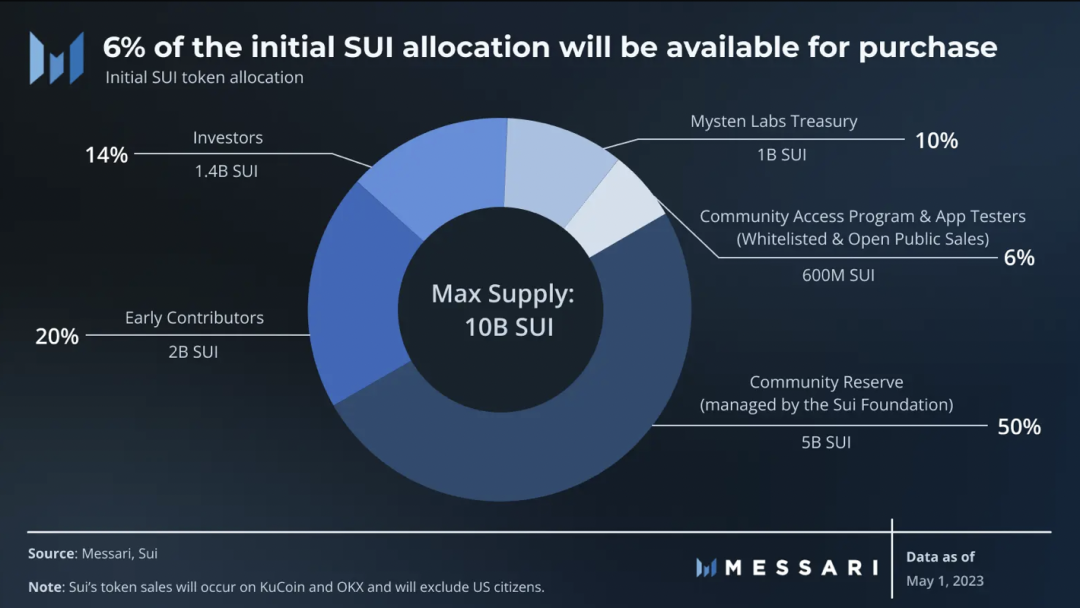
Community Reserve (50%): The Sui Foundation will control half of the maximum SUI supply, aiming to distribute it through community programs, including:
A delegation program to guide community-operated validators.
A grant program to distribute tokens to developers, community ambassadors, and other participants contributing to Sui.
A research and development fund.
Validator subsidies aimed at providing limited-time additional staking reward incentives for early validators.
Early Contributors (20%): One-fifth of the maximum SUI supply will be allocated to Sui's research and production team, namely its initial contributor, Mysten Labs.
Investors (14%): The Sui Foundation has not publicly disclosed any information regarding the sale of SUI tokens to investors.
Mysten Labs Treasury (10%): Mysten Labs has not disclosed where this allocation will be used.
Community Access Program and Application Testers (6%): The community access program includes a whitelist public sale (referred to as the recognition sale) open only to early Sui community members, who participate as representatives through Sui's Discord channel. It also includes a general sale open to the broader public. The recognition sale and general sale will be implemented through specific partner cryptocurrency exchanges.
Pre-Mainnet Launch
As the mainnet launch approaches, Sui's Devnet and Testnet have already supported over 200 projects covering various fields such as gaming, finance, law, and business. The validator set on Devnet only includes four validators—all operated by Sui's core contributors and protocol designers, Mysten Labs—because it prioritizes providing a secure execution environment for projects to stress-test application development.
Sui's Testnet is built in phases, testing various aspects of the protocol. Testnet Wave 1 aimed to provide a secure environment for validators to test Sui nodes/machines. Testnet Wave 2 expanded participation to application builders, end users, and delegators while testing the storage fund, Sui's DPoS consensus mechanism, and gas mechanism. At the end of March 2023, Sui announced its permanent Testnet for testing sponsored transactions, zero-knowledge proofs, and other future developments.
Here are the statistics related to Sui's permanent Testnet:
Total Transactions: 286.23 million
Total Package Releases: Approximately 125,949
Sui Wallet: A historical peak of 1.09 million weekly active users and 794,000 daily active users
Sui Explorer: 117,000 daily active users
Current TPS: Approximately 315
Total Number of Validators: 97 (2 operated by Mysten Labs, 95 by other entities)
Total Staking Delegation Operations: 7.35 million (Wave 2 Testnet)
Roadmap
Sui's mainnet is scheduled to launch on May 3, 2023. Mysten Labs told Messari that in the second half of 2023, it will focus on implementing key features covering scalability, tokenomics, and Sui Move on Sui.
Scalability
Lightweight Clients/Sparse Nodes: Lightweight clients/sparse nodes will be able to perform sparse replay.
Validator Sharding: Sui transactions are processed in parallel based on the groups (objects) involved in each transaction; scaling Sui's throughput requires validators to add more machines (sharding computation) to handle more groups of transactions.
Tokenomics
Congestion Pricing: Allowing users to pay "tips" above the reference price set by validators will make the transaction costs of Sui's block space more expensive during congestion, which may hinder surges in demand for Sui's block space.
Storage Fund and Governance: The storage fund is a mechanism for funding data storage on Sui; users pay storage gas fees to upload files to the network. Governance will cover protocol upgrades and setting storage gas fees.
MEV Improvements: MEV (Maximum Extractable Value) refers to the profits that miners or validators can potentially gain by strategically ordering, including, or excluding user transaction requests during block production. This value comes from arbitrage opportunities, liquidations, and other on-chain activities that allow miners or validators to prioritize certain transactions for their benefit.
Sui Move DevX
Prover: Helps Sui Move developers ensure the correctness and security of their applications. The Move prover checks whether new features from developers work correctly for all possible transactions and inputs.
Improved Language Server: The language server is a software development tool integrated with the Move compiler, providing developers with many features, including code understanding and error reporting. It complements the Move VSCode plugin "move-analyzer."
Lint Tool: The lint tool is a code analysis tool used to catch errors and enforce coding styles to improve code organization and readability. Sui's lint tool mainly includes rules for front-end project development.
Other Tools: As Sui's initial contributor and protocol designer, Mysten Labs plans to update/add other development tools to assist in development on Sui, including auto-formatting tools, debuggers, and REPL (Read, Eval, Print, Loop)/language shells (REPL allows developers to quickly write, execute, and test code snippets without a complete development environment or creating an entire application).
Conclusion
For Layer 1 blockchains to succeed, they must provide new use cases and frictionless experiences. Sui breaks the mold with its object-based data model, a novel approach that scales simple consensus-bypassing transactions and grants the ability to store arbitrary data values. Sui allows Android-style transaction signature permissions and PTBs, features that facilitate large-scale batch atomic composable transactions. It also includes user-friendly features like sponsored transactions, making users unaware of gas costs.
For mainstream adoption, Sui's mainnet and related features need to perform as expected and provide a solid foundation for users to onboard blockchain applications. If the digital asset industry becomes mainstream sooner than expected, developers and users will seek a flexible and secure smart contract platform that can scale with global throughput while remaining cost-effective and providing a Web2-style front-end experience.
 Risk warning
 Risk warning