








Negative premium returns to the same level as last year, is GBTC making a comeback?

 Competitors are lining up to enter, and the future of grayscale is not optimistic.
Written by: Loopy Lu
The discount of GBTC is continuing to narrow. Recently, its negative premium rate officially entered 30%, narrowing to 29.79%, the smallest value in a year. Its premium rate has recovered to the level of July 2022.
To put it more directly, how much return can GBTC bring to investors who joined this year?
For example, in February this year, GBTC once reached a low of $10.3, at which time the negative premium was about 47%. Taking today's price as an example, the current GBTC price is $18.6. In less than 5 months, GBTC has generated an 80% return in USD terms, and if calculated in terms of Bitcoin, GBTC has also generated a high return of 32%.
In a bear market, assets that can outperform BTC are incredibly valuable.
Trading Surge, Price Soars, GBTC Fully Recovers
Previously, GBTC faced a selling crisis. Since October 2022, the level of negative premium has continued to rise, quickly increasing from over 30% to over 40%. In December 2022 and February 2023, GBTC faced a high discount of "half price" for a long time, with the negative premium rate lingering around 50%.
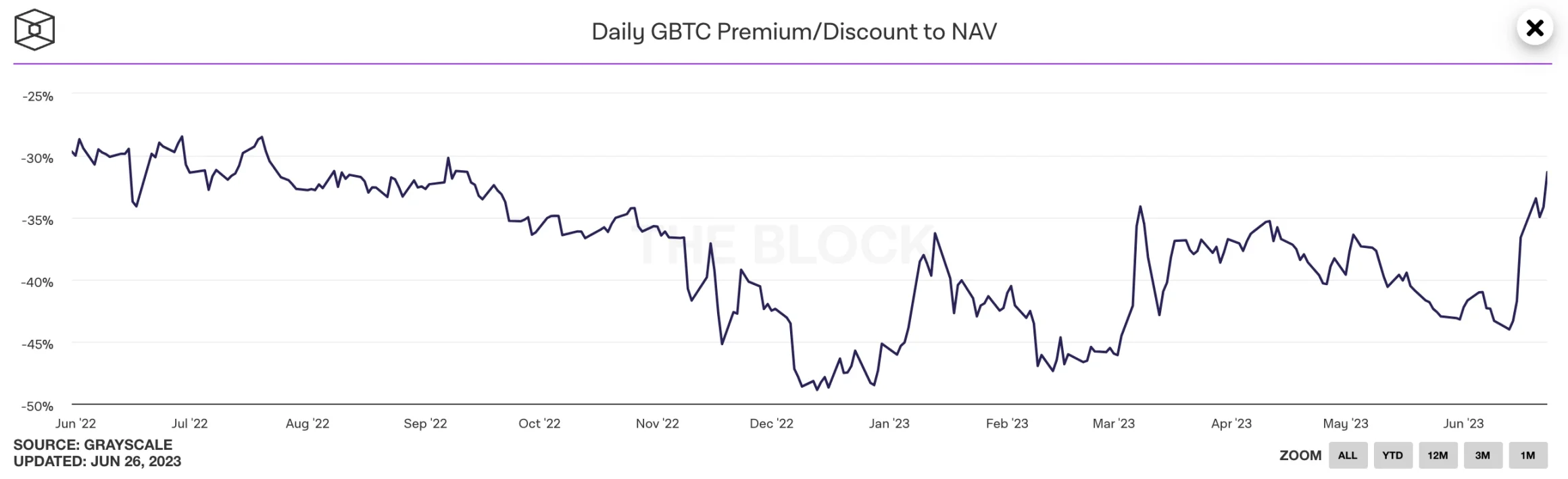
From the graph, it is not difficult to see that since mid-June, the price has been continuously rising for nearly half a month.
As the negative premium narrows, GBTC's trading activity has gradually become more active. Data from Nasdaq shows that since mid-June, GBTC's trading volume has continued to rise, reaching a peak trading volume of $10.2 million on June 20, the highest of the year.
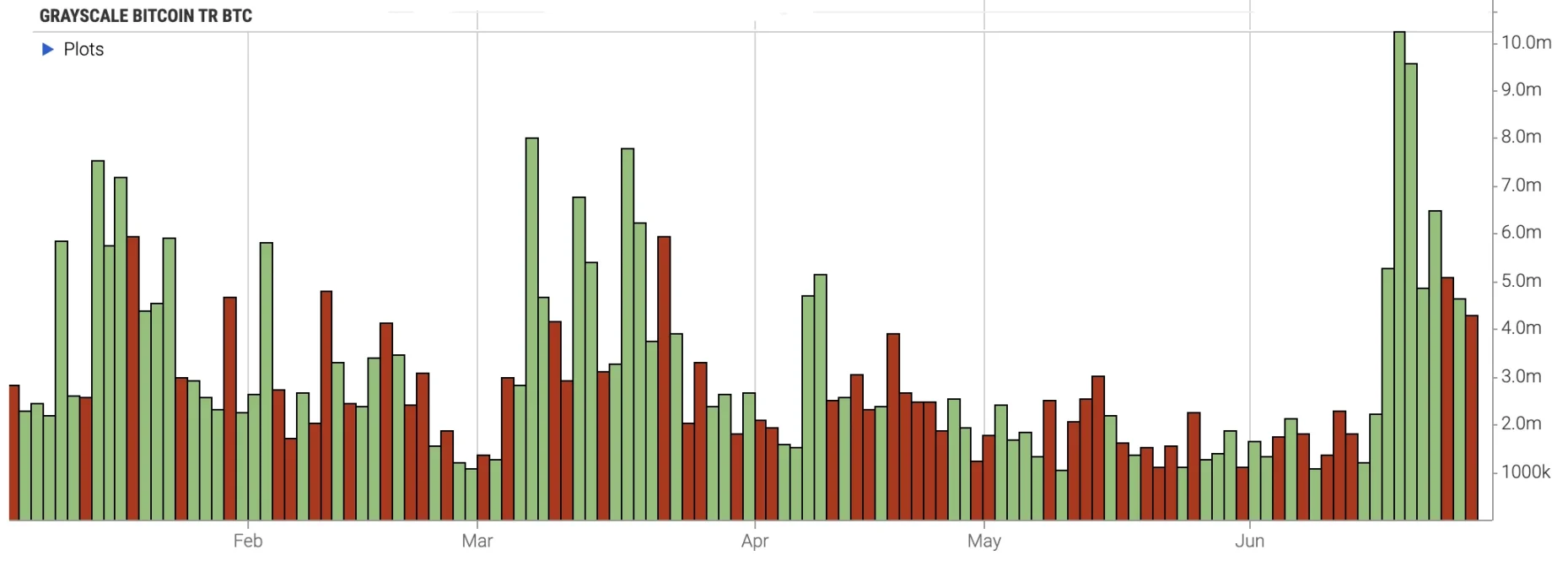
According to Nasdaq data, GBTC's trading volume in June reached $69.2 million, while in May, this figure was only $38.7 million, a month-on-month increase of 79%.
Accompanying the recovery of GBTC is the increase in Grayscale's revenue, which may revive this "flagship" institution in the crypto space that has faced numerous crises and rumors over the past year.
For a long time, Grayscale's high fees have been criticized by investors, with a management fee of 2% for GBTC and 2.5% for ETHE. Based on its holdings, it is estimated that Grayscale has earned about $44.13 million from its flagship products GBTC and ETHE this month. This is also the best revenue performance since the deep bear market in May 2022.
All signs indicate that the recovery of GBTC data reflects the market's increasingly positive sentiment towards it.
From Disliked to Fully Recovered, What Happened to GBTC?
In stark contrast to the current situation are the various crises and negative rumors surrounding GBTC over the past year.
At the end of 2022, a rumor about GBTC suddenly ignited the market. Although Grayscale has earned considerable revenue due to its advantageous market position for a long time, the crisis of its parent company dragged Grayscale down. Market rumors suggested that the crypto trading and lending institution Genesis might have solvency issues, and to fill the gap, Genesis's parent company DCG might choose to dissolve Grayscale's issued GBTC and ETHE.
Then in January this year, another wave of turmoil arose. Cameron Winklevoss, co-founder of Gemini, issued an open letter, harshly demanding that the founder of Digital Currency Group (DCG) repay the $900 million owed. Cameron also revealed in the open letter that DCG owed Genesis about $1.68 billion, and the escalating crisis of DCG drew significant attention from the crypto community.
As the Genesis crisis intensified, Gemini continued to sell GBTC collateral in the over-the-counter market. This also led to the continuous expansion of GBTC's negative premium, with the selling scale once accounting for 5% of GBTC's total circulation.
Previously, DCG had leveraged GBTC, which was one of the main reasons for triggering its financial crisis. According to Odaily Planet Daily statistics, since the first quarter of 2021, DCG has spent a total of $1.305 billion to purchase 54,823,667 shares of GBTC, with an average price of $23.8 per share. However, as the market turned bearish, DCG continued to increase its position during the bear market and even leveraged its investments. As GBTC continued to decline and the market environment gradually worsened, its financial crisis began to surface.
Just as the market was once extremely pessimistic about GBTC, the bullish sentiment towards it is now equally strong.
Although the market has shown an extremely positive outlook for GBTC's future, there is still a significant gap from GBTC's historical peak.
In June and September 2017, GBTC once recorded a premium of over 100%. Data from Coinglass shows that its premium rate historically peaked at 132%.
During the bull market of 2021, GBTC's premium rate turned from positive to negative. However, its negative premium was not severe, maintaining around 10% to 20% for a long time.
Currently, GBTC's premium level is far below its previous levels. As market sentiment gradually shifts towards a "bull return," is there hope for GBTC to return to its former glory, or even revert to a positive premium?
June 16 marked the beginning of GBTC's recent rise.
On that day, one of the world's largest asset management groups, BlackRock, submitted a filing for a spot Bitcoin ETF to the SEC through its subsidiary iShares. This also brought the narrative of "institutional players" entering the crypto market back into focus.
According to the application documents, its assets are primarily composed of Bitcoin held by the trust's custodian, with the "custodian" being managed through the cryptocurrency exchange Coinbase. As news of the institutional ETF spread, GBTC once again returned to the center of attention for some investors.
Throughout GBTC's long history, the company has attempted several times to convert GBTC into an ETF to provide a better exit channel for its investors. It first submitted this application in October 2021. Unfortunately, this idea has never been realized. However, with BlackRock entering the BTC ETF market, there is speculation that the likelihood of such products being approved is rapidly increasing.
If a spot BTC ETF is ultimately launched, it will mark a historic moment for cryptocurrencies. Once the precedent for spot ETFs is set, GBTC is expected to smoothly convert into an ETF, eliminating its negative premium. This not only contains significant arbitrage potential but also holds the promise of restoring GBTC to its former position.
Intense Competition for BTC ETF, Can Grayscale Reclaim Its Throne?
The comprehensive recovery of data and strong expectations for ETFs make GBTC appear to be improving continuously. However, in the long run, whether its market position can return to its peak still faces numerous challenges, and investors should not hold overly high expectations for it.
For a long time, Grayscale has been the largest single buyer in the crypto market.
At the beginning of 2021, Grayscale's holdings of BTC reached a historical peak, surpassing 650,000 BTC.
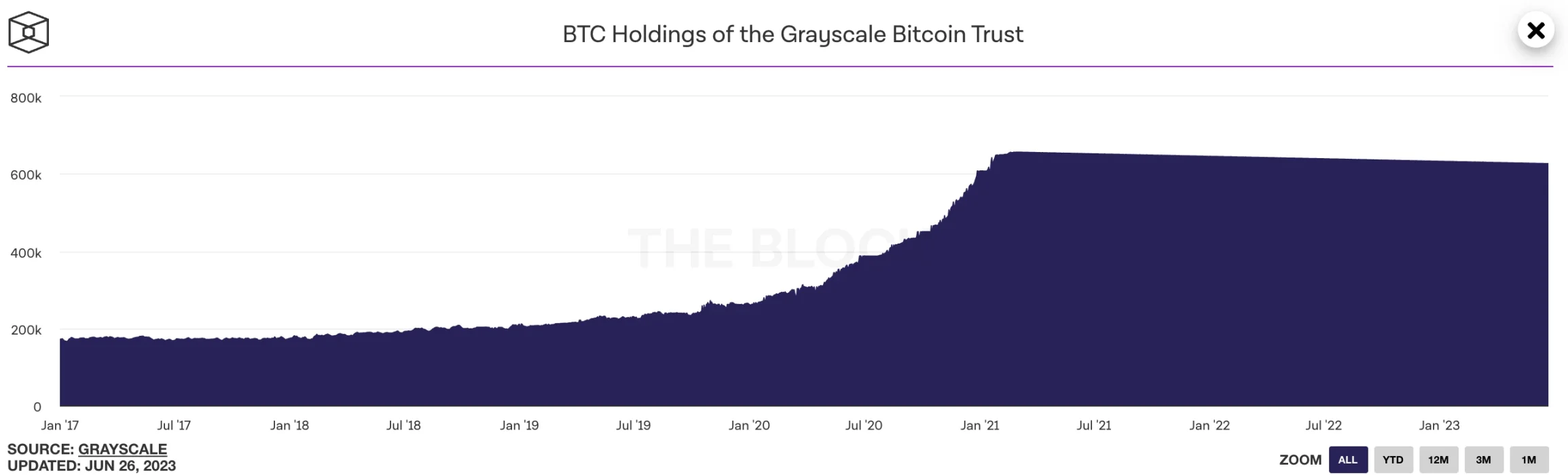
Looking at the image is even more shocking. Before reaching its peak, the number of coins it held resembled a steep mountain, constantly climbing. Due to its unique mechanism, Grayscale can only buy and not sell, exerting an immeasurable impact on the Bitcoin spot market.
The "consistent" large-scale buying also led to it being humorously dubbed the "bull market engine" and the Bitcoin Pi Xiu.
However, in the new round of the bull market, Grayscale's market position may face challenges.
Previously, due to numerous regulatory reasons or compliance requirements, Grayscale's GBTC was once regarded as the best choice for institutional investors. However, if a spot ETF is launched, GBTC will face numerous competitors.
Recently, Wall Street giants have concentrated on applying for ETFs and entering the crypto market. In addition to BlackRock, institutions such as Fidelity, Invesco, and WisdomTree have also joined the fray.
Once ETFs are approved, regardless of whether GBTC can successfully convert, the impact will be profound.
If GBTC cannot convert, the approval of other BTC ETFs will attract GBTC investors to shift to other ETFs. If GBTC successfully converts, other competitors will also pressure Grayscale to lower its high management fees. Most importantly, if GBTC converts to an ETF, the fund will face strong outflow pressure, and its massive assets under management may decline sharply.
The sentiment of "bull return" has gradually emerged. Regardless of whether Grayscale's market position can return to the past, its massive scale still warrants the market's attention. Even now, Grayscale still holds 625,900 BTC, worth about $19 billion, accounting for 3.2% of Bitcoin's circulation.
As the market continues to improve, Grayscale's role as a "barometer" in the market is far from what it used to be. Products that can replace Grayscale are gradually increasing, and Grayscale is no longer the only choice in the market.
 Risk warning Risk warning




Popular articles





