








YZi Labs invests tens of millions of dollars, CZ serves as an advisor, Genius still lacks followers
 Core Viewpoint

 Many users' core motivation is to quickly realize rewards, while the long-term holders envisioned by the project team cannot be cultivated solely through point incentives.
Author: Chloe, ChainCatcher
On April 13, the Perp DEX trading terminal Genius, supported by YZi Labs, disclosed information about its first quarter airdrop event, which will allocate a total of 70 million GENIUS tokens and will simultaneously launch on Binance Alpha. However, this launch, which was supposed to be a celebratory moment, triggered a crisis of trust within the community due to the significant gap between official rules and community expectations.
CZ Endorsement, Billions in Trading Volume, Are the Yield Farmers All In?
Genius is an on-chain perpetual contract trading terminal that has received tens of millions of dollars from YZi Labs, with CZ personally serving as an advisor, and has been under the spotlight since its inception. The platform aggregates over 10 public chains and more than 150 DEXs, boasting CEX-level execution speed and on-chain privacy trading, achieving over $2 billion in trading volume in a single week as early as January this year, with a cumulative total trading volume exceeding $15 billion.
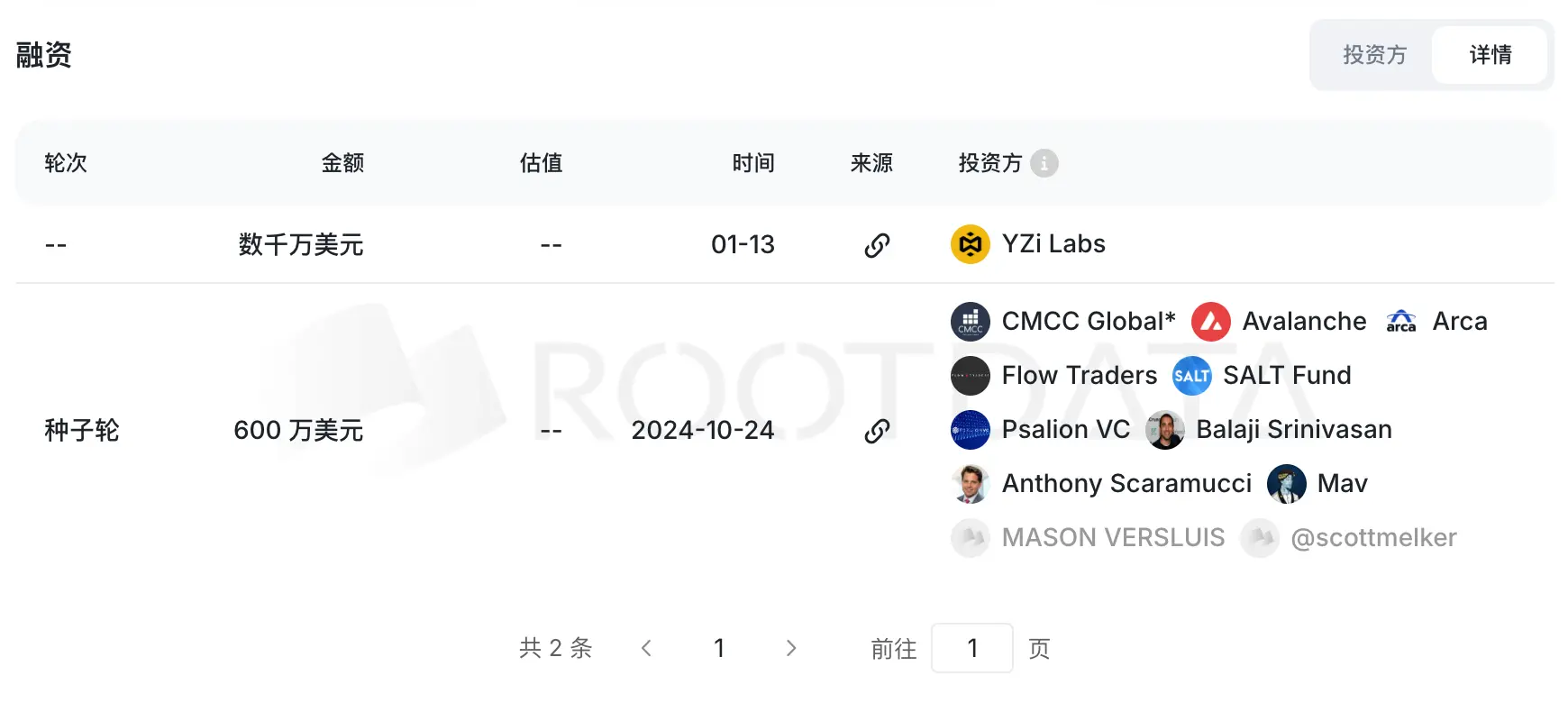
According to cryptocurrency asset data platform RootData, Genius completed a $6 million seed round financing in October 2024, led by CMCC Global, with participation from institutions like AVA Labs, Arca, and Flow Traders. Additionally, Genius co-founder Armaan Kalsi revealed that YZi Labs joined the financing this year and has made a "tens of millions of dollars" investment in Genius Trading, with CZ also joining the company as an advisor.
According to a previous official announcement, 21% of the total supply of Genius tokens is allocated for community airdrops, executed in three Seasons, with each season accounting for 7%. Users can accumulate Genius Points (GP) through spot trading volume, with points directly corresponding to token distribution. The platform has indeed returned real cash to the market during the distribution process, with a total of over $7 million in cash back and $1.3 million in referral rewards, distributed weekly in USDC.
This mechanism operated smoothly in the early stages, with clear expectations for many yield farmers. However, when the rules were suddenly rewritten on the eve of the TGE, these investments instantly became sunk costs.
70% of Users' Allocation Burned, Just Because the Officials Want to Filter Long-Term Holders
Season 1 officially ended at 22:00 EST on April 12, and the officials simultaneously revealed the airdrop details in the document: a total of 70 million GENIUS tokens will be allocated, but there are only two ways to claim them: one is to claim immediately, where users can operate within 7 days after the TGE, but the system will automatically burn 70% of the allocation, allowing users to only receive 30%; the other is to not claim and wait for a year, at which point the tokens will be locked in a smart contract, and users can claim 100% of the total amount after one year. The official narrative logic for this is "to filter long-term holders and reduce selling pressure in the early stages of listing."
Upon hearing this news, the community naturally did not buy it. For active users who have already contributed a significant amount of transaction fees, these two options essentially present a dilemma: either accept the reality of a 70% discount on the tokens or gamble a year of time on a project with an uncertain future.
As expected, a large number of criticisms such as "anti-yield," "scam," and "backstab" quickly emerged on X, with related tweets surpassing tens of thousands of views within hours, and community discussions surged nearly fourfold overnight. According to community user estimates, Genius's opening FDV must reach at least $800 million for users who recently entered to avoid losing money. For a project that has been online for a few months, with some features still not fully developed, this threshold is clearly too high.
"Genius is the last straw for yield farmers recently."
"Refund"? Users Can't Get Full Transaction Fees Back Either
In response to the strong backlash from the community, the Genius team made a response in less than 24 hours. In the early hours of April 13, the officials released announcements on X and Telegram, stating that they had "listened to community feedback" and added a third option in the airdrop document: refunds.
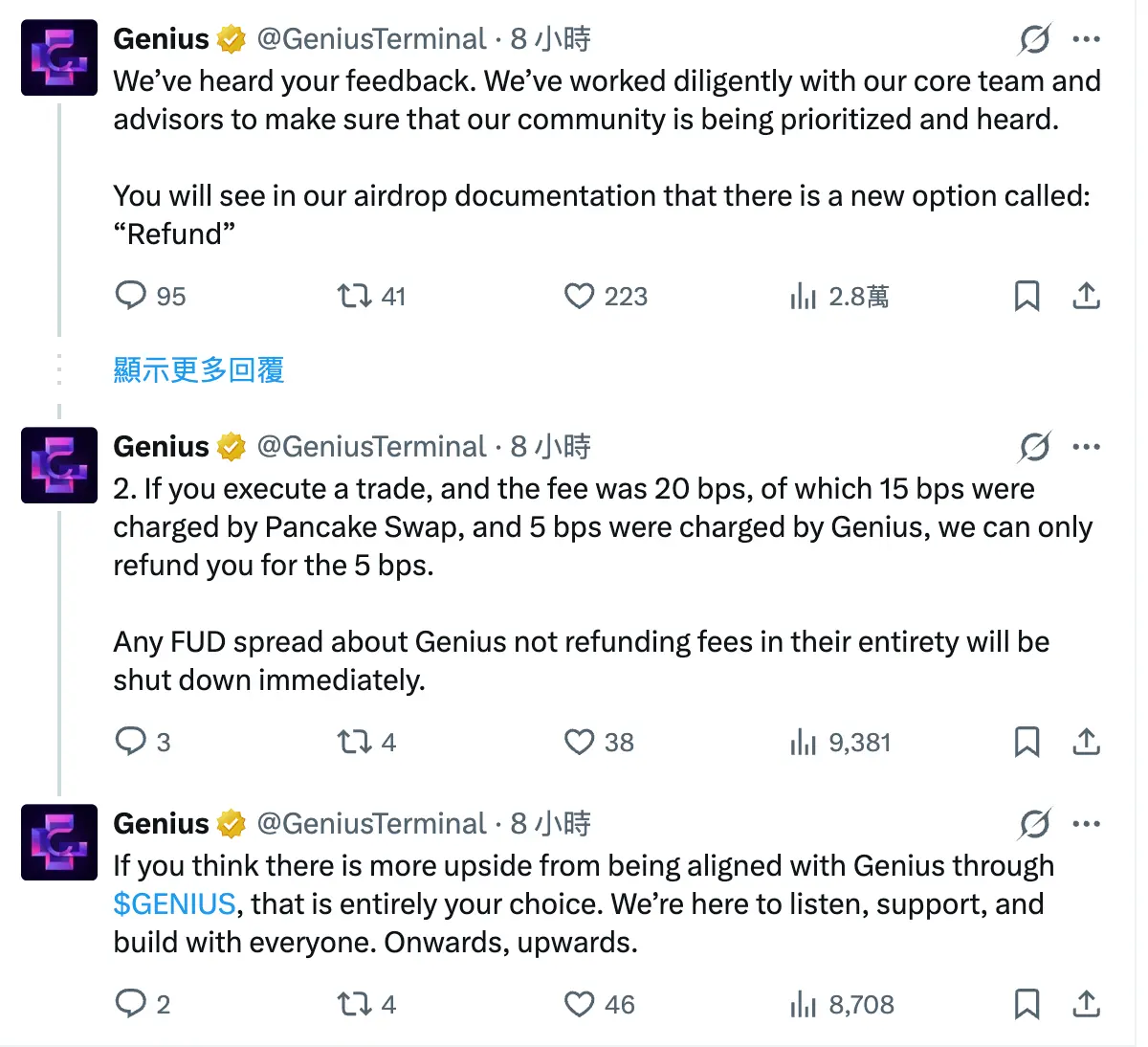
The officials provided that users can choose to burn 100% of their token allocation within 48 hours after the TGE in exchange for the net transaction fees they generated on the Genius platform, with refunds credited within 48 hours after application.
However, the "refund of transaction fees" still has limitations, and the amount users ultimately receive may differ from the actual fees they paid.
The calculation for Genius refunds has gone through two filters. First, the platform has already returned over $8.3 million to the community in the form of cash back and referral rewards over the past few months. These previously pocketed earnings will be deducted from the refund—meaning that the more volume users generate and the more rebates they have received, the less they can ultimately get back. For highly active heavy users, the net amount may be significantly compressed.
Second, not all on-chain transaction fees flow to Genius. The fees for each transaction are actually split among multiple parties, including the underlying DEX protocols (like PancakeSwap), and Genius, as the aggregation layer, only takes a small portion of that. The refund scope is strictly limited to the portion that Genius itself has received.
In this regard, the officials' attitude is clear, directly warning that they will refute any claims that they "did not refund in full," arguing that those fees never belonged to Genius in the first place. Additionally, the team has reserved an appeal channel for users who have doubts about the refund amount; within the first week after the TGE, users can raise objections through a dedicated form.
The introduction of the Refund option has indeed garnered some positive feedback for the Genius team. Some users believe that in the cryptocurrency industry, the fact that the project team can listen to feedback and update rules within 24 hours demonstrates a commitment to long-termism, at least providing a clear exit for users who do not want to continue holding.
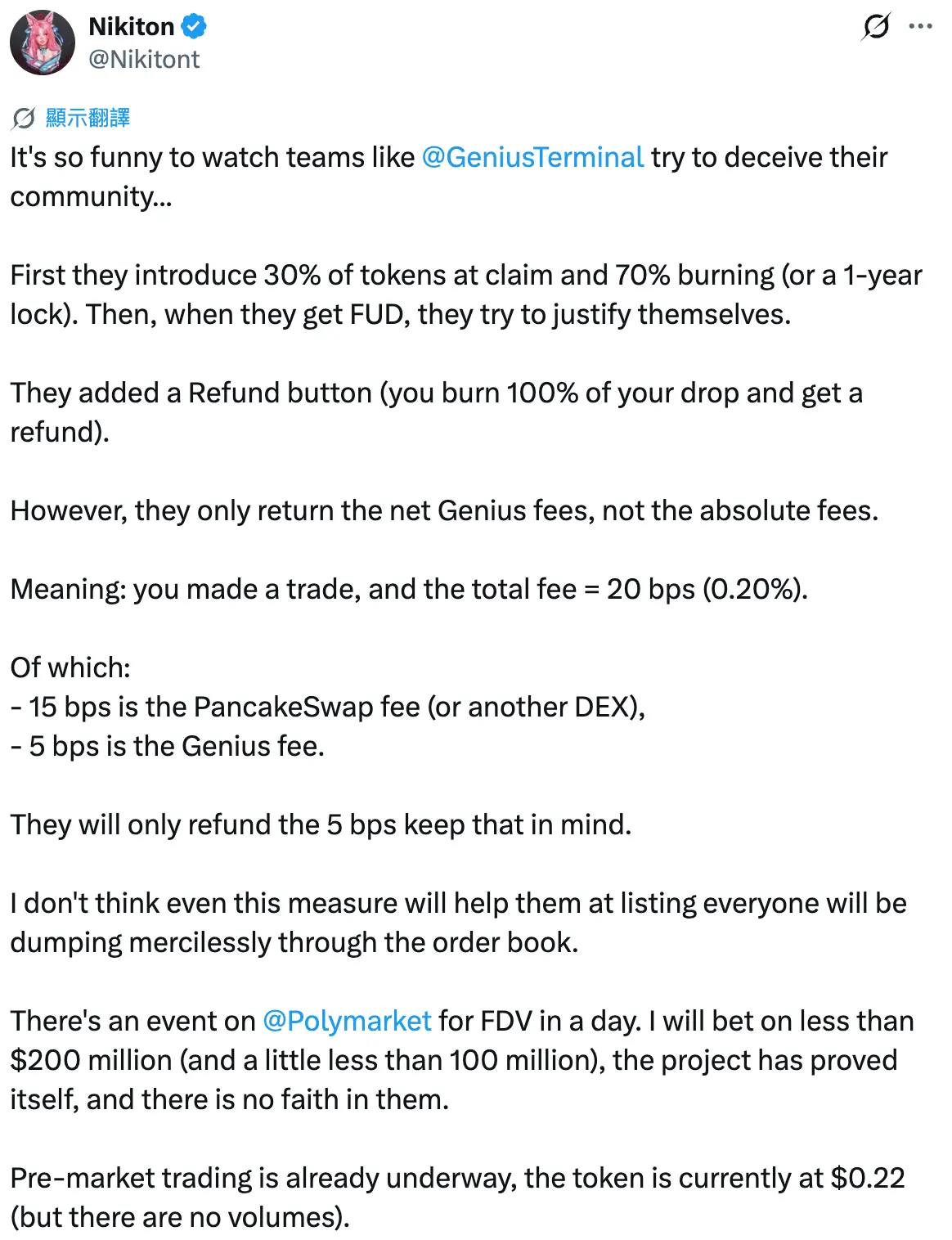
However, critics point out that the so-called refund only returns the 5 basis points that the platform itself collects, rather than the full transaction fees, which is hardly a drop in the bucket for many volume-generating users. Some users also believe that "long-termism is directly written into the code," and this entire operation from raising expectations to changing the rules at the last minute is just another anti-yield project; regardless of how the Refund option attempts to remedy the situation, the time and transaction costs already invested cannot be fully recovered.
Even on Polymarket, some users have started betting that Genius's FDV after launch will be below $200 million, reflecting the market's loss of confidence in this TGE operation.
Flaws in the Rules, Long-Term Holders Cannot Be Cultivated Just Through Incentives
Cryptocurrency KOL Leng, who is skilled in project research and analysis, criticized that Genius's approach is no different from a scam: "They could choose to give only 2% at the beginning instead of 7% and then claim 30% while burning 70%," how can users be expected to support this?
The project party hopes to attract early users to contribute liquidity and trading volume through a points system, but during the token distribution phase, they also want to prevent these users from immediately selling. There is a fundamental contradiction between these two goals: many users' core motivation is to quickly cash out their rewards, while the long-term holders envisioned by the project party cannot be cultivated solely through incentive points.
When the rules for claiming an airdrop require a high proportion of burning mechanisms to filter users, it may indicate that there is a mismatch in the design of the mechanism from the outset; the user group it attracts and the user group it ultimately wants to retain are not the same from the very beginning.
 Risk warning


Popular articles





